
MELU-323 · Lesson 7 of 12 · 20 min
Duties and responsibilities of the Master Electrician License holder
▶ Video coming soon A video version of this lesson is on the way.
Dale keeps a folder on his desk labeled with one word: mine. In it are the service and feeder calculations for every job Kanawha Ridge has open, each one signed and dated. When Renee asked him what would change for her once she held a master license, he handed her the folder. 'Today these are mine,' he said. 'When you pass, some of them will be yours, and if one of them is wrong, the State Fire Marshal will be calling you, not me.' This lesson covers what the master license allows, what it requires, and what can put it at risk: the scope of a master's work, supervision of journeymen and assistants, posting the license, honest dealings with applications and inspectors, and the grounds and process for discipline.
The duties come from three sources. Article 3B of Chapter 29 of the West Virginia Code defines the master and journeyman and sets the licensing requirement and penalties. The State Fire Marshal's rule, 103 CSR 5, defines supervision, design and assisting, and sets the limit on assistants. And the National Electrical Code, as adopted, sets the technical standard the master's designs must meet. The exam can draw on all three.
What a master may do
The statute describes a master as a person competent to design electrical systems and to instruct and supervise journeymen and related workers. The rule fills in the detail. A master electrician knows the code, can read plans and specifications, and can calculate demand loads. Design, in the rule, means planning or laying out electrical systems in sketches or drawings for licensed electricians to install, including service components, conductor and breaker sizing and the other components needed for the demand load. A journeyman may not design any part of an electrical system.
So the line between master and journeyman is not the size of the job or the voltage of the system; it is whether the work involves design, layout and load calculation. A journeyman may install a 2,000-ampere switchboard that a master designed. A journeyman may not decide on his own what size feeder a new subpanel needs, even on a small job. Renee has been careful about that line for years; when a customer asks her on site to add a circuit, she installs within the existing design or calls Dale.
Supervision
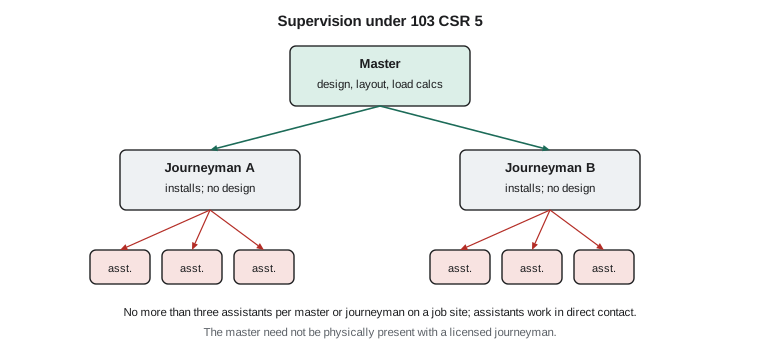
The rule's definition of supervision has three parts. First, supervising means drafting, coordinating and directing the design, layout and load calculations of electrical systems, and that is the master's job. Second, a master need not be physically present with a licensed journeyman; the journeyman installs under the master's design and direction without the master standing over the work. Third, assistants or helpers, who hold no license, must be supervised by a master or journeyman, and each master or journeyman may supervise no more than three assistants on a job site.
The definition of assisting is strict. An electrician's assistant or helper directly assists a journeyman or master in supervised work, may not do unsupervised work and may not work in hazardous locations as the code defines them. Assisting means working alongside a licensed electrician, in direct contact with them and under their direct supervision. An assistant working alone in another room while the journeyman is on a different floor is not assisting; he is doing unlicensed work. The rule has one exception for students in a West Virginia Department of Education vocational program, who must be under the direct and constant supervision of a licensed master instructor, with notice to the State Fire Marshal.
Worked problem
Checking a crew
On a school addition, Kanawha Ridge has one master, Dale, on site in the morning, two journeymen, Renee and Marcus, and seven assistants. Is the crew within the rule?
Show solution
- Each master or journeyman may supervise no more than three assistants on a job site.
- Dale, Renee and Marcus together may supervise up to 3 times 3, or 9 assistants, while all three are on site.
- In the afternoon Dale leaves. Renee and Marcus can supervise up to 6 assistants.
- With seven assistants and two journeymen in the afternoon, one assistant is over the limit.
Answer: The crew is within the limit only while Dale is on site; in the afternoon one assistant must leave the site or another licensed electrician must join.
Posting the license
Section 29-3B-2 requires a copy of the license to be posted on any job where electrical work is being done for pay, and the rule repeats it. On a Kanawha Ridge job, that means a copy of the license of each licensed electrician working there, plus, under the Contractor Licensing Act covered in Lesson 8, a copy of the company's contractor license. Many contractors keep a plastic sleeve in the job box or on the panel board with the copies. It is an easy rule to follow and an easy one for an inspector to check.
The license itself is personal. It is issued to an individual based on that individual's experience and exam, and section 29-3B-4's heading speaks of nontransferability and nonassignability. A master may not let another person or company use the license, put the master's name on work the master is not supervising, or pull permits on the master's credential for work the master is not responsible for. Lending a license is the kind of conduct that leads to discipline everywhere, because it puts unqualified people behind a qualified name.
Grounds for discipline
Section 29-3B-7 lets the State Fire Marshal deny a license to an applicant who lacks the required qualifications or does not follow the rules, and suspend or revoke a license, on a complaint or on its own inquiry, after notice. The grounds for suspension or revocation are four: the license was issued on an application or supporting documents that materially misstated qualifications or experience; the licensee signed off on or vouched for a material misstatement by an applicant; the licensee performs electrical work incompetently or unsafely; or the licensee violates a State Fire Marshal rule under the article.
Section 13 of the rule adds the process. The State Fire Marshal may deny, limit, suspend or revoke a license when the licensing article or its rules are violated, after written notice stating the grounds. The licensee has 10 working days after receiving the order to request a formal hearing. As of the effective date of the action, the person must stop practicing; an administrative appeal does not pause the action. An aggrieved party may appeal to the Office of Administrative Hearings, and a hearing examiner's decision may be appealed to the Intermediate Court of Appeals. The rule also offers an informal dispute resolution process before a three-person panel, without counsel, whose decision is final but may be appealed under the administrative procedures act.
| Ground under 29-3B-7 | Example | How to avoid it |
|---|---|---|
| Material misstatement on the application | Hours inflated on an exam application | Document hours with payroll records |
| Vouching for another's misstatement | A master signs an experience letter he knows is wrong | Sign only what your records support |
| Incompetent or unsafe work | A service installed without a grounding electrode system | Design and check to the adopted code |
| Violating a State Fire Marshal rule | Four assistants per journeyman on a site | Track crew sizes by site and by day |
Duties that come with design
A master who designs a system takes on the duty to get it right. That means using the edition of the code adopted for the job, with the state's amendments; calculating loads by the methods in the code; sizing services, feeders and branch circuits with the right conductor ampacity, temperature correction and adjustment factors; protecting conductors and equipment against overcurrent; grounding and bonding the system correctly; and coordinating with the utility's service requirements. Each of these is a core course in this series. The master's signature on a load calculation says that all of it was done.
Design also brings records. Renee will keep a copy of every load calculation, panel schedule and one-line diagram she prepares, with the code edition used and the date. When an inspector, an engineer or a future owner asks why a feeder is the size it is, the calculation answers the question. Dale's folder is that record, and it has answered questions for him more than once, including during an insurance investigation after a fire that started in a customer's appliance, not in Kanawha Ridge's wiring.
Training the next generation
The statute says a master is competent to instruct journeymen and related workers, and instruction is a duty as much as a skill. Every journeyman at Kanawha Ridge was once an assistant, and every master was once a journeyman. Dale's practice is to spend part of each week on site with the newest assistants, showing them why a box is placed where it is, why a conductor is derated in a crowded raceway, and why a bonding jumper goes where it does. He also pairs each assistant with one journeyman for months at a time, so that the direct supervision the rule requires becomes a real apprenticeship rather than a formality.
Instruction is also how a master protects the license. An assistant who understands the rule against working alone, or the rule against entering hazardous locations, is less likely to put the master's license at risk when nobody is watching. Renee plans to keep Dale's habit and add one of her own: a ten-minute code question at the start of each Monday's crew meeting, drawn from the week's work, with the answer read from the book. Tyler Moss, the newest assistant, has already asked to be first.
Training records help too. A short log showing who worked with whom, on which job and for how long, supports the hours each worker will later claim on an exam application, and it supports the master who signs that worker's experience letter. It also shows, if the question ever arises, that the company kept its assistants in direct contact with licensed electricians.
Honesty with inspectors and the office
A master's relationship with inspectors and the State Fire Marshal's office depends on honesty. Do not call for an inspection of work that is not ready. Do not ask an inspector to pass work that you know does not comply. Do not cover work before it is inspected. Do not misstate who did the work or who supervised it. And answer the office's questions about applications you have signed promptly and accurately. These rules sound obvious, but discipline cases often start with a small shortcut that turned into a false statement.
The rule on reporting also reaches inspectors. Article 3C requires certified electrical inspectors to report certain violations, and an inspector who sees unlicensed work or a lent license may be obligated to report it. A master who treats every inspection as a conversation about the code, rather than a negotiation, rarely has trouble.
# Crew check for one site and one shift
licensed_on_site = {"Dale": "master", "Renee": "journeyman", "Marcus": "journeyman"}
assistants_on_site = 7
limit_each = 3
capacity = limit_each * len(licensed_on_site)
print(f"Licensed electricians: {len(licensed_on_site)}; assistant capacity: {capacity}")
print("Within the rule" if assistants_on_site <= capacity else "Over the limit")
del licensed_on_site["Dale"]
capacity = limit_each * len(licensed_on_site)
print(f"After Dale leaves: capacity {capacity}; assistants {assistants_on_site}")
print("Within the rule" if assistants_on_site <= capacity else "Over the limit")Licensed electricians: 3; assistant capacity: 9 Within the rule After Dale leaves: capacity 6; assistants 7 Over the limit
Common mistakes
MistakeLetting a journeyman size a feeder for a new subpanel.
InsteadSizing conductors and breakers for the demand load is design, which only a master may do.
MistakeSending an assistant to work alone.
InsteadAssistants must work in direct contact with and under direct supervision of a licensed electrician.
MistakeCounting assistants per company instead of per licensed electrician on site.
InsteadThe limit is three assistants per master or journeyman on a job site.
MistakeAssuming an appeal stops a suspension.
InsteadThe rule says an administrative appeal does not pause the action.
MistakeTreating the license as a company asset.
InsteadThe license is personal and may not be lent or transferred.
Summary and key terms
- Only a master may design, lay out and calculate loads.
- A master need not be physically present with a licensed journeyman.
- Each master or journeyman may supervise no more than three assistants on a job site.
- Post a copy of the license on every job done for pay.
- 29-3B-7 lists four grounds for suspension or revocation.
- Request a hearing within 10 working days; an appeal does not pause the action.
- Supervision
- Drafting, coordinating and directing the design, layout and load calculations of electrical systems.
- Assisting
- Working alongside a licensed electrician, in direct contact and under direct supervision.
- Posting
- Displaying a copy of the license at the job site.
- Office of Administrative Hearings
- The West Virginia office that hears appeals of licensing actions.
- Informal dispute resolution
- A three-person panel process for contesting an order, without counsel.
Practice problems
Work each problem on paper first, then reveal the answer to check.
How many assistants may Renee supervise on a job site as a journeyman?
Show answer
No more than three.
Must Dale be on site whenever Renee is installing his design?
Show answer
No; a master need not be physically present with a licensed journeyman.
Can an assistant work in a hazardous location?
Show answer
No; the rule bars assistants from code-defined hazardous locations.
Within how many working days must a licensee request a hearing?
Show answer
10 working days after receiving the order.
Name one ground for revocation.
Show answer
Incompetent or unsafe electrical work, among others.
Lesson quiz · 5 questions
Score 60% or more to complete this lesson.
Create a free account to save your progress, take quizzes and earn a certificate.