
MELU-323 · Lesson 12 of 12 · 20 min
Practice exam review and test-day strategy
▶ Video coming soon A video version of this lesson is on the way.
Three weeks before her exam, Renee took a full practice exam under real conditions: four hours, a clean 2020 code book with tabs, the key word index, Ugly's, a calculator and two pencils, at the quiet office Kanawha Ridge lends its candidates on Friday afternoons. The practice exam was one she and Dale built from old job files and the core courses, in the State Fire Marshal's format of 50 multiple-choice questions and 5 calculations. She scored 74, a pass, but with a thinner margin than she wanted. More useful than the score was the error log she filled in afterward. This lesson shows how to review a practice exam so that each one makes the next one better, how to plan the four hours on exam day, and how to handle the morning of the exam in Charleston.
The State Fire Marshal does not sell practice exams or study guides, so West Virginia candidates build their own. The methods here work with any practice material: questions from the core courses in this series, questions you write from your own jobs, questions from commercial study books written for the 2020 edition, and the quizzes and final exam in this course. What matters is not where the questions come from but what you do after you answer them.
Reviewing a practice exam
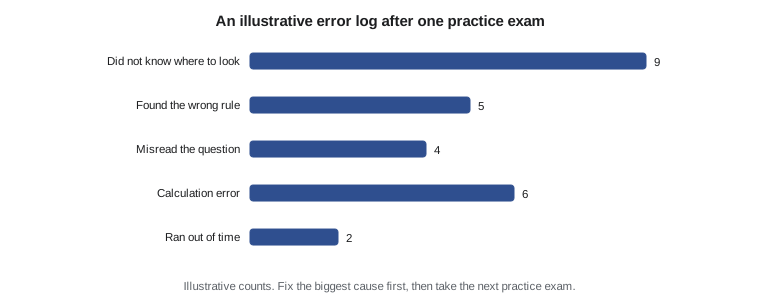
The review starts with every question you got wrong and every question you got right by guessing. For each one, find the rule in the code, read it in full, including exceptions and informational notes, and write down why your answer was wrong or uncertain. Then put each error into one of a few categories. Renee uses five: did not know where to look, found the wrong rule, misread the question, made a calculation error, or ran out of time. The categories tell you what to practice. A candidate who mostly misreads questions needs a reading method, not more code study; a candidate who cannot find rules needs navigation drills, not more reading.
Renee's first error log, counting guessed answers as well as wrong ones, had 26 entries and told a clear story. Nine were questions where she did not know where to look, five were the wrong rule, four were misreads, six were calculation errors and two were time. The calculation errors were the most expensive, because each calculation is worth five points. She spent the next week on calculations only, then the following week on navigation, then took a second practice exam.
Turning errors into points
Because of the scoring, every category is worth a different number of points. A calculation error costs five points; a missed multiple-choice question costs one and a half. If Renee's six calculation errors on the practice exam had included two of the five calculations, that would have cost ten points, more than six of her multiple-choice misses. That arithmetic sets the priority: make the calculations reliable first. Practice each calculation type until you can do it correctly in fifteen minutes, with the code open, without looking up the method.
The calculation types to practice come from the master's design work and the core courses. Dwelling service and feeder load calculations under Article 220, using both the standard and optional methods. Commercial load calculations with continuous loads and demand factors. Conductor sizing with ampacity correction and adjustment under Article 310. Overcurrent protection and conductor protection rules under Article 240. Motor branch circuit, feeder and overload sizing under Article 430. Transformer overcurrent protection under Article 450. Box fill under Article 314, raceway fill using Chapter 9 and the annexes, and voltage drop. Each one has a method in MELU-102 through MELU-105.
# Where Renee's points went on her first practice exam (illustrative)
mc_wrong = {"where to look": 6, "wrong rule": 3, "misread": 3, "arithmetic slip": 1, "time": 1}
calcs_wrong = 1
lost_mc = sum(mc_wrong.values()) * 1.5
lost_calc = calcs_wrong * 5
for k, v in mc_wrong.items():
    print(f"  {k}: {v} wrong, {v * 1.5:g} points")
print(f"  calculations: {calcs_wrong} wrong, {lost_calc} points")
print(f"Score: {100 - lost_mc - lost_calc:g}")where to look: 6 wrong, 9 points wrong rule: 3 wrong, 4.5 points misread: 3 wrong, 4.5 points arithmetic slip: 1 wrong, 1.5 points time: 1 wrong, 1.5 points calculations: 1 wrong, 5 points Score: 74
The script shows how Renee's 74 broke down: 14 multiple-choice misses cost 21 points, and a single missed calculation cost 5, as much as more than three multiple-choice questions. The other entries in her error log were questions she got right by guessing, which cost nothing on that exam but would cost points on the next one. After a week of calculation practice and a week of navigation drills, her second practice exam scored 83.
Writing your own practice questions
Because there is no official practice exam, writing questions is part of preparing, and it teaches more than answering them. Renee's method is to take one real job from the company files each week and write five multiple-choice questions and one calculation from it. A question starts from a decision someone made on the job: why the feeder to the second-floor panel is 3 AWG copper, why the kitchen receptacles are on GFCI protection, why the rooftop unit's disconnect is where it is. She writes the question, finds the rule, writes the correct answer and three wrong answers that a candidate who skipped a step would choose, and records the article and section number on the back of the card.
Dale checks her questions, and when he disagrees with an answer, the two of them open the book. Those disagreements have been the best study sessions of the whole preparation, because they force both of them to read the full rule. By exam day Renee had more than sixty cards, and she shuffled them into her daily practice. Candidates without a master to check their questions can trade with another candidate or ask an instructor, but even unchecked, writing questions builds the habit of asking which rule decides each choice.
Reading questions
Exam questions are written to test whether a candidate can apply the code to a situation, and many include details that do not matter. Read the last sentence first to see what is being asked. Then read the whole question and mark the facts that change the answer: voltage, phase, conductor material and insulation, ambient temperature, number of current-carrying conductors, occupancy type, whether a load is continuous, and whether the question asks for a minimum, a maximum or a standard size. Watch for words that reverse the question, such as not, except and unless.
Answer choices often include the number you get if you skip one step: the ampacity before correction, the load before the demand factor, the conductor size before the continuous-load multiplier. If your answer matches one of the choices, that does not prove it is right. Check that you have applied every step the question requires.
A plan for the four hours
Four hours for 55 questions leaves time for a deliberate plan. Renee's plan has three passes. In the first pass, about 90 minutes, she works through all 50 multiple-choice questions, answering the ones she knows or can find quickly and marking the rest. In the second pass, about 80 minutes, she works the five calculations, one at a time, checking each answer by a second method or by a rough estimate. In the third pass, with the remaining time, she returns to the marked multiple-choice questions, looks up each rule, and then checks that every answer sheet entry is filled in.
She checks the clock at set points: after question 25, after question 50, after each calculation. If she is behind at any checkpoint, she moves on and marks the question rather than spending more time on it. The exam does not penalize guessing, as far as the State Fire Marshal's page describes it, so no question should be left blank at the end.
| Pass | Work | Time (illustrative) | Checkpoint |
|---|---|---|---|
| 1 | All 50 multiple-choice: answer quick ones, mark the rest | About 90 minutes | Question 25 by about 45 minutes |
| 2 | The 5 calculations, each checked | About 80 minutes | One calculation every 16 minutes |
| 3 | Marked multiple-choice lookups | About 50 minutes | All marked items tried |
| Final | Answer sheet check: every item answered | About 20 minutes | No blanks |
The West Virginia law questions
The exam is based on the National Electrical Code, and the State Fire Marshal's page says so. But a West Virginia master needs the state law in this course for the job, and the Contractor Licensing Board's Business and Law exam, if the company needs it, tests business and law material directly. Review the facts that are easiest to confuse: the State Fire Marshal licenses electricians and the Contractor Licensing Board licenses businesses; the master needs 4,000 hours and the journeyman 2,000; assistants are limited to three per licensed electrician on a site; licenses expire June 30; liens must be recorded within 100 days and enforced within six months after filing; OSHA's clocks are 8 and 24 hours and the carrier's is five days.
Renee wrote those facts on a single page and read it every evening for the last two weeks. The page stays at home on exam day, because loose notes are not on the allowed list.
The day before and the morning of
The day before, Renee checks her folder: the written authorization from the State Fire Marshal, photo identification, the 2020 code book with tabs and nothing written inside, the key word index, Ugly's, a calculator she has used for every practice exam with a fresh battery, and two sharpened No. 2 pencils. She confirms the exam location and start time on the office's schedule and plans the drive along Interstate 64 into Charleston with thirty minutes to spare for traffic and parking. She stops studying by early evening and gets a full night's sleep.
On the morning of the exam, she eats a real breakfast, arrives early, and follows the proctor's instructions exactly. When the exam starts, she writes the time at the top of her scratch paper with her checkpoints next to it. If a question rattles her, she marks it and moves on; there are 54 others. When she finishes, she uses every remaining minute to check, because there is no prize for leaving early.
Worked problem
Using the error log between practice exams
After her second practice exam, Renee's error log shows 4 navigation misses, 3 wrong-rule misses, 2 misreads, 0 calculation errors and 1 time miss. Where should she spend her last two weeks?
Show solution
- Calculations are now reliable; keep them warm with one practice problem a day.
- Navigation is the largest category: drill index and article lookups for 20 minutes a day.
- Wrong-rule misses usually come from stopping at the first rule found; practice reading the full section, including exceptions.
- Take a third full practice exam a week before the real one, under the same conditions.
Answer: Navigation drills, full-section reading, light calculation upkeep and one more timed practice exam.
After the exam
Results come within 15 business days. If Renee passes, she pays the 50-dollar activation fee and, when the license is issued, Kanawha Ridge updates its records and Dale begins handing her the design work in his folder. If she does not pass, she reviews the result, files a new application for the next session and goes back to her error log; the second attempt is usually easier, because the candidate knows the format and the pace. Either way, the habits she built preparing, the error log, the navigation drills and the calculation methods, are the habits of a good master.
Common mistakes
MistakeReviewing only the questions you got wrong.
InsteadAlso review the questions you got right by guessing; they are the next ones you will miss.
MistakeSpending equal time on every kind of error.
InsteadWeight the practice by points: calculations first, then the largest category of misses.
MistakeLeaving marked questions blank at the end.
InsteadAnswer every question; return to marked ones in the third pass.
MistakeBringing a one-page summary into the exam.
InsteadLoose notes are not on the allowed list; leave the summary at home.
MistakeCramming the night before.
InsteadStop early and sleep; navigation and calculation speed depend on a rested mind.
Summary and key terms
- Review every wrong or guessed answer and sort errors into categories.
- Practice by points: calculations, worth 5 each, come first.
- Read the last sentence first and mark the facts that change the answer.
- Use a three-pass plan with clock checkpoints over the four hours.
- Bring only the allowed references and the written authorization.
- Results come within 15 business days; activate the license when you pass.
- Error log
- A record of each missed question and the reason for the miss.
- Checkpoint
- A planned time to check progress during the exam.
- Three-pass plan
- Answer quick questions first, then calculations, then marked lookups.
- Navigation drill
- Timed practice finding code rules by index and article.
- Activation
- Paying the fee after passing so the license is issued.
Practice problems
Work each problem on paper first, then reveal the answer to check.
Which error category should Renee fix first if she misses two calculations?
Show answer
Calculations, because each is worth 5 points.
What should she read first in a long question?
Show answer
The last sentence, to see what is asked.
Can she bring her one-page summary into the exam?
Show answer
No; loose notes are not allowed.
How long until she learns her result?
Show answer
Within 15 business days.
What should she do if she does not pass?
Show answer
Review the result, reapply for the next session and return to her error log.
Lesson quiz · 5 questions
Score 60% or more to complete this lesson.
Create a free account to save your progress, take quizzes and earn a certificate.