
MELU-323 · Lesson 11 of 12 · 20 min
Renewal and continuing education
▶ Video coming soon A video version of this lesson is on the way.
In April of every year, a courtesy reminder from the State Fire Marshal's office arrives at Kanawha Ridge for each licensed electrician on the payroll, and Cora sets them out on the break room table. Most of the crew renew for three years at a time, because it is cheaper per year and one less thing to remember. One journeyman, years ago, let his license lapse while he was out on a long medical leave and came back to find he could not legally work until he renewed. He did not have to retest, because he was within the grace period, but he paid double. Renee tells that story to every new journeyman. This lesson covers how a West Virginia master keeps the license current: expiration and renewal terms, late renewal and relicensing, continuing education, reciprocity when working outside the state, and keeping the company's licenses in step with the individual's.
The rules come from section 29-3B-4, which leaves renewal to the State Fire Marshal's rules, section 29-3B-6 on relicensing without retesting, section 7 of the rule at 103 CSR 5, and the State Fire Marshal's licensing page. They are short and easy to learn, which is one reason exam questions on them are easy points.
Expiration and terms
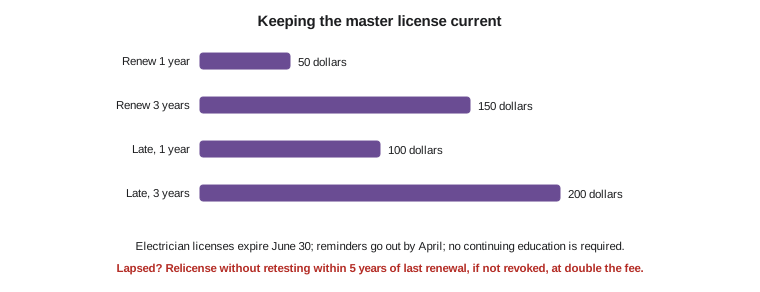
Electrician licenses issued by the State Fire Marshal, other than temporary licenses, expire on June 30. Under section 7 of the rule, the Fire Marshal renews a license annually, or for up to three years, when the licensee applies and pays the renewal fee. The licensing page lists the fees: 50 dollars for one year and 150 dollars for three years. The licensee must submit the renewal; the courtesy reminder mailed by April is a convenience, not a requirement, and a licensee who does not receive it is still responsible for renewing.
A license renewed for three years in the spring of 2027 would run through June 30, 2030, and the licensee would not need to think about renewal again until then. Renee plans to renew her new master license for three years as soon as she can, so that its expiration lines up with the rest of the crew's on the company calendar. Because her journeyman license and her master license are separate licenses, she will ask the office whether the journeyman license needs to be kept, renewed or surrendered once the master license is issued.
Late renewal and relicensing
No one may do electrical work while the license is expired. Section 7 of the rule allows a license not renewed on time to be renewed within the licensure year by paying the license fee plus a penalty; the licensing page lists expired renewal fees of 100 dollars for one year and 200 dollars for three years, described as double the license fee within the grace period. Section 29-3B-6 sets the outer limit: a former licensee may be relicensed without retesting if no more than five years have passed since the license was last renewed, the license was never revoked, and the applicant pays twice the current renewal fee.
After five years, the license cannot be revived; the person must apply and pass the exam again as a new candidate. That rule catches electricians who leave the trade, or leave the state, and assume their West Virginia license will be waiting for them. It also catches the occasional electrician who forgets to renew and keeps working; that person risks both the double fee and the unlicensed-work fines in section 29-3B-8, and each day of work counts separately.
| Situation | What happens | Source |
|---|---|---|
| Renewed by June 30 | License continues for 1 or up to 3 years | 103 CSR 5-7 |
| Not renewed by June 30 | No electrical work until renewed | 103 CSR 5-7 |
| Renewed late within the grace period | Double fee: 100 dollars for 1 year, 200 for 3 years | Licensing page |
| Lapsed less than 5 years, never revoked | Relicensed without retesting at twice the current fee | 29-3B-6 |
| Lapsed more than 5 years, or revoked | New application and exam | 29-3B-6 |
Continuing education
West Virginia does not require continuing education for journeyman or master electrician licenses. The State Fire Marshal's licensing page lists no continuing education requirement, the rule's renewal section mentions none, and industry summaries of state requirements say the same. That makes West Virginia unusual: many neighboring states require several hours of code update training each renewal cycle, often tied to each new edition of the National Electrical Code.
No requirement does not mean no need. The code changes every three years, the state adopts new editions on its own schedule, and a master who designs to an old edition can be wrong in ways that fail inspections, cost money and endanger people. Kanawha Ridge pays for every licensed electrician to attend a code update class each time the state adopts a new edition, and Dale reads the significant changes summaries the National Fire Protection Association publishes. Renee plans to keep that habit, and to add a short code change review at the crew meetings when a new edition takes effect. Electricians who also hold licenses in states that require continuing education will need to meet those states' rules, and West Virginia's lack of a requirement does not help them there.
Other credentials have their own rules. Certified electrical inspectors under Article 3C and building code officials under the State Fire Marshal's certification rules have continuing education requirements for their certifications. A master who also inspects, or who holds a code official certification, should check those rules separately.
Reciprocity and working outside the state
West Virginia's reciprocity is generous coming in. Section 29-3B-4 directs the State Fire Marshal to grant an equivalent license, without a written exam, to a person licensed in another jurisdiction that licenses electricians who shows safe and competent work, good standing everywhere and pays the fee, and the licensing page says the office recognizes reciprocity with all 50 states and with counties, cities and townships. Coming in, an applicant needs a letter of good standing and a copy of the license, and must meet West Virginia's experience minimums for the class.
Going out is a different question, because each other state sets its own rules. Ohio, Pennsylvania, Maryland, Virginia and Kentucky, the states that border West Virginia, each have their own licensing systems, and their willingness to accept a West Virginia license depends on their laws and agreements, not on West Virginia's. Some accept out-of-state licenses by agreement or after a review; others require their own exams. Some of their cities license electricians or contractors separately. Before Kanawha Ridge takes a job across the Ohio River, Cora checks the other state's requirements for both the electricians and the business, and she does not assume that West Virginia's reciprocity runs both ways.
Worked problem
Planning for a job in another state
Kanawha Ridge is invited to bid electrical work at a hospital in Ohio, just across the river from Huntington. What should the company check before bidding?
Show solution
- The other state's requirements for the electrical contractor business, including any state contractor license and local registrations.
- Whether the other state will accept Renee's or Dale's West Virginia master license, or requires its own exam or license.
- Which edition of the National Electrical Code the other state and city enforce.
- Workers compensation coverage for employees working in that state, and its lien and payment bond rules.
- Allow time: an out-of-state license application can take weeks.
Answer: Check the business license, the individual licenses, the code edition, coverage and lien rules in the other state; do not rely on West Virginia's reciprocity.
Changes, replacements and records
A license holder's details change over a career. Electricians move, marry, change employers and lose wallets. Keep the State Fire Marshal's office informed of a change of name or mailing address, so that renewal reminders and any official notices reach you; a notice sent to an old address is still a notice. If a license card is lost or damaged, ask the office for a replacement before the next job that needs a copy posted. A change of employer does not change the license, because the license belongs to the individual, but it may change which company's contractor license supports the work and which master supervises a journeyman.
For a master who qualifies a company, the change of employer has bigger effects. If Renee left Kanawha Ridge, the company would lose a master on staff, and Dale's plan to step back would have to change. If Dale retires and Renee is the only master, Kanawha Ridge will want a third licensed master on the path, which is one reason the company already tracks its journeymen's hours. Contractor Licensing Board rules also require written notice to the Board of address and phone changes, and name changes for a business must be completed with the other state agencies before the Board will process them.
Keep your own records as well. Renee keeps a folder at home with a copy of each license, each renewal receipt, her exam result letter and the experience file from Lesson 2. If a question about her license ever comes up, from an employer in another state, an inspector or the office itself, she can answer it in minutes. The same folder will hold the letter of good standing she will need if she ever applies for a license in another state.
Keeping the company in step
A master license supports the company only while it is current. If Renee's license lapsed, Kanawha Ridge could not rely on her for design work, and if she were the only master on staff, the company could not legally take on work that needs design until the license was renewed. The contractor license runs on its own 12-month cycle, with its own late fee and its own 90-day lapse rule, covered in Lesson 8. Workers compensation and unemployment coverage must be current for the contractor license to renew. And each assistant becomes a journeyman, and each journeyman a master, on a schedule that the company can plan for.
Cora's calendar handles all of it. It lists every Fire Marshal license with its expiration date and term, the company's contractor license expiration, insurance policy dates, the workers compensation policy, and the dates each assistant expects to reach 2,000 hours. In the first week of April, she checks every license due on June 30 and asks each person whether they have renewed. In January, she prints the payroll hours report described in Lesson 2.
The calendar also protects the people on it. A journeyman who is about to pass 4,000 hours gets a note from Cora suggesting that he start the experience file for his own master application. An assistant approaching 2,000 hours gets the same note for the journeyman exam. Kanawha Ridge has found that the habit of planning the next license, a year ahead, is what keeps a small company from ever being left with a single master and no one behind.
# License calendar check (illustrative)
from datetime import date
today = date(2027, 4, 5)
licenses = [("Dale Burdette", "master", date(2027, 6, 30)),
            ("Renee Halstead", "master", date(2030, 6, 30)),
            ("Marcus Webb", "journeyman", date(2027, 6, 30)),
            ("Kanawha Ridge", "contractor", date(2027, 9, 14))]
for name, kind, expires in licenses:
    days = (expires - today).days
    flag = "renew now" if days <= 90 else "ok"
print(f"{name:16} {kind:11} expires {expires} ({days} days) {flag}")Dale Burdette master expires 2027-06-30 (86 days) renew now Renee Halstead master expires 2030-06-30 (1182 days) ok Marcus Webb journeyman expires 2027-06-30 (86 days) renew now Kanawha Ridge contractor expires 2027-09-14 (162 days) ok
Common mistakes
MistakeWorking after June 30 on an unrenewed license.
InsteadNo one may do electrical work while the license is expired.
MistakeRelying on the April reminder.
InsteadThe licensee must submit the renewal whether or not the reminder arrives.
MistakeExpecting a license lapsed for six years to be revived.
InsteadRelicensing without retesting is limited to five years since the last renewal.
MistakeLooking for continuing education hours to report.
InsteadWest Virginia has no continuing education requirement for journeyman or master licenses.
MistakeAssuming other states accept a West Virginia license because West Virginia accepts theirs.
InsteadEach state sets its own reciprocity rules.
Summary and key terms
- Electrician licenses expire June 30 and renew for one or up to three years.
- Renewal is 50 dollars a year; 150 dollars for three years.
- Late renewal within the grace period costs double.
- Relicensing without retest is allowed within five years of the last renewal, if never revoked, at twice the current fee.
- There is no continuing education requirement, but code update training is wise.
- Reciprocity into West Virginia is broad; going out depends on the other state's rules.
- Renewal term
- The period a renewal covers: one year, or up to three years.
- Grace period
- The time within which an expired license can be renewed at a higher fee without retesting.
- Relicensing
- Restoring a lapsed license without retesting under 29-3B-6.
- Reciprocity
- Licensing based on a license from another jurisdiction.
- Code update class
- Training on the changes in a new edition of the National Electrical Code.
Practice problems
Work each problem on paper first, then reveal the answer to check.
When does Renee's master license expire if she renews it for three years in spring 2027?
Show answer
June 30, 2030.
What does a three-year renewal cost?
Show answer
150 dollars, per the licensing page.
A journeyman's license lapsed four years ago and was never revoked. Must he retest?
Show answer
No; he can be relicensed at twice the current renewal fee.
How many continuing education hours must a West Virginia master report?
Show answer
None; there is no continuing education requirement.
Does West Virginia's reciprocity guarantee Ohio will accept Renee's license?
Show answer
No; Ohio's own rules decide.
Lesson quiz · 5 questions
Score 60% or more to complete this lesson.
Create a free account to save your progress, take quizzes and earn a certificate.