
MELU-323 · Lesson 10 of 12 · 20 min
Workplace safety law and OSHA for electrical contractors
▶ Video coming soon A video version of this lesson is on the way.
Kanawha Ridge has gone more than four years without a lost-time injury, and Dale is proud of the number. He is also honest about why: two near misses in 2022, one an arc flash on a 480-volt panel that the crew believed was dead, and one a fall from a stepladder used as a straight ladder. Neither injured anyone, but both led to changes. Every crew now verifies absence of voltage with a tested meter before touching conductors, every job has a written lockout procedure, and the stepladders on Kanawha Ridge trucks carry a label that says, in plain words, how they may and may not be used. This lesson covers the safety law that applies to a West Virginia electrical contractor: who enforces it, the federal standards that matter most, NFPA 70E, injury reporting, and the state's workers compensation system.
As a master, Renee will be responsible not only for the code compliance of the work but also, in practice, for how her crews do it safely. The exam tests both. Expect questions on which agency enforces safety for a private contractor, which federal standards apply to construction and to maintenance work, the reporting deadlines after a serious injury, and how workers compensation works in West Virginia.
Who enforces workplace safety
West Virginia does not have a state plan under the federal Occupational Safety and Health Act. That means federal OSHA, through its area office, enforces workplace safety standards directly for private employers in the state, including electrical contractors. Some states run their own plans that cover private employers, with standards at least as effective as federal OSHA's; West Virginia is not one of them. A candidate from Kentucky, Virginia or Maryland, which do have state plans, should not carry that knowledge over.
Federal OSHA's authority comes from the general duty clause, which requires every employer to provide a workplace free from recognized hazards likely to cause death or serious physical harm, and from the specific standards in Title 29 of the Code of Federal Regulations. OSHA inspects after complaints, referrals, serious injuries and fatalities, and under targeted programs. It issues citations with penalties, and a contractor may contest a citation before the independent Occupational Safety and Health Review Commission. Electrical hazards and falls are perennial items on OSHA's list of most frequently cited standards in construction.
Construction standards: 29 CFR 1926
Most of an electrical contractor's work is construction, and the construction standards are in Part 1926. Subpart K covers electrical safety in construction: the installation safety requirements, ground-fault protection for temporary power on construction sites, safety-related work practices, lockout and tagging of circuits, and safety-related maintenance and environmental considerations. On a construction site, receptacle outlets used by workers must have ground-fault circuit-interrupter protection or be covered by an assured equipment grounding conductor program, and Subpart K sets out both.
Other subparts matter just as much. Subpart M covers fall protection, with the general trigger height of six feet for most construction work. Subpart X covers stairways and ladders, including the rules that would have prevented Kanawha Ridge's near miss: use ladders only for the purpose for which they were designed, and do not use the top or top step of a stepladder as a step. Subpart E covers personal protective equipment. Subpart C covers training and general safety. And Subpart CC covers cranes and derricks, which matters when a crew works near overhead power lines; the minimum clearance rules there are strict and depend on voltage.
General industry standards: 29 CFR 1910
When an electrical contractor performs maintenance or repair on existing equipment in an operating facility, such as the plant shutdowns Kanawha Ridge does along the Kanawha River, the general industry standards in Part 1910 may apply instead of, or alongside, Part 1926. Sections 1910.331 through 1910.335 cover electrical safety-related work practices: training, selection and use of work practices, working on or near exposed energized parts, use of equipment, and protective equipment. Section 1910.147 covers the control of hazardous energy, commonly called lockout and tagout, for servicing and maintenance of machines and equipment.
The line between construction and maintenance is not always clear, and OSHA has issued interpretations on where it falls. A useful rule of thumb: building, altering or substantially repairing an installation is construction; keeping existing equipment in working order is maintenance. On plant jobs, Kanawha Ridge follows the stricter of the two sets of rules and the plant's own safety program, which is usually written into the contract.
NFPA 70E
NFPA 70E, Standard for Electrical Safety in the Workplace, is a consensus standard rather than a regulation, and OSHA does not adopt it by reference. But OSHA's electrical standards set performance requirements, such as protecting employees from arc flash and shock, and OSHA and the courts have looked to NFPA 70E as evidence of how to meet them. In practice, most large owners and many general contractors require contractors to follow NFPA 70E, and they write it into their contracts.
NFPA 70E's core principle is that energized work is the exception. Equipment should be put into an electrically safe work condition, by identifying sources, disconnecting, verifying the absence of voltage with a tested meter, and applying lockout devices, before work begins. Where energized work is justified, the standard requires a risk assessment for shock and arc flash, an energized electrical work permit in most cases, and appropriate protective equipment. Kanawha Ridge's 2022 arc flash near miss happened because a crew relied on a panel directory instead of verifying the absence of voltage. The fix was not new equipment; it was the habit of testing before touching.
Reporting serious injuries
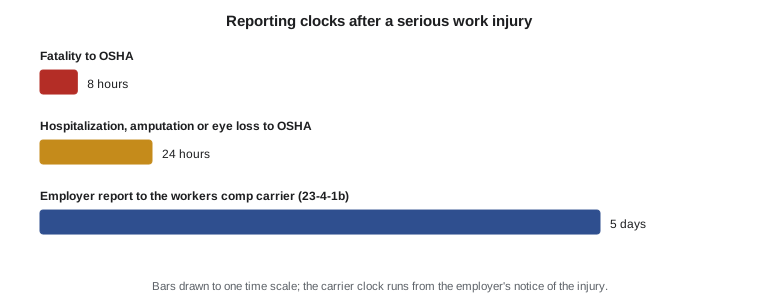
Under 29 CFR 1904.39, an employer must report a work-related fatality to OSHA within 8 hours of learning of it, and must report an inpatient hospitalization of one or more employees, an amputation or the loss of an eye within 24 hours of learning of it. Reports can be made by phone to the area office, by OSHA's toll-free number or online. Employers with more than ten employees in most industries, including construction, also keep the OSHA injury and illness logs required by Part 1904, and post the annual summary.
West Virginia's workers compensation law adds its own clock. Under section 23-4-1b, an employer must report every employee injury to its workers compensation carrier or claims administrator within five days of the employer's receipt of the employee's notice of injury, on forms prescribed by the Insurance Commissioner. The report states whether the employer disputes compensability or objects to temporary total disability benefits. The carrier cannot extend the five days, though the employer may file a supplemental report later.
| Event | Report to | Deadline | Source |
|---|---|---|---|
| Work-related fatality | OSHA | 8 hours | 29 CFR 1904.39 |
| Inpatient hospitalization, amputation or loss of an eye | OSHA | 24 hours | 29 CFR 1904.39 |
| Any employee injury reported to the employer | Workers compensation carrier | 5 days from the employer's receipt of notice | W. Va. Code 23-4-1b |
| Recordable injury or illness | OSHA log, kept on site | Within 7 calendar days of learning of it | 29 CFR 1904.29 |
Workers compensation in West Virginia
West Virginia's workers compensation system was run by a state fund for most of its history. Reforms in the 2000s closed the state monopoly, and since July 2008 employers have bought coverage from private insurance carriers in a competitive market, or self-insured if qualified. The Offices of the Insurance Commissioner regulate the market and the claims process. Employers with employees in West Virginia must carry coverage, subject to the narrow exemptions in the statute, and the Contractor Licensing Board verifies coverage before licensing or renewing a contractor.
Workers compensation is a no-fault system. An employee injured in the course of and as a result of employment receives medical benefits and wage-loss benefits without proving the employer was negligent, and in exchange the employer is generally protected from a negligence lawsuit by the employee. West Virginia recognizes a narrow exception, called deliberate intent, where an employer knowingly exposed an employee to a specific unsafe working condition that violated a safety rule; the statute sets strict elements for that claim. An injured worker generally must file a claim within six months of the injury; confirm the current deadline with the carrier or the Insurance Commissioner.
Worked problem
After an injury
On a Tuesday morning, an assistant on a Kanawha Ridge crew cuts his hand on a sharp box edge. He reports it to Renee at 10:00, and she drives him to an urgent care clinic, where he receives stitches and returns to work the next day. He is not hospitalized. What must the company report, and when?
Show solution
- OSHA: no 8-hour or 24-hour report, because there was no fatality, inpatient hospitalization, amputation or eye loss.
- OSHA log: stitches are medical treatment beyond first aid, so the injury is recordable; enter it within 7 calendar days.
- Workers compensation: report to the carrier within 5 days of the employer's receipt of notice, that is, by Sunday of that week; Cora files the same Tuesday afternoon.
- Review the cause: a deburring tool for boxes, and a reminder at the next crew meeting.
Answer: A carrier report within 5 days and an OSHA log entry within 7 days; no immediate OSHA report.
Safety programs and the master
The law places duties on the employer, but a master shapes how the work is done. Renee's safety duties as a master will include planning work so that it can be done de-energized, writing or approving lockout procedures for each job, making sure crews have tested meters and the right protective equipment, enforcing ladder and fall protection rules, and training assistants. The Fire Marshal's rule barring assistants from hazardous locations, covered in Lesson 7, is a licensing rule, but it is also a safety rule.
Kanawha Ridge's written safety program is twelve pages long. It covers hazard communication, lockout, energized work permits, ladders and fall protection, temporary power, trenching, heat and cold stress, vehicle safety and incident reporting. Dale reviews it every January with the foremen, and Renee will take over that review. A program that sits in a binder does little; a program the crew knows by heart prevents injuries.
Owners add their own requirements. The chemical plants where Kanawha Ridge does shutdown work require site-specific safety orientation for every worker, daily job hazard analyses, permits for hot work and confined spaces, and the plant's own lockout procedures, which apply on top of Kanawha Ridge's. Schools and hospitals require background checks and infection control or occupied-building rules. A master who plans the work has to fold these requirements into the schedule and the price, because a crew that arrives without the orientation cannot start, and a crew that skips a plant permit can be removed from the site for good.
# Reporting check for one incident
event = {"fatality": False, "hospitalized": False, "amputation": False, "eye_loss": False,
         "beyond_first_aid": True}
if event["fatality"]:
    print("Report to OSHA within 8 hours")
elif event["hospitalized"] or event["amputation"] or event["eye_loss"]:
    print("Report to OSHA within 24 hours")
else:
    print("No immediate OSHA report required")
print("Report to the workers compensation carrier within 5 days of notice")
if event["beyond_first_aid"]:
print("Enter on the OSHA log within 7 calendar days")No immediate OSHA report required Report to the workers compensation carrier within 5 days of notice Enter on the OSHA log within 7 calendar days
Common mistakes
MistakeAssuming West Virginia runs a state OSHA plan.
InsteadWest Virginia has no state plan; federal OSHA enforces for private employers.
MistakeTreating NFPA 70E as an OSHA regulation.
InsteadIt is a consensus standard, used as evidence of how to meet OSHA's requirements and often required by contract.
MistakeWaiting for the carrier to ask for an injury report.
InsteadSection 23-4-1b requires the employer to report within five days of notice.
MistakeReporting a hospitalization to OSHA within 8 hours only if it seems serious.
InsteadAny inpatient hospitalization must be reported within 24 hours; a fatality within 8.
MistakeRelying on a panel directory to decide a circuit is dead.
InsteadVerify absence of voltage with a tested meter before touching conductors.
Summary and key terms
- Federal OSHA enforces workplace safety for private employers in West Virginia; there is no state plan.
- Construction: 29 CFR 1926, especially Subparts K, M and X; maintenance: 29 CFR 1910.331 to 1910.335 and 1910.147.
- NFPA 70E is the consensus standard for electrical safety, often required by contract.
- Report fatalities to OSHA within 8 hours, hospitalizations, amputations and eye loss within 24 hours.
- Report every injury to the workers compensation carrier within 5 days of notice (23-4-1b).
- Workers compensation is no-fault and has been sold by private carriers since 2008.
- State plan
- A state-run occupational safety and health program approved by federal OSHA; West Virginia has none.
- Subpart K
- The electrical safety subpart of OSHA's construction standards.
- Electrically safe work condition
- Equipment disconnected, locked out and verified de-energized before work.
- Deliberate intent
- The narrow West Virginia exception allowing an employee to sue an employer for a knowing exposure to a specific unsafe condition.
- Offices of the Insurance Commissioner
- The state agency that regulates workers compensation in West Virginia.
Practice problems
Work each problem on paper first, then reveal the answer to check.
Who inspects a Kanawha Ridge job site for workplace safety?
Show answer
Federal OSHA.
A worker is admitted to the hospital overnight after a fall. When must OSHA be told?
Show answer
Within 24 hours of learning of it.
What does 23-4-1b require of the employer?
Show answer
A report to the carrier within five days of receiving the employee's notice of injury.
Is NFPA 70E a law?
Show answer
No; it is a consensus standard, often required by contract and used to meet OSHA's requirements.
Which standard covers lockout for maintenance?
Show answer
29 CFR 1910.147.
Lesson quiz · 5 questions
Score 60% or more to complete this lesson.
Create a free account to save your progress, take quizzes and earn a certificate.