
MELU-323 · Lesson 8 of 12 · 20 min
Contractor licensing, insurance and bonding
▶ Video coming soon A video version of this lesson is on the way.
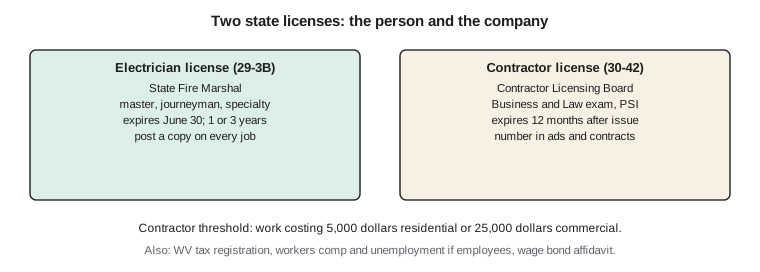
Kanawha Ridge Electric's contractor license hangs in a frame by the front door of the South Charleston office, next to Dale's master license. Visitors sometimes assume they are the same thing. They are not. The master license, issued by the State Fire Marshal, says that Dale is qualified to design and supervise electrical work. The contractor license, issued by the West Virginia Contractor Licensing Board, says that Kanawha Ridge, the business, may contract and bid for construction work in the electrical classification. When Dale steps back, the company's electrical work will rest on Renee's master license, but the contracting business will still need its own contractor license, its own registrations and its own coverage. This lesson covers the business side: the Contractor Licensing Act, the Business and Law exam, workers compensation and unemployment coverage, the wage bond, insurance and bonds.
The governing law is the West Virginia Contractor Licensing Act. It was enacted in 1991 as Chapter 21, Article 11 of the West Virginia Code. In 2021 the Legislature, through House Bill 2006, repealed that article effective June 15, 2021 and moved the Contractor Licensing Board to Chapter 30, Article 42, where it now sits with the other professional and occupational boards. Older forms, guides and exam prep books still cite Article 11; on the exam and in practice, cite Article 42.
Who needs a contractor license
Section 30-42-3 defines a contractor as a person who, for compensation and not as someone else's employee, undertakes or bids on construction, alteration, repair, demolition or similar work on a building, structure or other improvement, where the cost of the work is 5,000 dollars or more for residential work or 25,000 dollars or more for commercial work. An electrical contractor is a person in the business of installing, erecting, repairing or altering electrical equipment used to generate, transmit or use electrical energy. The Board's guidance adds an important point: licensing requirements are based on the entire construction project, including all labor and materials, not on the size of an individual subcontract. A subcontractor whose own price is under the threshold may still need a license because the project is over it.
Section 30-42-6 requires a license to work as a contractor or to bid on contractor work in West Virginia. A business entity, such as a limited liability company or corporation, may contract in the state only if one of its officers holds a license. Licensees must display the license, or a copy, at each construction site, and the license number must appear in all contractor advertisements and in all fully executed, binding contracts. After a hearing, a violation of the display and advertising rules can bring a warning, a reprimand or a fine of up to 200 dollars.
Exemptions from contractor licensing
Section 30-42-6 also lists exemptions. Among them are work done solely by employees of federal, state or local government; selling or installing finished products that are not built into the structure as permanent fixtures; work by a public utility regulated by the Public Service Commission and its employees; emergency repairs ordered by an equipment owner to keep equipment running; work by an employer's regular employees, paid wages rather than a contract price, on the employer's own property that is not for speculative sale or lease; and work an owner or occupant personally performs on their own structure. The definition in 30-42-3 also excludes material suppliers who do not install, and owners doing their own work on property they own or lease.
These exemptions are separate from the electrician licensing exemptions in 29-3B-3. A homeowner who wires his own garage needs neither license. A plant that has its own employees rewire a motor control center needs neither a contractor license nor, under the plant-employee exemption, electrician licenses for those employees. But a contractor hired for the job needs both: the contractor license for the business and Fire Marshal licenses for the electricians.
Getting the license
The Board's guidance says that all contractors must pass the West Virginia Business and Law exam, and that trade exams depend on the classification. PSI Services administers the tests. Scores do not expire, but each score may be used a maximum of three times. The Board also accepts NASCLA scores and scores from accredited national testing organizations in some cases. For the electrical classification, the Board's reciprocity entries refer to a current State Fire Marshal master electrician license; a company seeking the electrical classification should confirm with the Board exactly what the current rule requires of its qualifying officer, whether a master license, a trade exam or both.
The application asks for the business's identity and structure, the licensed officer, the classification sought, proof of good standing with the State Tax Department and, where applicable, the Secretary of State, and proof of workers compensation and unemployment coverage if the business has employees. Every applicant must also file a Wage Bond Status Affidavit, discussed below. Temporary contractor licenses are not issued. The Board does not license handymen; small jobs below the threshold still require registration with the State Tax Department.
| Step | What it involves | Source |
|---|---|---|
| Pass the Business and Law exam | Required of all contractors; given by PSI | Board guidance |
| Meet the classification requirement | Electrical: confirm the current rule for the qualifying officer | Board guidance and rules |
| Register with the State Tax Department | Business registration certificate | Board guidance |
| Show workers compensation and unemployment coverage | If the business has employees | Board guidance |
| File the Wage Bond Status Affidavit | Required of all applicants | Board guidance |
| Renew every 12 months | Late fee of 25 dollars after 15 days; lapse after 90 days ends renewal | Board guidance; 30-42-13 |
Renewal and lapse
Contractor licenses expire 12 months from issuance, and the expiration date is printed on the license. The Board mails renewal notices about 45 days before expiration. A renewal received more than 15 days after the renewal date carries a 25-dollar late fee. Under section 30-42-13, a license that is not renewed by its renewal date lapses, and a license that has lapsed for 90 days or more cannot be renewed; the business must reapply, and a grandfathered license expired that long may require exams. Proof of workers compensation and unemployment coverage must be verified before renewal.
Note that the contractor license and the electrician license run on different cycles. Renee's Fire Marshal license will expire every June 30, renewed for one or three years. The company's contractor license expires on its own anniversary. Cora keeps both dates, and the dates of every employee's license, on one calendar.
Penalties for unlicensed contracting
Section 30-42-14 gives the Board strong tools. When it finds that someone is contracting without a license, it must order them to stop all operations in the state, and the order lasts until a license is issued. After an opportunity for a hearing, the Board may impose a civil penalty of 200 to 1,000 dollars. Continuing to contract after a cease and desist order is a misdemeanor: a first offense carries a fine of 200 to 1,000 dollars; a second, a fine of 500 to 5,000 dollars, jail for up to six months, or both; and a third or later, a fine of 1,000 to 5,000 dollars and jail for 30 days to one year. On a project of 25,000 dollars or more, the Board may add up to 200 dollars for each day of violation. The Board may also seek an injunction in circuit court.
Workers compensation and unemployment
A contracting business with employees must carry workers compensation coverage and unemployment insurance. West Virginia's workers compensation system moved to a private, competitive insurance market in 2008, regulated by the Offices of the Insurance Commissioner. Employers buy policies from private carriers or, if qualified, self-insure. Lesson 10 covers how claims and injury reports work. For licensing, the point is simple: the Board verifies coverage before issuing or renewing a license, and an out-of-state company with no West Virginia employees must provide its home state's workers compensation certificate and its most recent quarterly unemployment report.
The wage bond
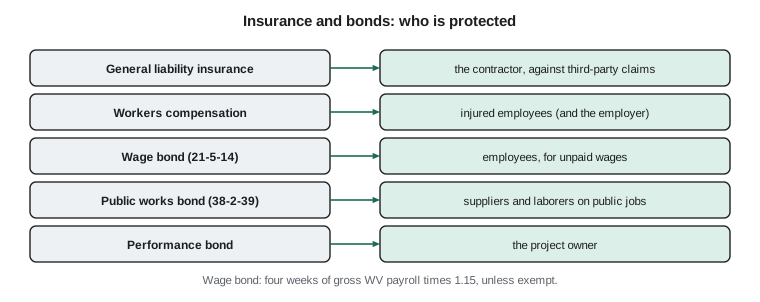
West Virginia's Wage Payment and Collection Act requires certain employers in the construction industry to furnish a wage bond to the Division of Labor, to protect employees if the employer fails to pay wages and fringe benefits. Under the Division of Labor's guidance, the bond equals four weeks of gross West Virginia payroll at maximum capacity, plus 15 in 100, that is, payroll times 1.15. Exemptions include businesses that have operated in West Virginia with employees for at least one year, businesses that have operated in another state for five years, subsidiaries of a parent company that has operated for five years, companies with no employees physically working in West Virginia, companies with at least 100,000 dollars in available assets, and companies doing only single-family dwelling or family farm construction. To claim an exemption, a business files a Wage Bond Status Affidavit, which is also required with every contractor license application.
Worked problem
Sizing a wage bond
A new electrical contractor from Ohio, in business for two years and with no West Virginia history, expects a West Virginia payroll at full capacity of 18,000 dollars a week. If no exemption applies, how large must its wage bond be?
Show solution
- Four weeks of gross payroll: 4 times 18,000 is 72,000 dollars.
- Add 15 in 100: 72,000 times 1.15 is 82,800 dollars.
- Check the exemptions: two years in Ohio is less than five; it has no year in West Virginia with employees; check its assets.
Answer: 82,800 dollars, unless the company qualifies for an exemption such as 100,000 dollars in available assets.
Insurance and bonds
The Contractor Licensing Board's guidance does not list a general liability insurance minimum for the license. That does not mean a contractor can do without it. Owners, general contractors, cities and public agencies routinely require certificates of insurance naming them as certificate holders or additional insureds, with stated limits for general liability, automobile liability, workers compensation and sometimes umbrella coverage. Kanawha Ridge's insurance agent issues certificates for every job on request, and Cora tracks policy renewal dates so that a certificate never expires during a job.
Bonds work differently from insurance. Insurance protects the contractor against claims from others. A performance bond protects the project owner if the contractor fails to finish the work. A payment bond protects subcontractors, suppliers and workers if the contractor fails to pay them. On public buildings in West Virginia, section 38-2-39 requires the public body to demand a bond from the contractor in a penal sum at least equal to the reasonable cost of materials, equipment and labor, from a surety authorized in the state, recorded in the county clerk's office; the contract is not binding until the bond is recorded. Lesson 9 explains why that bond matters: there are no liens on public property.
# Wage bond calculator (Division of Labor formula)
def wage_bond(weekly_payroll, weeks=4, factor=1.15):
    return round(weekly_payroll * weeks * factor, 2)
for payroll in (12000, 18000, 25000):
print(f"Weekly payroll {payroll}: bond {wage_bond(payroll):,.0f} dollars")Weekly payroll 12000: bond 55,200 dollars Weekly payroll 18000: bond 82,800 dollars Weekly payroll 25000: bond 115,000 dollars
Common mistakes
MistakeCiting Chapter 21, Article 11 for contractor licensing.
InsteadThe act moved to Chapter 30, Article 42 in 2021.
MistakeJudging the threshold by the subcontract price.
InsteadThe Board bases licensing on the entire project, including all labor and materials.
MistakeLeaving the license number off advertisements.
InsteadSection 30-42-6 requires it in ads and binding contracts, with a fine of up to 200 dollars.
MistakeWaiting four months to renew a lapsed contractor license.
InsteadA license lapsed 90 days or more cannot be renewed; the business must reapply.
MistakeConfusing a wage bond with liability insurance.
InsteadThe wage bond protects employees' wages; insurance protects the contractor against claims.
Summary and key terms
- The Contractor Licensing Act is now Chapter 30, Article 42.
- A license is needed for work of 5,000 dollars residential or 25,000 dollars commercial, judged by the whole project.
- All contractors pass the Business and Law exam, given by PSI; confirm the electrical classification rule.
- Display the license on site and put its number in ads and contracts.
- Licenses expire after 12 months; a 90-day lapse ends renewal.
- Carry workers compensation and unemployment coverage, file the wage bond affidavit, and expect owners to require insurance certificates and bonds.
- Contractor Licensing Board
- The state board that licenses contractors under 30-42.
- Business and Law exam
- The exam all West Virginia contractor license applicants must pass.
- Wage bond
- A bond protecting employees' wages, sized at four weeks of gross WV payroll times 1.15.
- Wage Bond Status Affidavit
- The form a business files to show whether it needs a wage bond.
- Cease and desist order
- A Board order to stop contracting without a license.
Practice problems
Work each problem on paper first, then reveal the answer to check.
Kanawha Ridge subcontracts 18,000 dollars of electrical work on a 400,000-dollar commercial project. Does it need a contractor license?
Show answer
Yes; licensing is based on the entire project, which is over 25,000 dollars.
Where must the license number appear?
Show answer
In all contractor advertisements and fully executed binding contracts.
What happens to a contractor license lapsed for 100 days?
Show answer
It cannot be renewed; the business must reapply.
What does a wage bond protect?
Show answer
Employees' unpaid wages and fringe benefits.
What is the civil penalty range for unlicensed contracting?
Show answer
200 to 1,000 dollars, after an opportunity for a hearing.
Lesson quiz · 5 questions
Score 60% or more to complete this lesson.
Create a free account to save your progress, take quizzes and earn a certificate.