
MELU-323 · Lesson 3 of 12 · 20 min
Applying, approval and booking the exam
▶ Video coming soon A video version of this lesson is on the way.
In West Virginia the State Fire Marshal does not just license electricians; it writes, schedules and gives their exams. There is no national testing company to book through, no testing center in a strip mall and no exam window that opens on demand. That changes how a candidate plans. Renee's colleague from Ohio, who once took a computer-based exam at a testing center near Columbus, was surprised to learn that the West Virginia exam is a paper exam on a scheduled date, given by the office that licenses him. This lesson walks through the process the way Renee planned it, from the application to the day the license is active.
The process rests on section 29-3B-5 of the statute, which lets the State Fire Marshal set rules for applications, examinations and fees, and on section 5 of the rule at 103 CSR 5, which sets the mechanics of scheduling. The State Fire Marshal's licensing page gives the current forms, fees and practical instructions. As always, check the current page before you rely on a date or fee.
The application
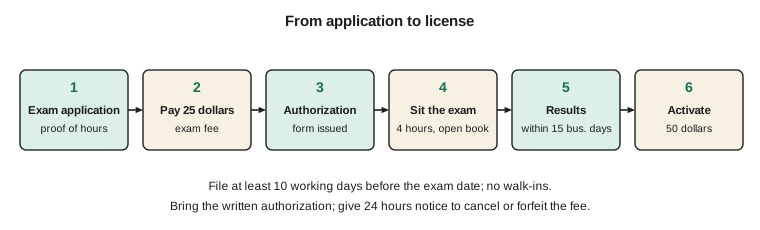
The candidate starts with the State Fire Marshal's electrical exam application. It asks which exam the candidate wants to take, the candidate's identifying information, and the experience the candidate is relying on, with the supporting proof described in Lesson 2. The statute requires the applicant's Social Security number. The form is signed, and it is the document the Fire Marshal relies on if a question later arises about the candidate's qualifications.
The rule sets a lead time. Under section 5.7, applications must be submitted at least ten working days before the next scheduled exam. Working days exclude weekends and state holidays, so ten working days is two calendar weeks at the least and more around a holiday. The licensing page adds that walk-ins are not permitted: a candidate who shows up on exam day without an approved application will not be seated. Renee planned to file at least a month ahead, so that any question about her hours could be answered before the cutoff.
Fees
The State Fire Marshal's page lists an exam fee of 25 dollars, which is not refundable, and a license activation fee of 50 dollars once the candidate passes. Renewal is 50 dollars for one year or 150 dollars for three years, covered in Lesson 11. These are small amounts compared with exam fees in many states, but the nonrefundable exam fee and the forfeiture rule below mean a careless candidate can pay more than once. Fees are set by the Fire Marshal's fee rule, Title 103, Series 2, and can change; confirm them on the current page.
Kanawha Ridge pays exam and license fees for its electricians, a common practice that Dale describes as cheap insurance. The company records the payment in Renee's training file along with the application date, so that Cora can track the cutoff dates for the whole crew.
Scheduling and the authorization
Section 5.10 of the rule requires the State Fire Marshal to hold exams at least four times a year, and allows more sessions at other locations. Section 5.11 makes Charleston the required testing site, with other locations possible if enough applicants preregister. In practice the office publishes its exam dates and locations on its licensing pages; a candidate picks a date, files in time and waits for approval.
Once the application is approved, the candidate receives a written authorization. Under section 5.8, the candidate must present that written authorization form at the exam site. Renee will keep hers in the folder with her code book, her calculator and her identification, and she will not leave the house without checking that it is there. A candidate without the authorization may be turned away, and a missed session means waiting for the next one.
Missing an exam
Section 5.4 of the rule says a candidate who misses an exam forfeits the fee unless the State Fire Marshal's office receives at least 24 hours notification. A candidate who reapplies after missing the first exam pays an additional exam fee. The rule is strict but simple. If Renee is sick the week of the exam, she must call or write the office at least a full day ahead, and she should keep a record of when and how she gave notice.
The rule does not state a waiting period before a retake. A candidate who fails files a new application for a later session, pays the exam fee again and sits the exam again. Because sessions are set by the office and applications close ten working days ahead, a failed exam usually costs at least a few weeks, which is why Renee's plan in Lesson 1 included a retake allowance. If the office has a limit on retakes or a waiting period that is not in the rule, it will be stated on the current application; read it.
| Rule | What it says | Why it matters |
|---|---|---|
| 103 CSR 5-5.7 | Apply at least 10 working days before the exam | Late applications wait for the next session |
| 103 CSR 5-5.8 | Present the written authorization at the site | No authorization, no seat |
| 103 CSR 5-5.4 | Missed exam forfeits the fee unless 24 hours notice | Give notice in writing and keep a record |
| 103 CSR 5-5.10 | Exams at least four times a year | Plan around set dates |
| 103 CSR 5-5.11 | Charleston is the required site | Other sites only with enough preregistration |
| 103 CSR 5-5.13 | 70 or better to receive a license | Lesson 4 covers the scoring |
Results and activation
The State Fire Marshal's page says exams are graded and results issued within 15 business days. A candidate who scores 70 or better, under section 5.13 of the rule, is eligible for the license. The license is not active until the activation fee is paid and the license is issued. Until then, Renee is still a journeyman.
For a company, the gap between the exam and the active license matters. Kanawha Ridge has a medical office building in Teays Valley scheduled to start design in March 2027. If Renee passes in February, the results arrive within three weeks and the license follows activation. Dale will still be on staff, so the company does not depend on Renee's timing, but he wants her to sign the design if her license is active by then. Cora's calendar has the exam date, the expected result date and a reminder to pay the activation fee the day the result arrives.
Worked problem
Working back from an exam date
Suppose the State Fire Marshal schedules a master exam for Thursday, February 11, 2027, and there are no state holidays in the period. What is the last day Renee can file?
Show solution
- Ten working days before Thursday, February 11, counting back: Wednesday the 10th is one, Tuesday the 9th two, Monday the 8th three.
- Friday the 5th is four, Thursday the 4th five, Wednesday the 3rd six, Tuesday the 2nd seven, Monday the 1st eight.
- Friday, January 29 is nine and Thursday, January 28 is ten.
- Check how the office counts: whether the exam day itself or the filing day is included can shift the answer by a day.
Answer: About Thursday, January 28, 2027 in this example; file well before that, because the office may need time to approve the hours.
The example uses an invented date. The real dates come from the State Fire Marshal's published schedule, and a state holiday such as Martin Luther King Jr. Day or Presidents' Day in the period moves the cutoff earlier.
Special arrangements and identification
Candidates who need an accommodation for a disability should ask the State Fire Marshal's office when they apply, not on exam day, so the office can arrange it. Bring government-issued photo identification that matches the name on the application. If your name has changed since you filed, contact the office first. These points are not unique to West Virginia, but a paper exam given by a small office leaves less room for last-minute fixes than a large testing center does.
The office also answers questions by phone and email, and its licensing staff handle the same applications every week. Renee called once to ask how to list her plant shutdown work, which was done for Kanawha Ridge but at a client's site, and got a clear answer in five minutes: list it under Kanawha Ridge, because Kanawha Ridge was her employer.
Studying while the application is pending
Because the State Fire Marshal does not sell study guides, prep courses or practice exams, and its page says so, candidates build their own preparation. Renee's plan has three parts. The first is code navigation: twenty minutes every weekday finding rules by the index and by the article layout, using the method from MELU-101, until she can find any common rule in under two minutes. The second is calculations: two evenings a week working dwelling and commercial load calculations, conductor sizing, voltage drop, motor circuits and box fill, using the methods from MELU-102 through MELU-105. The third is review of the West Virginia material in this course, because the state's law questions are not in the National Electrical Code at all.
Her schedule starts twelve weeks before the exam and does not depend on the application being approved. If the office asks a question about her hours, the studying continues; if the session is full or she has to move to the next date, she has more time, not less. She keeps a log of every practice question she misses and why, the error log described in Lesson 12, and she reviews it every Sunday.
Dale contributes in a way only a master can. Once a week he hands Renee a real job from the company files, a tenant finish or a school addition, and asks her to do the service and feeder calculation from scratch before she looks at his. Where they differ, they open the code together and find out why. The exam is open book, but the book helps only a candidate who already knows what to look for, and this kind of practice teaches that faster than any list of questions.
Kanawha Ridge also lets its candidates use a quiet office on Friday afternoons during the last month before an exam. It is a small cost for the company and a large help for a candidate who works long days on job sites. Employers who want masters on staff can do the same, and candidates who work for smaller shops can ask for it.
A checklist for the week before
In the last week, Renee's checklist is short. She confirms the date, time and location of the exam on the office's schedule. She checks that the written authorization is in her folder. She packs the allowed references from Lesson 4: a 2020 National Electrical Code, permanent tabs, the key word index, Ugly's Electrical References, a calculator and No. 2 pencils. She plans her route to the exam site in Charleston with time for traffic on Interstate 64. And she sets a reminder two days ahead in case she needs to give 24 hours notice.
# Cora's reminder dates for one exam session (illustrative)
from datetime import date, timedelta
exam = date(2027, 2, 11)
def working_days_before(d, n):
    while n > 0:
        d -= timedelta(days=1)
        if d.weekday() < 5:
            n -= 1
    return d
print("Last filing day (no holidays):", working_days_before(exam, 10))
print("Last day to cancel (24 hours):", exam - timedelta(days=1))
print("Results expected by about:", exam + timedelta(days=21), "(15 business days)")Last filing day (no holidays): 2027-01-28 Last day to cancel (24 hours): 2027-02-10 Results expected by about: 2027-03-04 (15 business days)
The calculation treats every weekday as a working day. Cora checks the state's holiday list each year and adjusts the reminders by hand.
Common mistakes
MistakePlanning to walk in on exam day.
InsteadThe licensing page says walk-ins are not permitted.
MistakeCounting ten calendar days instead of ten working days.
InsteadSection 5.7 says working days, so weekends and holidays do not count.
MistakeSkipping the exam without telling the office.
InsteadWithout at least 24 hours notice the fee is forfeited and a new fee is due.
MistakeTreating a passing score as an active license.
InsteadThe license is active only after the activation fee is paid and it is issued.
MistakeBooking through a national testing company.
InsteadThe State Fire Marshal gives its own electrical exams.
Summary and key terms
- The State Fire Marshal writes, schedules and gives the electrical exams.
- Apply at least ten working days before the exam; no walk-ins.
- The exam fee is 25 dollars and not refundable; activation is 50 dollars.
- Bring the written authorization; missing without 24 hours notice forfeits the fee.
- Exams are held at least four times a year, with Charleston the required site.
- Results come within 15 business days; 70 or better passes.
- Written authorization
- The form a candidate receives after approval and must present at the exam site.
- Working day
- A weekday that is not a state holiday.
- Activation fee
- The fee paid after passing to have the license issued.
- Forfeit
- Lose a fee without refund, as when an exam is missed without notice.
- 103 CSR 5-5
- The section of the electrician licensing rule that governs examinations.
Practice problems
Work each problem on paper first, then reveal the answer to check.
Where must the State Fire Marshal hold exams?
Show answer
Charleston is the required site; other locations may be added with enough preregistration.
Renee cannot attend and calls the office 30 hours ahead. Does she lose the fee?
Show answer
No; she gave at least 24 hours notice.
How soon are results issued?
Show answer
Within 15 business days, according to the licensing page.
What must Renee present at the exam site?
Show answer
The written authorization form, and identification.
Does the rule set a waiting period before a retake?
Show answer
Section 5 does not state one; she reapplies for a later session and pays the fee again.
Lesson quiz · 5 questions
Score 60% or more to complete this lesson.
Create a free account to save your progress, take quizzes and earn a certificate.