
MELU-323 · Lesson 1 of 12 · 20 min
How electrical licensing works in West Virginia
▶ Video coming soon A video version of this lesson is on the way.
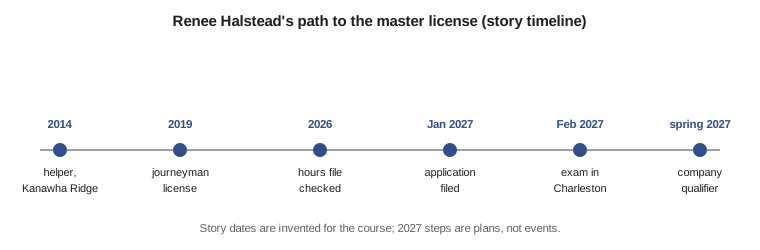
Renee Halstead started in the electrical trade in 2014 as a helper for Kanawha Ridge Electric, LLC, a sixteen-person contractor in South Charleston that wires stores, clinics, school additions and the occasional chemical plant shutdown along the Kanawha River. She pulled wire and carried material for five years, took night classes, and in 2019 passed the State Fire Marshal's journeyman exam in Charleston. Since then she has run crews on commercial jobs from Huntington to Beckley. The company and everyone in it are invented for this course, but the decisions they face are real. The owner, Dale Burdette, has held a West Virginia master electrician license since 1997. He designs the company's services and feeders, signs off on load calculations and stands behind the company's state contractor license. Dale is sixty-six and wants to step back by the summer of 2027, and he has asked Renee to earn her master license so that the company has a second master on staff before he does. This course follows her from her first question to exam day.
This is the West Virginia course in the HSM University master electrician exam prep series. The core courses, MELU-101 through MELU-107, teach the National Electrical Code skills every master-level exam tests: navigating the code, load calculations, conductors and overcurrent protection, grounding and bonding, motors and transformers, special occupancies, and business and law. This course adds what is specific to West Virginia: who licenses electricians, what the State Fire Marshal's exam looks like, which code edition is in force, how inspections and utility connections work, what the state requires of contracting businesses, and how mechanics' liens, workers compensation and safety law apply to an electrical contractor.
Two cautions apply to every lesson. First, rules change. The facts in this course were checked in November 2026 against Chapter 29, Article 3B of the West Virginia Code, the State Fire Marshal's electrician licensing rule at Title 103, Series 5 of the Code of State Rules, the State Fire Marshal's licensing pages, the West Virginia Contractor Licensing Act in Chapter 30, Article 42, the mechanics' lien article in Chapter 38, Article 2, and the workers compensation chapter. Where a fact could not be confirmed against a primary source, the lesson says so. Before you apply, pay a fee or book an exam, check the current pages yourself. Second, electrical codes are copyrighted. This course cites articles and sections of the National Electrical Code by number and explains them in plain words, but it never reproduces their text, tables or figures. Keep your own copy of the code your exam uses open beside you.
One state license for electricians
West Virginia licenses electricians at the state level, and it has done so since the Legislature passed the electrician licensing law in 1989. That law is now Article 3B of Chapter 29 of the West Virginia Code. Its core rule, in section 29-3B-2, is simple: no person, firm or corporation may perform, offer to perform or engage in electrical work for compensation in the state without a license issued by the State Fire Marshal. A person who is only assisting a licensed journeyman or master electrician, and only for the work that is supervised, does not need a license. The same section requires that a copy of the license be posted on any job where electrical work is being done for pay.
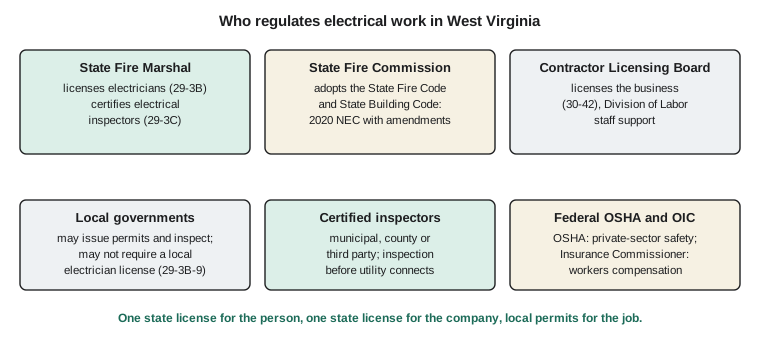
The licensing authority is the State Fire Marshal, an office that sits under the State Fire Commission. That surprises candidates from other states, where a board of electrical examiners or a labor department usually runs licensing. In West Virginia the same office that enforces the State Fire Code also examines electricians, issues their licenses, certifies electrical inspectors and investigates unlicensed work. The Fire Marshal's licensing rule, Title 103, Series 5, fills in the details the statute leaves open: definitions, qualifications for each exam, how exams are scheduled, renewal, reciprocity and discipline.
Classes of license
Section 29-3B-4 lets the State Fire Marshal issue master, journeyman and temporary electrician licenses, and additional specialty classes. The rule defines each one. A journeyman electrician has at least one year of experience, installs electrical equipment under the supervision of a master and knows the installation rules of the code, but may not design any part of an electrical system. A master electrician has at least two years of experience in all phases of wiring, is competent to design electrical systems, reads plans, calculates demand loads, and instructs and supervises journeymen and assistants. Specialty licenses cover narrow fields: plumbing, heating and air conditioning work incidental to that business, electric signs, single-family dwellings, low voltage systems such as fire and burglar alarms, and elevators and related equipment.
The difference between master and journeyman is the word design. In the rule's definitions, supervision means drafting, coordinating and directing the design, layout and load calculations of electrical systems, and that is work only a master may do. Renee has been running crews for years, laying out conduit runs and sizing branch circuits on the fly, but every service, feeder and load calculation the company has built went through Dale. Lesson 2 covers what she must prove to sit the master exam, and Lesson 7 covers what changes the day she passes.
| License | Experience before the exam | Main scope |
|---|---|---|
| Master | 24 months or 4,000 hours of hands-on work | Design, layout and load calculations; supervise journeymen and assistants |
| Journeyman | 12 months or 2,000 hours, or an approved apprenticeship or 1,080-hour course | Install under a master's supervision; no design |
| Specialty | 12 months or 2,000 hours in the specialty | Limited field named on the license |
| Assistant or helper | None; no license | Only in direct contact with, and under the supervision of, a licensed electrician |
No local electrician licenses
A West Virginia license works across the state, and the statute protects that. Section 29-3B-9 says that no municipality, county or other local government may require a holder of a valid state electrician license to hold a local license, or to show any other evidence of competence as an electrician, as a condition of doing electrical work there. The rule repeats the point in section 3.2. So when Kanawha Ridge takes a job in Morgantown, Wheeling or Martinsburg, Renee does not sit another exam or buy a city card to prove she is an electrician.
That does not mean local governments have no role. Cities and counties that have adopted the State Building Code issue building and electrical permits, review plans and inspect. Many charge permit fees, require a contractor to register its business, or ask for proof that the company holds a state contractor license. What they cannot do is add their own electrician licensing test on top of the state license. Lesson 6 explains how permits and inspections work across the patchwork of places that do and do not issue permits.
The person and the company
West Virginia separates the license an electrician holds from the license a contracting business holds. The electrician license comes from the State Fire Marshal under Article 3B. The business license comes from the West Virginia Contractor Licensing Board under the Contractor Licensing Act, which the Legislature moved in 2021 from Chapter 21, Article 11 to Chapter 30, Article 42. A contractor in that act is a person who, for compensation, takes on or bids on construction work costing at least 5,000 dollars on residential work or 25,000 dollars on commercial work, and an electrical contractor is one in the business of installing or altering electrical equipment.
The Fire Marshal's rule makes the separation plain: a firm's license does not exempt its electricians from holding their own journeyman or master licenses. Kanawha Ridge holds a contractor license with the electrical classification, and every electrician on its payroll holds a Fire Marshal license of the right class or works as an assistant under one. Lesson 8 covers the contractor license, the Business and Law exam, workers compensation and unemployment coverage, and the wage bond rules.
Exemptions worth knowing
Section 29-3B-3 lists work the licensing law does not reach. It does not apply to work on property owned or leased by the person doing it or by their immediate family, to employees of a manufacturing plant or industrial establishment working for the company that operates it, to employees of a retail appliance seller installing or repairing appliances the employer sold, to public utility employees working on utility service, or to government employees working on government property. The rule narrows the appliance exemption: it does not cover work that requires entering the electrical panel. Low voltage work of 80 volts or less, with directly related wiring, needs only a specialty license.
These exemptions explain much of what Renee sees in the field. The maintenance electricians at the plant where Kanawha Ridge does shutdown work may hold no state license at all, because they work for the plant's operator; the moment Kanawha Ridge's crew walks through the gate, the exemption does not apply to them, because they are a contractor working for pay. A homeowner may wire his own garage, but if he hires his neighbor to do it for money, the neighbor needs a license. Exam questions often turn on exactly this point: who is doing the work, for whom, and whether it is for compensation.
Enforcement
Article 3B is enforced mainly through fines, discipline and the courts. Under section 29-3B-8, doing electrical work without a license, or otherwise violating the article, carries a fine of 100 to 500 dollars for a first offense, 500 to 1,000 dollars for a second and 1,000 to 5,000 dollars for a third or later offense, and each day of unlicensed work, or of noncompliance after official notice, is a separate offense. Where unlicensed work is a hazard or is extensive, the State Fire Marshal may issue a citation or ask the circuit court for an injunction. Under section 29-3B-7 the Fire Marshal may deny, suspend or revoke a license for a false application, for vouching for someone else's false statement, for incompetent or unsafe work, or for breaking the rules.
For a master, enforcement is personal. The master's name is the one on the design and the load calculation, and the master is the person the Fire Marshal looks to when work is unsafe. Dale has told Renee that the best protection is dull paperwork: current licenses for everyone, copies posted on every job, permits pulled where they are required, inspections called on time, assistants never left alone, and a file for every job. Lesson 7 returns to those habits.
How this course is organized
The lessons follow Renee's path. Lesson 2 covers eligibility for the master license, Lesson 3 the application and booking process, and Lesson 4 the exam format and the references allowed. Lesson 5 explains the National Electrical Code as adopted in West Virginia, and Lesson 6 permits, inspections and the inspection authority. Lesson 7 covers the duties of a master, Lesson 8 contractor licensing, insurance and bonding, and Lesson 9 contracts and mechanics' liens. Lesson 10 covers safety law, OSHA and workers compensation, Lesson 11 renewal and continuing education, and Lesson 12 a practice review and test-day strategy. Every lesson ends with a quiz that mixes multiple choice, true or false, number, ordering and matching questions, and the course ends with a final exam.
The calculator below shows the first planning Renee did. Dale wants to step back in about eight months. She needs time to pull together proof of her hours, file the exam application, study, sit the exam, wait for the result, possibly retake it, activate the license and let the company update its records. Change the numbers to fit your own plan.
# Renee's planning check (illustrative months)
months_until_dale_steps_back = 8
steps = {
    "gather proof of hours": 0.5,
    "file the exam application": 0.5,
    "study for the master exam": 3,
    "sit the exam and wait for results": 1,
    "retake allowance, if needed": 2,
    "activate the license and update company records": 0.5,
}
needed = sum(steps.values())
for step, months in steps.items():
    print(f"{step}: {months} months")
print(f"Total: {needed} months; margin: {months_until_dale_steps_back - needed} months")gather proof of hours: 0.5 months file the exam application: 0.5 months study for the master exam: 3 months sit the exam and wait for results: 1 months retake allowance, if needed: 2 months activate the license and update company records: 0.5 months Total: 7.5 months; margin: 0.5 months
The margin is only half a month, so Renee decided to start studying before she files, not after. Many candidates make the same choice, because the State Fire Marshal schedules exams on set dates and a missed date can push the plan back by weeks.
Common mistakes
MistakeThinking a city may require its own electrician license from a state licensee.
InsteadSection 29-3B-9 bars local governments from requiring a local license or other proof of competence from a holder of a valid state license.
MistakeAssuming a company's contractor license covers its electricians.
InsteadThe rule says a firm's license does not exempt its electricians from holding their own licenses.
MistakeBelieving a journeyman may design small systems.
InsteadThe journeyman definition says a journeyman may not design any part of an electrical system.
MistakeTreating every plant electrician as exempt.
InsteadThe exemption covers employees of the company operating the plant, not contractors who come in to work for pay.
MistakeLooking for the licensing board in the Division of Labor.
InsteadElectrician licenses come from the State Fire Marshal; the Division of Labor supports the Contractor Licensing Board for businesses.
Summary and key terms
- The State Fire Marshal licenses electricians under 29-3B and the rule at 103 CSR 5.
- Master, journeyman, temporary and specialty licenses are issued; assistants work without a license only under direct supervision.
- Only a master may design, lay out and calculate loads for electrical systems.
- Local governments may not require a local electrician license from a state licensee, but may issue permits and inspect.
- The business needs a separate Contractor Licensing Board license under 30-42.
- Fines under 29-3B-8 rise with each offense, and each day counts separately.
- State Fire Marshal
- The West Virginia office that licenses electricians, certifies electrical inspectors and enforces the State Fire Code.
- 29-3B
- The article of the West Virginia Code that requires and governs electrician licenses.
- 103 CSR 5
- The State Fire Marshal's electrician licensing rule.
- Design
- Planning or laying out electrical systems, including service components, conductor and breaker sizing and load calculations; master work.
- Contractor Licensing Board
- The state board that licenses contracting businesses under 30-42.
Practice problems
Work each problem on paper first, then reveal the answer to check.
Does Renee need a Morgantown electrician card to work there?
Show answer
No; 29-3B-9 bars a local license requirement for a state licensee, though the city may require permits.
Who issues the master license Renee is working toward?
Show answer
The State Fire Marshal.
May a journeyman calculate the service load for a new building?
Show answer
No; design and load calculations are master work.
A plant's own maintenance electrician rewires a motor control center. Is a state license required?
Show answer
Not under the plant-employee exemption, if he works for the company operating the plant.
What is the fine range for a second offense of unlicensed work?
Show answer
500 to 1,000 dollars, with each day a separate offense.
Lesson quiz · 5 questions
Score 60% or more to complete this lesson.
Create a free account to save your progress, take quizzes and earn a certificate.