
MELU-323 · Lesson 5 of 12 · 19 min
The NEC as adopted in West Virginia and state amendments
▶ Video coming soon A video version of this lesson is on the way.
When Kanawha Ridge bid a school addition in Putnam County in 2022, the specification said the work had to comply with the National Electrical Code as adopted by the State of West Virginia. The architect's earlier draft had said the 2017 edition. By the time the job went to bid, the state had moved to the 2020 edition, effective August 1, 2022, and Dale caught the change only because he read the addendum line by line. Renee was on that job as a journeyman, and she remembers the week the crew spent learning the new ground-fault protection rules for the kitchen. This lesson explains how the National Electrical Code becomes law in West Virginia, what the state's amendments are, how a candidate keeps track of the edition in force, and why the exam may lag behind the code a contractor actually wires to.
West Virginia is unlike many states in one important respect. The National Electrical Code does not reach West Virginia through a separate electrical code statute or an electrical board. It is adopted as part of the State Fire Code and the State Building Code, both rules of the State Fire Commission. The commission is a body of fire service, building and public members, and the State Fire Marshal works under it. That arrangement explains why the same office that licenses electricians also enforces the code the electricians wire to.
The adoption chain
The State Fire Commission adopts codes by legislative rule. Under West Virginia's administrative procedures law, a legislative rule is proposed by the agency, published for public comment, reviewed by a legislative rule-making review committee, authorized by the Legislature and then filed with an effective date. The State Fire Code is Title 87, Series 1 of the Code of State Rules, and the State Building Code is Title 87, Series 4. Each adopts national model codes by reference, with amendments, and each names the edition of the National Electrical Code it uses.
The most recent completed adoption cycle moved the state to the 2020 National Electrical Code, along with the 2018 editions of the International Building, Residential, Mechanical, Plumbing and Existing Building Codes and the 2015 International Energy Conservation Code. The State Fire Commission announced the new codes in May 2022, and they took effect on August 1, 2022. As of November 2026, the 2020 edition is the one the State Fire Marshal's exams are based on, and it is the edition commonly listed for West Virginia. A new State Building Code rule was out for public comment in the summer of 2026, so a later edition may follow; check the current rule before you rely on the edition for a job.
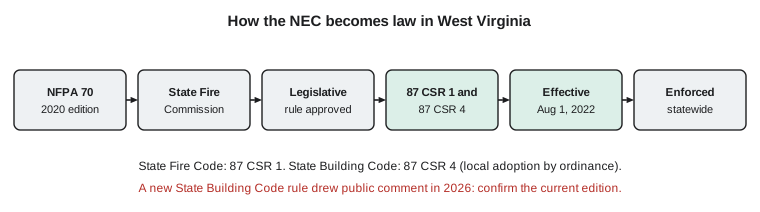
Two codes, one electrical standard
The State Fire Code applies statewide. It is enforced by the State Fire Marshal and by local fire officials, and it reaches existing buildings as well as new work. The State Building Code works differently. A county commission or municipality may adopt the State Building Code by ordinance, and where it does, the local building department reviews plans, issues permits and inspects new construction and alterations. Where a local government has not adopted it, there may be no local building department at all. Both codes point to the same edition of the National Electrical Code, so the electrical standard is the same everywhere in the state; what changes from place to place is who checks the work and when.
This is why Lesson 6 matters so much. In Charleston, South Charleston or Morgantown, a contractor pulls an electrical permit and a local inspector checks the work. In a county without a building code program, there may be no permit, but the installation must still meet the National Electrical Code as adopted, an electrical inspection is still needed before the utility will connect a new service, and the State Fire Marshal can still act on an unsafe installation. Dale's rule for the crew is simple: the code applies whether or not anyone is coming to look.
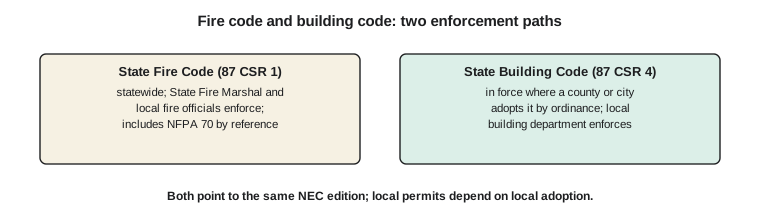
What a state amendment is
When a state adopts a model code by reference, it often changes parts of it. An amendment may delete a section, add a requirement, change an effective date for a new rule or limit a rule to certain occupancies. West Virginia's fire and building code rules adopt the 2020 National Electrical Code with amendments set out in the rules themselves. The amendments are short compared with the code, but they are law, and a contractor who wires to the unamended book can be wrong.
This course does not list the amendments, for two reasons. First, they change when the rule is revised, and a list in a course goes out of date faster than the rule does. Second, the rules are public: the State Fire Marshal links them from its laws page, and the Secretary of State publishes the Code of State Rules online. The habit to build is to read the electrical section of the current State Fire Code and State Building Code rules before a design, and to keep a copy with the job file. Exam questions on West Virginia law are more likely to ask where the code is adopted and who enforces it than to ask about a single amendment.
| Question | Answer for West Virginia | Where to check |
|---|---|---|
| Who adopts the code? | The State Fire Commission, by legislative rule | 87 CSR 1 and 87 CSR 4 |
| Which edition was adopted in 2022? | The 2020 National Electrical Code | Commission notice; the rules |
| When did it take effect? | August 1, 2022 | Commission notice |
| Which edition is the exam based on? | The 2020 National Electrical Code | State Fire Marshal licensing page |
| Is a newer edition coming? | A State Building Code update drew comment in 2026 | Current rule and the commission's notices |
| Who enforces at the job? | Local building departments where adopted; certified inspectors; the State Fire Marshal | Lesson 6 |
Edition questions on the exam and on the job
A candidate has to keep two editions straight if the state adopts a newer code. The exam uses the edition named on the licensing page, which is the 2020 edition today. The job uses the edition adopted in the rule in effect on the date the permit was applied for or the contract was signed, depending on the rule's transition language. For a while after a new adoption, a candidate may be studying one edition and wiring to another. That happened to many West Virginia electricians in 2022, when jobs designed under the 2017 edition were still being built while the 2020 edition was already in force for new permits.
The 2020 edition brought changes that a West Virginia master should know well, because they are now the law and the exam basis. Among the best known are expanded ground-fault circuit-interrupter protection in dwellings, including more outdoor outlets and areas such as basements and laundry areas, which falls under Article 210. The 2020 edition also required an emergency disconnect for one- and two-family dwelling services, located outside, in Article 230, and added surge protection requirements for dwelling unit services in the same article. Read these sections in your own book rather than relying on a summary; the details, exceptions and effective dates in the code are what the exam tests.
Worked problem
Which edition applies?
Kanawha Ridge is pricing a medical office building in Teays Valley in late 2026. The design will be permitted in early 2027. Which edition should Renee use for the design, and which for her February 2027 exam?
Show solution
- For the design: the edition adopted in the State Building Code rule in effect when the permit is applied for, which is the 2020 edition unless a new rule has taken effect by then.
- Check the current rule and the local building department's adopted codes list before the design is final.
- For the exam: the edition named on the State Fire Marshal's licensing page, which is the 2020 edition as of November 2026.
- If the state adopts a newer edition before the permit, the design may need to follow it even though the exam does not.
Answer: Use the edition in the rule in force at permit time for the design, and the licensing page's edition for the exam; today both are the 2020 edition.
Local adoption and local amendments
Because local governments adopt the State Building Code by ordinance, a city's code page usually says that it has adopted the State Building Code, sometimes listing the editions. West Virginia cities such as Martinsburg, Fairmont, Weirton, South Charleston, St. Albans and Milton publish their codes of ordinances online, and their building code chapters show how this works. The local government adopts the state rule; it does not write its own electrical code. If a city ordinance appears to require something different from the state rule, ask the local building official and the State Fire Marshal's office before relying on either.
Local adoption also affects fees, permit types and inspection schedules. Those are local matters within the state framework, and they are covered in Lesson 6. What the local government cannot do, as Lesson 1 explained, is require a state-licensed electrician to hold a local license.
Other standards that matter
A master in West Virginia works with more than the National Electrical Code. The State Fire Code adopts NFPA 1, the Fire Code, and the Life Safety Code, NFPA 101, which matter for fire alarm and emergency lighting work. The State Fire Marshal's plans review office applies these codes to the buildings it reviews. NFPA 72, the National Fire Alarm and Signaling Code, governs fire alarm systems, and a contractor doing alarm work needs to know which edition the state rule names. NFPA 70E, the standard for electrical safety in the workplace, is not a building code, but it is the standard most often used to show compliance with OSHA's electrical safety requirements, covered in Lesson 10.
Utilities add their own requirements. Appalachian Power and Mon Power, the state's two largest electric utilities, publish service requirements for meter locations, service entrance equipment and clearances. Those are not code requirements, but a service that meets the code and ignores the utility's specifications may still not be connected. Kanawha Ridge keeps the current service manuals for both utilities in the office, and Dale checks them on every new service.
# Edition tracker Cora keeps for the office (illustrative entries)
jobs = [
    ("Putnam County school addition", 2022, "2020 NEC"),
    ("Teays Valley medical office", 2027, "2020 NEC unless a new rule takes effect"),
    ("Kanawha plant shutdown", 2026, "2020 NEC"),
]
for name, permit_year, edition in jobs:
    print(f"{name} (permit {permit_year}): {edition}")
print("Exam basis on the licensing page: 2020 NEC")Putnam County school addition (permit 2022): 2020 NEC Teays Valley medical office (permit 2027): 2020 NEC unless a new rule takes effect Kanawha plant shutdown (permit 2026): 2020 NEC Exam basis on the licensing page: 2020 NEC
Common mistakes
MistakeAssuming each city writes its own electrical code.
InsteadLocal governments adopt the State Building Code; the electrical standard is the edition in the state rule.
MistakeWiring to the unamended code book.
InsteadThe state rules adopt the code with amendments; read the current rule.
MistakeStudying from the edition the job uses when the exam uses another.
InsteadUse the edition named on the licensing page for the exam.
MistakeThinking there is no code where no permit is issued.
InsteadThe State Fire Code applies statewide; the code applies even without a local permit.
MistakeIgnoring utility service requirements.
InsteadA service must meet the utility's specifications to be connected.
Summary and key terms
- The State Fire Commission adopts the code through the State Fire Code, 87 CSR 1, and the State Building Code, 87 CSR 4.
- The 2020 National Electrical Code took effect on August 1, 2022, with state amendments.
- The exam is based solely on the 2020 edition, per the licensing page.
- A State Building Code update drew comment in 2026; confirm the edition in force.
- Local governments adopt the State Building Code by ordinance and enforce it.
- Read the current rules' amendments; this course does not list them.
- State Fire Commission
- The West Virginia body that adopts the fire and building codes by legislative rule.
- 87 CSR 1
- The State Fire Code rule.
- 87 CSR 4
- The State Building Code rule.
- Adoption by reference
- Making a published model code law by naming it in a rule, with any amendments.
- Legislative rule
- A West Virginia agency rule that requires legislative authorization before it takes effect.
Practice problems
Work each problem on paper first, then reveal the answer to check.
What edition of the National Electrical Code did West Virginia adopt effective August 1, 2022?
Show answer
The 2020 edition.
Who adopted it?
Show answer
The State Fire Commission, through the State Fire Code and State Building Code rules.
Where are the state's amendments?
Show answer
In the rules themselves, 87 CSR 1 and 87 CSR 4.
A county has no building code program. Does the code apply to a new service there?
Show answer
Yes; the State Fire Code applies statewide, and an inspection is still needed before the utility connects.
Which edition will Renee's exam use?
Show answer
The 2020 edition, unless the licensing page changes before she sits.
Lesson quiz · 5 questions
Score 60% or more to complete this lesson.
Create a free account to save your progress, take quizzes and earn a certificate.