
MELU-320 · Lesson 9 of 12 · 20 min
Contracts and contractors' liens in Vermont
▶ Video coming soon A video version of this lesson is on the way.
Every master eventually meets a customer who does not pay. For Clarendon Ridge it was a developer who converted an old mill building in Rutland into apartments, paid the first three requisitions and then went quiet with 46,000 dollars of electrical work unpaid. Hal had seen it before, and he knew that the company's leverage was a contractors' lien on the property, with deadlines that would not wait for the developer's excuses. This lesson covers the basics of electrical contracts and Vermont's contractors' lien law in 9 V.S.A. chapter 51, subchapter 1, sections 1921 through 1928. It explains the rules in general terms; it is not legal advice, and a contractor facing a real lien deadline should talk to a Vermont lawyer.
A note on the title: many states call these mechanics' liens. Vermont's statute calls them contractors' liens, and this lesson uses Vermont's term.
The contract comes first
Lien rights grow out of a contract, and a good contract makes the lien less likely to be needed. A sound electrical contract identifies the parties and the property, describes the scope of work and what is excluded, states the price or the pricing method, sets out the payment schedule and the dates payment is due, explains how change orders are approved and priced, allocates responsibility for work notice fees and inspections, states the warranty, and says what happens if either side defaults. For residential work by a contractor on the OPR registry, Vermont requires several of those terms, as Lesson 8 explained, and they are good practice on every job.
Two contract terms matter especially for liens. The first is the date payment is due, because Vermont's lien clock runs from when payment for the last labor or materials became due. The second is any waiver of lien rights. Section 1921(f) makes an advance waiver of lien rights unenforceable, so a contract clause in which the contractor gives up its lien before doing the work does not bind it. Waivers given in exchange for payment received, at the time of payment, are a different matter and are common on commercial jobs.
Who has a lien
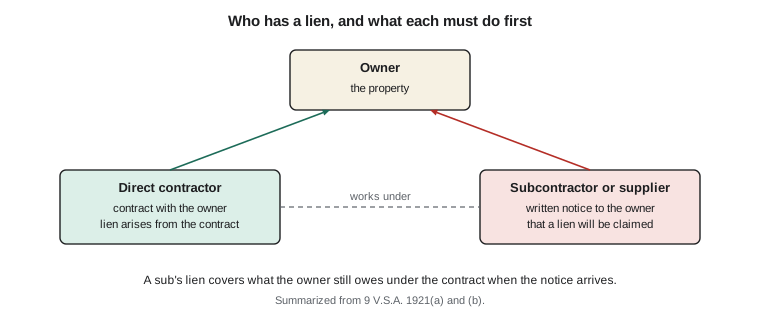
Section 1921(a) gives a lien to a person who has a contract with the owner, written or not, for erecting, altering, repairing or moving a building or other improvement, or for furnishing labor or materials for it. That person, the direct contractor, has a lien on the improvement and the lot it stands on for the amount due under the contract. Section 1921(b) extends lien rights to people who work under a contract with the owner's agent, contractor or subcontractor. Those claimants must give the owner, or the owner's agent in charge of the property, written notice that they will claim a lien, stating when payment is due if they know it. Their lien covers the amount the owner still owes under the contract at the time the owner receives that notice.
The practical lesson for an electrical subcontractor is that notice should go to the owner early. A subcontractor whose notice arrives after the owner has paid the general contractor in full may find there is nothing left for the lien to reach. Clarendon Ridge, which works as a subcontractor on many commercial jobs, sends its written notice to the owner when it begins work on any job where it does not have a direct contract with the owner.
Perfecting the lien: the 180-day recording deadline
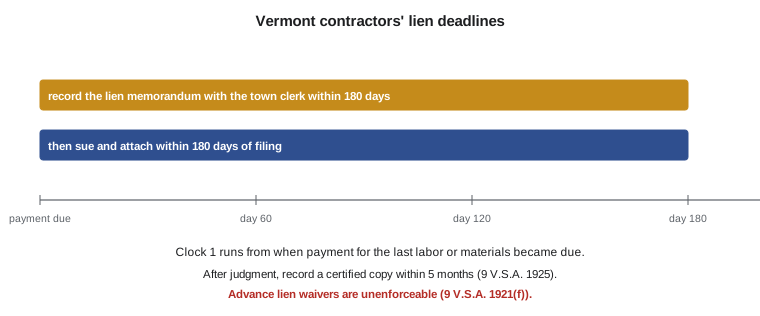
A contractors' lien exists from the visible start of work or the first delivery of materials, but it lapses unless it is perfected. Under sections 1921(c) and 1923 the claimant must record a written memorandum of the lien, signed, in the office of the town clerk of the town where the property is located, within 180 days from the date when payment for the last labor or materials became due. That is a Vermont feature to remember: liens are recorded with the town clerk, in the town land records, not in a county court.
The clock runs from the due date, not the last day of work. If the contract says payment is due thirty days after invoice and the last invoice went out on the last day of work, the 180 days begin thirty days later. A careful contractor does not rely on that extra time without reading the contract; if the due date is unclear, the safer course is to count from the earliest date a court might choose.
Enforcing the lien: suit and attachment
Recording the memorandum does not end the matter. Under section 1924 the claimant must commence a suit and obtain an attachment of the property within 180 days after filing the memorandum if payment was due when it was filed, or within 180 days after payment becomes due if it was not yet due. The attachment is a court order that ties the property to the claim. Under section 1925, after judgment, the claimant records a certified copy of the judgment with the town clerk within five months, and the lien may then be enforced in the same way as a mortgage. Missing any of these steps can cost the lien.
| Step | Deadline | Section |
|---|---|---|
| Subcontractor's written notice to the owner | Before the owner pays out the contract; as early as possible | 9 V.S.A. 1921(b) |
| Record the lien memorandum with the town clerk | Within 180 days after payment for the last labor or materials became due | 9 V.S.A. 1921(c), 1923 |
| Commence suit and attach the property | Within 180 days after filing, or after payment becomes due if later | 9 V.S.A. 1924 |
| Record certified copy of the judgment | Within five months after judgment | 9 V.S.A. 1925 |
Worked problem
Counting the mill-building deadlines
Clarendon Ridge had a direct contract with the developer. Its last work on the mill building was on June 30, 2026, and its final invoice was due on July 30, 2026. When must it record the memorandum, and if it records on November 2, 2026, when must it sue and attach?
Show solution
- The recording clock runs from July 30, 2026, the date payment for the last work became due.
- 180 days after July 30, 2026 is January 26, 2027.
- The memorandum recorded on November 2, 2026 is within that period.
- Payment was due when it filed, so suit and attachment must follow within 180 days of November 2, 2026, which is May 1, 2027.
Answer: Record by January 26, 2027 (it recorded on November 2, 2026); sue and attach by May 1, 2027. A lawyer should confirm the dates.
# Lien deadline calculator (illustrative; confirm with counsel)
from datetime import date, timedelta
payment_due = date(2026, 7, 30)
record_by = payment_due + timedelta(days=180)
recorded_on = date(2026, 11, 2)
sue_by = recorded_on + timedelta(days=180)
print("Record memorandum by:", record_by)
print("Recorded on:", recorded_on, "on time:", recorded_on <= record_by)
print("Sue and attach by:", sue_by)Record memorandum by: 2027-01-26 Recorded on: 2026-11-02 on time: True Sue and attach by: 2027-05-01
Priority and the owner's position
Section 1921(d) addresses priority. A lien does not defeat a deed to a buyer who paid in good faith before the lien was recorded, and a mortgage recorded before the lien generally keeps priority over it. If the mortgage lender receives written notice of the lien, the lien gains priority over later advances under the mortgage, except advances actually used for the improvements. Section 1921(e) limits the lien to the land owned and used, or intended for use, with the improvement, not adjoining land held for other purposes. Section 1922 adds a disclosure duty: a person who has received written notice of an unpaid claim must disclose it when selling or mortgaging the property, and is liable for damages caused by failing to do so. Section 1923 spreads the owner's available funds pro rata when several liens exceed them.
For an owner, the lien law is a reason to keep track of who is working on the property and to require lien waivers with each payment. For a contractor, it is a reason to record early and to put lenders on written notice when a construction loan is still funding.
Public projects
Liens generally do not attach to public property, so a contractor on a school, town or state job looks to the contract and any payment bond for protection. Vermont's bid documents for public projects commonly require payment and performance bonds, and the bond's terms and the contract's claim procedures set the notice and claim deadlines. Because this course did not verify a single statute that governs every public project bond in Vermont, read the bond and the contract on each public job and calendar its deadlines the day the contract is signed.
Other payment tools
Vermont also has a prompt payment law for construction contracts that sets default payment periods and interest on late payments, and contracts often include their own payment and dispute terms. Mediation, arbitration if the contract requires it, and small claims court for modest amounts are alternatives to a lien suit. A master should know these tools exist and should match the tool to the size of the debt.
Lien waivers on progress payments
On commercial jobs, owners and lenders usually require a lien waiver with each progress payment. A partial waiver releases lien rights for the work covered by the payment received, and a final waiver releases them when the contractor is paid in full. Because section 1921(f) makes advance waivers unenforceable, Vermont practice is to sign waivers only for payments actually received, or conditioned on the payment clearing. Clarendon Ridge's rule is never to sign an unconditional waiver for money not yet in the bank, and to keep a copy of every waiver with the payment record. If a payment check bounces after an unconditional waiver has been signed, the company may have released its lien for nothing.
On the mill-building job, the developer's lender had required waivers with each payment, and Clarendon Ridge's file showed that it had waived only the amounts it had received. When the developer stopped paying, the unpaid 46,000 dollars was untouched by any waiver, and the company's lawyer was able to record the memorandum promptly. As this course was written in November 2026, the claim was still being negotiated, with the lien recorded and the 180-day suit deadline on the calendar.
Keeping lien rights alive in practice
Corinne's lien calendar has three dates for every job where the company is not paid in full within the contract's terms: the date payment for the last work became due, the last day to record the memorandum, and, once recorded, the last day to sue and attach. She reviews the calendar every Monday. On subcontract jobs she also records the date the company sent its written notice to the owner and how it was delivered.
A last caution: lien law is technical, and the consequences of a mistake are large. The amounts at stake on a commercial job can exceed a year's profit for a small contractor. When a payment problem appears, the master's job is to recognize the deadline, gather the records and get a lawyer involved early, not to become a lien lawyer.
Common mistakes
MistakeCalling them mechanics' liens in a Vermont answer and expecting county filing.
InsteadVermont calls them contractors' liens and they are recorded with the town clerk.
MistakeCounting the 180 days from the last day of work.
InsteadThe recording clock runs from when payment for the last labor or materials became due.
MistakeRecording and then waiting.
InsteadSuit and attachment must follow within 180 days of filing.
MistakeRelying on an advance lien waiver in the contract.
InsteadSection 1921(f) makes advance waivers unenforceable.
MistakeAssuming a sub's lien reaches money the owner already paid out.
InsteadIt covers what the owner still owes when the notice arrives.
Summary and key terms
- Direct contractors have a lien from their contract; subcontractors and suppliers must give the owner written notice.
- Record the lien memorandum with the town clerk within 180 days after payment for the last work became due.
- Sue and attach within 180 days after filing; record the judgment within five months.
- Advance lien waivers are unenforceable in Vermont.
- On public jobs, rely on the contract and bonds rather than a lien.
- Contractors' lien
- Vermont's statutory lien for labor and materials on an improvement, in 9 V.S.A. 1921 to 1928.
- Memorandum of lien
- The signed written notice recorded with the town clerk to perfect the lien.
- Attachment
- A court order tying the property to the claim while the suit proceeds.
- Advance waiver
- A waiver of lien rights given before the work is done; unenforceable in Vermont.
- Pro rata
- In proportion; how section 1923 divides insufficient funds among several liens.
Practice problems
Work each problem on paper first, then reveal the answer to check.
Where is a Vermont contractors' lien recorded?
Show answer
In the office of the town clerk of the town where the property is located.
When does the recording period end?
Show answer
180 days after payment for the last labor or materials became due.
What must a subcontractor do that a direct contractor need not?
Show answer
Give the owner written notice that it will claim a lien.
Is an advance lien waiver enforceable?
Show answer
No, under section 1921(f).
After judgment, how long does the claimant have to record it?
Show answer
Five months under section 1925.
Lesson quiz · 5 questions
Score 60% or more to complete this lesson.
Create a free account to save your progress, take quizzes and earn a certificate.