
MELU-320 · Lesson 2 of 12 · 22 min
Eligibility for the Master Electrician License
▶ Video coming soon A video version of this lesson is on the way.
The first real question Nadia asked Hal was simple: am I eligible yet? She had been a licensed journeyman for more than four years, she had run crews on commercial jobs, and she had pulled her share of fire alarm cable. But she had heard different stories in the trade about what the Board wanted, and she did not want to send in an application that would sit unapproved through two Board meetings. This lesson works through the eligibility rule in 26 V.S.A. section 902 and the 2025 rules, the alternative path through comparable experience, and the records a candidate should assemble before applying.
The rule in section 902
Section 902 sets two requirements for the master license. The applicant must have been licensed as a journeyman electrician under chapter 15 for at least two years, or have comparable experience and training, inside or outside Vermont, that the Board finds acceptable. And the applicant must pass an examination to the Board's satisfaction. Once both are met and the fee is paid, the applicant receives a wallet-size license card, which the master must carry while working and show on request. For an additional fee the Board will issue a certificate suitable for framing.
The rule is short, and its shortness is a feature. Vermont does not count hours on the master level the way some states do, does not require a separate business examination, and does not set an age minimum or a high school diploma requirement in the statute. The core test is time as a licensed journeyman. Section 3.1 of the 2025 rules restates the same two requirements, so the statute and the rule agree.
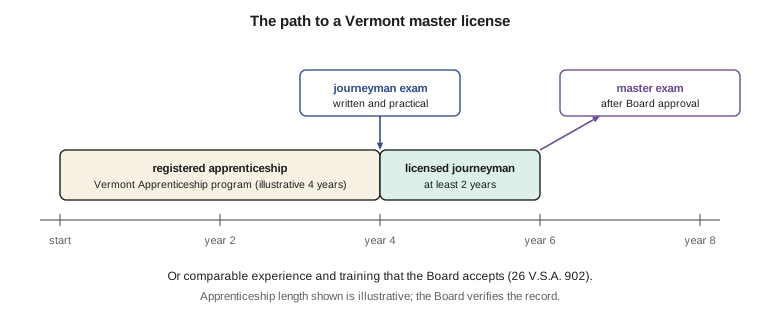
The usual path: apprenticeship, journeyman, then master
For most Vermont electricians the path starts with a registered apprenticeship. Section 903 requires a journeyman applicant to show completion of an electrical apprenticeship program verified by the Vermont apprenticeship program, or equivalent training and experience acceptable to the Board, and to pass the journeyman exam. Vermont's programs, including those run through the state's apprenticeship system, college workforce programs, contractor associations and union training centers, combine on-the-job hours with classroom instruction over several years. The statute's veteran route in section 906 mentions 8,000 hours and four years of field work for a journeyman, which gives a sense of the scale of a full apprenticeship, but the length of any particular program is set by that program and verified by the Board.
Once licensed, the journeyman's clock for the master license begins. Nadia's journeyman license was issued in March 2022, so by March 2024 she had two years as a licensed journeyman. Her time before the license, however skilled, counts toward the journeyman license, not toward the two-year master requirement, unless the Board accepts it as comparable experience under the alternative path.
The alternative: comparable experience and training
The second half of section 902 gives the Board discretion to accept comparable experience and training in place of two years as a licensed Vermont journeyman. This matters for three groups of candidates. The first is electricians licensed in another state, who may have years of journeyman experience that Vermont did not license. The second is electricians whose experience came in settings where Vermont licensing did not apply, such as work exempted under section 910 or work in industrial plants under an engineer's supervision. The third is military electricians, whose experience section 907 lets the Board credit.
Comparable experience is not automatic. The applicant must document it, and the Board decides whether it is comparable. A careful applicant describes the work by type and scale, names the supervising licensee or employer, states the dates and approximate hours, and attaches letters from employers or supervisors. A license from another state, with its issue date and status, is the strongest evidence of journeyman-level work elsewhere. Vague descriptions such as general electrical work invite questions and delay.
| Applicant | Likely route | Key evidence |
|---|---|---|
| Vermont journeyman licensed for two years or more | Section 902 main route | Vermont journeyman license number and issue date |
| Journeyman licensed in another state | Comparable experience, or reciprocity or endorsement under 906 | Out-of-state license history and employer letters |
| Military electrician | Comparable experience; sections 906 and 907 | Service records showing electrical duties and hours |
| Industrial plant electrician under an engineer | Comparable experience | Employer letters describing the work and supervision |
Records to gather before applying
Hal's advice to Nadia was to build the file before filling out the form. Her file had six pieces. First, a copy of her Vermont journeyman license card, showing the license number and the dates. Second, her apprenticeship completion record, which the Board already had from her journeyman application but which is useful to keep. Third, a one-page work history covering the years since her journeyman license, listing employers, dates and the main kinds of work. Fourth, two reference letters, one from Hal as her current master and one from a previous employer. Fifth, her continuing education certificates, which show she has kept up with the current code. Sixth, a certificate for the Vermont Energy Goals module, which section 905 requires of license applicants and renewing licensees.
The work history is worth extra care. The master exam covers design, services and feeders, motors and transformers, fire alarm and lightning protection, and the type S specialty fields, and the Board may look at whether the applicant's experience reached those areas. Nadia's history listed the service upgrade on the twelve-unit apartment building, the fire alarm system in a school addition, two ski-lodge kitchen projects with commercial cooking equipment, a series of heat pump installations and several farm jobs with three-phase motors. That breadth made her experience easy to approve.
Worked problem
Is Nadia eligible?
Nadia's Vermont journeyman license was issued in March 2022. It is November 2026. Has she met the experience requirement in section 902?
Show solution
- Section 902 requires two years licensed as a journeyman, or comparable experience the Board accepts.
- From March 2022 to November 2026 is four years and eight months.
- Four years and eight months is more than two years.
Answer: Yes. She meets the main route and still needs Board approval of the application and a passing exam.
Worked problem
An out-of-state journeyman
Marcus held a New York City journeyman-level card for six years and moved to Burlington last spring. He has no Vermont license. How might he qualify for the master exam?
Show solution
- He has not held a Vermont journeyman license for two years, so the main route does not apply.
- Section 902 lets the Board accept comparable experience and training inside or outside Vermont.
- He should document his out-of-state license and experience; the Board decides whether it is comparable. He may also ask whether a reciprocity or endorsement route applies.
Answer: He applies under the comparable experience route with full documentation, and the Board decides.
The exam is part of eligibility
Passing the exam is the second requirement in section 902, and the 2025 rules make the exam process part of the license path. The master exam has a written or computer-based part and a practical skills part, and it covers theory, practice, laws and rules, and the type S specialty fields. An approval to sit the exam is valid for three years. A candidate who fails may retake it twice more, with fees, and after a third failure must file a new application and obtain Board approval again. Before retaking, the rules require at least eight hours of education on the National Electrical Code, the NFPA fire alarm code or an exam preparation course. Lessons 3 and 4 cover these steps in detail, but a candidate deciding when to apply should know that the clock and the retake limits exist.
Grounds that can block a license
Section 909 lets the Board refuse to renew, suspend or revoke a license for obtaining it wrongfully or by fraud, for violating the chapter or the rules, or for being unfit or incompetent, and section 3.6 of the 2025 rules lists the same grounds and adds a license issued in error. An applicant who misstates experience, signs for hours not worked or submits another person's records risks both denial and later revocation. The honest file is the fast file.
Unlicensed work in the applicant's past is also a risk. Section 911 makes unlicensed electrical work an offense, and the Board may consider such conduct when it decides whether an applicant is fit. Nadia had nothing of that kind to report, but Hal had seen applicants delayed because they had done side jobs in complex structures under no one's license.
What does not count
Some experience that feels relevant does not count toward the two years. Time as an apprentice before the journeyman license counts toward the journeyman license, not the master. Time as a type S journeyman counts toward that specialty, not toward the master's two years as a journeyman electrician, unless the Board treats it as comparable. Teaching an electrical course, selling electrical supplies or working as an inspector may be valuable, but the Board decides whether it is comparable to journeyman work, and the applicant should not assume so.
The calculation below shows how Nadia checked her dates. It counts whole months between two dates and compares the result with the twenty-four months the main route requires.
# Months licensed as a journeyman (illustrative dates)
from datetime import date
licensed = date(2022, 3, 15)
today = date(2026, 11, 10)
months = (today.year - licensed.year) * 12 + (today.month - licensed.month)
if today.day < licensed.day:
    months -= 1
print("Months as a licensed journeyman:", months)
print("Meets the 24-month main route:", months >= 24)Months as a licensed journeyman: 55 Meets the 24-month main route: True
A note on type S experience and specialty work
Nadia's crew includes Priya Danforth, who holds a type S journeyman license in refrigeration and air conditioning and has asked whether her years of specialty work could count toward a master license. The honest answer is that section 902 speaks of two years as a licensed journeyman electrician, and a type S license is a specialty license under section 904. Priya's path to a master license most likely runs through the full journeyman license first, which requires a completed electrical apprenticeship or equivalent training the Board accepts under section 903, and then two years as a journeyman. She could ask the Board whether her specialty experience, combined with other electrical work, is comparable experience under section 902, but she should expect the Board to look for journeyman-level work across the full range of electrical installations, not only refrigeration circuits.
The same reasoning applies to other specialists. A well pump installer, a sign electrician or an elevator technician may be highly skilled, but the master license covers design and installation of every kind of electrical installation, and the exam reflects that. Specialists who want the master license should plan for the broader experience it assumes, and should talk to the licensing office early about which route fits their history.
Common mistakes
MistakeCounting apprenticeship years toward the two-year master requirement.
InsteadThe two years run from the journeyman license, unless the Board accepts other experience as comparable.
MistakeAssuming out-of-state experience is automatically accepted.
InsteadThe Board decides whether it is comparable; document it fully.
MistakeBelieving Vermont requires a separate business and law exam for the master license.
InsteadSection 902 requires one examination; the rules have it cover theory, practice and laws and rules.
MistakeForgetting the Vermont Energy Goals module.
InsteadSection 905 requires it for applicants and renewing licensees.
MistakeThinking an exam approval lasts indefinitely.
InsteadUnder rule 3.4 an exam approval is valid for three years.
Summary and key terms
- Section 902 requires two years as a licensed journeyman, or comparable experience the Board accepts, and a passing exam.
- The journeyman license itself rests on a registered apprenticeship or equivalent under section 903.
- Comparable experience covers out-of-state, military and exempt-setting work, but the Board decides.
- Gather license records, a work history, references, continuing education and the energy module certificate before applying.
- Exam approval lasts three years, with limits on retakes and required education before a retake.
- Comparable experience
- Experience and training, inside or outside Vermont, that the Board accepts in place of two years as a licensed journeyman.
- Registered apprenticeship
- An electrical apprenticeship registered with the state's apprenticeship program, the usual route to the journeyman license.
- Vermont Energy Goals module
- A short required module of no more than two hours on the state's energy goals.
- Wallet card
- The license card a master must carry while working and show on request.
- Exam approval
- The Board's approval to sit the exam, valid for three years.
Practice problems
Work each problem on paper first, then reveal the answer to check.
A journeyman licensed in June 2025 asks whether she can apply under the main route in November 2026. Can she?
Show answer
Not yet; she has about seventeen months, not twenty-four.
What two things does section 902 require?
Show answer
Two years as a licensed journeyman or comparable experience the Board accepts, and passing the exam.
Who decides whether out-of-state experience is comparable?
Show answer
The Electricians' Licensing Board.
What must a master carry while working?
Show answer
The wallet-size license card, shown on request.
How long is an exam approval valid?
Show answer
Three years under rule 3.4.
Lesson quiz · 5 questions
Score 60% or more to complete this lesson.
Create a free account to save your progress, take quizzes and earn a certificate.