
MELU-320 · Lesson 5 of 12 · 21 min
The NEC as adopted in Vermont and state amendments
▶ Video coming soon A video version of this lesson is on the way.
A week after the Board approved her experience, Nadia started a Rutland apartment-building job where the inspector asked, on the first walk-through, whether she had read the Vermont amendments to the ground-fault and arc-fault sections. She had, but not recently. That night she sat down with the 2025 Vermont Electrical Safety Rules and her 2023 NEC side by side and worked out exactly which documents make up the electrical code in Vermont, how they were adopted, and what the state changed. This lesson follows that evening. It names the amended sections by number and describes what they deal with in general terms, without reproducing any code text, so that you can find them in the rule and in your own book.
How Vermont adopts an electrical code
Vermont adopts its electrical code at the state level, through the Board's rules, rather than city by city. Section 891 of Title 26 lets the Electricians' Licensing Board adopt rules for electrical installations and, where practicable, adopt a national electrical code. The Board does that through Vermont's ordinary rulemaking process: a proposed rule, a public comment period and hearing, review by the legislative committee on administrative rules, and final adoption with an effective date. The 2025 rules went through that process in 2025, with a hearing in July and a comment period that closed in August, and the Division lists them as effective November 5, 2025.
Two consequences follow. First, the same electrical code applies across the state to the installations the rules cover; a town cannot pick its own NEC edition for those installations. Second, the adopted code changes only when the Board adopts new rules, so there is always a lag between a new NEC edition and its use in Vermont. Section 892 of the statute adds a transition rule: the rules do not apply to work begun within thirty days after their adoption or to installations in structures already standing or under construction when the rules were adopted.
The documents in the 2025 rules
Section 5 of the 2025 rules lists the adopted codes. The main one is NFPA 70, the National Electrical Code, 2023 edition, with the Vermont amendments that section 5 sets out. The second is NFPA 73, the code for electrical inspections of existing dwellings, 2021 edition, as modified for Vermont. The third is NFPA 780, the standard for lightning protection systems, 2023 edition, which matters because section 902 puts lightning rods within the master's scope. Section 6 then lists reference documents adopted through the Vermont Fire and Building Safety Code, such as the fire alarm, life safety and emergency power standards, and refers to the Vermont utilities' service requirements manual. When section 5 and section 6 conflict, section 5 controls.
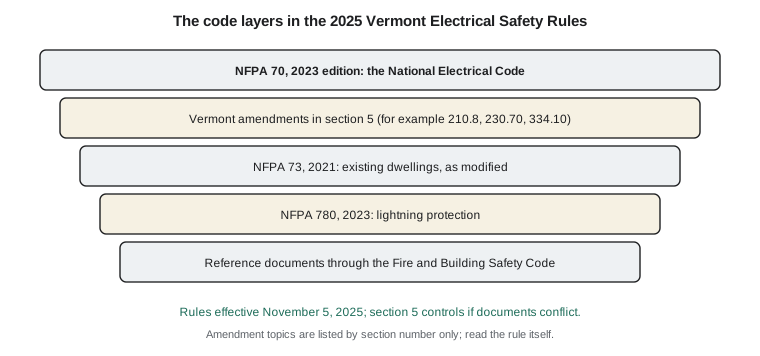
| Document | Edition | Role in Vermont |
|---|---|---|
| NFPA 70, National Electrical Code | 2023 | The installation code, with Vermont amendments in rule section 5 |
| NFPA 73 | 2021 | Existing dwellings, as modified for Vermont |
| NFPA 780 | 2023 | Lightning protection systems |
| Fire and Building Safety Code reference documents | As adopted there | Fire alarm, life safety and related standards |
| Vermont utilities' service requirements manual | Current | Utility service and metering requirements |
The Vermont amendments
The 2025 rules amend a short list of NEC sections. The list below gives each by number and describes the subject in general terms. It does not state the wording of either the NEC or the amendment; read both.
- 210.8(A)(11): a ground-fault circuit-interrupter location for dwelling units. Vermont amends this item in the dwelling GFCI list.
- 210.8(F), Exception No. 3: the GFCI requirement for certain outdoor outlets at dwellings. Vermont adds an exception.
- A general note on listing: the rules add a note about listing by a nationally recognized testing laboratory for AFCI and GFCI devices.
- 210.12(D)(2), Exception: arc-fault circuit-interrupter protection when branch circuits in dwellings are modified, replaced or extended. Vermont adds an exception; the 2020 rules had a similar exception aimed at hardwiring smoke and carbon monoxide alarms in existing dwellings.
- 230.70(A)(1): the location of the service disconnecting means. Vermont amends where the disconnect may be located.
- 334.10(3), Exception: where nonmetallic-sheathed cable is permitted in buildings of certain construction types. Vermont adds an exception related to fire-rated finishes.
- 334.12(A)(2): one of the uses where nonmetallic-sheathed cable is not permitted. Vermont deletes this item.
- 518.6: a requirement in the assembly occupancies article. Vermont amends parts A and B.
- NFPA 73, section 5.1, Exceptions No. 1 and No. 2: requirements for existing dwellings. Vermont modifies them.
Two features of this list are worth noticing. The amendments are few, so a candidate can learn all of them. And they cluster around dwellings, ground-fault and arc-fault protection, the service disconnect and nonmetallic-sheathed cable, the places where installation practice in an older housing stock meets the newest code requirements. Nadia made a one-page list of the section numbers and a sentence on each subject, and she reviewed it once a week.
Reading an amendment in practice
An amendment is applied by reading the NEC section first and then reading the amendment in the rule, which either adds to the section, replaces part of it, adds an exception or deletes an item. The amended section is the code for Vermont installations. On a Vermont job the inspector enforces the amended rule. On the exam, the bulletin decides whether a question is asking about the published NEC or Vermont's rule, and a well-written question will say which.
On the apartment job, the inspector's question was about a branch circuit extension in an existing unit. Nadia found 210.12(D) in her book, read the published requirement, then turned to section 5 of the rules and read Vermont's exception. The two together told her what protection the extension needed. That is the routine: NEC first, amendment second, then apply both.
Worked problem
Which edition governs this job?
Clarendon Ridge is wiring a new office building. The work notice was validated in March 2026. Which NEC edition applies?
Show solution
- The 2025 rules took effect November 5, 2025, and adopt the 2023 NEC.
- Section 892 exempts only work begun within thirty days of adoption or structures already under construction when the rules were adopted.
- A project begun in March 2026 began well after the rules took effect.
Answer: The 2023 NEC with Vermont amendments, as adopted in the 2025 rules.
Worked problem
A job that straddles the change
A school addition was under construction in October 2025, before the 2025 rules took effect, and the crew is still working in December 2025. Which rules apply?
Show solution
- Section 892 says new rules do not apply to installations in structures under construction when the rules were adopted.
- The addition was under construction before the new rules took effect.
- The prior rules, which adopted the 2020 NEC, apply to that structure unless the Division says otherwise.
Answer: Most likely the prior rules; confirm with the inspector on the project, because the facts of adoption dates matter.
Existing dwellings and NFPA 73
NFPA 73 is a code for evaluating electrical systems in existing dwellings, and Vermont's adoption of it, as modified, gives inspectors and licensees a reference for older homes. It is relevant to a Vermont master because so much of the state's housing is old and so much of the work in rentals, which can be complex structures, involves existing wiring. The modified section 5.1 deals with protective devices, and Vermont's exceptions adjust how it applies. A master who evaluates an older rental before a sale or after a fire should know that NFPA 73 exists and that Vermont has modified it.
Lightning protection and fire alarm
Section 902 places lightning rods, fire alarms and fire detection systems within the master's work. NFPA 780 is the adopted lightning protection standard, and the fire alarm standard comes in through the Fire and Building Safety Code's reference documents. The rules also require a separate type S license to install lightning rods or fire alarm systems for others if the person is not a master, which is a reminder that the master license is the broad one. On a school or apartment job, the fire alarm work is often the most closely inspected part of the electrical work, because the fire marshal's office cares about it as much as the electrical inspector does.
Keeping up with the next edition
The NFPA publishes a new NEC every three years. Vermont adopts a new edition only through new rules, and the Board's practice has been to adopt each edition some time after publication; the 2020 rules were followed by the 2025 rules adopting the 2023 code. A master should watch the Division's rules page and the Secretary of State's rules notices for proposed rules, read the summary of changes, and comment if a change affects the work. Continuing education, covered in Lesson 11, is the other way the trade keeps up: the 15 hours required each cycle are on the National Electrical Code, and courses on the newest edition often discuss the proposed Vermont amendments.
Why Vermont amends the code
The amendments in section 5 are not random. Each one reflects a judgment by the Board, after public comment, that a national requirement should be adjusted for Vermont's buildings, climate or practices. The dwelling ground-fault and arc-fault amendments, for example, address how protection requirements apply in an older housing stock where a small repair can trigger a large upgrade. The nonmetallic-sheathed cable amendments address how the cable may be used in buildings of certain construction types that are common in Vermont. The service disconnect amendment addresses where the disconnect may sit on buildings where the meter and service entrance are often on an exterior wall far from the panel, in a climate where snow and ice affect access.
Understanding the reason behind an amendment makes it easier to remember and to apply. When Nadia studied each amendment, she wrote one sentence on what it changes and one on why the Board might have made the change, and she checked her reasoning against the economic impact statement and the summary the Board published with the proposed rules. That second sentence was her own interpretation, not the rule, and she labeled it that way in her notes.
Other codes that touch electrical work
Electrical work in Vermont also meets codes outside the electrical rules. The Vermont Fire and Building Safety Code, administered by the Division of Fire Safety, governs fire protection, means of egress, fire alarm requirements by occupancy and many building features of public buildings. Vermont's residential and commercial building energy standards affect lighting power, controls and some equipment choices. Utilities' service requirements govern metering and service connections. A master who designs or installs in a complex structure should know which of these apply and should coordinate with the designer, the general contractor and the fire marshal's office where the codes overlap.
The exam version of this lesson is short. Know that the Board adopts the code statewide, know the editions in section 5, know the transition rule in section 892, and know the amended section numbers and what each one deals with. Questions that ask what a section says should be answered from the book the bulletin allows; questions that ask how Vermont treats a section should be answered from the amendment.
Common mistakes
MistakeThinking each town adopts its own electrical code edition.
InsteadThe Board adopts the electrical code statewide through its rules.
MistakeApplying the published NEC without the Vermont amendments on a job.
InsteadRead the NEC section, then the amendment in rule section 5, and apply both.
MistakeAssuming new rules apply to every job the day they take effect.
InsteadSection 892 exempts work begun within thirty days and structures already under construction.
MistakeForgetting NFPA 73 and NFPA 780.
InsteadBoth are adopted in section 5, for existing dwellings and lightning protection.
MistakeTreating the reference documents as overriding section 5.
InsteadIf section 5 and section 6 conflict, section 5 controls.
Summary and key terms
- The Board adopts the electrical code statewide under 26 V.S.A. 891.
- The 2025 rules, effective November 5, 2025, adopt the 2023 NEC, NFPA 73 (2021) and NFPA 780 (2023).
- Vermont amends a short list of sections, mostly on dwelling GFCI and AFCI rules, the service disconnect and NM cable.
- Section 892 keeps new rules off work begun within thirty days and structures already under construction.
- Read the NEC section, then the amendment, and apply both.
- Vermont amendment
- A change to an NEC section made in section 5 of the Vermont rules.
- NFPA 73
- The code for electrical inspection of existing dwellings, adopted as modified.
- NFPA 780
- The lightning protection standard adopted in section 5.
- Reference documents
- Standards adopted through the Fire and Building Safety Code and listed in section 6.
- Transition rule
- Section 892's rule that new rules do not reach work begun within thirty days or structures already under construction.
Practice problems
Work each problem on paper first, then reveal the answer to check.
Which body adopts Vermont's electrical code?
Show answer
The Electricians' Licensing Board, through rules under section 891.
Which NEC edition is in the 2025 rules?
Show answer
The 2023 edition.
Name two NEC sections Vermont amends.
Show answer
Any two of 210.8(A)(11), 210.8(F), 210.12(D)(2), 230.70(A)(1), 334.10(3), 334.12(A)(2) and 518.6.
If section 5 and a reference document conflict, which controls?
Show answer
Section 5.
What does NFPA 780 cover?
Show answer
Lightning protection systems.
Lesson quiz · 5 questions
Score 60% or more to complete this lesson.
Create a free account to save your progress, take quizzes and earn a certificate.