
MELU-320 · Lesson 10 of 12 · 20 min
Workplace safety law and OSHA for electrical contractors
▶ Video coming soon A video version of this lesson is on the way.
In February a Clarendon Ridge apprentice slipped on an icy ramp at a ski-area maintenance building, fell against a ladder and broke his wrist. Nobody was careless in an obvious way, but the injury started three clocks at once: a report to the workers compensation insurer, a decision about whether the injury had to be reported to the state's occupational safety program, and the company's own review of what to change. This lesson covers the safety law a Vermont electrical contractor works under: Vermont's VOSHA state plan, the federal OSHA standards it builds on, the reporting clocks after a serious injury, and the workers compensation system in 21 V.S.A. chapter 9.
VOSHA: Vermont's state plan
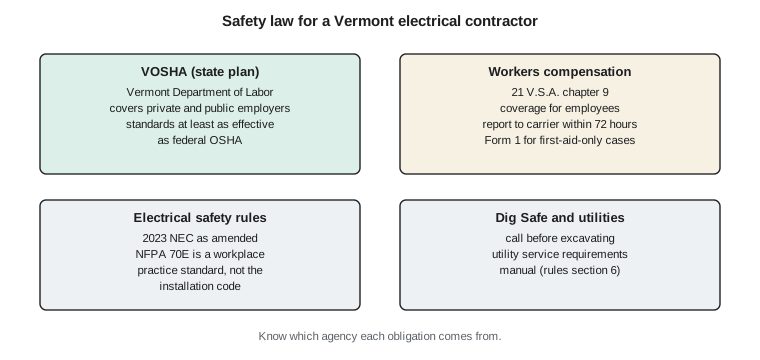
Federal law lets a state run its own occupational safety and health program, called a state plan, if the program is at least as effective as federal OSHA. Vermont does. The Vermont Occupational Safety and Health Administration, VOSHA, is part of the Vermont Department of Labor, and it covers private employers and state and local government employers in Vermont, with some exceptions for federal workplaces and certain other areas that remain under federal OSHA. For a private electrical contractor, VOSHA is the agency that inspects job sites, investigates complaints and accidents, and issues citations.
VOSHA's standards are at least as effective as the federal standards, and for construction they generally track the federal rules in 29 CFR Part 1926, including Subpart K on electrical safety, Subpart M on fall protection, Subpart X on ladders, Subpart L on scaffolds, Subpart P on excavations, the lockout and control of hazardous energy principles, and the hazard communication standard. On general industry sites, such as a factory where the crew does maintenance, the general industry electrical rules in 29 CFR 1910 Subpart S apply as well. A master who knows the federal standards knows most of what VOSHA enforces, but should check VOSHA's pages for any Vermont-specific rule or procedure.
Electrical safety on the job
Most electrical injuries happen during work on or near energized equipment, during troubleshooting and during work near overhead lines. Subpart K of the construction standards requires, among other things, that employees not work near energized parts unless protected, that circuits be deenergized and locked or tagged out before work where that is required, that ground-fault protection or an assured equipment grounding program protect temporary power on construction sites, and that equipment be used according to its listing. NFPA 70E, the standard for electrical safety in the workplace, is not an installation code and is not adopted in the Vermont electrical rules, but VOSHA and federal OSHA treat it as evidence of recognized safe practice for energized work, arc flash risk assessment and personal protective equipment.
The NEC and the workplace standards meet in a few places that matter to a master. Equipment labeling for arc flash, the working space rules in NEC 110.26, the requirement in some occupancies for available fault current markings, and the ground-fault protection of temporary wiring in NEC Article 590 all serve worker safety as well as the building's safety. A master who designs a service should think about the electrician who will maintain it.
Falls, ladders and cold weather
In Vermont the most common serious injuries in the electrical trade are not shocks but falls, struck-by injuries and strains, and winter makes them worse. Ladders on frozen ground, scaffolds with snow on the planks, icy ramps and short daylight all add risk. Fall protection rules require protection at heights set by the standard for the type of work, ladders must be used and secured as the standard requires, and walking surfaces must be kept clear. Clarendon Ridge's winter rule is that the first person on site in the morning salts the access path before anyone carries material in, a rule written after the apprentice's fall.
Excavation and Dig Safe
Electrical contractors dig trenches for underground feeders, site lighting and generator connections. Excavation standards require protective systems for trenches at the depths the standard sets, a competent person to inspect, and safe access. Before any digging, Vermont, like other New England states, uses the Dig Safe system for underground utility locates, and the state's underground facility damage prevention law requires excavators to notify it in advance. Calling for locates protects workers as well as the utilities' lines.
Reporting clocks after a serious injury
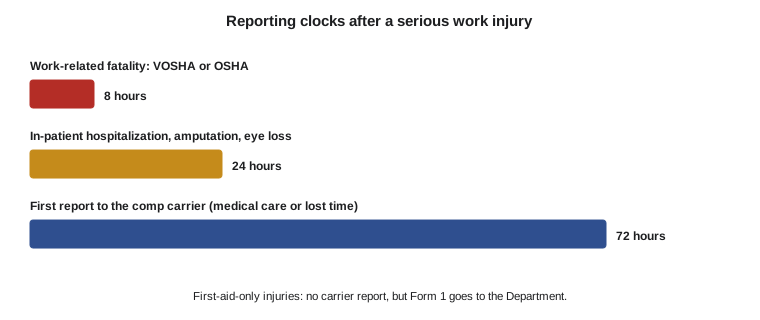
Three reporting rules matter after a serious work injury. First, under the federal recordkeeping rule in 29 CFR 1904.39, which VOSHA's reporting page applies, an employer must report a work-related fatality within eight hours of learning of it, and an in-patient hospitalization, an amputation or the loss of an eye within twenty-four hours. Reports can go to VOSHA through its online form or by phone, or to federal OSHA. Second, under Vermont's workers compensation rules, an employer must report an injury that requires medical care or causes lost work time to its workers compensation insurer within seventy-two hours of notice of the injury. Third, injuries that require only first aid are not reported to the insurer, but the Department of Labor's guidance says they are still reported to the Department on Form 1.
Worked problem
The apprentice's broken wrist
The apprentice was taken to the emergency room, treated with a cast and sent home the same day. He missed four days of work. Which reports are required?
Show solution
- He was treated and released, not admitted, so this is not an in-patient hospitalization.
- A fracture is not an amputation or loss of an eye.
- So no eight-hour or twenty-four-hour report to VOSHA is required.
- The injury required medical care and caused lost time, so the employer reports it to the workers compensation insurer within seventy-two hours.
- The injury is also recorded on the employer's injury and illness log if the employer is required to keep one.
Answer: A report to the insurer within seventy-two hours and the injury log; no VOSHA report unless he is admitted.
Workers compensation in Vermont
Vermont's workers compensation law requires employers to secure compensation for employees through insurance or approved self-insurance, and coverage must be full and primary. The system pays medical benefits and wage replacement for work-related injuries and diseases regardless of fault, and in exchange the employer is generally protected from negligence suits by its employees. Wage benefits begin after a waiting period: the first three days of disability are not paid unless the disability lasts ten consecutive days or more, under 21 V.S.A. section 642. Claims have limitation periods in the statute, generally measured in years from the injury, and an insurer that denies a claim must do so in writing within the period the statute sets.
Vermont's law also includes a statutory employer rule in 21 V.S.A. section 601. An owner or contractor can be treated as the employer of a worker it does not directly employ, such as an uninsured subcontractor's employee, when the work is part of the owner's or contractor's regular business. For a general contractor that hires Clarendon Ridge, that rule is a reason to ask for Clarendon Ridge's certificate of insurance. For Clarendon Ridge, it is a reason to ask the same of any subcontractor it hires, such as a trenching company.
| Question | Vermont rule | Source |
|---|---|---|
| Who must be covered? | Employees, with exclusions such as sole proprietors and some owners unless they elect coverage | 21 V.S.A. chapter 9 |
| Report to insurer? | Within 72 hours of notice, if medical care or lost time | Department of Labor guidance |
| First-aid-only injury? | No insurer report; Form 1 to the Department | Department of Labor guidance |
| Waiting period? | Three days, paid if disability lasts ten consecutive days | 21 V.S.A. 642 |
| Uninsured subcontractor's worker? | The hiring contractor may be the statutory employer | 21 V.S.A. 601 |
Building a safety program
A small contractor does not need a thick manual, but it needs a working program: a written lockout procedure, a ladder and fall protection rule, a plan for temporary power with ground-fault protection, a heat and cold plan, a vehicle policy, training records for each employee, and a habit of reviewing every injury and near miss. VOSHA offers consultation services to small employers that are separate from enforcement, and the workers compensation insurer usually offers loss control help as well. Hal uses both, and the company's insurance premium has reflected it.
# Which clock applies? (illustrative helper)
def reports(fatal=False, admitted=False, amputation=False, eye_loss=False, medical=False, lost_time=False):
    out = []
    if fatal:
        out.append("VOSHA or OSHA within 8 hours")
    elif admitted or amputation or eye_loss:
        out.append("VOSHA or OSHA within 24 hours")
    if fatal or admitted or amputation or eye_loss or medical or lost_time:
        out.append("workers comp insurer within 72 hours")
    else:
        out.append("first aid only: Form 1 to the Department")
    return out

print(reports(medical=True, lost_time=True))
print(reports(admitted=True, medical=True))
print(reports())['workers comp insurer within 72 hours'] ['VOSHA or OSHA within 24 hours', 'workers comp insurer within 72 hours'] ['first aid only: Form 1 to the Department']
Lockout in practice
Most electrical work should be done deenergized, and the decision to work on energized equipment should be deliberate, justified and documented. Clarendon Ridge's written lockout procedure follows the familiar steps: notify affected people, identify every energy source, shut down the equipment, isolate it at the disconnecting means, apply a personal lock and tag for each worker, release or block stored energy, verify the absence of voltage with a tested meter, and only then begin work. When the work is done, the steps reverse, with each worker removing only his or her own lock. The procedure also covers group lockout on larger jobs and what to do when a worker leaves the site with a lock still applied.
The verification step is where injuries happen when it is skipped. A meter must be tested on a known live source before and after testing the circuit, and the person testing must wear the protective equipment that the risk assessment calls for, because the equipment is assumed to be energized until proven otherwise. Nadia trains every new apprentice on this sequence in the first week and checks that it is followed on every job she runs.
Return to work and claims
After an injury, a good employer stays in touch with the injured worker, helps with the claim paperwork, and offers modified duty when the doctor allows it. Vermont's workers compensation system includes rules on medical care, on changing doctors after the first visit, and on the forms that employers and workers file with the Department of Labor, and the Department's website explains each step. For a small company, the insurer's claims adjuster is the main contact, and the employer's job is to report promptly, provide accurate wage and job information, and keep the worker informed. Clarendon Ridge's apprentice was back on light duty, handling material and helping with layout, two weeks after his fall, and back at full duty after six weeks.
The exam is likely to test this lesson through scenarios: an injury and a question about which report is due when, a trench and a question about the protective system, or an energized panel and a question about what must happen before work begins. Read the facts carefully, decide which body of law applies, and then apply its rule.
Common mistakes
MistakeAssuming federal OSHA inspects private Vermont job sites.
InsteadVOSHA, Vermont's state plan, covers most private employers.
MistakeReporting every emergency room visit to VOSHA.
InsteadOnly fatalities and in-patient hospitalizations, amputations and eye losses have the eight- and twenty-four-hour reports.
MistakeWaiting a week to tell the insurer.
InsteadReport injuries with medical care or lost time within seventy-two hours.
MistakeTreating NFPA 70E as the installation code.
InsteadIt is a workplace practice standard; the NEC is the installation code.
MistakeHiring an uninsured subcontractor.
InsteadThe hiring contractor may become the statutory employer of its workers.
Summary and key terms
- VOSHA, in the Vermont Department of Labor, is the state plan covering most private and public employers.
- Its construction standards track the federal 29 CFR 1926 rules, including electrical, fall and excavation safety.
- Report a fatality within eight hours and an in-patient hospitalization, amputation or eye loss within twenty-four hours.
- Report injuries with medical care or lost time to the comp insurer within seventy-two hours; first aid goes on Form 1.
- Employers must secure workers compensation; a hiring contractor can be a statutory employer.
- VOSHA
- Vermont Occupational Safety and Health Administration, the state plan in the Department of Labor.
- State plan
- A state-run occupational safety program at least as effective as federal OSHA.
- Statutory employer
- An owner or contractor treated as the employer of a worker it does not directly employ.
- Form 1
- The Department of Labor form used for first-aid-only injuries and claims.
- NFPA 70E
- The standard for electrical safety in the workplace, used as evidence of safe practice.
Practice problems
Work each problem on paper first, then reveal the answer to check.
Which agency inspects a private construction site in Rutland for safety?
Show answer
VOSHA.
An electrician is admitted to the hospital after an arc flash. How soon must the employer report to VOSHA?
Show answer
Within twenty-four hours.
A helper needs stitches and misses no work. Must the insurer be told?
Show answer
Yes, within seventy-two hours, because the injury required medical care.
When are the first three days of disability paid?
Show answer
When the disability lasts ten consecutive days or more.
What system do Vermont excavators notify before digging?
Show answer
Dig Safe.
Lesson quiz · 5 questions
Score 60% or more to complete this lesson.
Create a free account to save your progress, take quizzes and earn a certificate.