
MELU-320 · Lesson 3 of 12 · 20 min
Applying, approval and booking the exam
▶ Video coming soon A video version of this lesson is on the way.
In September 2026 Nadia sat down at Corinne's desk with the Division of Fire Safety's electrical application and instructions. The form covers all license classifications, so the first task was to mark the master box and read the instructions for that class. The second task was to work out the calendar. In Vermont the Board approves a candidate's experience before the candidate registers for the exam, and the Board acts at its meetings, so the date an application reaches the licensing office decides which meeting will review it. This lesson walks through the order of steps, the Board's review, booking with the testing company and the rules that apply if the first attempt does not go well.
The Vermont order of steps
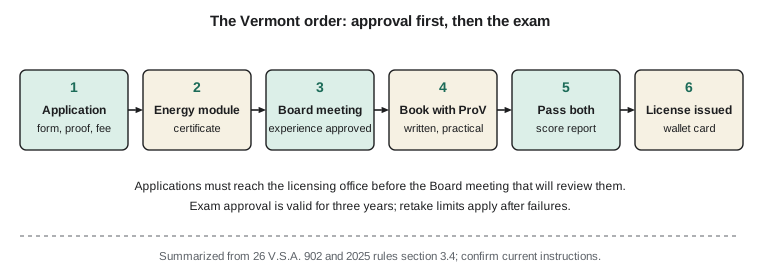
Many states let a candidate book a national exam, pass it and then apply with the score. Vermont reverses the order. The candidate applies first, the Board reviews and approves the experience, and only then does the candidate register with the testing company and sit the exam. Secondary sources that summarize Vermont licensing report that applications must reach the licensing office about two weeks before the Board meeting that will consider them, and that experience must be approved before exam registration. The instructions that come with the current application state the deadline the Board is using, and a candidate should follow those instructions rather than any general rule of thumb.
The application package
Nadia's package had five parts. The completed application form, signed, with the master classification marked. The application fee, paid as the instructions direct. Proof of experience: her journeyman license number and dates, a work history and the reference letters Lesson 2 described. A certificate showing she had completed the Vermont Energy Goals module, which the Division's licensing page says must accompany new license and renewal applications. And any other document the current instructions list, such as identification or a statement about prior discipline. Corinne made a copy of everything before it went out and sent it by a method that showed when it arrived.
Fees deserve a word of care. Section 905 sets the three-year license fee for a master at 150 dollars, a framing certificate at 10 dollars and a replacement license at 20 dollars. The application and exam fees are set by the Board and the testing company and are listed in the current instructions; the 2025 rules mention an exam fee of 80 dollars paid to the testing agency. Fees change, so the course does not treat any of these amounts as permanent. Read the current fee schedule before paying.
| Item | Where the amount comes from | Example in the sources |
|---|---|---|
| Master license, three years | 26 V.S.A. 905 | 150 dollars |
| Framing certificate | 26 V.S.A. 905 | 10 dollars |
| Replacement license | 26 V.S.A. 905 | 20 dollars |
| Exam fee to the testing agency | Board and testing company | 80 dollars per the 2025 rules; confirm |
| Application fee | Current application instructions | Check the form |
The Board's review
At the meeting, the Board reviews applications for experience and completeness. For a candidate on the main route, the review is usually straightforward: the Division's records show the journeyman license and its date, and the work history shows journeyman-level work. For a comparable experience candidate, the Board looks harder at the evidence and may ask for more. If the application is incomplete, the usual result is a letter asking for the missing piece, and the application moves to a later meeting. That delay is the most common avoidable cost in the process, and it is why Corinne checked Nadia's package against the instruction sheet line by line.
Nadia's application reached Waterbury in time for the Board's October 2026 meeting, and the Board approved her experience at that meeting. The approval letter told her she was eligible to register for the master examination, that the approval was valid for three years, and how to contact the testing company. In this course, her exam is booked for January 2027, so everything about the exam day is described as still to come.
Booking with the testing company
The Division's materials identify ProV as the testing company for Vermont's electrician exams. After approval, the candidate registers with the testing company by the method it provides, pays the exam fee, and chooses a date and site. The exam has a written or computer-based part and a practical skills part, as section 3.4 of the rules requires, and the testing company's candidate information explains how the two parts are scheduled, what references are allowed, what identification to bring and how scores are reported. Lesson 4 covers the format.
Hal gave Nadia two booking tips from his own experience and from apprentices he had trained. Book early enough to secure a date that leaves room for a retake before any deadline that matters, such as his planned step back. And book a date after which work is light, because the week before an exam is not the week to run a school shutdown job. Nadia picked a January date because the ski-area work peaks in the fall and the school work peaks in the summer.
Worked problem
Choosing the Board meeting
Suppose the Board's next two meetings are on the second Tuesday of October and the second Tuesday of December, and the instructions say applications must arrive two weeks before a meeting. Nadia's package arrives on September 28 and the October meeting is October 13. Which meeting reviews it?
Show solution
- Two weeks before October 13 is September 29.
- The package arrived on September 28, one day before the cutoff.
- It is in time for the October meeting.
Answer: The October meeting, assuming the package is complete. The dates are illustrative; use the Board's published schedule.
If the first attempt fails
The 2025 rules set out what happens after a failed attempt. Under section 3.4 a candidate who fails may take the exam two more times, paying the fee each time. Before retaking, the candidate must complete at least eight hours of education on the National Electrical Code, the NFPA fire alarm code or an exam preparation course, and should keep the certificate. After a third failure, the candidate must start over with a new application, new fees and new Board approval. Because the approval itself lasts three years, a candidate who spaces attempts too far apart can also run out of approval time.
These rules shape a sensible plan. Study seriously for the first attempt, because each retake costs time and money. If a retake is needed, use the score report to decide what the eight hours of education should cover. Lesson 12 shows how to turn a score report into a study plan.
# Retake planner (illustrative)
attempts_allowed = 3          # first attempt plus two retakes
approval_years = 3
months_between_attempts = 3
education_hours_before_retake = 8
for n in range(1, attempts_allowed + 1):
    month = (n - 1) * months_between_attempts
    note = "first attempt" if n == 1 else f"retake after {education_hours_before_retake} hours of education"
    print(f"Attempt {n} at month {month}: {note}")
print("Last attempt month:", (attempts_allowed - 1) * months_between_attempts,
"of", approval_years * 12, "months of approval")Attempt 1 at month 0: first attempt Attempt 2 at month 3: retake after 8 hours of education Attempt 3 at month 6: retake after 8 hours of education Last attempt month: 6 of 36 months of approval
After passing
When the candidate passes both parts, the testing company reports the result and the licensing office issues the license after any remaining fee is paid. Section 913 has the Board's chair issue licenses, and section 902 describes the wallet card and the optional framing certificate. The license is valid for three years from issue, expiring on the last day of a month the Board sets, and the renewal rules in Lesson 11 apply from that point.
For Clarendon Ridge, the license is only half the job. Once Nadia is licensed, the company will start filing work notices in her name on some projects so that she builds a record as a master while Hal is still around to help. Lesson 7 covers what that responsibility means and Lesson 8 the business side.
Common problems and how to avoid them
The Division's licensing staff see the same problems over and over. Applications arrive unsigned. The wrong classification is checked. The energy module certificate is missing. Reference letters are not signed or do not describe the work. The fee is the wrong amount. A candidate who received approval two years ago and never booked discovers the approval is about to expire. Each of these costs at least one Board cycle. A checklist made from the current instructions and checked by a second person, as Corinne did for Nadia, catches most of them.
Another problem is timing a move. A journeyman who plans to move to Vermont and apply under the comparable experience route should apply only once the evidence is assembled, because a thin file will be held for more information. A Vermont journeyman who plans to work out of state should look at Lesson 11 before assuming the Vermont license will be recognized elsewhere.
A worked application checklist
Corinne's checklist for Nadia's package had twelve lines, each checked by her and then by Nadia. Current application form downloaded from the Division's page that month, not an old copy from the files. Master classification marked. Name exactly as it appears on her photo identification, because the testing company will match the two. Mailing address and email current. Journeyman license number and issue date entered. Work history attached, one page, dated and signed. Two reference letters on letterhead, signed and dated, each describing the work Nadia did and the writer's relationship to her. Energy Goals module certificate attached. Disclosure questions answered, including any prior discipline or criminal matters the form asks about. Fee in the amount and form the instructions state. Signature and date on the form. Copy of the whole package kept in the company's files.
The checklist sounds fussy, and it is. But every line on it represents an application Corinne or Hal has seen delayed. The name match, for example, matters at the testing center: a candidate whose registration says Nadia Fortin while her driver's license says Nadia L. Fortin-Gauthier may be asked to sort it out before being seated. A few minutes of attention at the application stage avoids that.
Communicating with the licensing office
The licensing office is small, and its staff handle every electrician, plumber and other trade license the Division issues. Calls and emails are answered, but a candidate who writes a clear, short message with the license number and the question gets a faster answer than one who calls without the details. Nadia kept a log of every contact: date, person, question and answer. When the October approval letter arrived, she added it to the log and to her file. If a question about her application ever came up, she would have the record.
One more practical point: the approval letter is worth reading closely. It states the classification approved, the date of approval and how to contact the testing company, and it may state conditions. Nadia scanned hers into the company files and set a reminder on the date three years later when the approval would expire, even though she expected to pass long before then.
Common mistakes
MistakeBooking the master exam before the Board approves the experience.
InsteadIn Vermont the Board approves experience first; then the candidate registers with the testing company.
MistakeSending the application the day before the Board meets.
InsteadApplications must reach the office by the deadline the instructions set before the meeting.
MistakeRetaking without the required education.
InsteadRule 3.4 requires at least eight hours of NEC, fire alarm code or exam prep education before a retake.
MistakeTreating fees as fixed numbers.
InsteadStatutory license fees and Board fees can change; check current documents.
MistakeLetting an exam approval run out.
InsteadApproval is valid for three years; plan attempts inside that window.
Summary and key terms
- Vermont puts the application and Board approval before the exam.
- The package includes the form, fee, proof of experience and the Energy Goals module certificate.
- The Board reviews applications at its meetings; an incomplete file moves to a later meeting.
- After approval, the candidate books written and practical exams with the testing company.
- A candidate may take the exam three times on one approval, with eight hours of education before each retake.
- Board approval
- The Board's decision that an applicant's experience qualifies to sit the exam.
- ProV
- The testing company identified in the Division's materials for Vermont electrician exams.
- Retake education
- At least eight hours of NEC, fire alarm code or exam preparation education required before retaking.
- Framing certificate
- An optional wall certificate issued for an additional fee.
- Application deadline
- The date before a Board meeting by which a complete application must arrive.
Practice problems
Work each problem on paper first, then reveal the answer to check.
Nadia's application is missing her energy module certificate. What happens?
Show answer
It is likely held as incomplete until the certificate arrives, moving it to a later meeting.
What must happen before Nadia can register with the testing company?
Show answer
The Board must approve her experience.
How many attempts does one approval allow?
Show answer
Three: the first attempt and two retakes.
What education is required before a retake?
Show answer
At least eight hours on the NEC, the NFPA fire alarm code or an exam prep course.
What is the three-year master license fee in section 905?
Show answer
150 dollars, subject to change.
Lesson quiz · 5 questions
Score 60% or more to complete this lesson.
Create a free account to save your progress, take quizzes and earn a certificate.