
MELU-320 · Lesson 8 of 12 · 20 min
Contractor licensing, insurance and bonding
▶ Video coming soon A video version of this lesson is on the way.
When Nadia asked Corinne which contractor license Clarendon Ridge holds, Corinne laughed and pulled out a folder with no license in it. Vermont does not issue a separate state electrical contractor license. The license that carries the company's electrical work is Hal's master license, and soon Nadia's. Around that license sit a business registration with the Secretary of State, insurance policies, workers compensation coverage, a decision about the state's residential contractor registry, and the occasional bond. This lesson sorts those pieces out and explains what each one is for.
No separate electrical contractor license
Many states license electrical contracting businesses separately from individual electricians and require the business to name a qualifying master. Vermont's chapter 15 works differently. It licenses individuals: masters, journeymen and type S journeymen. Section 902 lets a master carry on electrical work as a business, or as part of another business, and employ licensed electricians and helpers. The work notice for a complex structure is filed by a master, or by a type S journeyman for specialty work. So a Vermont electrical business needs a master in charge of its electrical work, but it does not need a separate contractor license from the Board.
That simplicity has a cost. Because the master's license carries the business, the business is exposed when the master leaves. If Hal retired with no other master on staff, Clarendon Ridge could not file new work notices for complex structures, and its commercial and multi-unit work would stop until it hired or became another master. That is the business reason behind this whole course.
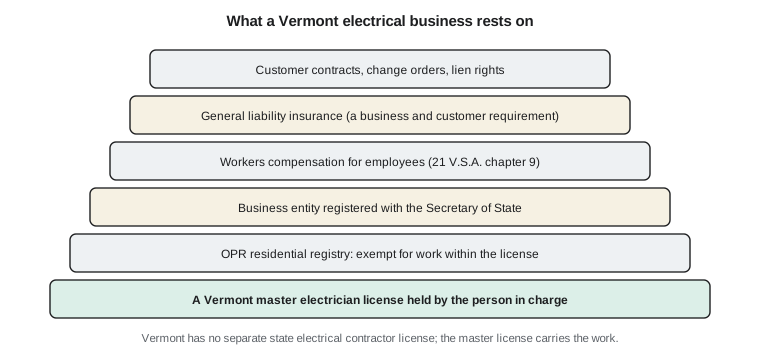
The business entity
Clarendon Ridge is a limited liability company registered with the Vermont Secretary of State. The entity separates the business's debts from the owners' personal assets in many situations, but it does not shield a licensee from the licensee's own professional duties: the master is still the person whose license is at risk if the work violates the rules. The Secretary of State registration, the annual report and any trade name registration are business law matters rather than electrical licensing matters, and the exam is more likely to ask whether an LLC can hold an electrical license than how to form one. The answer is that the license belongs to the individual master, not to the company.
The residential contractor registry
Since April 1, 2023, Vermont's Office of Professional Regulation, part of the Secretary of State's office, has required residential contractors to register before performing residential construction work with an estimated value of 10,000 dollars or more, counting labor and materials together. There are individual registrations for self-employed contractors without employees and business registrations for those with employees. Registrants must carry at least 1,000,000 dollars per occurrence and 2,000,000 dollars aggregate in liability coverage and upload a certificate of insurance with each initial and renewal application, and they must use written contracts that state the price or pricing method, estimated start and completion dates, a description of the work and materials, and how changes will be approved and documented in a signed writing.
The registry has an exemption that matters to electricians. Tradespeople licensed, registered or certified by the Department of Public Safety, which includes licensed electricians and plumbers, are exempt while working within the scope of their license. So Clarendon Ridge does not need to register for a residential service upgrade or the rewiring of a house. But if the company took on a residential job outside its license, such as a kitchen remodel that included carpentry, drywall and cabinets, and the job was 10,000 dollars or more, the exemption would not cover the non-electrical work. The OPR's current pages and rules decide close cases.
| Question | Electrical work within the license | Residential work outside the license, 10,000 dollars or more |
|---|---|---|
| Register with OPR? | No; exempt within scope | Yes, individual or business registration |
| OPR insurance minimum? | Not by OPR; set by customers and prudence | 1,000,000 per occurrence, 2,000,000 aggregate |
| OPR written contract rule? | Not by OPR; still good practice | Required contents |
| Electrical license and work notice rules? | Apply | Still apply to any electrical work |
Liability insurance
Vermont's electrician licensing law does not set a liability insurance minimum for masters. Insurance is still close to mandatory in practice. General contractors, school districts, ski resorts, property managers and many homeowners require a certificate of insurance before a contractor starts, often naming the customer as an additional insured, and the coverage limits are set by contract. The OPR registry's 1,000,000 and 2,000,000 dollar figures are a useful benchmark for residential work. A master should understand the main coverages: commercial general liability for bodily injury and property damage to others, completed operations coverage for claims that arise after a job is finished, commercial auto, and an umbrella policy above them.
Because a rule violation is prima facie evidence of negligence under section 897, an insurer defending a claim will look first at whether the installation complied with the rules and passed inspection. The final inspection report and the job file are the company's best evidence.
Workers compensation
Vermont's workers compensation law, in 21 V.S.A. chapter 9, requires employers to secure compensation for their employees through an insurer or approved self-insurance. Sole proprietors and partners are generally excluded from coverage for themselves unless they elect it, and certain corporate officers and LLC members may be excluded under the statute's conditions. For an electrical contractor with employees, coverage is not optional, and customers and general contractors routinely ask for the certificate. Lesson 10 covers reporting and claims.
Bonds
A bond is not insurance. Insurance protects the contractor against claims; a surety bond protects someone else, usually the project owner or the people who supply labor and materials, against the contractor's failure, and the surety expects to be repaid by the contractor if it pays a claim. Vermont's electrician licensing law does not require a license bond. Bonds appear in Vermont electrical work in three main places. Public owners and large private owners often require bid bonds, performance bonds and payment bonds by contract on major projects; the amount and form come from the bid documents. Some municipalities and utilities may require bonds for work in public rights of way. And a property owner or contractor can sometimes use a bond to discharge a contractors' lien from the property, which Lesson 9 mentions.
This course did not verify a general Vermont statute requiring payment bonds on all state public works, so it treats public works bonding as a matter for the bid documents. A master bidding a school or state job should read the bid package's bond requirements before pricing it, because a bond costs money and requires the company to qualify with a surety.
Worked problem
Does Clarendon Ridge need to register?
A homeowner asks Clarendon Ridge to rewire an 1890 farmhouse she lives in and to replace the plaster walls the work disturbs, for a total of 38,000 dollars, of which 26,000 dollars is electrical and 12,000 dollars is plaster and paint. Does the company need an OPR residential contractor registration?
Show solution
- The job is residential and over 10,000 dollars.
- The electrical work is within the master license and exempt from registration.
- The plaster and paint work is outside the license and is itself over 10,000 dollars of the job.
Answer: Likely yes, unless the company subcontracts the non-electrical work to a registered contractor or OPR's guidance treats the job differently; check with OPR.
Home improvement fraud and consumer protection
Vermont also has a criminal home improvement fraud statute, and consumer protection law reaches contractors who take deposits and do not perform or who misrepresent their work. A master who takes deposits on residential jobs should have a written contract, a schedule, and a clear record of what the deposit is for and when the work will start. Those habits, which the OPR registry requires of registrants, are good practice for every residential job.
# Certificate of insurance tracker (illustrative)
from datetime import date
today = date(2026, 11, 10)
policies = {
    "General liability": date(2027, 4, 1),
    "Commercial auto": date(2027, 4, 1),
    "Workers compensation": date(2026, 12, 15),
    "Umbrella": date(2027, 4, 1),
}
for name, expires in sorted(policies.items(), key=lambda p: p[1]):
print(f"{name}: renews {expires} ({(expires - today).days} days)")Workers compensation: renews 2026-12-15 (35 days) General liability: renews 2027-04-01 (142 days) Commercial auto: renews 2027-04-01 (142 days) Umbrella: renews 2027-04-01 (142 days)
Subcontracting and teaming
Clarendon Ridge regularly hires subcontractors of its own: a trenching company for underground feeders, a fire alarm programming specialist for complex systems, and occasionally another electrical contractor to add crews on a large job. Each relationship raises questions this lesson has covered. The trenching company needs its own workers compensation coverage, or Clarendon Ridge risks being its statutory employer. The fire alarm specialist must hold the license the work requires, whether a type S license for fire alarm work or a master license, because section 911 makes employing an unlicensed person for electrical work an offense. And another electrical contractor working under Clarendon Ridge must work under a master's direction, which raises the question of whose name goes on the work notice.
The answer to the last question is practical: the master who files the work notice is responsible for the work under it, so the master must actually direct all of that work, including work done by a subcontractor's crew. Hal's rule is that a subcontractor's electrical crew either works under his direction on his notice, with the same supervision and inspection habits as his own crews, or files its own work notice for a separate scope with its own master. Mixed arrangements, where nobody is quite sure who is responsible, are the ones that end in disputes.
Insurance certificates in practice
Corinne handles certificates of insurance almost weekly. When a general contractor or property manager asks for one, she calls the company's insurance agent, who issues a certificate showing the coverages, limits, policy numbers and dates, and, if the contract requires it, naming the customer as an additional insured with the right endorsement. She checks the contract's insurance clause against the certificate before sending it, because contracts sometimes ask for limits or endorsements the company does not carry, and that is better discovered before signing than after a claim. When policies renew each spring, she sends updated certificates to every customer with an ongoing job.
In the other direction, she collects certificates from Clarendon Ridge's own subcontractors before they start work, checks the dates and limits, and diaries the expiration dates. A subcontractor whose workers compensation policy lapses mid-job is a risk to the whole project.
The structure has one more consequence for the exam. Questions that ask which credential a Vermont electrical company must hold to do commercial work are asking about the master license and the work notice system, not about a separate contractor license, an insurance minimum or a bond, none of which the electrician licensing law imposes. Questions about the OPR registry usually turn on the 10,000-dollar threshold, the exemption for licensed trades within scope and the insurance and contract requirements for registrants.
Common mistakes
MistakeApplying for a Vermont electrical contractor license from the Board.
InsteadVermont licenses individuals; the master's license carries the business's electrical work.
MistakeAssuming an LLC can hold the electrical license.
InsteadThe license belongs to the individual master.
MistakeRegistering with OPR for purely electrical residential work.
InsteadLicensed electricians are exempt within the scope of their license.
MistakeTreating a bond as insurance.
InsteadA bond protects others against the contractor's failure, and the surety seeks repayment.
MistakeSkipping workers compensation for a small crew.
InsteadEmployers must secure compensation for employees under 21 V.S.A. chapter 9.
Summary and key terms
- Vermont has no separate state electrical contractor license; the master license carries the work.
- A business needs a master in charge to file work notices for complex structures.
- OPR's residential contractor registry applies to residential work of 10,000 dollars or more, but licensed electricians are exempt within scope.
- Liability insurance is set by customers and contracts; workers compensation is required for employees.
- Bonds come mainly from bid documents and contracts, not from the electrician licensing law.
- Residential contractor registry
- The OPR registration required since April 1, 2023 for residential work of 10,000 dollars or more.
- Certificate of insurance
- A document from the insurer showing the contractor's coverages and limits.
- Completed operations coverage
- Liability coverage for claims arising after work is finished.
- Surety bond
- A three-party promise in which a surety guarantees the contractor's performance or payment.
- Additional insured
- A customer added to the contractor's policy for claims arising from the contractor's work.
Practice problems
Work each problem on paper first, then reveal the answer to check.
Does Clarendon Ridge need a Board-issued contractor license?
Show answer
No; Vermont licenses individuals, and the master license carries the work.
When does OPR registration apply to a residential job?
Show answer
When it is residential construction of 10,000 dollars or more outside the scope of a DPS license.
What liability limits does OPR require of registrants?
Show answer
1,000,000 dollars per occurrence and 2,000,000 dollars aggregate.
What happens to the company's commercial work if its only master leaves?
Show answer
It cannot file new work notices for complex structures until another master is in charge.
Who usually sets bond requirements on a school project?
Show answer
The bid documents and contract.
Lesson quiz · 5 questions
Score 60% or more to complete this lesson.
Create a free account to save your progress, take quizzes and earn a certificate.