
MELU-320 · Lesson 7 of 12 · 20 min
Duties and responsibilities of the Master Electrician License holder
▶ Video coming soon A video version of this lesson is on the way.
Hal keeps a framed certificate on the shop wall and a worn license card in his wallet. When Nadia asked him what changes on the day the card says master, he answered with a list: you file the notices, you answer to the inspector, you decide who is qualified to do what, you make sure the helpers are never alone, and your name is on every mistake the company makes in a complex structure. This lesson turns that list into the legal duties of a Vermont master under 26 V.S.A. chapter 15 and the 2025 rules, and the habits that keep a master out of trouble.
What a master may do
Section 902 sets the master's scope. A master may design, install, repair, maintain and replace electrical installations, including lightning rods, fire alarms and fire detection systems. The master may do that work as a principal business or as part of another business the master runs, and may employ other licensed electricians and electrician's helpers to work under the master's direction. Section 3.1 of the 2025 rules restates the scope. The breadth matters: a master is not limited to one specialty, and the master exam covers the type S fields for that reason.
The scope also explains the master's place in the work notice system. Rule 7.1 has a master electrician, or a type S journeyman for work in the specialty, file the work notice for a complex structure. A journeyman cannot file on his or her own behalf for a complex structure, and so a company doing commercial or multi-unit work needs a master to file notices and stand behind the work.
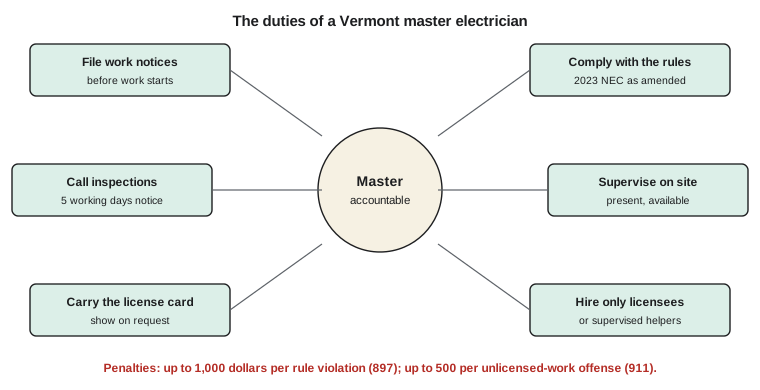
Duty 1: comply with the rules
Section 4 of the 2025 rules sets out licensees' duties. The core is compliance: electrical installations must meet the adopted code, the 2023 NEC with Vermont amendments, and the other documents section 5 adopts. A master who designs an installation is responsible for the design, and a master under whose direction the work is done is responsible for the result. The statute adds weight to compliance by making a rule violation prima facie evidence of negligence in a civil suit, so the same defect that earns a correction notice can become the centerpiece of a damages claim.
Duty 2: file the work notice and run the inspections
The master who files a work notice takes on the procedural duties Lesson 6 described: no work before validation, at least five working days' notice before required inspections, no covering before inspection unless waived in writing, a request for the final inspection when work is complete, and no connection to power before an energizing permit. Rule section 8 also gives the Division a lever: it may refuse to validate new work notices for a licensee who has ongoing work that was never filed or who owes fees or penalties. A master who lets the paperwork slide on one job can find every other job stalled.
Hal's rule for the company is that no crew goes to a complex structure until Corinne confirms the notice is validated. The rule cost a half day once, when a validation came through late, and saved far more on the day an inspector asked to see the notice for a ski-lodge kitchen and it was there.
Duty 3: supervision
The rules define supervision in terms of presence. A master supervising apprentices or helpers must be physically present at the work site and immediately available, or a journeyman working under the master's direction must be. A journeyman supervising must be physically present and immediately available, and so must a type S journeyman. The statute's definition of electrician's helper says the same thing in its own words: a helper works under the direct supervision of a master or journeyman who is present at the work site. Neither the statute nor the 2025 rules states a numeric ratio of apprentices or helpers to licensees, but the presence requirement limits how many people a licensee can actually supervise, and apprenticeship programs set their own ratios for their apprentices.
Supervision is where small companies most often get in trouble. A helper sent alone to finish a few devices in a rental apartment is doing electrical work without a license and without the supervision that would make it lawful, and under section 911 the company that employed the helper commits an offense as well. Hal's rule is simple: helpers and apprentices never work in a complex structure without a licensed electrician on site.
| Worker | May do | Supervision rule |
|---|---|---|
| Master | All electrical work; file work notices; employ others | Supervises others directly or through a journeyman under the master's direction |
| Journeyman | Electrical work under a master's direction | Must be present and immediately available when supervising |
| Type S journeyman | Work in the licensed specialty | Must be present and immediately available when supervising |
| Registered apprentice | Work while learning | Only under a present, available licensee |
| Electrician's helper | Assist with installations | Only under direct supervision of a licensee at the site |
Duty 4: hire and assign only qualified people
Section 911 makes it an offense to employ a person for electrical work that the person is not properly licensed to do. That puts the duty on the employer, and in a small company the master is usually the employer or the employer's representative. A master should check each new hire's license status, keep a copy of each license card on file, track expiration dates, and assign type S journeymen only to work in their specialty. A journeyman whose license lapses is no longer licensed, even if renewal is only a form away.
Duty 5: carry the license
Section 902 requires a master to carry the wallet card at all times while engaged in electrical work and to show it on request. The rule sounds minor, but it is easy to test on an exam and easy to fail on a job site. Inspectors ask.
Duty 6: do not lend the license
A license is personal. Filing work notices under a master's name for work the master does not direct, or allowing a company the master does not work for to use the master's name, is the kind of conduct that the Board treats as obtaining or using a license wrongfully and as unfitness under section 909 and rule 3.6. It also exposes the master to liability for work the master never saw. Hal has turned down offers from out-of-state contractors who wanted to borrow his name for a Vermont job; Nadia should expect the same offers and give the same answer.
Duty 7: keep records
The statute does not list the records a master must keep, but the work notice system makes record-keeping essential. For each job, Clarendon Ridge keeps the validated notice, inspection requests and reports, any correction orders and the proof of correction, the energizing permit, the final report, the names of the licensees and apprentices who worked on the job, and the customer contract with any change orders. Those records protect the company in a dispute with a customer, in a lien case and in a negligence suit.
Discipline
The Board's disciplinary process in rule section 9 begins with a written complaint to the Division. The complaint is docketed and investigated by a panel that includes an investigator and an assistant attorney general, who recommend whether to proceed. Many cases end in a stipulated settlement. If charges go forward, the licensee is entitled to a formal hearing with at least twenty days' notice, and the Board issues written findings. The available actions range from a reprimand, added education or conditions on installations to suspension, refusal to renew or revocation. An appeal goes to the Vermont Supreme Court. Separately, the Commissioner may impose administrative penalties of up to 1,000 dollars per violation under section 897.
Worked problem
A helper alone on site
On a busy Friday, a Clarendon Ridge helper is sent alone to install six receptacles in a rented single-family house, which is a complex structure, while the journeyman finishes another job across town. What problems does this create?
Show solution
- A helper may work only under the direct supervision of a licensee present at the site.
- Under section 910 a license is not needed in a building with no more than two dwelling units, so the license itself is not the issue, but the rental makes it a complex structure.
- The work still needs a work notice, inspection and compliance with the rules, and the company remains responsible for the work.
- As a company policy matter, Hal's rule is broken, and the company should treat the work as needing review by a licensee before inspection.
Answer: The licensing exemption may apply, but the work notice and code duties do not go away; send a licensee to review the work before the inspection.
# License expiration check for the crew (illustrative data)
from datetime import date
today = date(2026, 11, 10)
crew = {
    "Nadia Fortin, journeyman": date(2028, 3, 31),
    "Owen Lacasse, journeyman": date(2026, 12, 31),
    "Priya Danforth, type S (refrigeration)": date(2027, 6, 30),
}
for name, expires in crew.items():
    days = (expires - today).days
    flag = "RENEW SOON" if days < 90 else "ok"
print(f"{name}: expires {expires}, {days} days, {flag}")Nadia Fortin, journeyman: expires 2028-03-31, 507 days, ok Owen Lacasse, journeyman: expires 2026-12-31, 51 days, RENEW SOON Priya Danforth, type S (refrigeration): expires 2027-06-30, 232 days, ok
When the master is away
A master cannot be on every site, and the rules do not require it. They require supervision of apprentices and helpers by a licensee who is present, and they let a journeyman working under the master's direction provide that supervision. What the master must do is direct the work: decide who is assigned where, make sure each crew has a licensee in charge, review designs and changes, and be reachable when a question comes up. For a company like Clarendon Ridge, with several jobs running at once, the master's direction is mostly exercised through planning, the morning crew assignments and the job folders.
Hal's practice is to visit each complex-structure job at least once a week and before every rough-in and final inspection, to review every change order that affects the electrical design, and to sign off on the job folder before a final inspection is requested. When he is on vacation, he names another master to direct the work, by written agreement, and the work notices for new jobs during that time are filed in that master's name. Nadia will take over that role once she is licensed, and the company will no longer need to borrow another master for Hal's vacations.
The duties in this lesson also matter on the exam. Questions often describe a situation, such as a helper alone on site, a journeyman filing a notice for a commercial job, or a master who lets another company use the license, and ask which rule is broken. The answer usually turns on who may do what under sections 902 through 911 and the rules' supervision definitions.
Common mistakes
MistakeLeaving a helper alone on a job.
InsteadA helper works only under the direct supervision of a licensee present at the site.
MistakeAssuming a numeric apprentice ratio from another state applies.
InsteadVermont's rules require presence and availability; apprenticeship programs may set their own ratios.
MistakeLetting another company file under your name.
InsteadLending a license is grounds for discipline and exposes you to liability.
MistakeForgetting the license card.
InsteadSection 902 requires the master to carry it and show it on request.
MistakeIgnoring unpaid fees on an old job.
InsteadThe Division may refuse to validate new work notices until fees and unfiled work are resolved.
Summary and key terms
- A master may design, install and maintain all electrical installations, including lightning rods and fire alarms, and employ others.
- The master files work notices for complex structures and runs the inspection and energizing steps.
- Supervision means a licensee physically present and immediately available.
- Employing an unlicensed person for electrical work is an offense under section 911.
- Discipline runs through a complaint, investigation, hearing and Board findings, with appeal to the Supreme Court.
- Direct supervision
- Supervision by a licensee who is present at the work site and immediately available.
- Electrician's helper
- A person who assists with electrical work under a licensee's direct supervision.
- Stipulated settlement
- An agreed resolution of a disciplinary case without a full hearing.
- Prima facie evidence
- Evidence that establishes a fact unless rebutted; a rule violation is prima facie evidence of negligence.
- Lending a license
- Allowing one's license to be used for work one does not direct.
Practice problems
Work each problem on paper first, then reveal the answer to check.
Who must be on site when an apprentice works in a school?
Show answer
A licensee who is physically present and immediately available.
Must a master carry the license card?
Show answer
Yes, while engaged in electrical work, and show it on request.
What may the Division do if a master owes penalties?
Show answer
Refuse to validate new work notices until they are resolved.
Where does an appeal from a Board disciplinary order go?
Show answer
The Vermont Supreme Court.
Is there a numeric apprentice ratio in the 2025 rules?
Show answer
No; the rules require presence and immediate availability.
Lesson quiz · 5 questions
Score 60% or more to complete this lesson.
Create a free account to save your progress, take quizzes and earn a certificate.