
MELU-320 · Lesson 6 of 12 · 20 min
Permits, inspections and the inspection authority
▶ Video coming soon A video version of this lesson is on the way.
In most states an electrician pulls a permit from the city before starting a job. In Vermont the equivalent document is the work notice. Corinne files several a month for Clarendon Ridge, and Nadia, as a future master, needs to know when one is required, who may file it, what it costs, how inspections are requested and what has to happen before the utility will connect a new installation. This lesson covers the work notice system in 26 V.S.A. sections 893 through 899 and section 7 of the 2025 rules, the inspection authority of the Division and of municipalities, and the energizing permit that closes the loop.
The work notice is the permit
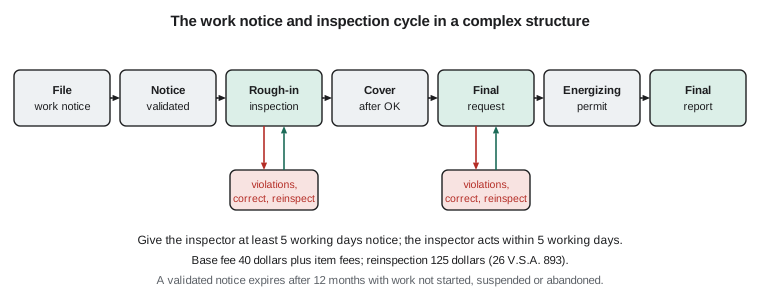
Section 893 says that electrical work in a complex structure may not begin until a work notice and the required fee have been submitted to the Department of Public Safety and the notice has been validated. Section 7.1 of the 2025 rules adds the detail. The notice is filed by a master electrician or a type S journeyman in good standing for the work in the specialty, except that for a residential complex structure with no more than two dwelling units, any person may file. The notice may be filed online, by mail or at a regional office, and the fees must be paid before validation. The inspector may accept an annual work notice for ongoing work at an existing building, which helps a contractor that does continual small jobs in a hospital or factory.
The rules also list situations that require a notice even when they might seem minor, such as demolition involving energized wiring and certain lighting retrofits, and situations that do not, such as minor maintenance like replacing lamps, fuses or appliances and communications work under NEC Article 800. A validated notice expires if the work is not started, or is suspended or abandoned, for twelve months, and fees other than the base fee may be refunded on written request when work is abandoned, prorated for what was done.
Which buildings are complex structures
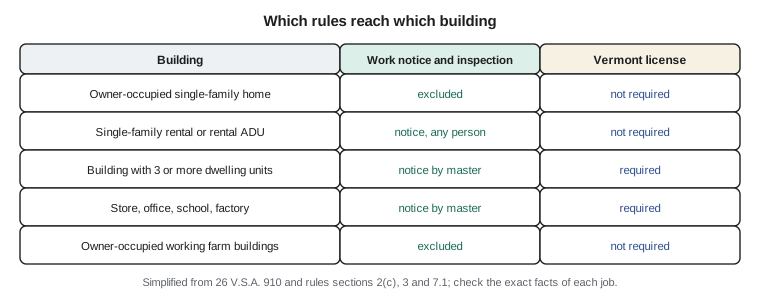
The trigger for the work notice is the building, not the size of the job. Complex structure has the meaning of public building in Title 20, the fire safety statute, and that term covers commercial, industrial, institutional and assembly buildings, buildings with three or more dwelling units, and buildings in which people rent accommodations. The 2025 rules say directly that single-family rental dwellings and rental accessory dwelling units are not excluded. What is excluded is the owner-occupied single-family dwelling and buildings used for agriculture on owner-occupied farms.
Licensing and the work notice do not line up exactly. Under section 910 a license is not required for electrical work in a building used for dwelling purposes that has no more than two dwelling units, and rule section 3 says the same. But if such a building is rented, it can still be a complex structure, and then a work notice and inspection are required, which is why rule 7.1 lets any person file the notice for a residential complex structure with two or fewer units. In practice, Clarendon Ridge treats every rental as needing a notice and every job in a building with three or more units, or any commercial building, as needing both a notice filed by a master and licensed workers.
Fees
Section 893 sets the fees in the statute itself. There is a base fee of 40 dollars for each work notice, except for electrical work in one- and two-family residential dwellings, plus item fees for the scope of work: services by size, transformers by kVA, motors and generators by rating, panels and feeders after the main disconnect, outlets and devices in groups of fifty, fire alarm devices and panels, elevators, platform lifts, fire pumps and other items. A reinspection required because of code violations costs 125 dollars. Because the fees are in the statute, they change only when the Legislature changes them, but they do change, so check the current section before quoting a customer.
Worked problem
Estimating a work notice fee
Clarendon Ridge will install a new 400-ampere permanent service, two panels with feeders after the main disconnect, and 120 receptacle, switch and fixture outlets in a small commercial building. Using the section 893 fees as summarized in this course (base 40, permanent service through 400 amperes 35, each panel and feeder 35, outlets 20 per 50 or part of 50), estimate the fee.
Show solution
- Base fee: 40 dollars.
- Service: 35 dollars.
- Two panels with feeders: 2 times 35 is 70 dollars.
- Outlets: 120 is two full groups of 50 plus a part group, so three groups at 20 is 60 dollars.
- Total: 40 plus 35 plus 70 plus 60 is 205 dollars.
Answer: About 205 dollars, before any reinspection fee. Confirm the current statute and any items this summary omits.
# Work notice fee estimate (amounts as summarized from 26 V.S.A. 893; confirm current law)
import math
base = 40
service_400a = 35
panels = 2 * 35
outlets = 120
outlet_fee = math.ceil(outlets / 50) * 20
total = base + service_400a + panels + outlet_fee
print("Outlet groups:", math.ceil(outlets / 50), "fee", outlet_fee)
print("Estimated work notice fee:", total, "dollars")Outlet groups: 3 fee 60 Estimated work notice fee: 205 dollars
Requesting inspections
The licensee drives the inspection schedule. Section 4(b) of the 2025 rules requires the licensee to give the electrical inspector at least five working days' notice before any required inspection, to schedule rough and final inspections, and to notify the inspector when the work is complete. Installations in a complex structure may not be covered or concealed until the inspector has inspected them, unless the inspector waives the inspection in writing. When the work is done, the applicant requests a final inspection, and under section 893 and rule 7.3 the inspector must, within five working days after receiving the request, inspect, set a reasonable date or issue a waiver. The Commissioner may set inspection priorities by risk, size and type of structure, so not every job is handled the same way.
If the inspector finds violations, the work is corrected and reinspected, and a reinspection for code violations carries its own fee. Section 895 lets the Commissioner order violations corrected, withdraw the validation of the work notice or order disconnection until the installation is safe. Those orders are rare on a well-run job, but every master should know they exist.
The energizing permit and the final report
Under section 894 and rule 7.4, a new installation in or on a complex structure, or one used for testing or construction, may not be connected to a source of power until the electrical inspector has issued a temporary or permanent energizing permit. Vermont's utilities coordinate with the Division on this, and the utilities' service requirements manual, which the rules reference, sets out the utility's side of the connection. The rules also give the inspector and the utility a role when power is restored to a structure that was unpowered or damaged, such as after a fire or flood: they may require an evaluation and, where needed, a work notice and inspection before reconnection.
When the installation passes final inspection and the fees are paid, the inspector issues a final inspection report; the statute calls it a certificate of completion. No part of a complex structure containing a new installation may be sold or conveyed for occupancy until that certificate has issued. The rules also allow a permit holder, with the inspector's permission, to offer a certificate of completion for low-priority inspections. And a violation of the rules is prima facie evidence of negligence in a civil suit, which gives the final report real value as a record.
Who inspects: the state, municipalities and private entities
The Division's electrical inspectors do most inspections in Vermont. Section 898 lets a municipality's legislative body appoint trained inspectors and, with the Commissioner's approval, take over the state's inspection duties within the municipality, setting its own fees in place of the section 893 fees. Municipal inspectors report monthly to the Commissioner, appeals from their decisions go to the Commissioner within fifteen calendar days, and the Commissioner may revoke the assignment. Burlington, for example, has its own electrical inspection and certificate provisions in its city ordinances. Section 899 lets the Commissioner assign inspections to a qualified private entity with an ongoing need, such as a large institution, when state and municipal resources are insufficient, subject to training, monthly reports and random state inspections.
For Clarendon Ridge, the question on each job is simply who the inspector is. Corinne's job sheet has a box for it. On most jobs it is the Division's regional inspector. On a job in a municipality that has taken over inspection, it is the municipal inspector, and the fee schedule and request procedure are the municipality's.
Appeals
A licensee who disagrees with an order or decision may ask for reconsideration. Under section 896 the request is made in writing within fifteen days, the Commissioner reviews it within thirty days and rules within thirty days after that, and an appeal from the Commissioner goes to the Superior Court, which hears it anew. For a municipal inspector's decision, section 898 sends the appeal to the Commissioner within fifteen calendar days, with a hearing within forty-five days and a decision within thirty days after the hearing. The practical lesson is that the clocks are short; a master who means to appeal should decide quickly and put the request in writing.
A work notice from start to finish
The new service at the twelve-unit apartment building in Rutland City shows the system in motion. Hal, as the master, filed the work notice online in August, listing the new 400-ampere service, two panels with feeders and about 140 outlets, and paid the base and item fees. The Division validated the notice two days later, and Corinne printed the validation for the job folder. Nadia's crew set the service equipment and ran the feeders, then Corinne requested the rough-in inspection with more than five working days' notice. The inspector found one issue, a missing bonding jumper at a water heater, which the crew fixed the same afternoon. After the walls were closed and the devices set, Corinne requested the final inspection in writing. The inspector came within the five working days, issued the energizing permit, and the utility made the connection the next morning. The final inspection report went into the folder with the work notice, the inspection reports and the contract, and Corinne marked the job closed.
Every step in that story is a step the statute or the rules require. None of them is difficult, and together they take only a few hours of office time. What makes them hard is doing them on every job, every time, while crews are busy. That is why the master's habits matter so much.
A final practical note: the work notice number is the job's identity in the Division's system. Corinne writes it on every inspection request, every correspondence with the inspector and the cover of the job folder, and the crew lead carries a copy on site. When an inspector arrives unannounced, as inspectors may, the crew can show the validated notice at once.
Common mistakes
MistakePulling a town building permit and assuming it covers the electrical work.
InsteadElectrical work in a complex structure needs a validated work notice from the state or a delegated municipality.
MistakeTreating a single-family rental as an exempt single-family home.
InsteadThe rules say single-family rentals and rental ADUs are not excluded.
MistakeCovering work before inspection.
InsteadWork in a complex structure may not be covered until inspected, unless waived in writing.
MistakeAsking the utility to connect before the energizing permit.
InsteadA new installation in a complex structure needs a temporary or permanent energizing permit first.
MistakeWaiting a month to challenge an order.
InsteadReconsideration must be requested in writing within fifteen days.
Summary and key terms
- Electrical work in a complex structure needs a validated work notice and fee before it starts.
- A master or type S journeyman files; for residential complex structures with two or fewer units, anyone may.
- Give at least five working days' notice for inspections; the inspector acts within five working days of a final request.
- An energizing permit is required before a new installation is connected to power.
- Municipalities may take over inspection with the Commissioner's approval under section 898.
- Complex structure
- A public building under Title 20, including commercial, multi-unit and rental buildings.
- Validation
- The Division's acceptance of a work notice and fee, after which work may begin.
- Energizing permit
- The inspector's permission to connect a new installation to power, temporary or permanent.
- Certificate of completion
- The final inspection report issued when an installation complies and fees are paid.
- Annual work notice
- A notice the inspector may accept for ongoing work at an existing building.
Practice problems
Work each problem on paper first, then reveal the answer to check.
Who may file the work notice for a twelve-unit apartment building?
Show answer
A master electrician, or a type S journeyman for work in the specialty.
How long does a validated work notice last if work is suspended?
Show answer
It expires after twelve months not started, suspended or abandoned.
What must happen before the utility connects a new service at a school?
Show answer
The inspector must issue an energizing permit.
How many working days' notice must a licensee give for a required inspection?
Show answer
At least five.
What is the reinspection fee for code violations under section 893?
Show answer
125 dollars, subject to change.
Lesson quiz · 5 questions
Score 60% or more to complete this lesson.
Create a free account to save your progress, take quizzes and earn a certificate.