
MELU-320 · Lesson 1 of 12 · 20 min
How electrical licensing works in Vermont
▶ Video coming soon A video version of this lesson is on the way.
Nadia Fortin has worked in the electrical trade in Rutland County for eleven years. She started as a helper on a residential crew in 2015, entered a registered electrical apprenticeship the following year, sat the journeyman examination after finishing it, and has held a Vermont journeyman electrician license since March 2022. For the last three years she has run crews for Clarendon Ridge Electric, LLC, a twelve-person shop on the south side of Rutland that wires schools, small factories, ski-area buildings, apartment houses and the occasional dairy barn. The company is invented for this course, but the questions it faces are real. Its owner, Hal Pomainville, has held a Vermont master electrician license since 1994. Hal plans to step back from daily work in 2027, and he has asked Nadia to earn her own master license so that the company always has a master in charge who can file work notices and answer for the work. This course follows her from her first question to exam day.
This is the Vermont course in the HSM University master electrician exam prep series. The core courses, MELU-101 through MELU-107, teach the National Electrical Code skills that every master-level exam tests: navigating the code, load calculations, conductors and overcurrent protection, grounding and bonding, motors and transformers, special occupancies, and business and law. This course adds what is specific to Vermont: the statute that creates the license, the Electricians' Licensing Board and the rules it adopts, the Division of Fire Safety that runs the licensing office and the inspectors, the work notice system that takes the place of a building permit for electrical work, the business and lien law a master needs, and the habits that carry a candidate through a long, open book exam with a practical skills portion.
Two cautions apply to every lesson. First, licensing rules change. The facts in this course were checked in November 2026 against Title 26, chapter 15 of the Vermont Statutes, the 2025 Vermont Electrical Safety Rules, the Division of Fire Safety's licensing pages, the contractors' lien statute in Title 9, the Office of Professional Regulation's residential contractor pages and the Department of Labor's workers compensation and VOSHA pages. When a fact comes from a secondary source or could not be confirmed, the lesson says so. Before you apply, pay a fee or book an exam, check the current pages yourself. Second, electrical codes are copyrighted. This course cites code articles and sections by number and explains them in plain words, but it never reproduces their text, tables or figures. Keep your own copy of the code edition your exam uses open beside you.
One state license, one board
Vermont regulates electricians at the state level. The Legislature created the license in 26 V.S.A. chapter 15, and the chapter's licensing subchapter makes it unlawful to install, replace or repair electrical work without the appropriate license, or to employ someone to do work that person is not licensed to do, except where the chapter itself exempts the work. A license earned in Vermont is good everywhere in Vermont. There is no separate city or county electrician license to collect, which makes Vermont simpler than states where every city runs its own system.
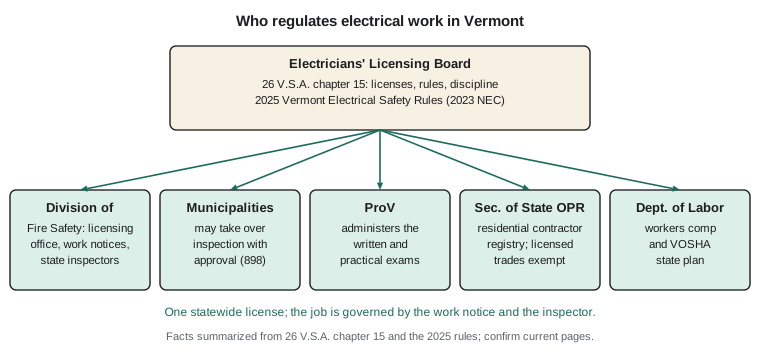
The licensing authority is the Electricians' Licensing Board, created by 26 V.S.A. section 901. The Board has five members: the Commissioner of Public Safety or a designee, and four members appointed by the Governor with the advice and consent of the Senate. The four appointed seats are filled by a master electrician, a journeyman electrician, a representative of the electric utility industry and a representative of the fire insurance industry. Appointed members serve three-year terms, and the Governor names the chair. The Board examines and licenses electricians, adopts the rules for electrical installations under section 891, approves continuing education and disciplines licensees under section 909.
The day-to-day work is done by the Department of Public Safety through its Division of Fire Safety. The Division's licensing office in Waterbury takes applications, collects fees, issues license cards and handles renewals. The Division's electrical inspectors validate work notices, inspect installations and issue energizing permits. When Nadia calls about her application or Hal calls about an inspection, they are calling the Division, even though the decisions on licenses belong to the Board.
The license classes
Vermont issues three main kinds of electrician license. The master electrician license under section 902 is the top credential. A master may design, install, repair, maintain and replace electrical installations, including lightning rods, fire alarms and fire detection systems, may carry on that work as a business or as part of another business, and may employ other licensed electricians and electrician's helpers to work under the master's direction. The journeyman electrician license under section 903 lets the holder do electrical work under the direction of a master and supervise apprentices and helpers. The type S journeyman license under section 904 is a specialty license limited to one field, such as heating equipment, refrigeration and air conditioning, well pumps, farm equipment or outdoor signs, and the 2025 rules identify the specialty fields by codes such as A1, B2 and C3.
Two other categories matter. A registered apprentice is enrolled in an electrical apprenticeship registered with the Department of Labor's apprenticeship program, and the apprentice's hours count toward the journeyman license. An electrician's helper is a person who assists with an electrical installation under the direct supervision of a master or journeyman who is present at the work site. Neither is a license to work alone. Lesson 7 returns to supervision, because it is one of the master's most important duties.
| License | Statute | Core requirement | What it allows |
|---|---|---|---|
| Master electrician | 26 V.S.A. 902 | Two years as a licensed journeyman, or comparable experience the Board accepts, plus the exam | Design, install and maintain; run the business; employ licensees and helpers |
| Journeyman electrician | 26 V.S.A. 903 | Completed registered apprenticeship, or equivalent the Board accepts, plus the exam | Work under a master; supervise apprentices and helpers |
| Type S journeyman | 26 V.S.A. 904 | Approved training or experience in a specialty, plus the specialty exam | Work limited to the licensed specialty |
| Registered apprentice | 26 V.S.A. 881 | Enrollment in a registered apprenticeship | Work under supervision while learning |
What the rules cover
Section 891 lets the Board adopt rules for electrical installations and, where practicable, adopt a national electrical code. The Board's current rules are the 2025 Vermont Electrical Safety Rules, which the Division lists as effective November 5, 2025. They adopt the 2023 edition of NFPA 70, the National Electrical Code, with Vermont amendments, along with the 2021 edition of NFPA 73 for existing dwellings and the 2023 edition of NFPA 780 for lightning protection. They also set out the license classes, exam and renewal rules, the work notice and inspection procedures, enforcement powers and the disciplinary process. Lesson 5 covers the code layers and the amendments, and Lesson 6 the work notice system.
The statute ties the inspection system to a defined term, complex structure. Section 881 gives it the same meaning as public building in the fire safety statute in Title 20, and in Vermont that term reaches far beyond government buildings. Stores, offices, schools, factories, places of assembly, apartment buildings and many rental dwellings are complex structures. Electrical work in a complex structure needs a validated work notice before it starts, inspection before it is covered, and an energizing permit before it is connected to power. The owner-occupied single-family home is outside the rules, and section 910 exempts several other kinds of work from licensing, which Lesson 6 sorts out.
What stays with each job
Because Vermont has one license and one set of rules, the questions that differ from job to job are fewer than in states with local licensing, but they still matter. Is the building a complex structure? Who must file the work notice? Has the municipality taken over inspection from the state under section 898, as some larger communities may? Does the work need an energizing permit before the utility connects it? Is the customer a homeowner whose project would otherwise require the contractor to be on the state's residential contractor registry? Those questions are answered by the job, not by the license.
Hal's office manager, Corinne Bessette, keeps a job sheet for every project with five boxes at the top: building type, work notice number, inspector, energizing permit and closeout. Last spring the company had a school gymnasium lighting retrofit in Proctor, a new service for a twelve-unit apartment building in Rutland City, a heat pump circuit in an owner-occupied farmhouse and a well pump replacement for a camp on a lake. Each sheet looked different. The school and the apartment building needed work notices filed by Hal as the master, inspections and energizing permits. The farmhouse work fell outside the state rules because the owner lives there and the building is a single-family home. The camp was a seasonal rental, so its sheet raised the question of whether it counted as a complex structure, and Corinne called the Division to confirm before the crew went out.
Enforcement
Enforcement runs through the Division and the Board. Under section 895 the Commissioner may order violations corrected, withdraw the validation of a work notice or order an installation disconnected until it is fixed. Under section 897 the Commissioner may impose an administrative penalty of up to 1,000 dollars for each violation after notice and an opportunity for hearing, and the Superior Court may enjoin violations. Under section 911 unlicensed work, employing an unlicensed person and obtaining a license wrongfully or by fraud each carry a fine of up to 500 dollars per offense. Under section 909 the Board may revoke, suspend or refuse to renew a license after notice and a hearing. And section 897 adds a civil law twist: a violation of the rules is prima facie evidence of negligence in a lawsuit for damages.
For a master, enforcement is personal. The work notice is filed in the master's name, the inspection reports go to the master, and the license on the line is the master's. Hal has told Nadia that the best protection is dull paperwork: a current license card in her wallet, a work notice validated before any crew touches a complex structure, inspections requested on time, helpers and apprentices supervised as the rules require, and a file for every job. Lesson 7 returns to these habits.
The exam picture
Vermont's master exam is administered for the Board by a testing company, ProV, and the Division's licensing page says the current exams are based on the 2023 National Electrical Code. The rules in section 3.4 require a written or computer-based examination and a practical skills examination covering theory, practice, and the applicable laws and rules, and the master exam covers the type S specialty fields as well. Unlike many states, Vermont expects the Board to approve the candidate's experience before the candidate registers for the exam. Lessons 3 and 4 cover the order of steps and the exam format.
Vermont also offers routes to a license without the exam. Under section 906 the Board may license by reciprocity with states whose standards are equivalent, by endorsement of a licensee from another state who has held the license in good standing for the required time, and through routes for veterans and service members. Lesson 11 covers these routes and working in neighboring states.
How this course is organized
The lessons follow Nadia's path. Lesson 2 covers eligibility for the master license, Lesson 3 the application, Board approval and booking, and Lesson 4 the exam format and references. Lesson 5 explains the 2023 NEC as adopted in Vermont and the state amendments, and Lesson 6 work notices, inspections and the inspection authority. Lesson 7 covers the duties of the master, Lesson 8 contractor registration, insurance and bonding, and Lesson 9 contracts and contractors' liens. Lesson 10 covers VOSHA and workers compensation, Lesson 11 renewal and continuing education, and Lesson 12 a practice review and test-day strategy. Every lesson ends with a quiz that mixes multiple choice, true or false, number, ordering and matching questions, and the course ends with a final exam.
The calculator below shows the first planning Nadia did. Hal wants to step back in about fourteen months. She needs time to gather her journeyman record, submit an application before a Board meeting, wait for approval, book and study, sit the written and practical exams, allow for a retake, and receive the license. Change the numbers to fit your own plan.
# Nadia's planning check (illustrative months)
months_until_hal_steps_back = 14
steps = {
    "gather journeyman record and references": 1,
    "application reaches the Board before a meeting": 1,
    "Board reviews and approves experience": 1,
    "study for the written and practical exams": 4,
    "book and sit both exams": 1,
    "retake allowance, if needed": 3,
    "license card issued": 1,
}
needed = sum(steps.values())
for step, months in steps.items():
    print(f"{step}: {months} months")
print(f"Total: {needed} months; margin: {months_until_hal_steps_back - needed} months")gather journeyman record and references: 1 months application reaches the Board before a meeting: 1 months Board reviews and approves experience: 1 months study for the written and practical exams: 4 months book and sit both exams: 1 months retake allowance, if needed: 3 months license card issued: 1 months Total: 12 months; margin: 2 months
Common mistakes
MistakeThinking Vermont cities issue their own electrician licenses.
InsteadVermont issues one statewide license through the Electricians' Licensing Board.
MistakeAssuming the Division of Fire Safety makes licensing decisions on its own.
InsteadThe Board licenses and disciplines; the Division runs the licensing office and inspections.
MistakeTreating complex structure as meaning only government buildings.
InsteadIt has the meaning of public building in Title 20, which reaches stores, offices, schools, apartment buildings and many rentals.
MistakeExpecting to book the master exam first and apply afterward.
InsteadVermont's Board approves the candidate's experience before the exam is booked.
MistakeBelieving a rule violation matters only to the inspector.
InsteadUnder 26 V.S.A. 897 a violation of the rules is prima facie evidence of negligence in a civil suit.
Summary and key terms
- Vermont licenses electricians statewide under 26 V.S.A. chapter 15.
- The Electricians' Licensing Board licenses, adopts rules and disciplines; the Division of Fire Safety runs licensing and inspection.
- The 2025 Vermont Electrical Safety Rules, effective November 5, 2025, adopt the 2023 NEC with Vermont amendments.
- The license classes are master, journeyman and type S journeyman, with registered apprentices and helpers working under supervision.
- Electrical work in a complex structure needs a validated work notice, inspection and an energizing permit.
- Check current statutes, rules and pages before relying on any detail.
- Electricians' Licensing Board
- The five-member board created by 26 V.S.A. 901 that licenses electricians and adopts the electrical rules.
- Division of Fire Safety
- The Department of Public Safety division that runs the licensing office and the electrical inspectors.
- Complex structure
- A building that is a public building under Title 20, including commercial, multi-unit and many rental buildings.
- Work notice
- The notice a licensee files, and the Division validates, before electrical work in a complex structure begins.
- Type S journeyman
- A specialty license limited to one field, such as heating, refrigeration or well pumps.
Practice problems
Work each problem on paper first, then reveal the answer to check.
Who issues Nadia's master license if she passes?
Show answer
The Electricians' Licensing Board, with the license card issued through the Division of Fire Safety's licensing office.
Does Clarendon Ridge need a city electrician license to work in Rutland City?
Show answer
No; Vermont has one statewide license. The job may still need a work notice and inspection.
Which NEC edition do the 2025 Vermont rules adopt?
Show answer
The 2023 edition, with Vermont amendments.
What is the maximum administrative penalty per violation under section 897?
Show answer
Up to 1,000 dollars, after notice and an opportunity for hearing.
Who decides whether to revoke a license?
Show answer
The Board, after notice and a hearing under section 909.
Lesson quiz · 5 questions
Score 60% or more to complete this lesson.
Create a free account to save your progress, take quizzes and earn a certificate.