
MELU-320 · Lesson 4 of 12 · 20 min
The exam format and the references allowed
▶ Video coming soon A video version of this lesson is on the way.
Once the Board approved her experience, Nadia's questions turned practical. How long is the exam? How many questions? Can she bring her code book, and can it have tabs? What is the practical skills part, and how is it scored? This lesson describes the Vermont master exam as the rules define it and as recent sources report it, explains how to prepare a code book that meets the candidate bulletin, and sets out the topics a Vermont master candidate should expect. Where a detail comes from a secondary source or could not be confirmed, the lesson says so. The candidate information from the testing company is the controlling document, and every candidate should read it in full before exam day.
What the rules require
Section 3.4 of the 2025 Vermont Electrical Safety Rules sets the frame. The exam must be written or computer-based and must include a practical skills examination. It must cover electrical theory and practice and the laws and rules that apply to the work, and the master exam must include all of the type S specialty fields. That last point is distinctive. Because a Vermont master may do work in every specialty field, the master exam can ask about heating equipment, refrigeration and air conditioning, well pumps, farm equipment, outdoor signs and the other type S areas, as well as the general journeyman and master material and the lightning protection and fire alarm work that section 902 places within the master's scope.
The rules do not state a passing score, and the statute does not either. The testing company's candidate information states how the exam is scored and what score passes. This course does not assume a number; read the bulletin.
The reported format
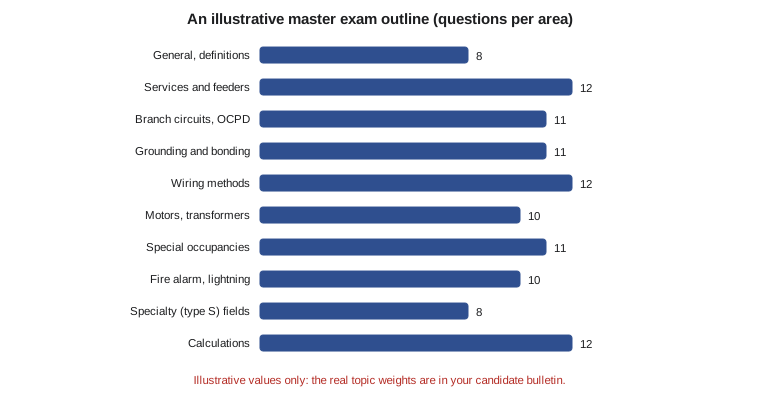
Recent summaries of Vermont licensing, including a widely used national licensing reference, report that the master exam has 105 questions with a five-hour time limit and that the journeyman exam has 90 questions with a four-hour limit, each with a practical skills portion. They also report that the current exams are based on the 2023 National Electrical Code, which the Division's own licensing page confirms. Treat the question count and time as the format reported for recent exams, and confirm them in the bulletin for your exam date, because testing companies adjust formats.
At 105 questions in 300 minutes, the average is a little under three minutes a question. That is generous compared with some states, but it is not generous for a question that requires a load calculation and two code lookups. The three-pass method in Lesson 12 is built around that average.
The practical skills part
The practical skills examination is what makes Vermont's exam feel different to candidates who have taken purely written tests elsewhere. The rules require it but do not describe its tasks, and the testing company's candidate information is the place to learn what it involves at your exam. Candidates commonly describe practical exams in the electrical trades as tasks such as identifying components, reading a diagram, making terminations, wiring a control circuit or testing a circuit with a meter, scored against a checklist. The course does not claim that any of those tasks is on the Vermont exam. It recommends that a candidate read the bulletin's description, ask the testing company any question the bulletin leaves open, and rehearse the listed tasks with the tools and time the bulletin allows.
Hal took his own master exam in 1994, when the format was different, so he could not tell Nadia what the practical portion would look like now. What he could tell her was how to practice: with the same meter she would use on the day, in a set amount of time, with someone watching and a checklist in hand, until each task was routine. Nadia booked two evenings a month at the shop for that rehearsal.
References: the code book
Most master electrician exams are open book, and the Vermont reports describe the written exam that way. The bulletin decides which books are allowed, in which editions, and what marking is permitted. Typical rules across testing companies allow a bound copy of the named NEC edition, permit permanent tabs and highlighting, and prohibit loose notes, written explanations in the margins, photocopies and electronic devices. Some allow a short list of additional references. A candidate whose book does not meet the rules may have it taken away at the door.
Nadia's book was a new bound copy of the 2023 NEC. She tabbed it by article, using one color for chapters 1 through 4, another for chapters 5 through 7, and a third for chapter 9 and the informative annexes. She highlighted sparingly, mainly the opening scope sections of articles she seldom used. She wrote nothing in the margins. She kept a separate personal list of the Vermont amendment section numbers from section 5 of the rules, which she studied at home, and did not bring it to the exam because the bulletin did not list it as an allowed reference.
| Reference question | Who decides | Nadia's plan |
|---|---|---|
| Which NEC edition? | Candidate bulletin; the Division page says the 2023 NEC | Bound 2023 NEC |
| Tabs and highlighting? | Candidate bulletin | Permanent article tabs; light highlighting |
| Margin notes? | Candidate bulletin | None |
| Vermont rules or statutes in the room? | Candidate bulletin | Only if listed |
| Calculator? | Candidate bulletin | Only a model the bulletin allows |
The Vermont layer on the exam
A national code exam tests the published code. Vermont's exam is written for Vermont, and the rules require it to cover the laws and rules that apply to the work. A candidate should expect questions on chapter 15 of Title 26 and the 2025 rules: who must hold which license, what a master may do, the work notice and inspection procedure, energizing permits, continuing education and renewal, penalties, and the supervision of apprentices and helpers. Whether Vermont's amendments to the NEC are tested, and how, is a question for the bulletin. A sensible plan is to know where the amendments sit, which sections they touch and what they change in general terms, so that a question about a Vermont rule does not come as a surprise.
When a question asks about the code, the safest approach is to answer from the edition the bulletin names, as published, unless the question says it is asking about Vermont's amended rule. Lesson 5 explains the amendments.
Calculations
Master exams lean on calculations: dwelling and commercial service loads, feeder sizing, conductor ampacity with correction and adjustment, voltage drop, motor branch circuits and transformer protection, box and conduit fill. The core courses MELU-102 through MELU-105 teach those methods. On the Vermont exam the farm, heating and pump material in the type S fields can show up in calculation questions, so practice motor and single-phase pump problems as well as the commercial ones.
The short script below is a quick check on pacing. It assumes the reported format and shows how much time a candidate has per question after setting aside time for a final review.
# Pacing check for a 105-question, 300-minute exam (reported format; confirm)
questions = 105
minutes = 300
review_reserve = 30
per_question = (minutes - review_reserve) / questions
print(f"Minutes per question after a {review_reserve}-minute review: {per_question:.2f}")
for checkpoint in (25, 50, 75, 105):
print(f"Question {checkpoint} by minute {checkpoint * per_question:.0f}")Minutes per question after a 30-minute review: 2.57 Question 25 by minute 64 Question 50 by minute 129 Question 75 by minute 193 Question 105 by minute 270
Worked problem
Reading a reference rule
The bulletin says a candidate may bring the named NEC edition with permanent tabs and highlighting but no handwritten notes. Nadia has written the words see amendment beside one section. May she bring the book?
Show solution
- The bulletin allows tabs and highlighting.
- It prohibits handwritten notes.
- The words see amendment are a handwritten note.
Answer: Not as it is. She should replace the page or the book, or ask the testing company whether the note must be removed before the exam.
Exam-day logistics
The bulletin lists what to bring: usually government photo identification matching the registration name, the admission notice if one is issued, the permitted books and a permitted calculator. It also lists what not to bring, such as phones and watches with communication features. Candidates should plan to arrive early, because check-in can take a while when books are inspected. Nadia planned to visit the site the week before so that the drive in January weather would hold no surprises.
Studying the type S fields
Because the master exam covers all type S fields, Nadia built a short study plan for each one. For heating equipment, she reviewed the NEC articles on fixed electric space heating and on appliances, the disconnecting means and overcurrent protection rules for furnaces and boilers, and the emergency switch provisions that Vermont amended in the 2020 rules. For refrigeration and air conditioning, she reviewed Article 440, including the nameplate values used to size conductors and protection and the rules for the disconnecting means within sight of the unit. For well pumps and farm equipment, she reviewed motor branch circuit rules in Article 430, the agricultural buildings rules in Article 547 and the equipotential plane requirements that matter in livestock buildings. For outdoor advertising, she reviewed Article 600 on electric signs and outline lighting.
She also asked Priya, the shop's refrigeration specialist, to quiz her on the refrigeration material, and she spent a Saturday with a well pump installer the company sometimes works with. Seeing the equipment made the code sections easier to remember.
Fire alarm and lightning protection
The master's scope in section 902 includes lightning rods and fire alarm and fire detection systems, and the master exam is reported to include questions on both. The fire alarm material comes from the NFPA fire alarm and signaling code adopted through the Fire and Building Safety Code, and from the NEC articles on fire alarm systems and power-limited circuits. The lightning protection material comes from NFPA 780, adopted in section 5 of the rules. Whether those standards are allowed references in the exam room is a question for the bulletin. If they are not, the candidate must know the main ideas well enough to answer without them, which is a reason to study them early rather than in the last week.
Nadia's approach was to learn the structure of each standard, so that she could recognize what a question was about, and to memorize a small set of core facts: the kinds of initiating and notification devices, the supervision of circuits, the secondary power supply requirement for fire alarm systems, and the basic components of a lightning protection system, namely air terminals, conductors, bonding and grounding electrodes.
A last point on the format: the written and practical parts may be scheduled on the same day or on different days, and they may be scored separately. Read how the bulletin handles a candidate who passes one part and fails the other, because that decides whether a retake covers the whole exam or only the part not passed. Nadia's plan assumes she must pass both parts and prepares for each as if it were the only one.
Common mistakes
MistakeAssuming a passing score from another state's exam.
InsteadVermont's rules and statute do not state one; read the candidate bulletin.
MistakeIgnoring the type S specialty fields.
InsteadRule 3.4 makes the master exam cover all of them.
MistakeTreating the practical skills portion as a formality.
InsteadIt is a required part of the exam; rehearse the tasks the bulletin lists.
MistakeBringing a code book with margin notes.
InsteadMost bulletins prohibit handwritten notes; check yours.
MistakeAnswering a national code question from memory of Vermont amendments.
InsteadAnswer from the edition the bulletin names unless the question asks about Vermont's rule.
Summary and key terms
- Rule 3.4 requires a written or computer-based exam and a practical skills exam covering theory, practice, laws and rules.
- The master exam covers all type S specialty fields as well as fire alarm and lightning work.
- Recent sources report 105 questions in five hours for the master exam; confirm in the bulletin.
- The Division says current exams are based on the 2023 NEC.
- The candidate bulletin controls references, marking, calculators and the passing score.
- Candidate bulletin
- The testing company's information for candidates, the controlling document for format and references.
- Practical skills examination
- The hands-on part of the Vermont exam required by rule 3.4.
- Open book
- An exam on which a named code book and certain references may be used.
- Type S fields
- Specialty fields such as heating, refrigeration, well pumps and farm equipment.
- Pacing
- Planning time per question so the whole exam can be answered and reviewed.
Practice problems
Work each problem on paper first, then reveal the answer to check.
Which NEC edition do current Vermont exams use according to the Division?
Show answer
The 2023 edition.
Does the master exam cover type S specialty fields?
Show answer
Yes; rule 3.4 requires it.
Where do you find the passing score?
Show answer
In the testing company's candidate bulletin.
What is the reported format of the master exam?
Show answer
105 questions in five hours, with a practical skills portion; confirm in the bulletin.
May Nadia bring her list of Vermont amendment numbers?
Show answer
Only if the bulletin lists it as an allowed reference.
Lesson quiz · 5 questions
Score 60% or more to complete this lesson.
Create a free account to save your progress, take quizzes and earn a certificate.