
MELU-320 · Lesson 12 of 12 · 20 min
Practice exam review and test-day strategy
▶ Video coming soon A video version of this lesson is on the way.
Nadia's master exam is booked for a Saturday in January 2027. In the ten weeks before it, she plans to take five full practice exams under timed conditions, review every miss, rehearse the practical skills tasks twice a month, and walk into the testing center with a tabbed code book, a permitted calculator and a plan for the five hours. This lesson describes that plan: how to use practice tests well, how to turn mistakes into a study list, how to pace a long open book exam, how to prepare for the practical portion, and what to do on the day itself. The methods apply to any master exam; the details are tuned to the Vermont format the earlier lessons described.
What practice exams are for
A practice exam has three uses. It measures readiness, it trains speed with the code book, and it exposes gaps. The third use is the most valuable and the most often wasted. A candidate who takes a practice test, notes the score and moves on has learned little. A candidate who reviews every miss and every lucky guess, classifies the reason and fixes it has learned the most the test can teach.
Practice questions come from several sources: the core MELU courses, commercial exam prep books, online question banks and the questions at the end of each lesson in this course. Commercial materials vary in quality, and none of them is the real exam. Use them for practice, not as a guide to what the Vermont exam contains. The candidate bulletin's content outline is the only reliable guide to topics and weights.
The error log
After each practice exam, Nadia writes every missed or guessed question into a log with four columns: the question number, the topic, the reason for the miss and the fix. The reasons fall into a few categories. She could not find the section in time. She misread the question. She made a calculation slip. She did not know the Vermont rule or amendment. She did not know the code rule at all. She ran out of time. Each category has a different fix, and counting them tells her where to spend the next week.
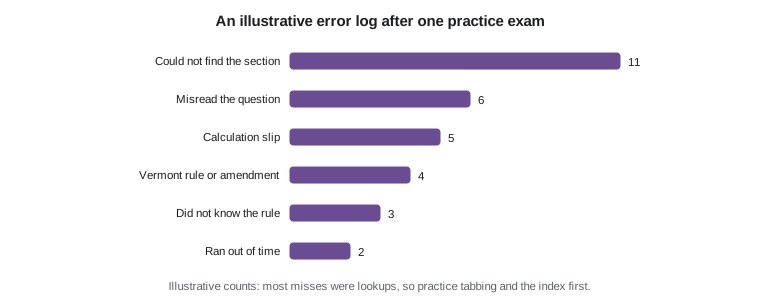
| Reason for the miss | Fix |
|---|---|
| Could not find the section | Drill the index and tabs; practice finding ten sections in ten minutes |
| Misread the question | Underline the ask; read the last sentence first; watch for not and except |
| Calculation slip | Write every step; check units; recompute with a second method |
| Vermont rule or amendment | Review the statute and rules summary sheet; learn section numbers |
| Did not know the code rule | Study the article; work five more questions on it |
| Ran out of time | Use the three-pass method; skip faster on pass one |
Building speed with the code book
On an open book exam, speed with the book is often the difference between passing and failing. The core skill is knowing which article covers a subject without looking, then knowing how that article is organized. Nadia's drill is simple: Hal or Corinne reads her a subject, such as the working space in front of a panelboard, the ampacity adjustment for more than three current-carrying conductors, the grounding electrode conductor for a given service, or the GFCI requirement in a dwelling basement, and she times herself finding the governing section. At first each lookup took more than two minutes. By the fourth week most took under forty seconds.
The index is the second tool. When a subject does not suggest an article, the index usually does, and learning the index's habits, such as listing items under the equipment rather than the location, saves time. Chapter 9 tables and the informative annexes are the third tool, especially for conduit fill and calculation examples.
Pacing a five-hour exam
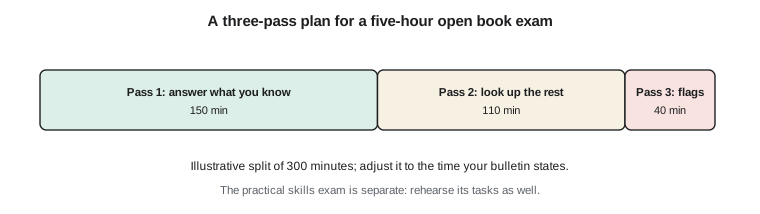
Lesson 4 described the reported format: 105 questions in five hours. The three-pass method fits that format well. On the first pass, the candidate answers every question she can answer from knowledge or with a quick lookup, and marks the rest. On the second pass, she works the marked questions that need longer lookups or calculations. On the third pass, she reviews flagged answers and makes sure every question has an answer, because an unanswered question is always wrong. Nadia's illustrative split is 150 minutes for the first pass, 110 for the second and 40 for the third, which leaves room for the slow questions without sacrificing the easy ones.
# Three-pass pacing plan (illustrative; adjust to your bulletin)
total_minutes = 300
questions = 105
plan = {"pass 1": 150, "pass 2": 110, "pass 3": 40}
assert sum(plan.values()) == total_minutes
pass1_target = 70     # questions answered on pass 1
print(f"Pass 1 pace: {plan['pass 1'] / pass1_target:.1f} min per question for {pass1_target} questions")
print(f"Pass 2 pace: {plan['pass 2'] / (questions - pass1_target):.1f} min per question for the rest")
for name, minutes in plan.items():
print(name, minutes, "minutes")Pass 1 pace: 2.1 min per question for 70 questions Pass 2 pace: 3.1 min per question for the rest pass 1 150 minutes pass 2 110 minutes pass 3 40 minutes
Answering a code question
A disciplined routine helps on every question. Read the last sentence first to see what is asked. Identify the subject and the article. Note the conditions in the question: dwelling or other, indoor or outdoor, the voltage, the conductor material, the number of conductors, the occupancy. Open the book to the article and find the section. Read the requirement and its exceptions. Then read the answer choices and pick the one the section supports. When two answers both look right, the question usually turns on a condition you passed over. When none looks right, recheck the conditions and the units.
Worked problem
A calculation under time pressure
A question asks for the minimum size of a copper conductor for a 50-ampere load after adjustment for six current-carrying conductors in a raceway, using the 90-degree column for the adjustment and the 75-degree column for termination limits. How should Nadia approach it on pass one?
Show solution
- It requires an adjustment factor, two ampacity columns and a comparison, so it is a pass-two question unless she is already fast at it.
- On pass one she marks it and moves on.
- On pass two she finds the adjustment factor in Article 310, applies it to the 90-degree ampacity of candidate sizes, checks the 75-degree limit for the terminations, and picks the smallest size that satisfies both.
Answer: Mark it on pass one and work it on pass two, using the steps taught in MELU-103.
The Vermont law questions
Law questions reward a summary sheet. Nadia's sheet, studied at home and not brought to the exam unless the bulletin allows it, lists the main Vermont numbers: two years as a licensed journeyman for the master; three-year licenses; fifteen hours of NEC education for masters and journeymen and eight for type S; the one-year grace period and 25-dollar late fee; the 1,000-dollar administrative penalty and 500-dollar unlicensed-work fine; five working days for inspection notice and for the inspector's response; twelve months for a work notice to expire; fifteen days to request reconsideration; and the master's 150-dollar three-year fee. It also lists the work notice rules, the complex structure definition, the energizing permit, the supervision rule and the section numbers of the Vermont NEC amendments.
The practical skills portion
The practical portion is required by the rules, and its tasks are described in the candidate information. Nadia's preparation follows three principles. Rehearse exactly the tasks listed, with the tools the bulletin allows. Time each rehearsal against the time limit the bulletin gives. And practice under observation, because working while someone watches is a skill in itself. She also prepares her own body: practical tasks done in winter after a long drive go better with warm hands, so she plans to arrive early and give herself time to settle.
The week before and the day of the exam
The last week is for review, not new material. Nadia plans one last timed practice exam six days out, a light review of her error log and summary sheet after that, and a full night's sleep the night before. She will pack the night before: photo identification matching her registration, the admission notice if the testing company issues one, the bound 2023 NEC with permanent tabs, a permitted calculator with fresh batteries and a spare if allowed, and anything else the bulletin lists. She will leave her phone in the truck or wherever the testing center directs. With January roads, she plans to leave early enough to arrive thirty minutes before check-in.
During the exam she will follow the three-pass plan, watch the clock at the checkpoints she set, and refuse to spend more than a few minutes on any single question during the first pass. If a question looks unfamiliar, she will mark it and move on; often a later question jogs the memory or points to the right article.
After the exam
The testing company reports scores as its candidate information describes. A candidate who passes completes any remaining licensing steps and pays any fee, and the license is issued. A candidate who does not pass should read the score report carefully. Under rule 3.4, the candidate must complete at least eight hours of education on the NEC, the fire alarm code or an exam prep course before retaking, and the score report shows which topics to choose. The candidate may retake twice on the same approval, within the three-year approval period. Nadia's plan, if she needs a retake, is to take a targeted course on her weakest area and sit again within about three months.
Using the score report
If Nadia passes in January, she will not need her score report for much beyond the license file. If she does not, the report becomes the most important study document she has. Testing companies typically report performance by content area rather than question by question, so the report tells her which areas were weakest but not which questions she missed. She plans to compare the weak areas with her practice-test error log; where the two agree, the fix is clear, and where they disagree, the real exam is telling her something her practice materials missed. The eight hours of required education before a retake would then go to the weakest area, chosen from the Board's approved list.
She has also planned what not to do after a failed attempt: book the retake for the next available date without changing anything. A retake is worth taking only after the study plan has changed in response to the score report.
A final word
The master license is a professional credential, and the exam is only the gate. The skills that carry a candidate through it, finding the governing rule quickly, reading the facts carefully, checking the calculation and refusing to guess when a lookup is possible, are the same skills that make a good master on the job. Nadia's preparation, if it works, will leave her with a license and with habits that serve Clarendon Ridge long after Hal has stepped back. Your preparation can do the same.
Common mistakes
MistakeTaking practice tests without reviewing the misses.
InsteadLog every miss and guess, classify the reason and fix it.
MistakeSpending ten minutes on one hard question early.
InsteadMark it on pass one and come back on pass two.
MistakeIgnoring the practical portion until the last week.
InsteadRehearse the listed tasks under time and observation for weeks.
MistakeLearning new topics the night before.
InsteadUse the last week for review and rest.
MistakeRetaking without the required education.
InsteadRule 3.4 requires eight hours before a retake.
Summary and key terms
- Use practice exams to find gaps, and keep an error log with a fix for each kind of miss.
- Speed with the code book comes from knowing the articles, the index and the tables.
- A three-pass plan fits the reported 105-question, five-hour format.
- Rehearse the practical skills tasks the bulletin lists, under time and observation.
- Plan the day: identification, permitted references, calculator, early arrival and every question answered.
- Error log
- A record of each missed or guessed practice question, its topic, the reason and the fix.
- Three-pass method
- Answer what you know, look up the rest, then check flagged answers.
- Checkpoint
- A planned question number to reach by a given minute.
- Summary sheet
- A one-page list of state rules and numbers for study.
- Score report
- The testing company's report showing performance by topic.
Practice problems
Work each problem on paper first, then reveal the answer to check.
What should Nadia do with a question she cannot answer in a minute on pass one?
Show answer
Mark it and move on to the next question.
What are the three passes?
Show answer
Answer what you know, look up the rest, check flagged answers.
What is the most valuable use of a practice exam?
Show answer
Finding gaps through a careful review of every miss.
What must a candidate complete before a retake?
Show answer
At least eight hours of NEC, fire alarm code or exam prep education.
Should she leave questions blank?
Show answer
No; an unanswered question is always wrong.
Lesson quiz · 5 questions
Score 60% or more to complete this lesson.
Create a free account to save your progress, take quizzes and earn a certificate.