
MELU-320 · Lesson 11 of 12 · 20 min
Renewal and continuing education
▶ Video coming soon A video version of this lesson is on the way.
Hal's license renews every three years, and every cycle Corinne puts the same note on the shop calendar six months before the expiration date: fifteen hours, energy module, fee. Nadia's journeyman license follows the same cycle, and once she is a master, so will her master license. This lesson covers how Vermont licenses expire and renew, the continuing education rules for masters, journeymen and type S journeymen, what happens when a license lapses, and the routes for licensees moving into or out of Vermont.
A three-year license
Section 908 of Title 26 makes every electrician's license valid for three years. A license expires on the last day of a month the Board sets, and the Board renews a valid license when it receives the renewal application and fee on or before the expiration date, together with proof that the licensee has met the continuing education requirement. Renewals are filed online through the state's licensing portal, as the Division's page explains. The renewal fee for a master is the same 150-dollar three-year fee that section 905 sets for the license, and journeyman and type S licenses are 115 dollars each, with a separate fee for each type S field. Fees can change, so check the current amount before renewing.
Continuing education hours
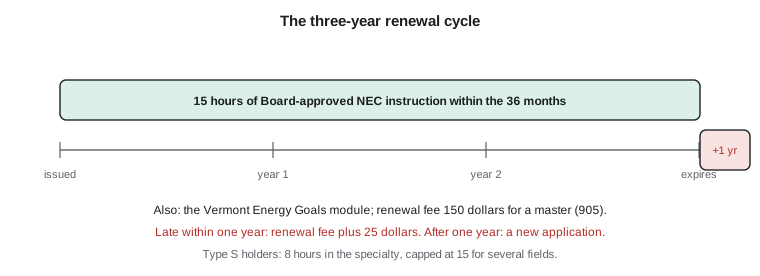
Section 908(b) and rule 3.5(b) set the continuing education requirement. A master or journeyman must complete fifteen hours of Board-approved instruction on the National Electrical Code during the preceding thirty-six months. A type S journeyman must complete eight hours of Board-approved instruction on the licensee's specialty. A licensee who holds several type S licenses need not exceed fifteen hours in total, and the rules set an eight-hour cap for a licensee who holds only certain specialty combinations. The Board approves courses and keeps a searchable list of approved electrical seminars, and the Division's page links to it.
The Board also requires the Vermont Energy Goals module. Section 905 requires applicants and renewing licensees to complete a module of no more than two hours on the state's energy goals, and the Division's page says the requirement applies to new licenses and renewals after July 1, 2021, with the completion certificate submitted with the application. A secondary source adds a sequencing rule some providers mention: a licensee who has missed earlier code update courses should complete them before taking a course on the newest edition. Treat that as a provider's advice to confirm with the Board, not as a statutory rule.
| License | Hours per three-year cycle | Subject | Plus |
|---|---|---|---|
| Master | 15 | National Electrical Code | Energy Goals module |
| Journeyman | 15 | National Electrical Code | Energy Goals module |
| Type S journeyman, one field | 8 | The specialty | Energy Goals module |
| Several type S fields | No more than 15 in total | The specialties | Energy Goals module |
Planning the hours
Fifteen hours over three years is a light load, and that is exactly why licensees miss it. The most common approach is a single fifteen-hour code update course on the current NEC edition, often offered in the year after Vermont adopts a new edition. Because Vermont adopted the 2023 NEC in rules effective November 5, 2025, many Vermont electricians are taking 2023 code update courses in this cycle. Courses are offered in person by trade schools, contractor associations, union training centers and supply houses, and online by approved providers. A licensee should check that a course is on the Board's approved list before paying for it, keep the certificate, and record the course date to confirm it falls inside the thirty-six months before expiration.
Corinne keeps a simple spreadsheet for the company: each licensee, license type, expiration date, hours completed with dates and provider, and whether the energy module certificate is on file. When Nadia becomes a master, her row will change license type but not her cycle.
# Continuing education check (illustrative)
from datetime import date
expires = date(2028, 3, 31)
window_start = date(expires.year - 3, expires.month, expires.day)
courses = [("2023 NEC code update", date(2026, 2, 14), 15)]
energy_module_done = True
hours = sum(h for name, d, h in courses if window_start <= d <= expires)
print("Window:", window_start, "to", expires)
print("Hours inside the window:", hours, "of 15")
print("Ready to renew:", hours >= 15 and energy_module_done)Window: 2025-03-31 to 2028-03-31 Hours inside the window: 15 of 15 Ready to renew: True
Late renewal and lapse
Rule 3.5 and section 905 provide a grace path. A license that has lapsed for no more than one year may be renewed by paying the renewal fee plus a late fee of 25 dollars and meeting the continuing education requirement. After a license has been lapsed for more than a year, the licensee must file a new application and go through the licensing procedure again, although the Board may waive re-examination for hardship. During the lapse, the license is not valid, so the holder may not do licensed work. For a master, that also means no work notices for complex structures, which can stop a company's commercial work overnight.
Worked problem
A late renewal
Owen's journeyman license expired on December 31, 2026, while he was working out of state. He returns in April 2027 with his fifteen hours and energy module completed. What must he do?
Show solution
- The license lapsed on December 31, 2026.
- April 2027 is within one year of expiration.
- He may renew by paying the renewal fee plus the 25-dollar late fee, with proof of the education.
- Until the renewal is processed, he may not do licensed work.
Answer: Renew under the one-year grace path with the late fee; do no licensed work until it is renewed.
Moving into Vermont
Section 906 lets the Board license an applicant without examination in some cases. One route is reciprocity with states whose licensing standards are substantially equivalent and that extend the same courtesy to Vermont licensees. Another is endorsement of a licensee from another state who has held the license in good standing for at least three years. The rules also refer to the New England regional arrangement among state electrical boards, under which the 2025 rules describe a shorter good-standing period for licensees of member states. And section 906 includes routes for veterans and service members, with hour and year requirements for the journeyman license. Secondary sources list Maine and New Hampshire as states with which Vermont has reciprocity; confirm the current list with the licensing office, because reciprocity agreements change.
Section 907 adds that the Board may credit out-of-state journeyman experience, military experience and prior qualifications toward a Vermont license, and that foreign credentials are assessed by the Commissioner. An electrician moving to Vermont should start by asking which route fits, because the difference between a license by endorsement and an application under the comparable experience route in section 902 can be months.
Working outside Vermont
A Vermont master who takes a job in New Hampshire, New York, Massachusetts or Maine needs whatever license that state requires, and the rules there are that state's. A reciprocity agreement may make the other state's license easier to get, but it does not make the Vermont license valid across the border. The MELU courses for those states describe their systems. Clarendon Ridge occasionally works across the New York line near Fair Haven, and for those jobs it confirms the local licensing and permit rules on the New York side before bidding.
Changes and records
The Division's page provides an online form for address changes and replacement licenses, and section 905 sets a replacement license fee of 20 dollars. A licensee should keep a current mailing address with the licensing office, because renewal notices and Board correspondence go there, and a missed notice is not an excuse for a lapsed license. Licensees should also keep their continuing education certificates for at least the cycle they cover and preferably longer, in case the Board audits.
What the Board does with continuing education
Section 901 asks the Board to review its continuing education requirements every five years, and the Board approves the providers and courses that count toward renewal. Providers submit course outlines, instructor qualifications and hours for approval, and approved courses appear on the searchable list the Division's page links to. A licensee who takes an unapproved course, however good it is, may find at renewal that the hours do not count. Courses offered outside Vermont may or may not be approved for Vermont credit, so a licensee who works in several states should check each state's list rather than assume one course counts everywhere.
The Board may audit renewals and ask licensees to produce certificates. Keeping certificates for the whole cycle, and a little longer, is the simplest protection. Corinne scans each certificate into the company's files the week it arrives and keeps the paper copy in the licensee's folder.
Planning a master's cycle
A master's three-year cycle is a good time to plan beyond the minimum. Fifteen hours on the current NEC keeps the license valid, but a master who designs services, fire alarm systems and lightning protection has reasons to take more. Nadia's plan for her first cycle as a master includes the fifteen-hour code update, a fire alarm course, a course on arc flash risk assessment, and a short course on the business law topics in this course, most of which will not count toward the fifteen NEC hours but will make her better at the job. She also plans to attend at least one public hearing the next time the Board proposes new rules, so that she understands the changes before they take effect.
Hal's advice on continuing education was blunt: do not wait for the last month. Courses fill, schedules change, and the energy module takes longer to find than it does to complete. Corinne's six-month reminder exists because Hal once spent the last week of a cycle driving to Burlington for the only course he could still get into.
License status and the public
License status is public information that customers, general contractors and inspectors can check. A master whose license has lapsed may find that a general contractor's prequalification check flags it, or that an inspector will not validate a work notice in the master's name. Keeping the license current is part of keeping the company in business.
Sample renewal timeline
Corinne's renewal timeline for a master whose license expires on March 31 runs like this. In September of the year before, six months out, she confirms that the fifteen hours are complete or scheduled and that the energy module certificate is current. In December she checks the Board's approved list for the course the licensee plans to take and confirms the date. In January she confirms the course certificate is in the file. In February, about six weeks before expiration, the licensee files the online renewal with the fee and the certificates. In early March she confirms the renewed license appears in the state's lookup and that the new card has arrived. If anything is still missing by mid-March, she treats it as an emergency, because a lapse on April 1 would stop every new work notice in that master's name.
The same timeline works for journeymen and type S licensees, with the hours adjusted. Its value is not the exact months but the habit of starting early and checking each step.
Common mistakes
MistakeThinking Vermont licenses renew every two years.
InsteadSection 908 makes them valid for three years.
MistakeTaking any electrical course for the fifteen hours.
InsteadThe hours must be Board-approved instruction on the National Electrical Code.
MistakeForgetting the Energy Goals module.
InsteadIt is required for renewals as well as new licenses.
MistakeWorking on a lapsed license during the grace period.
InsteadThe license is not valid until renewed; do no licensed work.
MistakeAssuming reciprocity makes a Vermont license valid in another state.
InsteadEach state requires its own license; reciprocity only eases the application.
Summary and key terms
- Vermont electricians' licenses are valid for three years and expire on the last day of a month the Board sets.
- Masters and journeymen need fifteen hours of Board-approved NEC instruction in the thirty-six months before renewal.
- Type S journeymen need eight hours in their specialty, capped at fifteen for several fields.
- Every renewal requires the Vermont Energy Goals module.
- A license lapsed up to one year renews with a 25-dollar late fee; after that, a new application is needed.
- Renewal cycle
- The three-year period of validity of a Vermont electrician's license.
- Code update course
- A Board-approved course on the current NEC, the usual way to earn fifteen hours.
- Grace path
- Renewal within one year after expiration with a 25-dollar late fee.
- Endorsement
- Licensure without examination for a licensee from another state in good standing for the required period.
- Reciprocity
- An agreement under which states license each other's licensees on substantially equivalent standards.
Practice problems
Work each problem on paper first, then reveal the answer to check.
How many hours does a master need each cycle?
Show answer
Fifteen hours of Board-approved NEC instruction.
What else is required besides the hours?
Show answer
The Vermont Energy Goals module, the renewal application and the fee.
A type S licensee holds one specialty. How many hours?
Show answer
Eight hours in the specialty.
What is the late fee for renewal within one year of expiration?
Show answer
25 dollars.
How long must an out-of-state licensee generally have held a license for endorsement under section 906?
Show answer
At least three years in good standing, with a shorter period for regional member states under the rules.
Lesson quiz · 5 questions
Score 60% or more to complete this lesson.
Create a free account to save your progress, take quizzes and earn a certificate.