
MELU-319 · Lesson 9 of 12 · 19 min
Contracts and construction liens in Utah
▶ Video coming soon A video version of this lesson is on the way.
In October, the general contractor on the Layton townhomes stopped answering Janelle's calls. Wasatch Ridge had finished its work at the end of September, the city had approved the final inspections and the company was still owed its last progress payment and its retainage. Janelle opened the job folder and found what she hoped to find: a copy of the preliminary notice she had filed on the State Construction Registry in early April, three weeks after the crew started on site. "We're protected," she told Lorraine. "But the clock is running, and the general contractor filed a notice of completion, so it's running faster."
This lesson covers the contract that defines the work and the payment, and Utah's preconstruction and construction lien law in Title 38, Chapter 1a, which protects people who improve real property and are not paid. It explains the State Construction Registry, preliminary notices, notices of completion, the deadlines for recording and enforcing a lien, the protections for owner-occupied residences and the status of the Residence Lien Recovery Fund in 2026.
The contract comes first
Every payment right starts with the contract. A sound electrical subcontract or prime contract names the parties and the property, describes the scope by reference to drawings and specifications, sets the price and the payment schedule, says how much retainage may be held and when it is released, describes how change orders are requested and approved, and says what happens if a party does not pay or does not perform. On residential work for homeowners, DOPL publishes a template residential construction agreement and a homeowner guide, and a written contract matters for a reason this lesson explains under the owner-occupied residence rules.
Change orders deserve special care. Extra work done on a verbal request is the most common source of payment disputes, and a lien claim is limited to amounts the claimant can show are owed. Lorraine's rule is that no crew starts extra work without a signed change order or, in an emergency, a written confirmation by email or text that she follows with a change order within a day.
Preconstruction and construction liens
Utah's lien statute is titled Preconstruction and Construction Liens, and it uses those terms rather than the older phrase mechanics' liens. A preconstruction lien protects people who provide preconstruction services, such as design work, before construction begins. A construction lien protects people who provide construction work, including labor, materials and equipment, that improves real property. An electrical contractor or subcontractor who is not paid can claim a construction lien on the property it improved, if it has followed the statute's notice and filing steps.
The State Construction Registry
Utah handles construction notices through the State Construction Registry, an online database overseen by DOPL. Owners, contractors, subcontractors, suppliers, lenders and designers file notices there and search them. On government projects, the original contractor files a notice of commencement, generally within 15 days after starting work, which lets subcontractors find the project. On private and public projects alike, the registry holds the preliminary notices and notices of completion that drive lien rights and deadlines.
The preliminary notice
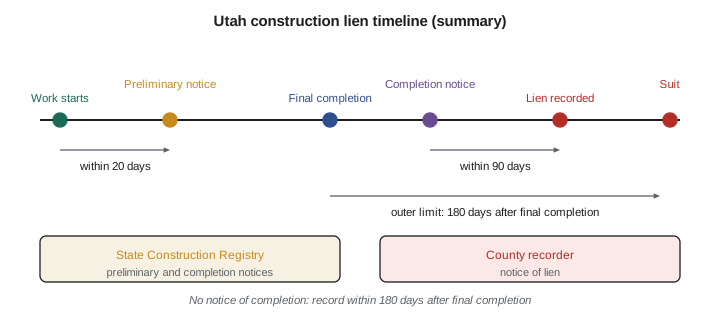
Section 38-1a-501 requires a person who wants to preserve the right to claim a construction lien to file a preliminary notice on the registry no later than 20 days after the day the person begins providing construction work on the project. A person who does not file a required preliminary notice may not claim a construction lien. A late preliminary notice can still help, but not fully: a lien cannot cover work performed before five days after the late notice is filed, and a preliminary notice filed more than 10 days after a notice of completion has no effect.
Janelle files a preliminary notice for every job, whatever its size, within the first week. On the Layton townhomes the crew started on March 16, 2026, so the 20-day deadline was April 5, and she filed on April 2. Filing early costs nothing, and it is the one step that can never be fixed after the fact.
Final completion and the notice of completion
When a project is finished, the owner or original contractor may file a notice of completion on the registry, typically after the final inspection, the certificate of occupancy or substantial completion of the work. The notice does two things. It cuts off late preliminary notices filed more than 10 days afterward, and it shortens the time to record a lien.
Recording the lien
Section 38-1a-502 sets the deadline to record a notice of construction lien with the county recorder. If no notice of completion is filed, the lien must be recorded within 180 days after final completion of the original contract. If a notice of completion is filed, the lien must be recorded within 90 days after the notice of completion is filed, but never later than 180 days after final completion of the original contract. A subcontractor who provides substantial work after the certificate of occupancy or final inspection has a separate deadline measured from final completion of that subcontractor's work.
| Step | Deadline (summary of Title 38, Chapter 1a) | Where it is filed |
|---|---|---|
| Filing a notice of commencement (government projects) | Generally within 15 days after work starts | State Construction Registry |
| Preliminary notice | No later than 20 days after the claimant starts work | State Construction Registry |
| Late preliminary notice | Covers work from five days after filing; void if more than 10 days after a notice of completion | State Construction Registry |
| Record the lien, no notice of completion | Within 180 days after final completion of the original contract | County recorder |
| Record the lien, notice of completion filed | Within 90 days after the notice, never later than 180 days after final completion | County recorder |
| Enforce the lien | Within the period set in the statute after recording, commonly summarized as 180 days | District court, with a lis pendens |
# Lien deadlines for the Layton townhomes (study aid, invented dates)
import datetime as dt
start = dt.date(2026, 3, 16)               # crew begins work
final_completion = dt.date(2026, 9, 30)    # original contract finished
notice_of_completion = dt.date(2026, 10, 9)
prelim_due = start + dt.timedelta(days=20)
late_prelim_cutoff = notice_of_completion + dt.timedelta(days=10)
cap = final_completion + dt.timedelta(days=180)
record_by = min(notice_of_completion + dt.timedelta(days=90), cap)
print("preliminary notice due:", prelim_due)
print("late preliminary notices void after:", late_prelim_cutoff)
print("record the lien by:", record_by, "(outer limit", cap, ")")preliminary notice due: 2026-04-05 late preliminary notices void after: 2026-10-19 record the lien by: 2027-01-07 (outer limit 2027-03-29 )
The output is the date Janelle wrote in red on the folder. Because the general contractor filed a notice of completion on October 9, 2026, the lien must be recorded by January 7, 2027, well before the 180-day outer limit in March 2027. As of mid-November there are still weeks left, but not many once a lawyer needs time to prepare the filing.
Enforcing the lien
Recording a lien preserves the claim; it does not collect the money. If the debt is not paid, the claimant must file an action to enforce the lien in court and record a lis pendens, a notice that the action is pending, within the time Section 38-1a-701 allows. Lien guides commonly summarize that period as 180 days after the lien is recorded. A lien that is not enforced in time becomes void. Utah law also penalizes abuse: a person who records a lien for more than is owed, or without a good faith basis, can face liability, so the amount claimed must be supportable.
Owner-occupied residences
Utah gives special protection to owners of owner-occupied residences, as Title 38, Chapter 11 defines them. A notice of lien on an owner-occupied residence must include a statement describing the steps the owner may take to require the claimant to remove the lien. The key protection is that an owner who had a written contract with a licensed contractor and paid that contractor in full according to the contract can obtain a certificate of compliance from DOPL. Once DOPL issues the certificate, the lien claimant must remove the lien within 15 days. The unpaid subcontractor must then pursue the contractor who failed to pay, not the homeowner.
For an electrical subcontractor on a single-family home, that means the lien is a weak tool against an owner who paid in full. The protection there is careful credit management: knowing the general contractor, keeping invoices current and acting quickly when payments slow down.
The Residence Lien Recovery Fund in 2026
For decades Utah also had the Residence Lien Recovery Fund, created in 1994 and financed by contractor licensing fees, which could pay qualified subcontractors and suppliers who were left unpaid on qualifying residences when the owner had paid in full. By 2017 claims had dropped sharply, which DOPL has linked in part to the State Construction Registry, and the Legislature stopped funding the program. In June 2026 DOPL announced that the fund was depleted. DOPL's fund page says it still accepts applications to preserve a claimant's place in line but that there is a high probability those claims will not be paid unless the fund is replenished. Older study materials that describe the fund as a working safety net are out of date.
Worked problem
Protecting Wasatch Ridge's Layton payment
The general contractor owes Wasatch Ridge its last progress payment and retainage on the Layton townhomes, which are being built for sale and are not owner-occupied. A notice of completion was filed on October 9, 2026. What should the company do now?
Show solution
- Confirm the preliminary notice of April 2 is on the registry and covers the project.
- Calculate the recording deadline: 90 days after the notice of completion, January 7, 2027, within the 180-day outer limit.
- Send a written demand for payment and review the contract's dispute terms.
- Engage a construction lawyer now to prepare a notice of lien for an amount the records support and record it with the county recorder before the deadline.
- If payment still does not come, enforce the lien in court within the statutory period after recording.
Answer: Confirm the notice, compute the 90-day deadline, demand payment and record and enforce the lien on time with a lawyer's help.
Lien waivers and releases
Payment on a construction project usually comes with paperwork. General contractors, owners and lenders ask subcontractors for lien waivers and releases when they pay, and Title 38, Chapter 1a includes provisions on waivers and releases, including statutory forms for conditional and unconditional waivers on progress and final payments. Use the form the statute provides when the statute calls for one, read every waiver before signing it, and match each waiver to the payment it covers. A conditional waiver takes effect only when the payment actually clears; an unconditional waiver gives up the lien rights it covers whether or not the money arrives. Janelle signs unconditional waivers only after the check has cleared the bank.
Waivers also need to be tracked. Janelle logs each waiver the company signs with its date, amount and type, and checks the log before recording any lien, because a lien cannot claim amounts the company has already released.
Common mistakes
MistakeSkipping the preliminary notice on small jobs.
InsteadWithout a required preliminary notice, the claimant may not claim a construction lien.
MistakeCounting 180 days from completion when a notice of completion was filed.
InsteadWith a notice of completion, the lien must be recorded within 90 days after it, within the 180-day outer limit.
MistakeRelying on the Residence Lien Recovery Fund.
InsteadDOPL announced in June 2026 that the fund is depleted; claims are unlikely to be paid.
MistakeTreating a recorded lien as collected money.
InsteadThe lien must be enforced in court within the statutory period or it becomes void.
Summary and key terms
- Utah's lien statute, Title 38, Chapter 1a, covers preconstruction and construction liens.
- Claimants file a preliminary notice on the State Construction Registry within 20 days after starting work.
- A lien is recorded within 180 days after final completion, or within 90 days after a notice of completion, within the 180-day limit.
- An owner of an owner-occupied residence who paid a licensed contractor in full under a written contract can obtain a DOPL certificate of compliance that requires the lien's removal.
- The Residence Lien Recovery Fund was announced as depleted in June 2026.
- Construction lien
- A claim against real property for unpaid construction work that improved it.
- State Construction Registry
- The online database, overseen by DOPL, where construction notices are filed.
- Preliminary notice
- The notice a claimant files within 20 days after starting work to preserve lien rights.
- Completion notice
- A registry filing after a project is finished that shortens the lien recording period.
- Lis pendens
- A recorded notice that a lawsuit affecting the property is pending.
Practice problems
Work each problem on paper first, then reveal the answer to check.
What does Utah's statute call the liens electricians claim?
Show answer
Construction liens (Title 38, Chapter 1a, Preconstruction and Construction Liens).
When is the preliminary notice due?
Show answer
No later than 20 days after the claimant starts work.
With a notice of completion filed, when must the lien be recorded?
Show answer
Within 90 days after the notice, and no later than 180 days after final completion.
What did DOPL announce about the Residence Lien Recovery Fund in June 2026?
Show answer
That it is depleted.
Lesson quiz · 5 questions
Score 60% or more to complete this lesson.
Create a free account to save your progress, take quizzes and earn a certificate.