
MELU-319 · Lesson 5 of 12 · 19 min
The NEC as adopted in Utah and state amendments
▶ Video coming soon A video version of this lesson is on the way.
Two weeks into studying, Mateo hit a practice question about receptacles on a kitchen island and answered it straight from his 2023 NEC. He got it wrong. The explanation pointed him to Title 15A of the Utah Code, where the Legislature rewrote that requirement for Utah. "That's the trap," Lorraine said. "The book on your shelf is the starting point. The law says which edition, and the law says what Utah changed. Four questions on the exam are about the Utah amendments alone, and the inspectors use them every day."
This lesson explains how Utah adopts the National Electrical Code, which edition is in force in 2026, where the statewide amendments live, what kinds of changes they make, how local governments fit in and how to tell which edition governs a particular job. It cites sections by number only; the NEC text itself is in your copy of NFPA 70, and the amendment text is in the Utah Code.
Adoption by the Legislature
Many states adopt construction codes by agency rule. Utah adopts them by statute. The State Construction and Fire Codes Act, Title 15A of the Utah Code, creates the State Construction Code and lists the codes that make it up in 15A-2-103. That list names the International Building Code, the International Residential Code and the other International Code Council codes, the plumbing and mechanical codes and the National Electrical Code issued by the National Fire Protection Association. Each entry names an edition.
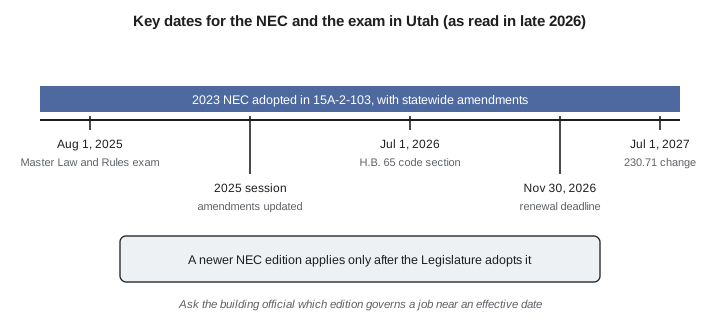
As of 2026, the NEC entry in 15A-2-103 names the 2023 edition. The 2026 General Session passed H.B. 65, Construction Code Amendments, which updated several of the International Code Council codes and took effect for that section on July 1, 2026; the bill did not change the NEC entry. That matches the exam bulletin, which lists the 2023 NEC as the reference. NFPA has since published a 2026 edition of the NEC, but a new edition has no force in Utah until the Legislature adopts it, so a 2026 NEC on a contractor's shelf is a study aid, not the law.
How the code changes
Title 15A also sets out how the code is updated. The state's construction code commission, called the commission in the statute, reviews new editions and proposed amendments with input from the trades, building officials and the public, and reports its recommendations to the Legislature's Business and Labor Interim Committee. The committee can prepare a bill for the next general session, and the Legislature then adopts or amends the code by statute. The commission may amend the code by rule only in narrow emergency situations, such as imminent peril to public health or safety, and those emergency amendments are repealed on July 1 after the next general session unless the Legislature adopts them.
For a master, the practical effect is that code changes arrive with bills, and bills have effective dates. Lorraine reads the construction code bill each session, or the summaries her trade association circulates, and marks the effective dates on the shop calendar. A change that passes in March often takes effect on July 1, so jobs permitted before and after that date may fall under different rules.
The statewide amendments
Title 15A, Chapter 3, Part 6 is titled Statewide Amendments to National Electrical Code. Its first section, 15A-3-601, sets general provisions, including how the electrical requirements apply to dwellings built under the International Residential Code and to all other installations, and it lists the amendments to particular NEC sections. Because every jurisdiction in the state enforces the same amendments, they are as much a part of the Utah code as the NEC sections they change.
The amendments, as the statute read in 2026, change requirements in several areas. In Article 210 they modify parts of the ground-fault protection rules in 210.8, rewrite the island and peninsula receptacle provisions in 210.52(C) and delete or modify requirements in sections including 210.12 and 210.65. They delete or modify requirements in 215.18, 225.42 and 230.67. They replace 230.71 on the number and kind of service disconnects, with one subsection scheduled to change on July 1, 2027. They replace 314.27(C) on boxes that support ceiling-suspended fans, adjust the bending radius language in 334.24 and 338.24, change 334.80, adjust part of 406.9(B)(2) and replace 700.3(A) on testing of emergency systems witnessed by the authority having jurisdiction.
| NEC article | Sections affected by Utah amendments (2026 reading) | General subject |
|---|---|---|
| 210 | 210.8, 210.12, 210.52(C), 210.65 | Branch-circuit protection and receptacle locations |
| 215 and 225 | 215.18, 225.42 | Feeders and outside branch circuits and feeders |
| 230 | 230.67, 230.71 | Services and service disconnects |
| 314 | 314.27(C) | Boxes supporting ceiling-suspended fans |
| 334 and 338 | 334.24, 334.80, 338.24 | Cable bending radius and ampacity provisions |
| 406 | 406.9(B)(2) | Receptacles in wet locations |
| 700 | 700.3(A) | Testing of emergency systems |
# Counting Utah statewide NEC amendments by article (study aid, 2026 reading)
amended = ["210.8(A)", "210.8(D)", "210.8(F)", "210.12", "210.52(C)", "210.65",
           "215.18", "225.42", "230.67", "230.71", "314.27(C)", "334.24",
           "334.80", "338.24", "406.9(B)(2)", "700.3(A)"]
by_article = {}
for s in amended:
    art = s.split(".")[0]
    by_article[art] = by_article.get(art, 0) + 1
for art, n in sorted(by_article.items(), key=lambda kv: (-kv[1], kv[0])):
    print("Article", art.ljust(4), "#" * n, n)
print("sections touched:", len(amended))Article 210 ###### 6 Article 230 ## 2 Article 334 ## 2 Article 215 # 1 Article 225 # 1 Article 314 # 1 Article 338 # 1 Article 406 # 1 Article 700 # 1 sections touched: 16
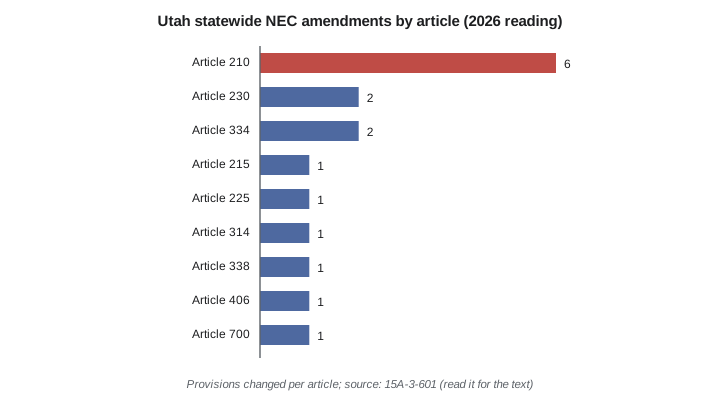
The count explains Lorraine's advice. Article 210 carries more Utah changes than any other article, and those are the provisions an electrician uses on almost every dwelling and many commercial jobs. Mateo placed a permanent tab at each amended section in his NEC and a matching tab in his printout of 15A-3-601, so that whenever he looked up one of those sections he would see at once that Utah had changed it.
Local governments and the statewide code
Utah's code is statewide in a strong sense. Under 15A-1-204, political subdivisions generally may not adopt or enforce a rule on a subject the State Construction Code addresses if the local rule is more restrictive, a limit that has applied since December 1, 2016. The statute lists narrow exceptions, such as enforcing federal law, rules for buildings a public entity owns or uses, and certain rules adopted earlier to address conditions likely to cause imminent injury or death. For electricians the result is simple: the amendments are state amendments, and a city or county building official enforces the same code and the same amendments as every other jurisdiction.
Local governments still matter in other ways. They decide how to staff and run their building departments, set permit fees, schedule inspections and interpret the code in the field within the code's own provisions for the authority having jurisdiction. A building official's interpretation of an ambiguous section can differ from a neighbor's, and an experienced master learns those habits. But a building official cannot write a new electrical requirement into a local ordinance that the statewide code does not contain.
Which edition applies to a job
When the Legislature adopts a new edition, jobs in progress do not change codes overnight. The general practice is that the code in effect when the permit application is made governs the work under that permit, but the building official for the job is the authority on how a transition is handled. Before bidding a job that will be permitted around an effective date, ask the building department which edition it will apply and get the answer in writing if the difference matters to the price.
The exam follows its own reference list. The bulletin lists the 2023 NEC and the Utah amendments, so answer exam questions from those, even if a newer edition has been published or adopted after the bulletin. If a bulletin issued after a future adoption lists a different edition, study that one.
Worked problem
Answering the island receptacle question
A practice question asks what is required for receptacles at a kitchen island in a new Utah dwelling. Mateo's first answer came from the 2023 NEC as printed. How should he work it now?
Show solution
- Recognize that 210.52(C) is on the list of Utah-amended sections, which his tab in the NEC now flags.
- Turn to 15A-3-601 and read the Utah replacement text for 210.52(C)(2) and (3).
- Answer from the Utah text, which governs in every Utah jurisdiction, rather than from the unamended NEC.
- Note the general subject for review: Utah rewrote the island and peninsula receptacle provisions.
Answer: For any amended section, the Utah text in Title 15A controls; check the amendment list before answering from the NEC alone.
Keeping current between sessions
Because Utah changes its code through legislation, a master's code knowledge has a season. Bills affecting the State Construction Code are introduced in the general session that begins in January, and enrolled bills show their effective dates. Lorraine's habit is simple: in late March, after the session ends, she reads the summary of the construction code bill, notes any change to 15A-2-103 or to Part 6 of Chapter 3, and adds the effective dates to the shop calendar. In July she checks that the Legislature's online code shows the changes, and she updates the company's tabbed code books and the job checklists her foremen use.
Trade associations, the state's code commission and building officials also publish summaries, and DOPL's continuing education rule rewards staying current: the NEC core hours must cover the code as adopted or proposed for adoption. A course on proposed changes can therefore count toward renewal and prepare a contractor for the next adoption at the same time.
| When | What to check |
|---|---|
| January to March | Construction code bills in the general session |
| Late March | Enrolled bill summaries and effective dates |
| July 1 | Common effective date; confirm the online code shows the changes |
| Before bidding | Which edition and amendments the building official will apply |
Future dates deserve care. The 2026 reading of 15A-3-601 schedules one change to the 230.71 amendment for July 1, 2027. Until that date arrives, the current text applies, and a new session could change the plan again. A master who bids work that will be permitted after a scheduled change should note the date in the estimate and confirm it with the building official.
Residential work and the IRC
Many Wasatch Ridge jobs are one- and two-family dwellings and townhomes built under the International Residential Code, which Utah also adopts in 15A-2-103. The general provisions of 15A-3-601 address how the electrical requirements apply to dwellings built under that code and to all other installations, and the residential code has its own Utah amendments elsewhere in Title 15A. On a residential job, read both: the NEC as amended for Utah and any residential code provisions the statute applies, and ask the building official if the two seem to point in different directions.
The same discipline applies to the exam. The bulletin names the references and editions it tests, and the questions are written from those. If the Legislature adopts a new edition after your bulletin was published, the exam does not change until the provider issues a new bulletin and outline, so study from the bulletin you booked under and check for a newer version shortly before test day.
Common mistakes
MistakeAssuming a newly published NEC edition is in force.
InsteadA new edition applies in Utah only when the Legislature adopts it in 15A-2-103.
MistakeTreating Utah amendments as local amendments.
InsteadThey are statewide amendments in Title 15A, Chapter 3, Part 6, enforced everywhere in the state.
MistakeAnswering amended sections from the NEC alone.
InsteadCheck 15A-3-601 first; the Utah text controls for the sections it changes.
MistakeExpecting a city to add its own electrical requirements.
InsteadSince December 1, 2016, political subdivisions generally may not adopt more restrictive rules on subjects the code covers.
Summary and key terms
- Utah adopts the NEC by statute in 15A-2-103; as of 2026 the adopted edition is 2023.
- Statewide NEC amendments are in Title 15A, Chapter 3, Part 6, beginning with 15A-3-601.
- The amendments cluster in Article 210 and also change sections in Articles 215, 225, 230, 314, 334, 338, 406 and 700.
- Local governments generally may not adopt more restrictive rules on subjects the State Construction Code covers.
- The exam uses the 2023 NEC and the Utah amendments listed in the bulletin.
- State Construction Code
- The set of codes adopted by statute under Title 15A for use throughout Utah.
- 15A-2-103
- The section that lists the adopted codes and their editions.
- 15A-3-601
- The section that sets general provisions and statewide amendments to the NEC.
- Political subdivision
- A city, county or other local government unit.
- Authority having jurisdiction
- The official or office responsible for enforcing the code on a job, usually the building official.
Practice problems
Work each problem on paper first, then reveal the answer to check.
Which NEC edition does 15A-2-103 name as of 2026?
Show answer
The 2023 edition.
Where are the Utah NEC amendments?
Show answer
Title 15A, Chapter 3, Part 6, beginning with 15A-3-601.
Which NEC article has the most Utah amendments?
Show answer
Article 210.
May a Utah city adopt a more restrictive electrical rule on a subject the code covers?
Show answer
Generally no, with narrow exceptions in 15A-1-204.
Lesson quiz · 5 questions
Score 60% or more to complete this lesson.
Create a free account to save your progress, take quizzes and earn a certificate.