
MELU-319 · Lesson 6 of 12 · 19 min
Permits, inspections and the inspection authority
▶ Video coming soon A video version of this lesson is on the way.
In March, Wasatch Ridge won the electrical contract for a twelve-unit townhome project in Layton and a tenant improvement for a physical therapy clinic in Kaysville. Lorraine asked Mateo to run both permits from application to final, with Janelle handling the paperwork. "You'll be the one signing for this soon," she said. "Learn who you're dealing with on each job and what they expect before the first wire goes in."
This lesson covers who issues electrical permits and inspects in Utah, how to identify the inspection authority for a job, what a typical permit and inspection sequence looks like, how corrections and reinspections work and how special projects, such as state buildings and emergency systems, change the picture. It also connects inspections to the business side, because a final inspection often marks the date that starts lien deadlines and releases retainage.
The inspection authority
In Utah, the State Construction Code is enforced locally. Each city and county with a building department acts through a building official, who has authority to issue permits, review plans, inspect work and approve or reject it. Title 15A uses the term compliance agency for the body that enforces the code in a jurisdiction. For electricians, the building official and the inspectors who work under that official are the authority having jurisdiction, the phrase the NEC uses throughout for the person who interprets and enforces its requirements.
Identifying the authority starts with the address. A job inside city limits is usually the city's. A job in unincorporated territory is usually the county's. Some smaller cities contract with the county or with a private inspection firm for building services, so the inspector who arrives may work for someone other than the city named on the permit. A few kinds of projects fall under a different authority altogether, which the last part of this lesson covers.
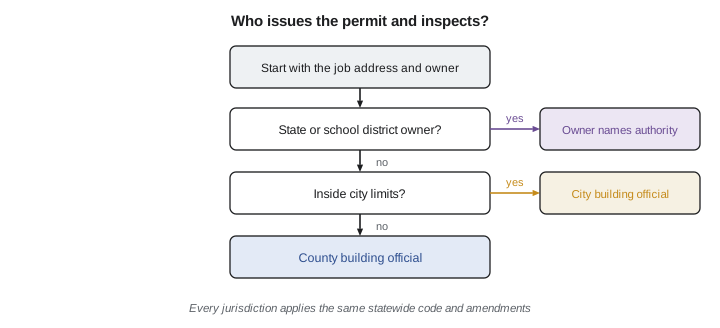
| Job situation | Usual inspection authority | What to confirm |
|---|---|---|
| Inside city limits | The city building official | Whether the city uses its own inspectors or a contracted service |
| Unincorporated county land | The county building official | The exact parcel; annexations can move a parcel into a city |
| Small city contracting for services | The contracted provider, under the city's authority | Who schedules inspections and who signs approvals |
| State-owned or school district building | The authority the public owner designates | The owner's process for permits, plan review and inspection |
When a permit is required
Electrical work generally needs a permit from the building official before it starts, with limited exceptions for minor repairs and replacements that the adopted code and local practice allow. Utah's statute notes that even some structures exempt from a building permit may still require a plumbing, electrical or mechanical permit, so a shed or small agricultural building that needs no building permit can still need an electrical permit for its wiring. When in doubt, ask the building department and record the answer.
The permit is issued to the person responsible for the work. For a contractor job, that is the licensed contractor, and the permit application names the company and its license. Many departments also ask for the name and license number of the master electrician responsible for the job. The permit makes the contractor responsible for calling for inspections, correcting violations and keeping the work open for inspection until it is approved.
A typical inspection sequence
Building departments differ in how they name and group inspections, but most electrical work moves through a similar sequence. A temporary power inspection may come first on new construction. Underground or slab inspections check conduit and grounding electrodes before concrete or backfill covers them. The rough-in inspection checks wiring, boxes, bonding and supports before walls are closed. A service inspection checks the service equipment and grounding before the utility energizes the service. The final inspection checks devices, fixtures, panel labeling and the finished installation, and its approval is usually needed before the building official issues a certificate of occupancy.
# A typical inspection sequence for a new townhome building (study aid)
seq = ["Temporary power", "Underground and slab", "Rough-in",
       "Service", "Final"]
must_precede = {"Rough-in": "insulation and drywall",
                "Underground and slab": "concrete or backfill",
                "Service": "utility energizing the service",
                "Final": "certificate of occupancy"}
for step, name in enumerate(seq, 1):
    before = must_precede.get(name, "permanent power")
    print(step, name.ljust(22), "approve before", before)
units, per_unit = 12, 3            # rough-in, service, final per unit
print("unit-level inspections to schedule:", units * per_unit)1 Temporary power approve before permanent power 2 Underground and slab approve before concrete or backfill 3 Rough-in approve before insulation and drywall 4 Service approve before utility energizing the service 5 Final approve before certificate of occupancy unit-level inspections to schedule: 36
On the Layton townhomes, the arithmetic at the end of the script became Mateo's scheduling problem. Twelve units, each needing rough-in, service and final inspections, means thirty-six inspections on top of the site work. He set up a shared calendar with the general contractor so that inspection requests went in as soon as each unit was ready and drywall crews never arrived at a unit that had not passed rough-in.
Requesting inspections and handling corrections
The contractor requests each inspection by the method the department uses, such as an online portal, a phone line or an app, usually by a cutoff time the day before. The work must be ready and accessible when the inspector arrives. An inspector who finds a violation issues a correction, often called a correction notice or a failed inspection report, that identifies the problem and the code section involved. The contractor fixes the problem and requests a reinspection, which some departments charge for.
A master learns to read a correction for what it is: the inspector's statement of what must change before approval. If the master disagrees with the interpretation, the first step is a respectful conversation with the inspector, citing the section and, where it applies, the Utah amendment. If that does not resolve it, building codes provide for an appeal to a board or official the jurisdiction designates. Most disagreements end at the first conversation, especially when the master brings the code section rather than an opinion.
| Step | Who acts | Good practice |
|---|---|---|
| Request inspection | Contractor | Request only when the work is complete and accessible |
| Inspect | Inspector | Have the permit card and approved plans on site |
| Correction issued | Inspector | Read the section cited; check whether a Utah amendment applies |
| Fix and request reinspection | Contractor | Photograph the fix and note the date |
| Approval | Inspector | Record the approval in the job file |
Special projects
Some projects bring a different authority or extra steps. Buildings owned by the state are typically handled through the state's own facilities process, and school district buildings through the arrangement the district and state law set up. On those jobs, the owner's project manager will say who reviews plans and who inspects, and the contractor should ask before applying for a city permit by habit. Federal property can have its own rules entirely.
Emergency systems are a special case under the Utah amendments. The amendment to 700.3(A) addresses testing of emergency systems, including testing that the authority having jurisdiction conducts or witnesses when the system is installed and periodically afterward. On a clinic, a hotel or another building with an emergency system, Mateo plans the witnessed test with the inspector early, because it involves the owner, the generator or battery supplier and sometimes the fire marshal, and the certificate of occupancy can wait on it.
Why inspection dates matter for the business
Inspection approvals are also business records. The final inspection, or the certificate of occupancy that follows it, is often what the contract uses to mark substantial completion, which triggers final payment and the release of retainage. Under Utah's lien law, a notice of completion can be filed after final inspection or certificate of occupancy, and that filing shortens the time to record a lien, as lesson 9 explains. Janelle keeps a log of every approval with its date, because those dates later answer questions about payment and lien deadlines.
Worked problem
Planning the Kaysville clinic inspections
The clinic tenant improvement includes new branch circuits, a small emergency lighting system and relocated equipment in a ceiling with a suspended grid. The building is privately owned and inside Kaysville city limits. What should Mateo plan?
Show solution
- Confirm with Kaysville that the city's building official is the authority and how the city schedules inspections.
- Apply for the electrical permit under the company's E200 license, naming the responsible master as the city requires.
- Schedule rough-in before the ceiling grid is closed and plan the final with the general contractor's schedule.
- Arrange the emergency system test that the 700.3(A) amendment calls for, so the authority can conduct or witness it before occupancy.
- Record each approval and its date in the job file for payment and lien purposes.
Answer: City authority, permit under the E200 license, inspections timed to the build sequence, a planned witnessed emergency test and a dated approval log.
Plans, documents and the permit card
Commercial work often needs plan review before a permit issues. The building department reviews the electrical drawings, load calculations, panel schedules and equipment information against the code and returns comments that must be resolved. On the Kaysville clinic, the review asked for an updated panel schedule and confirmation of the emergency lighting layout. Mateo answered both in writing, and the permit issued a week later. Answering review comments fully the first time is the fastest way through, because each round trip adds days.
Once a permit issues, the permit card or its electronic equivalent and the approved plans belong on the site. Inspectors check the work against the approved plans, and changes in the field may need a revision submitted to the building department before inspection. A crew that wires to an old drawing set, or that moves a panel without telling anyone, can turn a routine inspection into a correction and a revision.
| Document | Purpose |
|---|---|
| Permit card or record | Shows the permit number, scope and inspection approvals |
| Approved plans | The drawings the inspector checks the work against |
| Load calculation and panel schedules | Support the service and feeder sizing on the plans |
| Plan review comments and responses | Show how review issues were resolved |
| Inspection reports | Record approvals and corrections with dates |
Small jobs need discipline too. A service upgrade on a house can be permitted, wired and inspected in a few days, and it is tempting to skip the paperwork. But the same rules apply: the permit comes first, the work stays accessible until approved, and the utility will not energize a new service until the building official has approved it. Mateo's rule for small jobs is the same as for big ones: no permit, no work.
Working with inspectors over time
Inspectors remember contractors. A company whose crews call for inspections only when the work is ready, have the plans on site and fix corrections promptly earns a reputation that shortens every later inspection. A company that calls early, argues every item and covers work before approval earns the opposite. The master sets that tone.
Common mistakes
MistakeApplying for a city permit for a state-owned building by habit.
InsteadAsk the public owner which authority reviews plans and inspects.
MistakeAssuming no building permit means no electrical permit.
InsteadUtah's statute notes that some permit-exempt structures still need an electrical permit.
MistakeArguing a correction from opinion.
InsteadBring the code section and any Utah amendment, then use the appeal path if needed.
MistakeTreating inspection approvals as paperwork only.
InsteadApproval dates often mark completion for payment, retainage and lien deadlines.
Summary and key terms
- Utah's construction code is enforced locally by city and county building officials, the authority having jurisdiction.
- The job address, the owner and any contracted inspection service decide who inspects.
- Electrical work generally needs a permit, even on some structures exempt from a building permit.
- Inspections usually run from temporary power and underground through rough-in and service to final.
- The Utah amendment to 700.3(A) addresses emergency system tests conducted or witnessed by the authority.
- Building official
- The local officer who issues permits, reviews plans and approves or rejects work.
- Compliance agency
- The Title 15A term for the body that enforces the code in a jurisdiction.
- Rough-in inspection
- The inspection of wiring, boxes and bonding before walls or ceilings are closed.
- Correction notice
- An inspector's written statement of a violation that must be fixed before approval.
- Certificate of occupancy
- The building official's approval for a building to be occupied, usually after final inspections.
Practice problems
Work each problem on paper first, then reveal the answer to check.
Who is the authority having jurisdiction on most Utah jobs?
Show answer
The city or county building official for the job address.
Can a structure exempt from a building permit still need an electrical permit?
Show answer
Yes. Utah's statute notes it may.
What should a master do first when disagreeing with a correction?
Show answer
Discuss it with the inspector, citing the code section and any Utah amendment.
Which Utah amendment addresses emergency system testing witnessed by the authority?
Show answer
The amendment to 700.3(A).
Lesson quiz · 5 questions
Score 60% or more to complete this lesson.
Create a free account to save your progress, take quizzes and earn a certificate.