
MELU-319 · Lesson 4 of 12 · 19 min
The exam format and the references allowed
▶ Video coming soon A video version of this lesson is on the way.
Mateo had taken the journeyman exam in 2020 with a code book and a calculator and remembered it as a long afternoon of looking things up. When he opened the content outline for the Master Law and Rules exam, he was surprised. "Half of this isn't the code book at all," he told Lorraine. "It's the licensing act, DOPL's rules, the labor code and safety." Lorraine nodded. "That's the job now. Anyone can look up a box fill. The master is the one who has to know the law."
This lesson describes how the Master Law and Rules exam is built: the number of questions, the time, the passing score, the content areas and how many questions each carries, and the references and permitted items the bulletin lists. It ends with a pacing plan and a method for working a law question with the reference in hand.
The shape of the exam
The Master Law and Rules exam has 80 questions and a time limit of 240 minutes, which is four hours. The bulletin sets the passing score at 75. If the score is a straight share of the questions, that means about 60 correct answers out of 80, though the bulletin is the authority on how scores are reported. The questions are multiple choice, delivered on a computer at a testing location.
Four hours for 80 questions is an average of three minutes per question. That is generous for a recall question and tight for one that needs a voltage drop calculation or a search through a statute. The pacing plan later in this lesson shows how to spend the time where it is needed.
| Feature | Master Law and Rules exam (late 2025 bulletin) |
|---|---|
| Questions | 80 |
| Time limit | 240 minutes |
| Passing score | 75 |
| Format | Computer-based multiple choice at a testing location |
| Replaced | The separate master theory and code exams, from August 1, 2025 |
What the exam covers
The bulletin's content outline lists twenty-one areas and the number of questions in each. They fall into two groups. The law and safety group covers the Construction Trades Licensing Act in Title 58, Chapter 55 (7 questions), the DOPL Licensing Act in Title 58, Chapter 1 (8), the Electricians Licensing Act Rule R156-55b (7), DOPL's general rule R156-1 (7), the Utah Labor Code in Title 34A (5), the Utah health and safety rule R612-1 (2), the Utah occupational safety and health rule R614-1 (2), the Utah NEC amendments in Title 15A (4) and NFPA 70E (5). Together that is 47 questions.
The electrical group covers current, resistance and voltage drop (8), grounding and bonding (5), services, feeders and branch circuits (4), conductors and cables (3), special occupancies and equipment (3), motors and controllers (2), overcurrent protection (2), special conditions (2), communications systems (1), definitions and general requirements (1), lighting and general use equipment (1) and raceways and enclosures (1). Together that is 33 questions. The NEC still matters, but it is less than half of the exam.
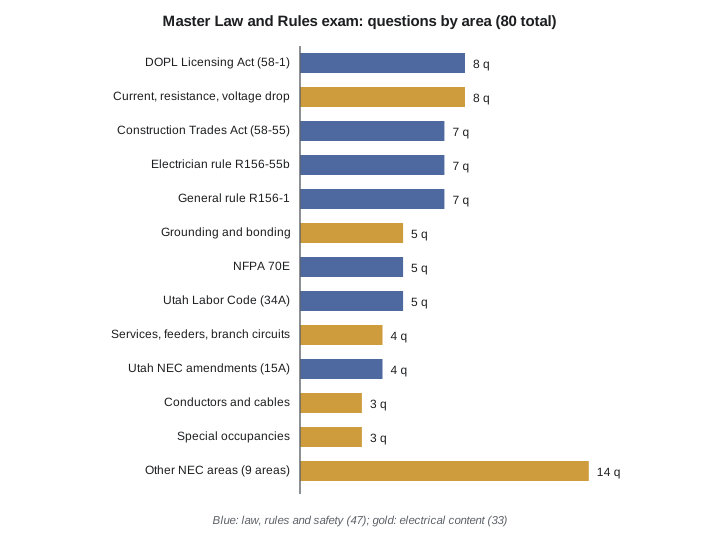
# Content outline of the Master Law and Rules exam (late 2025 bulletin)
law = {"Title 58, Ch. 55 (Construction Trades Licensing Act)": 7,
       "Title 58, Ch. 1 (DOPL Licensing Act)": 8,
       "R156-55b (Electricians Licensing Act Rule)": 7,
       "R156-1 (General DOPL rule)": 7,
       "Title 34A (Utah Labor Code)": 5,
       "R612-1 (Utah health and safety)": 2,
       "R614-1 (Utah occupational safety and health)": 2,
       "Title 15A (Utah NEC amendments)": 4,
       "NFPA 70E": 5}
electrical = {"Current, resistance, voltage drop": 8, "Grounding and bonding": 5,
              "Services, feeders, branch circuits": 4, "Conductors and cables": 3,
              "Special occupancies and equipment": 3, "Motors and controllers": 2,
              "Overcurrent protection": 2, "Special conditions": 2,
              "Communications systems": 1, "Definitions and general": 1,
              "Lighting and general use equipment": 1, "Raceways and enclosures": 1}
a, b = sum(law.values()), sum(electrical.values())
print("law and safety:", a, " electrical:", b, " total:", a + b)
print("law and safety share of the exam: about", round(a / (a + b) * 100), "in 100")
need = 60   # 75 in 100 of 80 questions, if scored as a straight share
print("if every electrical question were right, law questions still needed:", max(0, need - b))law and safety: 47 electrical: 33 total: 80 law and safety share of the exam: about 59 in 100 if every electrical question were right, law questions still needed: 27
The last line of the output is the one Lorraine circled. Even a candidate who answered every electrical question correctly would still need more than half of the law and safety questions to reach about 60. No one passes this exam on the NEC alone.
The references
The bulletin lists the references for the Master Law and Rules exam. They are NFPA 70, the National Electrical Code, 2023 edition; NFPA 70E, 2024 edition; Ugly's Electrical References, 2023 edition; the State Construction and Fire Codes Act, specifically 15A-3-601 and the related Utah NEC amendments; the DOPL Licensing Act in Title 58, Chapter 1, with sections 301 and 501 named; the Utah Construction Trades Licensing Act in Title 58, Chapter 55; the Electricians Licensing Act Rule R156-55b; the general rule R156-1, with sections 102, 308 and 309 named; the workplace safety rule R614-1-5; the Utah Labor Commission's industrial accidents material; and OSHA's personal protective equipment standards in 29 CFR 1910 Subpart I, sections 1910.132, 1910.133 and 1910.134.
The list tells you what to study even if you never open a book in the testing room. Every statute and rule on it can be printed from the Utah Legislature's code site and the Utah Administrative Code site, and the OSHA sections are on the federal OSHA site. Mateo printed the Utah materials into a binder with dividers, one section per reference, so he could study them in order and find them quickly.
| Reference | Edition or scope listed | Area it supports |
|---|---|---|
| NFPA 70 (NEC) | 2023 | All electrical areas |
| NFPA 70E | 2024 | Electrical safety in the workplace |
| Ugly's Electrical References | 2023 | Formulas, tables and quick reference |
| Title 15A, State Construction and Fire Codes Act | 15A-3-601 and the Utah NEC amendments | Utah NEC amendments |
| Title 58, Chapters 1 and 55 | Sections named in the bulletin | Licensing law |
| R156-1 and R156-55b | Sections named in the bulletin | DOPL and electrician rules |
| R614-1-5 and Labor Commission material | Workplace safety; industrial accidents | Utah safety and labor law |
| 29 CFR 1910 Subpart I | 1910.132 to 1910.134 | Personal protective equipment |
Permitted items and how to prepare the books
The bulletin's rules on reference books are specific. Permanent tabs are allowed: gummed tabs, self-adhesive tabs with printable inserts, or insertable dividers in three-ring binders. Movable tabs and sticky notes are not allowed in reference books. Highlighting and underlining are allowed, but you may not write in the books during the test. Handwritten notes are not allowed, and formula sheets or stickers may not be glued or taped into a book. For the theory and code exams, the bulletin says both current and previous year code books are permitted; because it states that rule in the section on those exams, confirm with Prov which books you may bring to the Master Law and Rules exam and in what form.
The calculator rule is short and strict: only the calculator the provider links to in the bulletin is allowed, and no other calculators will be permitted. The bulletin advises candidates to practice with it beforehand. Mateo downloaded it the same week he started studying and used it for every practice calculation, so that on test day the keystrokes were familiar.
The bulletin's testing rules also say no taking notes. Plan your method around that: you cannot copy a formula onto scratch paper from memory before starting, so the tabbed books and the practiced calculator are your tools.
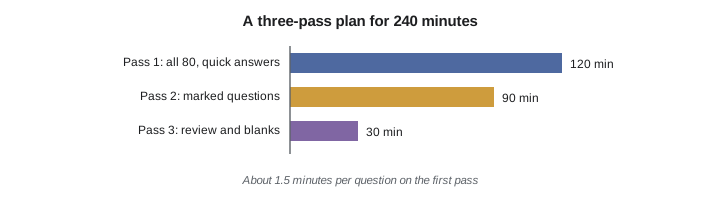
A pacing plan
Lorraine taught Mateo a three-pass plan. On the first pass, he answers every question he knows without opening a book and marks the rest, spending no more than about a minute and a half on each. On the second pass, he works the marked questions with the references, starting with the calculations, which take predictable time, and then the statute and rule look-ups. On the third pass, he checks the answers he was least sure of and makes sure none is left blank. With 80 questions, a first pass of about two hours leaves almost two hours for the hard ones.
Worked problem
Working a law question with the reference
A practice question asks how long a licensee has to complete continuing education before renewal and offers four choices. Mateo does not remember the figure. How should he work it?
Show solution
- Identify the layer: continuing education for electricians is in the electrician rule, R156-55b.
- Turn to the tab for R156-55b and find the continuing education section.
- Read the requirement and note that it is stated per two-year license term, with core and professional hours.
- Match the wording to the choices rather than relying on memory of a similar state's rule.
- Mark the question for review if any choice uses wording he could not confirm.
Answer: Go to the right layer first, then the right section, then match the text; the tabs are what make this fast.
Preparing the books in a week
Tabbing the references is study, not just preparation. Mateo set aside a week to build his set. He printed the Utah statutes and rules on the reference list from the official sites, punched them into a three-ring binder and used insertable dividers for each one: Title 58, Chapter 1; Title 58, Chapter 55; R156-1; R156-55b; Title 15A, Chapter 3, Part 6; Title 34A, Chapter 2 and the safety rules. Inside each divider he highlighted the definitions section and the sections that set numbers, deadlines and penalties.
In the NEC he placed permanent tabs at the articles that carry the most questions in the outline, such as Articles 250, 230, 210, 215 and 310, and at every section on the Utah amendment list. In NFPA 70E he tabbed the articles on the electrically safe work condition, risk assessment and the energized work permit. In Ugly's he tabbed the voltage drop, Ohm's law and motor pages he uses most. Each tab was labeled in plain words he would recognize under time pressure.
| Book | Where Mateo tabbed (study choices) |
|---|---|
| NEC 2023 | High-count articles and every Utah-amended section |
| Utah statutes and rules binder | One divider per reference, definitions and penalties highlighted |
| NFPA 70E 2024 | Electrically safe work condition, risk assessments, work permit |
| Ugly's 2023 | Voltage drop, Ohm's law and power, motor formulas |
The week of tabbing also showed him what he did not know. Each time he could not decide where a tab belonged, he read the section, and those sections became the first items on his study list. By the time the set was finished, he could find most law sections in under a minute, which is the speed the second pass of the pacing plan depends on.
Reading the question before the reference
A last habit separates fast candidates from slow ones: read the whole question and all four choices before opening any book. The choices often reveal which layer of law the question belongs to, and sometimes they reveal that the question is about a definition or a number that can be found in seconds. Opening the code book first, before knowing what to look for, is the most common way to lose ten minutes on a three-minute question.
Common mistakes
MistakeStudying only the NEC.
InsteadMore than half of the questions are on Utah law, rules, safety and amendments.
MistakeBringing sticky notes as tabs.
InsteadOnly permanent tabs are allowed; movable tabs and sticky notes are not.
MistakePracticing with a favorite calculator.
InsteadOnly the calculator the provider links to is allowed; practice with it.
MistakeSpending ten minutes on the first hard question.
InsteadUse passes: answer what you know, mark the rest and come back with the references.
Summary and key terms
- The Master Law and Rules exam has 80 questions, 240 minutes and a passing score of 75.
- About 47 questions cover Utah law, rules, safety, amendments and NFPA 70E; about 33 cover electrical content.
- The listed references include the 2023 NEC, 2024 NFPA 70E, Ugly's, Titles 15A, 58 and 34A, R156-1, R156-55b, R614-1 and OSHA Subpart I.
- Permanent tabs and pre-marked highlighting are allowed; movable tabs, notes and other calculators are not.
- A three-pass pacing plan leaves time for calculations and look-ups.
- Content outline
- The bulletin's list of exam areas and the number of questions in each.
- Permanent tab
- A gummed or self-adhesive tab, or binder divider, fixed in a reference book.
- Ugly's Electrical References
- A pocket reference of formulas and tables listed for the exam.
- NFPA 70E
- The standard for electrical safety in the workplace, listed in its 2024 edition.
- Pacing plan
- A plan for spending exam time, such as three passes through the questions.
Practice problems
Work each problem on paper first, then reveal the answer to check.
How many questions and minutes does the Master Law and Rules exam have?
Show answer
80 questions in 240 minutes.
Which NEC edition is listed as the reference?
Show answer
NFPA 70, 2023 edition.
Are sticky notes allowed as tabs?
Show answer
No. Only permanent tabs are allowed.
Roughly how many questions cover law, rules and safety rather than electrical content?
Show answer
About 47 of the 80.
Lesson quiz · 5 questions
Score 60% or more to complete this lesson.
Create a free account to save your progress, take quizzes and earn a certificate.