
MELU-319 · Lesson 12 of 12 · 19 min
Practice exam review and test-day strategy
▶ Video coming soon A video version of this lesson is on the way.
Three weeks before his exam date, Mateo sat a full practice exam at the kitchen table on a Saturday morning: 80 questions, four hours, his tabbed books and the provider's calculator. He did well on the electrical questions he expected to ace and much worse on the law than he wanted. Lorraine read the results with him on Monday. "Good," she said. "Now you know where the points are. You've got three weeks to move the law and safety numbers, and that's where the exam put most of the questions."
This lesson pulls the course together for the exam. It sets out a study plan weighted by the content outline, a method for reviewing a practice exam, the question patterns the Master Law and Rules exam tends to use, a test-day routine and what to do after the result. It closes with a short set of mixed practice questions that touch every lesson.
Weight the plan by the outline
The content outline tells you where the points are. About 47 of the 80 questions cover Utah law, rules, safety, the Utah NEC amendments and NFPA 70E, and about 33 cover electrical content. A study plan that gives equal time to every NEC article and an afternoon to the statutes has it backwards for this exam. Mateo's plan gave each area study time in rough proportion to its question count, with extra time for the areas his practice exam showed were weak.
# A three-week study plan weighted by the exam outline (study aid)
outline = {"Title 58, Ch. 1": 8, "Title 58, Ch. 55": 7, "R156-55b": 7,
           "R156-1": 7, "Title 34A": 5, "NFPA 70E": 5, "15A amendments": 4,
           "R612-1 and R614-1": 4, "Calculations": 8, "Grounding and bonding": 5,
           "Other NEC areas": 20}
weak = {"Title 58, Ch. 1", "R156-1", "Title 34A"}   # from the practice exam
hours_available = 36
weight = {k: v * (1.5 if k in weak else 1.0) for k, v in outline.items()}
total = sum(weight.values())
for k, w in sorted(weight.items(), key=lambda kv: -kv[1]):
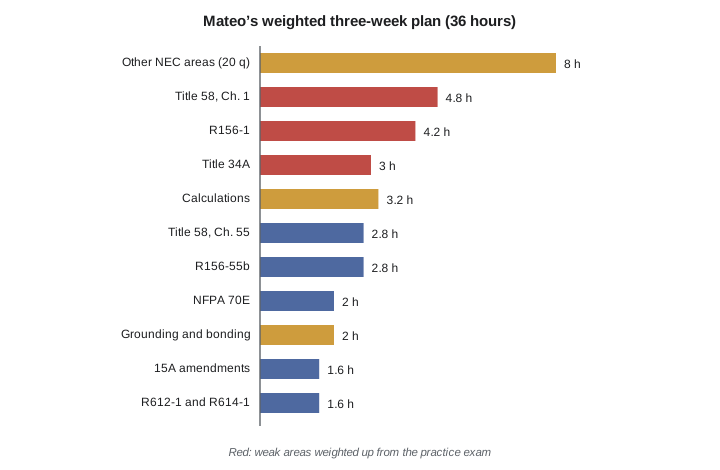
print(k.ljust(24), round(hours_available * w / total, 1), "h")Other NEC areas 8.0 h Title 58, Ch. 1 4.8 h R156-1 4.2 h Calculations 3.2 h Title 34A 3.0 h Title 58, Ch. 55 2.8 h R156-55b 2.8 h NFPA 70E 2.0 h Grounding and bonding 2.0 h 15A amendments 1.6 h R612-1 and R614-1 1.6 h
The output gives Mateo's twelve study sessions a shape. The DOPL Licensing Act and DOPL's general rule rise to just behind the combined NEC areas because they carry many questions and were his weakest areas. The NEC areas still get real time, but in proportion to the 33 questions they carry.
Reviewing a practice exam
A practice exam is useful only if the review is thorough. For each question he missed, and each one he got right by guessing, Mateo wrote down three things: the layer of law or code the question came from, the exact reference that answered it and the reason he missed it. The reasons fell into four groups. Some were knowledge gaps, where he simply did not know the rule. Some were look-up failures, where he knew where to look but could not find it fast enough. Some were reading errors, where he missed a word such as not, except or residential. And some were Utah traps, where the unamended NEC or another state's rule gave a different answer from Utah law.
| Reason for a miss | Fix |
|---|---|
| Knowledge gap | Read the section in full and write a one-line summary |
| Look-up failure | Add or move a permanent tab; practice finding the section from the index |
| Reading error | Slow down on qualifiers such as not, except, residential and only |
| Utah trap | Check the Utah amendment list or the Utah statute before answering from the NEC or memory |
Question patterns on the law and rules
Law and rules questions on licensing exams follow a few patterns, and knowing them speeds up the look-up. A number question asks for a figure from the text, such as an hour requirement, a deadline or a limit, and the fix is to find the section and read the number. A who question asks which agency, board or official does something, and the fix is to keep the map from lesson 1 in mind. A definition question asks what a term means in the statute or rule, and the answer is in the definitions section, often R156-1-102 or a definitions section in the act. A consequence question asks what happens if someone breaks a rule, such as working on an expired license, and the answer is in the unlawful conduct, unprofessional conduct or penalty sections.
Electrical questions on this exam lean toward calculations and core concepts: voltage drop, Ohm's law and power, grounding and bonding, services and feeders and overcurrent protection. Ugly's and the provider's calculator are allowed, and practicing calculations with both is the best use of an evening. For any question about a section on the Utah amendment list, check the amendment first.
Test-day routine
The routine starts the day before. Pack the books the bulletin allows, with permanent tabs only. Pack the photo ID whose name matches the booking. Check the route and travel time to the testing site and plan to arrive before the doors open, at least 15 minutes before the appointment. Sleep. On the day, eat, arrive early, check in calmly and listen to the proctor's instructions on the calculator and the books.
In the room, use the three-pass plan from lesson 4. On the first pass, answer what you know and mark the rest, keeping to about a minute and a half per question. On the second pass, work the marked questions with the references, calculations first. On the third pass, review the answers you were least sure of and make sure nothing is blank, because an unanswered question cannot be right. Watch the clock at the one-hour, two-hour and three-hour marks against the plan.
| Time into the exam | Target |
|---|---|
| 1 hour | About 40 questions through the first pass |
| 2 hours | First pass done; second pass started on marked calculations |
| 3 hours | Second pass done on calculations and look-ups |
| 3 hours 45 minutes | Final review; every question answered |
After the result
If you pass, apply to DOPL with the route documentation, the exam result and the fee, as lesson 3 describes, and plan the renewal and continuing education that follow, as lesson 11 describes. If you do not pass, use the score report to see which areas pulled the score down, wait the thirty days the bulletin requires before a retake, and adjust the study plan toward those areas. Many strong electricians pass on the second attempt after a focused month on the law.
Whatever the result, the exam is the start of the master's job, not the end. Lorraine reminded Mateo that the statutes and rules he studied would come up again in a DOPL inquiry, a lien deadline, a safety investigation or a renewal notice, and that the habits he built studying, going to the right layer of law and reading the exact words, would serve him on every one of them.
Mixed review
These short items revisit every lesson. Work them with your references closed, then check each answer against the lesson and the source it cites. Which agency licenses electricians and contractors? DOPL. What are the three master routes? An EE degree plus 2,000 apprentice hours, a qualifying AAS degree plus 4,000 journeyman hours, or 8,000 journeyman hours. Who delivers the exam? Prov. How many questions and minutes? 80 and 240. Which NEC edition is adopted in 2026? The 2023 edition, with statewide amendments in 15A-3-601. Who inspects? The local building official. What classification does a general electrical contractor hold? E200, with a master qualifier. When is the preliminary notice due? 20 days after starting work. Who enforces safety on a private job? UOSH. When do electrical licenses expire? November 30 of even years.
Worked problem
Turning a weak score into a pass
Mateo's practice exam showed weak scores in the DOPL Licensing Act, DOPL's general rule and the Utah Labor Code. With three weeks and about 36 study hours, what should he do?
Show solution
- Weight the plan by the outline, with extra time for the three weak areas.
- Read each weak area's listed sections in full and write a one-line summary of each subsection.
- Add permanent tabs at the definitions, unlawful conduct, renewal and reporting sections.
- Take a second timed practice exam after two weeks and review it with the four-reason method.
- Use the last days for calculations with Ugly's and the provider's calculator, then rest before test day.
Answer: A weighted plan, full reading of weak sections, better tabs, a second practice exam and a calm last few days.
The last week before the exam
The last week is for consolidation, not new material. Mateo used it to take a second timed practice exam on Monday, review its misses on Tuesday and Wednesday with the four-reason method, and spend Thursday on calculations with Ugly's and the provider's calculator. On Friday he checked his books against the bulletin's permitted items list one last time, removed a sticky note he had forgotten inside the back cover of his 70E, packed his ID and confirmed the route to the testing site. The day before the exam he did no studying at all.
A short list of facts can help in that last week, provided it is used for review at home and not taken into the room. Mateo's list fit on one page: the three master routes and their hours, the exam's 80 questions and 240 minutes, the 2023 NEC and where the Utah amendments are, the E200 and E201 classifications, the 20-day preliminary notice and the 90-day and 180-day recording periods, the 7-day workers' compensation report and the 16-hour continuing education mix with its November 30 deadline.
| Day | Focus |
|---|---|
| Monday | Second full timed practice exam |
| Tuesday and Wednesday | Review every miss and guess by reason |
| Thursday | Calculations with Ugly's and the provider's calculator |
| Friday | Check books against permitted items; pack ID; plan the route |
| Day before | Rest |
Managing nerves in the room
Even well-prepared candidates feel pressure when the clock starts. The three-pass plan helps because it guarantees early progress: the first pass answers the questions you know, so the score starts building before any hard question can slow you down. If a question causes panic, mark it and move on; it will look different on the second pass. Take a few slow breaths at each clock checkpoint, sit back and look away from the screen for a moment. Four hours is long enough to recover from a bad stretch, as long as you keep moving.
After the exam, write down while it is fresh which areas felt hardest and which references you used most. If you passed, that note becomes the start of your continuing education plan and of the advice you give the next candidate at your company. If you did not, it is the most useful study guide you will have for the retake, more useful than any score report, because it records where your time went and which look-ups failed under pressure.
Common mistakes
MistakeStudying in the order of the NEC.
InsteadStudy in proportion to the content outline, which puts most questions on law and safety.
MistakeReviewing only the questions you got wrong.
InsteadAlso review the ones you guessed, and sort every miss by its reason.
MistakeLeaving hard questions blank to save time.
InsteadMark them, come back, and answer every question before time ends.
MistakeAnswering an amended section from the NEC alone.
InsteadCheck the Utah amendment list first.
Summary and key terms
- About 47 of the 80 questions cover law, rules, safety, amendments and NFPA 70E; plan study time to match.
- Sort practice-exam misses into knowledge gaps, look-up failures, reading errors and Utah traps.
- Law questions usually ask for a number, a who, a definition or a consequence.
- Use a three-pass plan and clock checkpoints at each hour.
- After a pass, apply to DOPL; after a fail, wait thirty days and refocus on weak areas.
- Content outline
- The bulletin's list of exam areas and question counts that guides the study plan.
- Utah trap
- A question where the unamended NEC or another state's rule gives a different answer from Utah law.
- Three-pass plan
- Answering known questions first, then working marked questions with references, then reviewing.
- Score report
- The result report that shows performance by area.
- Clock checkpoint
- A planned time mark for checking progress through the exam.
Practice problems
Work each problem on paper first, then reveal the answer to check.
Which areas carry most of the exam's questions?
Show answer
Utah law, rules, safety, amendments and NFPA 70E, about 47 of 80.
What are the four reasons for a miss?
Show answer
Knowledge gap, look-up failure, reading error and Utah trap.
How early should you arrive?
Show answer
Before the doors open, at least 15 minutes before the appointment.
How long must you wait after a failed first attempt?
Show answer
Thirty days.
Lesson quiz · 5 questions
Score 60% or more to complete this lesson.
Create a free account to save your progress, take quizzes and earn a certificate.