
MELU-319 · Lesson 1 of 12 · 21 min
How electrical licensing works in Utah
▶ Video coming soon A video version of this lesson is on the way.
Lorraine Haskell started Wasatch Ridge Electric in 2003 with a used box truck, a rented shop on Wall Avenue in Ogden and a master electrician license she had earned the year before. Twenty-three years later the company employs sixteen electricians and apprentices and works across the northern Wasatch Front: tenant improvements in downtown Ogden, new townhomes in Layton and Kaysville, a cold-storage warehouse near the Ogden airport, dairy barns and well pumps in western Weber County, and every so often a restaurant or clinic in Salt Lake City. For the whole of that time Lorraine has been the company's qualifier, the licensed master electrician whose license stands behind the company's electrical contractor license and who answers to the state for the work.
On a cold Tuesday in January, Lorraine asked her lead foreman, Mateo Ruiz, and the office manager, Janelle Ostler, to stay after the safety meeting. "I turn sixty-two this year," she said. "Our contractor license is only good while a master electrician qualifies it. If I step back, or if something happens to me, we are stuck until someone else is licensed and named. I want you to sit the master exam this year, Mateo." Mateo had held a Utah journeyman electrician license since the spring of 2020 and had finished the master electrician core courses on the National Electrical Code, load calculations, grounding and bonding, motors and transformers, special occupancies, and business and law. This course takes that preparation and applies it to Utah: who licenses electrical work, how the master electrician license works, how the exam is built, which code applies, how permits and inspections run, and the state law on contracts, liens, safety and renewal that the exam and the job both demand.
One division, one board, one statewide code
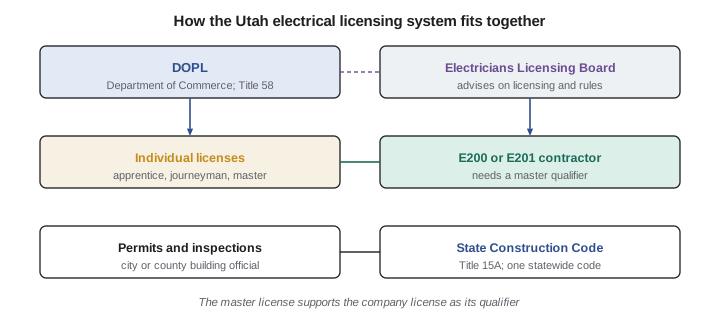
Utah builds its electrical licensing system around one state agency. The Division of Professional Licensing, almost always called DOPL, is part of the Utah Department of Commerce. DOPL issues and renews the licenses for electricians and for contractors, keeps the public license lookup, handles complaints and investigates people who work without the license the law requires. The same division licenses plumbers, general contractors and dozens of other professions, so many of its general rules apply to every license it issues, and the master exam tests those general rules alongside the electrical ones.
DOPL works with boards made up of people from the trade and the public. The Electricians Licensing Board advises the division on electrician licensing, rules, education and discipline. Contractor licensing involves the Construction Services Commission, which works with DOPL on rules for the contractor classifications, including the insurance and education requirements covered in lesson 8. You do not need to memorize the membership of either body, but you should know that the boards and commission help shape the rules and that DOPL issues the licenses.
Several layers of law sit underneath the system. Utah Code Title 58, Chapter 1 is the Division of Professional Licensing Act, which sets general rules for every DOPL license: applications, unlawful and unprofessional conduct, discipline and penalties. Title 58, Chapter 55 is the Utah Construction Trades Licensing Act, which covers contractors, electricians and plumbers together, including the experience required for each electrician license. The detailed rules are in the Utah Administrative Code: R156-1 is DOPL's general rule, R156-55a is the construction trades rule for contractors and R156-55b is the Electricians Licensing Act Rule. All of these appear on the reference list for the master exam, which tells you the exam will ask about them.
Licenses for people and licenses for businesses
Utah separates the people who do and supervise electrical work from the business that sells it. The individual licenses form a ladder. An apprentice electrician is licensed and works under supervision while gaining hours. A journeyman electrician may do electrical work under the general direction of a master. A master electrician may plan, lay out and supervise electrical installations of every kind and may serve as the qualifier for an electrical contractor. Parallel residential licenses, the residential journeyman and residential master, cover work on residential buildings within the scope the statute and rule define.
The business holds a contractor license. In Utah's classification system, the general electrical contractor classification is E200 and the residential electrical classification is E201. DOPL's contractor pages say that an electrical contractor must have a master electrician qualifier, and that requirement cannot be waived, even for applicants who are licensed in another state. The qualifier is the individual whose license and knowledge support the company's license. Lesson 8 covers the contractor license, the qualifier and the insurance and registration requirements that come with it.
| License | Who holds it | What it allows (summary) |
|---|---|---|
| Apprentice electrician | An individual | Electrical work under supervision while gaining experience |
| Journeyman electrician | An individual | Electrical work of any type under the general direction of a master |
| Master electrician | An individual | Planning, laying out and supervising installations, and qualifying an electrical contractor |
| Residential journeyman and residential master | An individual | The same roles, limited to residential work as defined in the statute and rule |
| E200 general electrical or E201 residential electrical | The business | Offering and performing electrical work for others, with a master qualifier |
Why a contractor needs a master
The link between the business license and the master's license explains why Lorraine is worried. The contractor license stays valid only while the company has a qualifier who meets the requirements. If the qualifier leaves the company, retires or lets the master license lapse, the company has to replace the qualifier within the time and in the manner the rules allow, or it stops being able to contract for electrical work. A company that depends on one master is one resignation away from a crisis. That is why many Utah contractors encourage their senior journeymen to sit the master exam long before anyone plans to retire.
The master license also changes what Mateo personally may do. As a journeyman he works under a master's direction. As a master he could plan and lay out installations, supervise crews and apprentices and, if the company named him, serve as a qualifier. He would also take on the responsibility that comes with those roles, which lesson 7 covers in detail. The exam reflects that shift: it spends more of its questions on law and rules than on wiring, because the master is the person who answers for whether the work and the business follow the law.
Who does not need a license
The statute lists exemptions, and the exam tests their edges. In general, anyone who performs electrical work for another person needs to be licensed at the right level, and anyone who contracts to do it needs a contractor license. Property owners have a limited right to do work on their own property, with permits and inspections, and with limits when the property is meant for sale or rent. Some employees doing maintenance on their employer's premises, some utility work and some work covered by other licenses fall under their own rules. When a question asks whether a license is needed, read it for three facts: who is doing the work, whose property it is and what kind of system is involved.
Lorraine's favorite example is a customer near Huntsville who built a shop on his own land. As the owner, he could take out a permit and wire the building himself, and the building official inspected it like any other installation. When he later asked Wasatch Ridge to add a subpanel for a welder and a lift, the work had to be done under the company's contractor license and permit, by licensed electricians, because the crew was now working for someone else.
Who issues permits and inspects
Licensing is statewide, but permits and inspections are mostly local. Utah's cities and counties enforce the State Construction Code through their building officials, who issue permits, review plans and inspect. Because the code is adopted statewide by the Legislature, a city or county building department applies the same NEC edition and the same Utah amendments as every other jurisdiction. Utah law limits local governments from adopting more restrictive rules on subjects the State Construction Code already covers, so the code a Wasatch Ridge crew follows in Ogden is the same one it follows in Logan or Salt Lake City. Lesson 6 covers the permit and inspection process in detail.
Janelle keeps a sheet listing the building department for every active job. A tenant improvement inside Ogden city limits goes to the city. A townhome project in Layton goes to Layton. A dairy barn in unincorporated western Weber County goes to the county. The company's contractor license and the master's license are the same everywhere; only the permit counter changes.
# Which building department handles the permit? (study aid; confirm every
# job address with the city or county before applying)
DEPARTMENTS = {                         # invented examples for practice only
    ("Ogden", "city"): "Ogden City building services",
    ("Layton", "city"): "Layton City building department",
    ("Kaysville", "city"): "Kaysville City building department",
    ("Weber County", "unincorporated"): "Weber County building inspection",
    ("Salt Lake City", "city"): "Salt Lake City building services",
}
jobs = [
    ("Downtown tenant improvement", "Ogden", "city"),
    ("Twelve townhomes", "Layton", "city"),
    ("Clinic remodel", "Kaysville", "city"),
    ("Dairy barn and well pump", "Weber County", "unincorporated"),
    ("Restaurant fit-out", "Salt Lake City", "city"),
    ("Cabin in another county", "Elsewhere", "unincorporated"),
]
for name, place, kind in jobs:
    who = DEPARTMENTS.get((place, kind), "look up the county building official")
print(name.ljust(30), "->", who)Downtown tenant improvement -> Ogden City building services Twelve townhomes -> Layton City building department Clinic remodel -> Kaysville City building department Dairy barn and well pump -> Weber County building inspection Restaurant fit-out -> Salt Lake City building services Cabin in another county -> look up the county building official
The script mirrors the decision Janelle makes for every new job. The exact address decides the jurisdiction, because city limits do not follow mailing addresses. A job with an Ogden mailing address can sit in unincorporated county land, and a new annexation can move a parcel from the county to a city. The real check always uses the parcel address and the jurisdiction's own records.
Worked problem
Sorting Wasatch Ridge's spring jobs
Janelle lists five new jobs: a tenant improvement in downtown Ogden, townhomes in Layton, a clinic in Kaysville, a dairy barn in unincorporated Weber County and a restaurant in Salt Lake City. Which licenses does the company need, and which code applies to each job?
Show solution
- The licenses do not change by job: an active E200 contractor license qualified by a master electrician, with licensed electricians and apprentices doing the work.
- Each permit comes from the building department with jurisdiction over the job address, which Janelle confirms before applying.
- Every building official applies the same State Construction Code, including the NEC edition the Legislature adopted and the statewide Utah amendments.
- If the company's only master left, the contractor license would need a new qualifier before the company could keep contracting.
Answer: Same licenses for all five jobs; each permit comes from the jurisdiction for that address, and the code is the same everywhere in the state.
Where the rules live
Utah electrical contractors work under several layers of law, and the exam rewards knowing which layer answers which question. Title 58, Chapters 1 and 55 set the licensing framework. R156-1, R156-55a and R156-55b fill in the details, from experience rules to continuing education and unprofessional conduct. Title 15A, the State Construction and Fire Codes Act, adopts the codes and holds the statewide NEC amendments. Title 38, Chapter 1a covers preconstruction and construction liens. Title 34A, the Utah Labor Code, covers workers' compensation and occupational safety, with the Utah Labor Commission enforcing it. When a question comes up on the job or on the exam, start by asking which of these layers it belongs to.
A quick way to remember the map is to tie each layer to a question a master asks during a normal week. Am I allowed to do this work, and is my crew? That is Title 58 and the R156 rules. Is the installation right? That is the NEC as adopted and amended under Title 15A, checked by the local building official. Will we get paid? That is the contract and Title 38. Is the crew safe, and what happens if someone is hurt? That is Title 34A, the UOSH rules and the federal OSHA standards Utah enforces through its state plan. Lessons 2 through 11 take each of these questions in turn, and lesson 12 brings them back together for the exam.
| Question on the job | Where the answer lives |
|---|---|
| Who may do or supervise this work? | Title 58, Chapters 1 and 55; R156-1 and R156-55b |
| Can the company contract for it? | Title 58, Chapter 55; R156-55a |
| Is the installation compliant? | Title 15A and the adopted NEC with Utah amendments |
| How do we protect payment? | The contract and Title 38, Chapter 1a |
| Is the crew covered and safe? | Title 34A, UOSH rules and OSHA standards |
Common mistakes
MistakeAssuming the master license belongs to the company.
InsteadThe master license belongs to the individual; the company holds an E200 or E201 contractor license qualified by that individual.
MistakeExpecting each city to write its own electrical code.
InsteadUtah adopts its construction codes statewide, and local governments are limited from adopting more restrictive rules on subjects the code covers.
MistakeThinking the master exam is mainly a wiring test.
InsteadMost of the master exam's questions are on Utah law, rules, safety and the Utah amendments; the NEC and theory share the rest.
MistakeTreating DOPL's general rules as irrelevant to electricians.
InsteadTitle 58, Chapter 1 and R156-1 apply to every DOPL license and are on the master exam's reference list.
Summary and key terms
- DOPL, part of the Utah Department of Commerce, licenses electricians and contractors and enforces the licensing laws.
- The Electricians Licensing Board advises DOPL on electrician licensing; contractor rules involve the Construction Services Commission.
- Title 58, Chapters 1 and 55 and the rules R156-1, R156-55a and R156-55b govern licensing.
- An E200 or E201 electrical contractor must have a master electrician qualifier.
- Local building officials issue permits and inspect under one statewide code adopted through Title 15A.
- DOPL
- The Division of Professional Licensing in the Utah Department of Commerce.
- Electricians Licensing Board
- The board that advises DOPL on electrician licensing, rules and discipline.
- Title 58, Chapter 55
- The Utah Construction Trades Licensing Act, covering contractors, electricians and plumbers.
- R156-55b
- The Electricians Licensing Act Rule in the Utah Administrative Code.
- Qualifier
- The licensed individual whose license and knowledge support a company's contractor license.
Practice problems
Work each problem on paper first, then reveal the answer to check.
Which agency issues electrician and contractor licenses in Utah?
Show answer
The Division of Professional Licensing (DOPL) in the Department of Commerce.
Name the statute and the rule that govern electrician licensing.
Show answer
Title 58, Chapter 55 (with Chapter 1) and the rule R156-55b (with R156-1).
What must an E200 electrical contractor have to hold its license?
Show answer
A master electrician qualifier.
Does Ogden apply a different NEC edition from Logan?
Show answer
No. Utah adopts the code statewide, so both apply the same edition and Utah amendments.
Lesson quiz · 5 questions
Score 60% or more to complete this lesson.
Create a free account to save your progress, take quizzes and earn a certificate.