
MELU-319 · Lesson 11 of 12 · 18 min
Renewal and continuing education
▶ Video coming soon A video version of this lesson is on the way.
Mateo's master license was issued in late April 2026. When the card arrived, Janelle pointed at the expiration date and laughed. "November 30, 2026," she read. "Seven months. Every electrical license in Utah expires on the same day in even-numbered years, so a license issued in the spring of a renewal year is due almost right away. Do you have your continuing education hours?" Mateo had taken an NEC course in the winter and a 70E refresher in the summer, but he was not sure the hours added up the way the rule required.
This lesson covers renewal of Utah electrician licenses: the two-year cycle and its November 30 deadline, the 16 hours of continuing education and how they divide between core and professional topics, who may have the requirement waived or deferred, what happens if a license expires and how a company keeps track of every license it depends on. As of mid-November 2026, the current cycle's deadline is only weeks away, so the lesson uses Mateo's own renewal as its example.
The two-year cycle
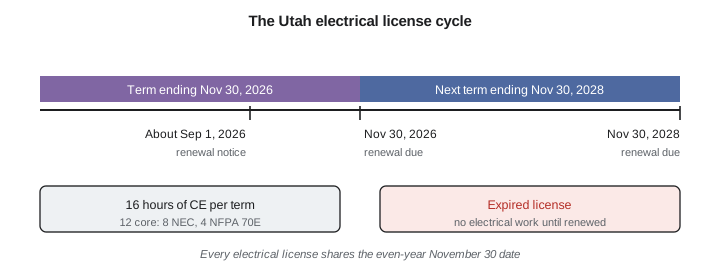
DOPL's electrical renewal page says electrical license renewals are due November 30 of even years. Every apprentice, journeyman and master license in the state therefore shares one deadline, and the current cycle ends on November 30, 2026. DOPL sends a renewal notice by email about 90 days before expiration, which makes an accurate email address on file with DOPL part of keeping a license. The renewal is completed online, with the fee shown on DOPL's fee schedule and an attestation that the continuing education requirement has been met.
The shared date has a consequence that surprises new licensees. A license issued partway through a cycle still expires on the cycle's November 30. Mateo's master license, issued in April 2026, expires seven months later. Contractor licenses have their own cycle and renewal requirements, which DOPL's contracting pages describe, so a company like Wasatch Ridge tracks the contractor license and each electrician license separately.
Sixteen hours, and how they divide
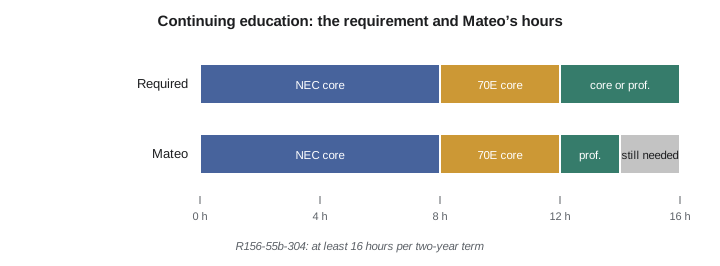
R156-55b-304 requires each licensee to complete at least 16 hours of continuing education during each two-year license term. At least 12 of those hours must be core education: 8 hours on the National Electrical Code as adopted or proposed for adoption, and 4 hours on NFPA 70E. The remaining 4 hours may be core or professional education. The rule lists professional topics such as OSHA or MSHA training, electrical motors and motor controls, electrical tool usage, and supervision skills related to the electrical trade.
| Category | Hours | Examples (summary of R156-55b-304) |
|---|---|---|
| Core: NEC | 8 | The NEC as adopted or proposed for adoption |
| Core: NFPA 70E | 4 | Electrical safety in the workplace |
| Core or professional | 4 | More core, or OSHA or MSHA training, motors and controls, tool usage, supervision skills |
| Total | 16 | Per two-year license term |
# Does Mateo's continuing education meet R156-55b-304? (invented courses)
courses = [("2023 NEC changes, part 1", "nec", 4),
           ("2023 NEC changes, part 2", "nec", 4),
           ("NFPA 70E 2024 refresher", "70e", 4),
           ("Supervising apprentices", "professional", 2)]
need = {"nec": 8, "70e": 4}
have = {"nec": 0, "70e": 0, "professional": 0}
for name, cat, hrs in courses:
    have[cat] += hrs
core = have["nec"] + have["70e"]
total = core + have["professional"]
print("NEC core:", have["nec"], "of", need["nec"])
print("70E core:", have["70e"], "of", need["70e"])
print("total:", total, "of 16 ->", "met" if total >= 16 and core >= 12
and have["nec"] >= 8 and have["70e"] >= 4 else "short " + str(16 - total) + " hours")NEC core: 8 of 8 70E core: 4 of 4 total: 14 of 16 -> short 2 hours
Mateo's transcript meets both core requirements and still falls 2 hours short of the total. He has until November 30, 2026 to close the gap, and he booked a two-hour approved course on motor controls for the following week. The calculation shows why it pays to check the categories early in the cycle: a candidate with 16 hours that are all professional would still be short 12 core hours.
Approved courses and records
Hours count only when they come from courses that meet the rule's standards for Utah electrician continuing education. Providers advertise approval for Utah, and DOPL can ask a licensee to document completion. Keep the certificate of completion for each course, showing the provider, the course title, the date and the hours by category, for at least as long as the rule or DOPL's audit practice requires. Janelle keeps a folder for each electrician with every certificate, and she checks it in August of each renewal year when DOPL's notices start to arrive.
A course on the NEC must be on the code as adopted or proposed for adoption, which in 2026 means the 2023 NEC that Utah has adopted, and courses on a newer edition proposed for adoption may also qualify under that wording. Read the course description before paying. A course built around another state's amendments, or around an edition Utah has neither adopted nor proposed, may not count toward the NEC core hours.
Waivers and deferrals
R156-55b-304 gives DOPL discretion to defer or waive the continuing education requirement for some licensees: instructors in a program of electrical study, members of the Electricians Licensing Board who regularly attend its meetings, and licensees who qualify under DOPL's general rule, R156-1-308d, which sets out further circumstances in which DOPL may defer or waive requirements. These are discretionary, not automatic: a licensee who believes one applies must ask DOPL, as the rule describes, rather than simply skipping the hours. Apprentice licensees are generally treated differently, because their education is part of their apprenticeship program.
When a license expires
A license that is not renewed by November 30 expires. DOPL's renewal page warns that practicing after a license expires is unlawful under Utah Code 58-1-501 and subject to the penalties in 58-1-502, and that DOPL may take disciplinary action for any time worked without a license, even after the license is later renewed or reinstated. DOPL's general rule, R156-1, sets out the framework for late renewal and reinstatement, with additional fees and requirements the longer a license stays expired.
For a contractor, one expired license can stop a job. If the qualifier's master license expires, the contractor license loses the qualifier it depends on. If a journeyman's license expires, that person may not do electrical work until it is renewed. Wasatch Ridge's license log lists every license the company depends on, with its expiration date, and Janelle sends reminders in September and October of each even year.
| Date (current cycle) | Action at Wasatch Ridge |
|---|---|
| Late summer 2026 | DOPL renewal notices arrive by email; confirm every address on file |
| September 2026 | Check each electrician's continuing education folder against the 16-hour mix |
| October 2026 | Book any missing courses; reminder to every licensee |
| Before November 30, 2026 | Every licensee renews online and sends Janelle the confirmation |
| December 2026 | Verify every renewal in DOPL's public license lookup |
Renewal on the exam
The exam asks about renewal in several areas: the electrician rule's continuing education section, DOPL's general rule on renewal and reinstatement, and the statute on unlawful conduct. Typical questions ask for the number of hours, the core split, the renewal date or the consequence of working on an expired license. They reward reading the exact words, such as license term, core and professional, rather than relying on another state's system or on what a course provider's advertisement says.
Worked problem
Renewing three licenses at Wasatch Ridge
It is mid-November 2026. Lorraine has 16 approved hours with the right core mix. Mateo has 14 hours, meeting both core requirements, with a 2-hour course booked. Kenji, a journeyman, has 16 hours, but all of them are from a general construction safety course. Who can renew now?
Show solution
- Lorraine can renew now: 16 hours with at least 8 NEC and 4 NFPA 70E core hours.
- Mateo can renew after completing his 2-hour course, as long as he finishes and renews before November 30, 2026.
- Kenji cannot renew yet: his hours lack the 8 NEC and 4 NFPA 70E core hours, so he needs 12 core hours before the deadline.
- If Kenji cannot finish in time, he must not work as an electrician after his license expires, and the company should plan his schedule around that.
Answer: Lorraine now; Mateo after his last course; Kenji only after 12 core hours, before November 30, 2026.
Choosing courses that count
Not every course advertised to electricians counts in Utah. Before paying, check three things: that the provider and course are approved for Utah electrician continuing education, that the course falls in the category you need, such as NEC core, NFPA 70E core or professional, and that the hours on the certificate will match the hours you need. An online course on the NEC, for example, may be approved for Utah as core hours, while a general construction safety course may count only as professional hours or not at all. The difference matters most in the last weeks of a cycle, when there is no time to replace a course that does not count.
Spreading the hours across the two years also helps. Lorraine asks her electricians to complete the NFPA 70E hours in the first year of each cycle, when the company holds its annual safety training, and the NEC hours in the second year, when courses on the current code and proposed changes are easiest to find. The four remaining hours fit wherever they are convenient. With that pattern, nobody at Wasatch Ridge has to scramble in November.
| When in the cycle | Suggested focus |
|---|---|
| First year | NFPA 70E core hours alongside company safety training |
| Second year, spring and summer | NEC core hours on the adopted or proposed code |
| Any time | The remaining four core or professional hours |
| August of the renewal year | Check every certificate against the 16-hour mix |
Renewing after a move or a change of employer
A license belongs to the licensee, not the employer, so a change of job does not change the renewal date or the continuing education requirement. A licensee who moves should update the address and email on file with DOPL promptly, because the renewal notice goes to the email address DOPL has. A licensee who leaves the state but wants to keep the Utah license must still renew and meet the continuing education requirement for the term, even if no Utah work is planned.
A licensee who stops working in the trade for a while faces a choice at each renewal. Renewing and completing the hours keeps the license active and avoids reinstatement later. Letting the license expire is allowed, but the licensee may not do electrical work while it is expired, and returning later means following DOPL's late renewal or reinstatement rules, which grow more demanding the longer the license stays expired. For a master who qualifies a contractor, letting the license lapse is never a quiet decision, because the company's license depends on it.
Common mistakes
MistakeTaking any 16 hours of courses.
InsteadAt least 12 must be core: 8 on the NEC and 4 on NFPA 70E.
MistakeExpecting a new license to run two full years.
InsteadEvery electrical license expires on November 30 of an even year, whenever it was issued.
MistakeAssuming instructors are automatically exempt.
InsteadDOPL may defer or waive the requirement; it is discretionary.
MistakeWorking a few days after expiration and renewing later.
InsteadWorking on an expired license is unlawful, and DOPL may act on that time even after renewal.
Summary and key terms
- Utah electrical licenses renew every two years, due November 30 of even years; the current cycle ends November 30, 2026.
- R156-55b-304 requires 16 hours per term: 8 NEC core, 4 NFPA 70E core and 4 core or professional.
- NEC courses must cover the code as adopted or proposed for adoption.
- DOPL may defer or waive continuing education for instructors, board members and licensees under R156-1-308d.
- Practicing on an expired license is unlawful under 58-1-501, and DOPL may act on that time even after renewal.
- License term
- The two-year period of an electrical license, ending November 30 of an even year.
- Core education
- Continuing education on the NEC or NFPA 70E, at least 12 of the 16 hours.
- Professional education
- Continuing education on listed topics such as OSHA training, motors and controls, tools or supervision skills.
- Reinstatement
- Restoring an expired license under DOPL's general rule, with its fees and requirements.
- R156-55b-304
- The rule section that sets continuing education standards for Utah electricians.
Practice problems
Work each problem on paper first, then reveal the answer to check.
When are Utah electrical license renewals due?
Show answer
November 30 of even years; the current cycle ends November 30, 2026.
How many continuing education hours are required per term?
Show answer
16.
How do the core hours divide?
Show answer
8 hours on the NEC and 4 hours on NFPA 70E, at least 12 core in all.
Can renewal cure time worked on an expired license?
Show answer
No. DOPL may still take action for that time.
Lesson quiz · 5 questions
Score 60% or more to complete this lesson.
Create a free account to save your progress, take quizzes and earn a certificate.