
MELU-319 · Lesson 2 of 12 · 19 min
Eligibility for the Master Electrician License
▶ Video coming soon A video version of this lesson is on the way.
The week after the meeting, Mateo spread his paperwork across the break-room table: his journeyman license card, five years of pay stubs from Wasatch Ridge, a letter from the contractor in Clearfield where he had finished his apprenticeship and a printout of R156-55b from the Utah Administrative Code. Janelle brought coffee and a highlighter. "Before you pay for anything," she said, "let's prove you qualify. The rule counts hours, and it counts them a particular way."
Eligibility is the first gate, and it is stricter than many candidates expect. Utah does not ask simply how long you have been in the trade. It asks how long you have worked while holding a particular license, and for the master electrician license the usual answer is a set number of hours as a licensed journeyman. This lesson walks through the three routes in the statute and rule, the residential master routes, how to count and document hours, and the special cases that trip candidates up.
Three routes to the master license
The statute and rule give three routes to the master electrician license. The first is for graduate electrical engineers: a bachelor's or master's degree in electrical engineering from a program accredited by the Engineering Accreditation Commission of ABET, plus at least 2,000 hours of work experience as a licensed apprentice electrician. The second is for trade school graduates: an associate of applied science degree from an electrical trade school course of study that meets the rule's standards, plus at least 4,000 hours of work experience as a licensed journeyman electrician. The third, the route most electricians take, has no degree requirement: at least 8,000 hours of work experience as a licensed journeyman electrician.
The statute frames the same routes in years. It describes one year of practical experience as a licensed apprentice for the engineering graduate, two years as a licensed journeyman for the associate degree graduate and four years as a licensed journeyman for everyone else. The rule's hour figures match a working year of about 2,000 hours. When an exam question gives a number, check whether it is asking about years in the statute or hours in the rule, because both appear on the reference list.
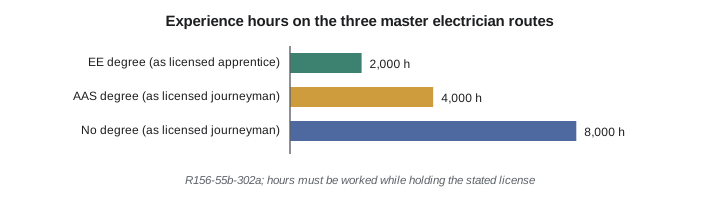
| Route | Education | Experience required |
|---|---|---|
| Engineering | Bachelor's or master's in electrical engineering from an EAC/ABET-accredited program | At least 2,000 hours as a licensed apprentice electrician |
| Trade school | Associate of applied science from a qualifying electrical trade school program | At least 4,000 hours as a licensed journeyman electrician |
| Experience | None beyond the journeyman license | At least 8,000 hours as a licensed journeyman electrician |
The words that matter: licensed and journeyman
On the trade school and experience routes, the hours must be worked as a licensed journeyman. Hours worked as an apprentice count toward the journeyman license, not toward the master license. Hours worked before the journeyman license was issued, even if the work was journeyman-level, do not count toward the 8,000. Hours worked while the journeyman license was expired do not count either, and they may raise a separate question about unlicensed practice. The clock for most candidates therefore starts on the issue date printed on the journeyman license.
Mateo's journeyman license was issued in April 2020. He has worked full time for Wasatch Ridge since then, with overtime most summers. Janelle added his hours from pay stubs month by month and found that he crossed 8,000 hours at the start of 2024 and has worked well beyond that since. His apprenticeship hours from Clearfield matter for his journeyman license, which he already holds, but they add nothing to the master count. He qualifies on the third route.
# Counting master hours from the journeyman issue date (invented figures)
# Only hours worked while holding an active journeyman license count.
monthly = {          # year: hours per month from pay stubs (illustrative)
    2020: [0, 0, 0, 120, 176, 184, 190, 188, 176, 180, 168, 160],
    2021: [168, 160, 176, 176, 184, 192, 196, 192, 180, 176, 168, 160],
    2022: [168, 164, 176, 176, 184, 196, 200, 196, 184, 180, 168, 160],
    2023: [168, 160, 176, 180, 188, 200, 204, 196, 184, 180, 168, 156],
    2024: [164, 160, 176, 180, 188, 196, 200, 196, 184, 176, 168, 160],
}
total = 0
crossed = None
for year in sorted(monthly):
    for m, h in enumerate(monthly[year], start=1):
        total += h
        if crossed is None and total >= 8000:
            crossed = (year, m)
    print(year, "running total", total)
print("Crossed 8,000 journeyman hours in", crossed)2020 running total 1542 2021 running total 3670 2022 running total 5822 2023 running total 7982 2024 running total 10130 Crossed 8,000 journeyman hours in (2024, 1)
A running total like this is the simplest way to check a route before paying any fee. It also shows the value of keeping records as you go. Janelle could build the table in an hour because Wasatch Ridge keeps payroll records by employee and month. A candidate who changed employers several times may need letters or payroll summaries from each one, and those take time to collect.
The residential master routes
Utah also licenses residential master electricians, who may qualify an E201 residential electrical contractor. The rule gives two routes: at least 4,000 hours of work experience as a licensed residential journeyman electrician, or a bachelor's or master's degree in electrical engineering from an accredited program plus at least 2,000 hours as a licensed apprentice. A residential master works within the residential scope the statute and rule define. An electrician who expects to work on commercial and industrial jobs, as Mateo does, needs the full master license. DOPL's contractor pages allow an E201 residential electrical contractor to be qualified by either a master or a residential master, while an E200 general electrical contractor needs a master.
Documenting the hours
DOPL's application asks you to show the experience behind your route, and the exam provider's bulletin says candidates self-certify that they meet the eligibility requirements, under penalty of perjury, before they test. That self-certification is serious. An applicant who tests on a false claim of eligibility risks more than a wasted fee: a false statement on a license application is unprofessional conduct under the DOPL rules and can lead to denial or discipline. Build the record first, then test.
A complete record usually has four parts. The first is the license history: the issue date of the journeyman license and proof that it stayed active. The second is the hours: payroll records, W-2 forms or employer letters showing hours by period. The third is the kind of work: a short description of the installations, which helps if DOPL asks whether the experience was electrical work at the right level. The fourth is a contact at each employer who can confirm the record. DOPL's forms change, so follow the current application packet for the exact documents it wants.
| Part of the record | What it shows | Where it comes from |
|---|---|---|
| License history | When the journeyman license was issued and that it stayed active | DOPL license lookup and your license card |
| Hours | Hours worked while licensed | Payroll records, W-2 forms or employer letters |
| Kind of work | That the hours were electrical work at journeyman level | A job log or employer description |
| Employer contacts | Someone who can confirm the record | Each employer you count hours from |
Special cases
Candidates licensed in other states face their own questions. DOPL has separate application paths for out-of-state applicants, including licensure by endorsement for some people who hold an equivalent license elsewhere, and paths for those who do not qualify by endorsement. The exam bulletin and DOPL's pages make one point clearly: master applicants coming from another state still take the Utah Master Law and Rules exam, because that exam covers Utah's own statutes and rules. If you are moving to Utah, read the current out-of-state pages and ask DOPL how your hours and license will be counted.
Military experience, plant maintenance work and work in an unlicensed role raise similar questions. The hours count only if they meet the rule's terms, which for most candidates means hours as a licensed journeyman. Work done under another state's license, or under no license at all, may or may not be credited depending on the path. The safest approach is to describe the history to DOPL before applying and ask how it will be treated, rather than guessing and self-certifying on the strength of a guess.
A last special case is the candidate who already holds a residential master or residential journeyman license and wants the full master license. Residential hours count toward residential licenses. Whether and how they count toward the full master depends on the current rule and on the rest of the candidate's record, and the practical exam has tasks that apply only when upgrading from a residential license. Lesson 3 covers the practical exam.
Worked problem
Checking three candidates
Lorraine is also helping two other electricians plan. Ana has an associate of applied science degree from a qualifying electrical program and has worked 4,600 hours as a licensed journeyman. Ben has worked 7,400 hours as a licensed journeyman and 8,000 hours as an apprentice before that. Mateo has well over 12,000 hours as a licensed journeyman. Who meets a master route today?
Show solution
- Ana meets the trade school route: a qualifying associate degree plus at least 4,000 hours as a licensed journeyman.
- Ben does not yet meet the experience route: his apprentice hours count toward the journeyman license, not the master, so he has 7,400 of the 8,000 hours.
- Ben needs about 600 more journeyman hours, roughly three to four months of full-time work.
- Mateo meets the experience route with hours to spare.
Answer: Ana and Mateo qualify now; Ben will qualify after about 600 more hours as a licensed journeyman.
A checklist before you apply
Before Mateo booked anything, Janelle wrote a short checklist on the whiteboard, and it is worth copying. Confirm which route you are using and read its text in the current rule. Confirm the issue date of the license that starts your clock and that it never lapsed. Add the hours from records, not memory, and keep the worksheet. Collect a contact at each employer. Read the current candidate information bulletin and DOPL's application page, because both change. Only then self-certify and book the exam. The checklist takes an afternoon. Skipping it can cost months.
Planning around the hours you still need
Candidates who are close to a route but not yet over the line can still use the time well. Ben, the journeyman in the example below, has a few months of work left before he reaches 8,000 licensed journeyman hours. Lorraine suggested he spend those months studying the law and rules material, which takes longer than most people expect, and asking for assignments that broaden his experience, such as a service change, a motor control job or a stint on a commercial tenant improvement crew. When his hours are complete, he will be ready to self-certify and book the exam the same week instead of starting to study from scratch.
It also helps to check the record once a year rather than once a career. A five-minute update to an hours log each January, with a copy of the year's W-2 and a note of any change of employer or license status, turns the application from a research project into a simple form.
Common mistakes
MistakeCounting apprentice hours toward the 8,000-hour master route.
InsteadThe experience route counts hours as a licensed journeyman; apprentice hours count toward the journeyman license.
MistakeStarting the count from the first day in the trade.
InsteadFor most candidates the count starts on the journeyman license issue date.
MistakeTreating the self-certification as a formality.
InsteadCandidates certify eligibility under penalty of perjury; a false statement can lead to denial or discipline.
MistakeAssuming an out-of-state license excuses the Utah exam.
InsteadOut-of-state master applicants still take the Utah Master Law and Rules exam.
Summary and key terms
- The master license has three routes: an EE degree plus 2,000 apprentice hours, a qualifying AAS degree plus 4,000 journeyman hours, or 8,000 journeyman hours.
- The statute states the routes in years and the rule states them in hours.
- Hours count only while the required license was held and active.
- Residential master routes lead to the residential master license, which can qualify an E201 contractor.
- Candidates self-certify eligibility before testing, so the record should be complete first.
- Licensed journeyman hours
- Hours of work performed while holding an active journeyman electrician license.
- R156-55b-302a
- The rule section that sets the education and experience requirements for electrician licenses.
- Self-certification
- The candidate's sworn statement of eligibility made before testing.
- Residential master electrician
- A master-level license limited to residential work that can qualify an E201 contractor.
- Endorsement
- A path to licensure for some applicants who hold an equivalent license in another state.
Practice problems
Work each problem on paper first, then reveal the answer to check.
How many hours as a licensed journeyman does the no-degree route require?
Show answer
At least 8,000 hours.
Do apprentice hours count toward the 8,000-hour master route?
Show answer
No. They count toward the journeyman license.
What does the trade school route require?
Show answer
A qualifying associate of applied science degree plus at least 4,000 hours as a licensed journeyman.
Must an out-of-state master take a Utah exam?
Show answer
Yes, the Utah Master Law and Rules exam.
Lesson quiz · 5 questions
Score 60% or more to complete this lesson.
Create a free account to save your progress, take quizzes and earn a certificate.