
MELU-319 · Lesson 7 of 12 · 19 min
Duties and responsibilities of the Master Electrician License holder
▶ Video coming soon A video version of this lesson is on the way.
In April, a state investigator called Wasatch Ridge about a complaint from a homeowner in Roy. A handyman the homeowner had hired had told her he was "working under" a Wasatch Ridge license and had wired a basement finish without a permit. Nobody at Wasatch Ridge had heard of him. Lorraine spent an afternoon with Janelle pulling payroll and permit records to show that the man had never worked for the company. When it was over, she sat down with Mateo. "That's the other half of a master license," she said. "Your name and your number are worth something, and people will try to borrow them. You answer for everything that goes out under them."
This lesson describes what a Utah master electrician may do, what the license makes the holder responsible for, how supervision of journeymen and apprentices works, what the master's role as a contractor's qualifier adds, and what DOPL treats as unlawful or unprofessional conduct. These topics carry many of the questions in the Title 58 and R156 areas of the exam.
What a master may do
The master electrician license is the top individual electrical license in Utah. A master may plan, lay out and supervise the installation, alteration and repair of electrical systems, and may do the work personally. A master may supervise journeymen and apprentices, and a master may serve as the qualifier for an E200 general electrical contractor or an E201 residential electrical contractor. A residential master has the same roles within the residential scope.
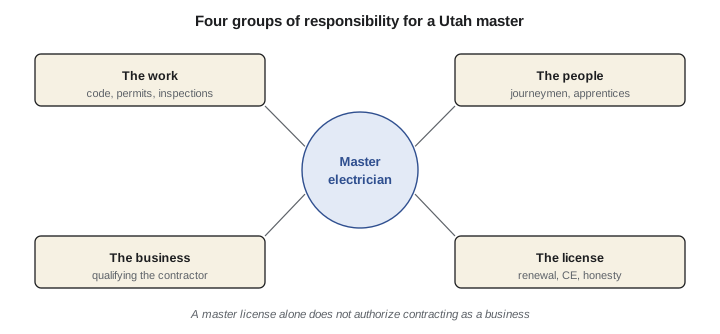
Doing the work and contracting for it are separate. A master who wants to sell electrical work to the public needs a contractor license, either by forming a company that holds one or by qualifying a company that employs the master. A master who works for a contractor, as Mateo does, uses the license on the contractor's jobs. A master license by itself does not authorize a person to bid, contract or advertise electrical work as a business.
Supervision of journeymen and apprentices
Supervision is one of the master's central duties. Journeymen work under the general direction of a master, and apprentices must work under the supervision the rule requires. R156-55b defines the levels of supervision and limits how many apprentices a supervising licensee may oversee at one time, and it ties those limits to the supervisor's license level and to whether the supervisor is on the job. Read the current rule for the numbers and definitions; the exam tests them, and the rules have changed over the years.
In practice, supervision means three things. The supervisor is available and responsible for the apprentice's work. The supervisor checks that work before it is covered or energized. And the supervisor makes sure the apprentice holds an active apprentice license, because an unlicensed helper doing electrical work is a violation for both the helper and the company. Lorraine keeps a crew board in the shop that lists, for each job, the licensed supervisor and the apprentices assigned to that supervisor, so that a glance shows whether the assignments fit the rule.
# Crew license audit before a job starts (study aid, invented crew)
# Every worker needs an active license at the right level; apprentices need a
# licensed supervisor assigned. The ratio limit comes from R156-55b; the value
# below is a placeholder to replace with the current rule.
RATIO_LIMIT = 2                      # placeholder, check R156-55b
crew = [("Mateo Ruiz", "journeyman", "active", None),
        ("Kenji Sato", "journeyman", "active", None),
        ("Ava Lund", "apprentice", "active", "Mateo Ruiz"),
        ("Tyler Beck", "apprentice", "expired", "Mateo Ruiz"),
        ("Rosa Diaz", "apprentice", "active", "Kenji Sato"),
        ("Sam Ortiz", "helper", "none", None)]
load = {}
for name, level, status, sup in crew:
    if status != "active":
        print("STOP:", name, "has no active license; no electrical work")
        continue
    if level == "apprentice":
        load[sup] = load.get(sup, 0) + 1
for sup, n in load.items():
    flag = "ok" if n <= RATIO_LIMIT else "over the limit"
print(sup, "supervises", n, "apprentice(s):", flag)STOP: Tyler Beck has no active license; no electrical work STOP: Sam Ortiz has no active license; no electrical work Mateo Ruiz supervises 1 apprentice(s): ok Kenji Sato supervises 1 apprentice(s): ok
The audit catches two problems before the crew leaves the shop. Tyler's apprentice license has expired, so he may not do electrical work until it is renewed, and Sam has no license at all, so he may not do electrical work at the job. Neither problem can be fixed on site, and both would be the company's and the supervisor's problem if an investigator arrived.
The qualifier's added responsibility
When a master serves as the qualifier for a contractor, the master's knowledge and license support the company's license, and the rules expect the qualifier to have real authority over the company's electrical work, not just to lend a name. The contractor rule, R156-55a, sets out what a qualifier must be and do, including the relationship the qualifier must have with the company. A qualifier who is never on the company's jobs, who does not supervise and who cannot say what work the company is doing invites discipline for both the qualifier and the company.
The qualifier is also the person DOPL often contacts when something goes wrong. Complaints about unlicensed work, missing permits or unsafe installations by the company may lead DOPL to the qualifier. Lorraine treats the role as a management job: she reviews the permit log weekly, signs off on each project's plan and visits every active site at least once a month.
| Role | Typical responsibilities |
|---|---|
| Master doing the work | Code-compliant installations, safe work practices, accurate records |
| Master supervising | Assigning and checking journeymen and apprentices within the rule's limits |
| Master as qualifier | Real authority over the company's electrical work, permits and compliance |
| Every licensee | Keeping the license active, completing continuing education, honest dealings with DOPL |
Permits, inspections and the master's name
Permits connect the master to each job. Many building departments ask for the responsible master's name and license number on the permit application, and the master who appears there is expected to direct the work under that permit. A master should never let a license number be used on a permit for work he or she does not control. The Roy complaint is a common pattern: someone outside the company claims to work under a contractor's license, and the contractor has to prove otherwise.
The master is also responsible for what happens after an inspector finds a problem. Corrections need to be made promptly and correctly, and work must not be covered or energized before approval. Repeated failed inspections or covering work before inspection are the kinds of patterns building officials report and DOPL investigates.
Unlawful and unprofessional conduct
Utah law separates unlawful conduct from unprofessional conduct. Unlawful conduct, defined in Title 58, Chapter 1 and in Chapter 55, includes practicing or offering to practice without the required license, using a license that belongs to someone else and working on an expired license. DOPL's renewal page warns that practicing after a license expires is unlawful under 58-1-501 and subject to the penalties in 58-1-502, and that DOPL may take action for time worked without a license even after the license is renewed or reinstated.
Unprofessional conduct, defined in the statutes and in rules such as R156-1 and R156-55b, covers behavior by licensees that falls below the standard expected: for example, failing to supervise as the rule requires, aiding unlicensed practice, submitting false information to DOPL or a building official, or repeated serious code violations. DOPL can respond with actions ranging from a citation and fine to probation, restriction, suspension or revocation of a license, following the procedures in Title 58 and the general rules.
| Kind of conduct | Examples (summary) | Where it is defined |
|---|---|---|
| Unlawful | Working without a license, on an expired license or on someone else's license | Title 58, Chapters 1 and 55 |
| Unprofessional | Inadequate supervision, aiding unlicensed work, false statements, repeated serious violations | Title 58 and rules such as R156-1 and R156-55b |
| Possible DOPL responses | Citation and fine, probation, restriction, suspension, revocation | Title 58, Chapters 1 and 55 |
Worked problem
Responding to the Roy complaint
DOPL's investigator asks Wasatch Ridge whether the handyman worked under its license. What should the company and its master do?
Show solution
- Respond promptly and honestly; cooperation is expected and a false or misleading answer is itself a problem.
- Pull payroll records to show the man was never an employee and permit records to show no permit was issued to the company for that address.
- Confirm that no one at the company gave out the license number for the job.
- Offer the homeowner information on hiring a licensed contractor to correct the work under a permit.
- Review how the company's license number appears in advertising and on documents to limit misuse.
Answer: Cooperate, document, confirm no one lent the license and help the homeowner find a lawful fix.
Advertising, documents and the license number
Misuse of a license often starts with documents. A business card, a truck door, a website or an estimate that shows a license number tells the public that the work will be done under that license. Utah's construction trades law expects contractors to use their own license information accurately in advertising and on contracts, and DOPL treats offering to do work without the required license as unlawful conduct. A handyman who prints someone else's number on his flyer is doing exactly that, and a licensee who knowingly lets him do it risks being treated as aiding unlicensed practice.
Lorraine took three steps after the Roy complaint. She made sure the company's license number appears only with the company's legal name, so that a number shown with any other name looks wrong at once. She asked the office to keep a copy of every estimate and contract, so the company can prove what it did and did not offer. And she told every employee that the license number is not to be given out for anyone else's job, even as a favor to a relative.
| Situation | Better practice |
|---|---|
| Friend asks to pull a permit under your license | Decline; permits are for work you control |
| Subcontractor wants to list your license on its bid | Decline; each contractor uses its own license |
| Customer asks for proof of license | Point to DOPL's public license lookup |
| Former employee still advertises the company | Ask them to stop and keep a record of the request |
Records a master should keep
Good records protect a master in every inquiry. For each job, keep the contract and change orders, the permit and inspection reports, the names and license numbers of the people who worked on it and the dates they were there. For the crew, keep a current list of licenses and expiration dates and the supervision assignments for apprentices. For the master's own license, keep continuing education certificates and renewal confirmations. When an investigator calls, as one did about the Roy basement, these records turn a stressful afternoon into a short conversation.
Records also help the company learn. Reviewing failed inspections by type once a quarter shows which crews or tasks need attention, and reviewing injuries and near misses shows where the safety program needs work. A master who uses the records this way is supervising in the fullest sense.
Common mistakes
MistakeThinking a master license allows bidding work as a business.
InsteadContracting requires a contractor license; a master license alone does not authorize it.
MistakeLetting a helper do electrical work to save time.
InsteadAnyone doing electrical work needs an active license at the right level, with required supervision.
MistakeTreating the qualifier role as a name on paper.
InsteadThe rules expect the qualifier to have real authority over the company's electrical work.
MistakeBelieving renewal cures time worked on an expired license.
InsteadDOPL warns it may act on time worked without a license even after renewal.
Summary and key terms
- A master may plan, lay out, supervise and perform electrical work and may qualify an E200 or E201 contractor.
- Supervision of apprentices follows the definitions and limits in R156-55b.
- A qualifier must have real authority over the company's electrical work.
- Unlawful conduct includes working without a license or on an expired or borrowed license.
- Unprofessional conduct includes inadequate supervision, aiding unlicensed work and false statements, and DOPL can discipline it.
- Supervision
- The responsibility of a licensed electrician for the work of apprentices or others assigned to them, as the rule defines.
- Qualifier
- The master whose license supports a contractor license and who directs the company's electrical work.
- Unlawful conduct
- Acts the statute prohibits, such as practicing without a required license.
- Unprofessional conduct
- Licensee behavior below the required standard, as the statute and rules define.
- Citation
- A DOPL enforcement action that can carry a fine for certain violations.
Practice problems
Work each problem on paper first, then reveal the answer to check.
Does a master license alone let a person contract for electrical work?
Show answer
No. Contracting requires a contractor license.
Where are the apprentice supervision limits?
Show answer
In R156-55b, the Electricians Licensing Act Rule.
Is working on an expired license unlawful conduct?
Show answer
Yes. DOPL warns it is unlawful under 58-1-501.
Name two possible DOPL responses to unprofessional conduct.
Show answer
Any two of citation and fine, probation, restriction, suspension or revocation.
Lesson quiz · 5 questions
Score 60% or more to complete this lesson.
Create a free account to save your progress, take quizzes and earn a certificate.