
MELU-319 · Lesson 3 of 12 · 19 min
Applying, approval and booking the exam
▶ Video coming soon A video version of this lesson is on the way.
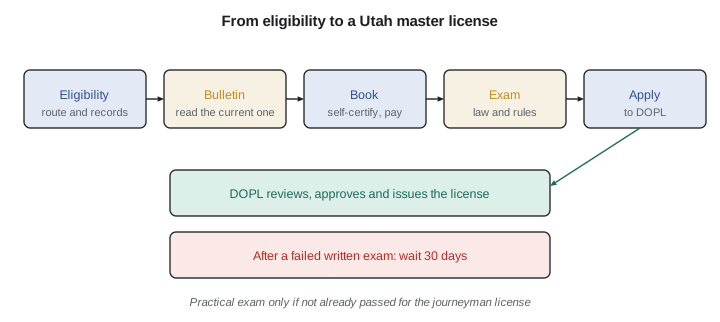
With the hours counted, Mateo expected the next step to be an application to DOPL and a long wait for permission to test. Janelle had been through the process with two other electricians and corrected him. "Utah does it the other way around for electricians," she said. "You read the bulletin, certify that you qualify, book the exam with the testing company and pass it. Then you send DOPL the license application, and DOPL approves the license." Mateo wrote the order on the back of his hours worksheet so he would not forget it.
This lesson follows that order: who gives the exams, how to read the candidate information bulletin, how to book and what to bring, the retake rules, and the DOPL application and approval that turn a passing score into a license. The sequence matters on the exam as well as in real life, because the law and rules portion of the master exam asks about DOPL's application and licensing procedures.
Who gives the exams
DOPL does not run the testing centers itself. Utah's electrical exams are delivered by Prov, an exam provider that publishes the candidate information bulletin, runs the online scheduler and operates testing locations around the state. DOPL's exam information page lists the exams each license needs and links to the bulletin. For the master electrician license, DOPL lists two: the Utah Master Electrician Law and Rule exam and the Utah Electrician Practical exam, which has six modules. A master applicant who already passed the practical exam for a journeyman license does not need to take it again.
The Master Law and Rule exam is new. The bulletin explains that beginning August 1, 2025, master electricians no longer take separate theory and code exams and instead take the Master Law and Rules exam. Mateo passed his journeyman written exam and the practical in 2020, so his only exam for the master license is the Master Law and Rules exam. Lesson 4 covers its format, content and references in detail.
Self-certification instead of pre-approval
Many states make candidates apply to the licensing agency and wait for approval before they may test. The Utah electrical bulletin describes a different arrangement: before any exam, the candidate self-certifies, under penalty of perjury, that he or she meets the eligibility requirements. The bulletin also warns that exam eligibility and licensure requirements may differ, and it gives DOPL's contact details for eligibility questions. Passing the exam does not guarantee a license. DOPL decides whether to issue the license when it reviews the application after the exam.
The practical lesson is that the burden is on the candidate. No one at the testing center will check Mateo's hours. If he self-certified without meeting a route, he could pass the exam and still be denied the license, and the false certification could become a disciplinary matter. The record he and Janelle built in lesson 2 is what protects him.
Booking the exam
The bulletin describes two ways to book. Online, the candidate selects the Utah electrical program, chooses the license, enters personal information, picks a date, time and location, and pays. By phone, the candidate calls the provider's scheduling line during its posted hours. The practical exam must be booked at least seven days ahead. To cancel or reschedule without losing the fee, the candidate must do so at least three business days before the appointment.
Fees are paid to the provider, not to DOPL. The late 2025 bulletin lists a fee of 85 dollars each for the code, theory and practical exams, and secondary sources report the same figure for the Master Law and Rules exam. The DOPL license application has its own separate fee. Because both sets of fees change, Janelle checks the current bulletin and the DOPL fee schedule before every booking and writes the figures on the job folder.
| Item | What the bulletin says (late 2025) | Why it matters |
|---|---|---|
| Booking | Online scheduler or phone line | Pick a location and time that leave room for travel and check-in |
| Practical lead time | Book at least seven days ahead | Late planning can push the practical into the next month |
| Cancel or reschedule | At least three business days before | Later changes forfeit the fee |
| Identification | Current, valid government-issued photo ID with an exactly matching name | A name mismatch can mean no test |
| Arrival | Doors open at least 15 minutes before the appointment | Arriving late can cost the appointment |
Test day logistics
The bulletin is strict about identification. The candidate needs a current, valid government-issued photo ID, such as a driver license, passport, military ID or permanent resident card, and the name on it must match exactly the name used to book. A paper temporary license alone is not enough. Mateo's driver license shows his full legal name, Mateo Andres Ruiz, so Janelle booked him under exactly that name rather than the shorter name on his company badge.
The bulletin also lists what may and may not come into the testing room, including the reference books, tabs and calculator rules that lesson 4 explains. Candidates who arrive with a book full of sticky notes or a calculator the provider does not allow lose time at check-in or lose the item. Reading the permitted items list a week ahead, and preparing the books to match, is part of booking.
Retakes
Not everyone passes the first time. The bulletin says that a candidate who fails a written exam must wait thirty days before retaking it. After six failed attempts, the candidate must wait 120 days before each further attempt. For the practical exam, a candidate retests only the tasks he or she failed, and tasks already passed do not need to be repeated. Each retake is booked and paid for like a new exam.
# Earliest retake dates under the bulletin's waits (study aid, invented dates)
import datetime as dt
first = dt.date(2026, 3, 14)          # first attempt
wait_regular = 30                      # days after a failed written exam
wait_after_six = 120                   # days before each attempt after six failures
attempt, day = 1, first
for _ in range(8):
    wait = wait_regular if attempt < 6 else wait_after_six
    nxt = day + dt.timedelta(days=wait)
    print("attempt", attempt, "on", day, "-> earliest next attempt", nxt)
attempt, day = attempt + 1, nxtattempt 1 on 2026-03-14 -> earliest next attempt 2026-04-13 attempt 2 on 2026-04-13 -> earliest next attempt 2026-05-13 attempt 3 on 2026-05-13 -> earliest next attempt 2026-06-12 attempt 4 on 2026-06-12 -> earliest next attempt 2026-07-12 attempt 5 on 2026-07-12 -> earliest next attempt 2026-08-11 attempt 6 on 2026-08-11 -> earliest next attempt 2026-12-09 attempt 7 on 2026-12-09 -> earliest next attempt 2027-04-08 attempt 8 on 2027-04-08 -> earliest next attempt 2027-08-06
The script makes the cost of repeated failure concrete. Five failures in a row still leave the candidate testing about once a month, but from the seventh attempt on, each try is four months after the last. The better plan is to prepare well enough to pass early, which is what lessons 4, 5 and 12 are for.
Applying to DOPL and approval
After passing, the candidate applies to DOPL for the license. DOPL's pages describe applying online through the state licensing portal or by a manual application. The application asks for identifying information, the route and its supporting documentation, the exam results and the fee, and it asks the qualifying questions that every DOPL application asks about past discipline and criminal history. DOPL reviews the application against the statute and rule. If it meets them, DOPL approves the application and issues the license; if something is missing, DOPL asks for it, and if the applicant does not qualify, DOPL can deny the application.
Approval is DOPL's decision, and the general rules in Title 58, Chapter 1 and R156-1 apply to it. An applicant who is denied has the rights those general rules provide. An applicant who answers a qualifying question falsely risks discipline even after the license issues. Mateo's application will be simple: a clean history, a single route and one employer for all his journeyman hours.
After the license issues
A new master license changes the paperwork at the company. If Wasatch Ridge wants Mateo to serve as a qualifier, alongside Lorraine or in her place, the company has to update its contractor license with DOPL, following the contractor rules in R156-55a and the steps covered in lesson 8. Until DOPL records the change, Lorraine remains the qualifier of record. Janelle also adds Mateo's license number and expiration date to the company's license log, because every electrician license in Utah expires on the same two-year cycle described in lesson 11.
Worked problem
Planning Mateo's calendar
Mateo wants to test in March, after the busy holiday service season, and Lorraine wants his license issued before summer. What should the plan look like?
Show solution
- February: finish the hours worksheet and read the current bulletin and DOPL application page.
- Late February: self-certify and book the Master Law and Rules exam for mid-March, at least three business days ahead of any possible change.
- Mid-March: take the exam. No practical is needed because he passed it for his journeyman license.
- Late March: apply to DOPL with the route documentation, exam result and fee; respond quickly to any request.
- Spring: DOPL approves and issues the license; the company then decides whether to add him as a qualifier.
Answer: Study and records first, then booking, testing, applying and approval, with time left for a retake if needed.
The practical exam in brief
Mateo does not need the practical, but many master candidates do, especially those coming from another state or upgrading from a residential license, so the exam's structure is worth knowing. The bulletin describes six tasks in 110 minutes. They include setting a torque wrench from a chart, terminating conductors on a delta-wye transformer, bending conduit between two boxes, wiring a motor control circuit from a ladder diagram, wiring three-way and four-way switches to work together, and wiring a small circuit from a schematic. The bulletin marks some of those tasks as required only when upgrading from a residential license.
Most tasks are scored pass or fail; conduit bending is scored on points, with deductions for work that is not straight, plumb or level or that shows poor bending practice. Wiring tasks are done without power. The examiner inspects first and energizes the work only if it is safe, and a candidate may not rework a task after asking for inspection. Candidates bring their own tools, from the bulletin's list, which includes conduit, a bender, a reamer, a saw and a non-digital level.
| Practical feature | What the bulletin describes (late 2025) |
|---|---|
| Length | Six tasks in 110 minutes |
| Scoring | Pass or fail for most tasks; points for conduit bending |
| Energizing | Examiner inspects first and energizes only safe work |
| Retakes | Only failed tasks are retested |
| Tools | Candidates bring their own, from the bulletin's list |
A candidate who passes some tasks and fails others keeps the passed tasks and retests only the failed ones, and the bulletin allows tasks to be completed over more than one testing day. That makes the practical forgiving of one bad task, but each retest still costs a booking, a fee and a trip, so practicing every task with your own tools before test day is the cheapest preparation there is.
Keeping the paperwork in one place
Janelle keeps a single folder for each candidate: the hours worksheet and its sources, a copy of the bulletin used to book, the booking confirmation, the score report, the DOPL application and its receipt, and the license once it arrives. When DOPL asks a question months later, or when the candidate renews and someone asks how the license was obtained, the answer is in one place. The folder also helps the next candidate, because it shows exactly what worked and how long each step took.
Common mistakes
MistakeWaiting for DOPL to approve the exam before booking.
InsteadThe bulletin has candidates self-certify and book with the provider; DOPL approves the license application after the exam.
MistakeAssuming a pass means a license.
InsteadDOPL still reviews the application and can deny it if the applicant does not qualify.
MistakeBooking under a nickname.
InsteadThe ID name must match the booking name exactly.
MistakeRetaking the practical after passing it for the journeyman license.
InsteadDOPL's exam page says master applicants who passed the practical for the journeyman license need not retake it.
Summary and key terms
- Utah electrical exams are delivered by Prov under a bulletin that DOPL links to.
- The master license needs the Master Law and Rules exam and, unless already passed, the six-module practical.
- Candidates self-certify eligibility under penalty of perjury before testing.
- After a failed written exam the wait is thirty days; after six failures it is 120 days before each attempt.
- After passing, the candidate applies to DOPL, which reviews, approves and issues the license.
- Candidate information bulletin
- The exam provider's document that sets out exams, content, references, fees and testing rules.
- Prov
- The provider that delivers Utah's electrical licensing exams.
- Master Law and Rules exam
- The written exam for Utah master electricians since August 1, 2025.
- Practical exam
- The hands-on exam of six tasks that journeyman and master applicants take once.
- Approval
- DOPL's decision that a license application meets the statute and rule.
Practice problems
Work each problem on paper first, then reveal the answer to check.
Who delivers Utah electrical licensing exams?
Show answer
Prov, under a candidate information bulletin linked from DOPL's pages.
How long must a candidate wait after failing a written exam the first time?
Show answer
Thirty days.
Does passing the exam guarantee a license?
Show answer
No. DOPL reviews and approves or denies the license application.
How far ahead must the practical be booked?
Show answer
At least seven days.
Lesson quiz · 5 questions
Score 60% or more to complete this lesson.
Create a free account to save your progress, take quizzes and earn a certificate.