
MELU-319 · Lesson 8 of 12 · 19 min
Contractor licensing, insurance and bonding
▶ Video coming soon A video version of this lesson is on the way.
In May, Wasatch Ridge's insurance agent called Janelle about the company's general liability policy. "DOPL raised the minimum this year," he said. "Your limits are fine, but I want to make sure DOPL is listed correctly as certificate holder before your next filing." The call started a longer conversation at the shop. If Mateo became a qualifier, or if he ever left to start his own company, what would the contractor license itself require?
This lesson covers the business side of the license: the electrical contractor classifications, the qualifier, pre-licensure education, the insurance and registrations DOPL requires, workers' compensation and the coverage waiver, what changes when a qualifier leaves, and where bonding fits in a Utah electrical contractor's business. The Title 58, Chapter 55 and R156-55a material here supports a block of exam questions and every bid a contractor submits.
The electrical contractor classifications
Utah licenses contractors by classification, and the contractor rule, R156-55a, defines each classification's scope. Two are electrical. E200, General Electrical Contractor, covers general electrical work as the statute defines it. E201, Residential Electrical Contractor, covers residential electrical work. A related classification, S202, Solar Photovoltaic Contractor, covers installing solar modules and related components but not the wiring and connections governed by the NEC; an S202 contractor may hire an E200 or E201 contractor for that work. E100 sounds similar but is the general engineering contractor classification, not an electrical one.
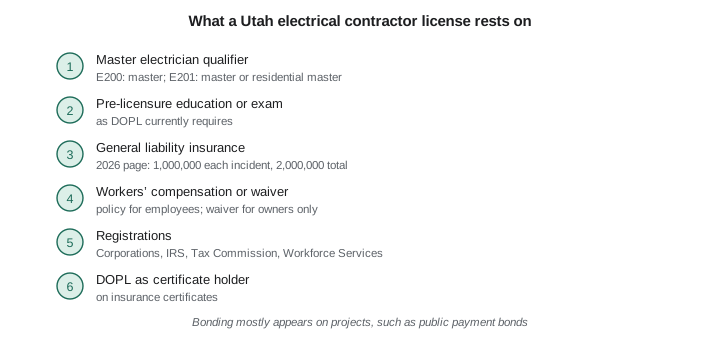
Each electrical classification needs a qualifier with the right license. DOPL's contractor pages say an electrical contractor must have a master electrical qualifier and that the requirement cannot be waived, even for endorsement applicants. Under the statute, an E200 is qualified by a master electrician, and an E201 may be qualified by a master electrician or a residential master electrician. Wasatch Ridge holds an E200, qualified by Lorraine.
| Classification | Scope (summary) | Qualifier |
|---|---|---|
| E200 General Electrical Contractor | General electrical work | Master electrician |
| E201 Residential Electrical Contractor | Residential electrical work | Master electrician or residential master electrician |
| S202 Solar Photovoltaic Contractor | Solar modules and components, not NEC wiring and connections | As the rule requires for S202; NEC wiring is done by an E200 or E201 |
| E100 General Engineering Contractor | Engineering construction; not an electrical classification | As the rule requires for E100 |
Pre-licensure education and the business and law requirement
Utah requires contractor applicants to show business and law knowledge as well as trade skill. DOPL's specialty contractor page says specialty contractors complete a 25-hour pre-licensure course from an approved provider, and it names the providers: Associated Builders and Contractors, the Utah Home Builders Association and Associated General Contractors. The statute also describes a five-hour business law course for applicants who completed the 25-hour course on or after July 1, 2019. DOPL's general contractor page, which lists the electrical classifications, describes the Utah Business and Law exam through the authorized provider and tells applicants not to submit the application until they have passed it, with listed alternatives for some applicants. Because the two pages describe the requirement differently, check DOPL's current instructions for an E200 or E201 application before enrolling or booking.
Insurance
The statute requires a contractor applicant to file proof of public liability insurance in the amounts and form the rule sets. For years the rule required at least 100,000 dollars for each incident and 300,000 dollars in total. In 2026, DOPL's specialty contractor page lists a minimum of 1,000,000 dollars for each incident and 2,000,000 dollars in total, with DOPL named as the certificate holder. Insurance brokers reported the change as part of a 2026 rule amendment applying to new applications and renewals. The certificate must also cover the work the contractor performs and stay in force for as long as the license is active.
The certificate holder detail matters more than it looks. DOPL's instructions say its name and address must appear as certificate holder on the insurance certificate. A certificate that names the general contractor or the agent's office instead can delay an application or renewal. Janelle keeps a copy of each year's certificate in the license file and checks the certificate holder line before filing it.
# Checking an insurance certificate against 2026 DOPL minimums (study aid)
MIN_EACH, MIN_TOTAL = 1_000_000, 2_000_000     # 2026 DOPL page; confirm current
certs = [
    {"name": "Wasatch Ridge", "each": 1_000_000, "total": 2_000_000, "holder": "DOPL"},
    {"name": "Old policy", "each": 100_000, "total": 300_000, "holder": "DOPL"},
    {"name": "New startup", "each": 1_000_000, "total": 3_000_000, "holder": "Insurance agent"},
]
for c in certs:
    problems = []
    if c["each"] < MIN_EACH: problems.append("per-incident limit too low")
    if c["total"] < MIN_TOTAL: problems.append("total limit too low")
    if c["holder"] != "DOPL": problems.append("DOPL not certificate holder")
print(c["name"].ljust(14), "OK" if not problems else "; ".join(problems))Wasatch Ridge OK Old policy per-incident limit too low; total limit too low New startup DOPL not certificate holder
The old policy in the script would have been fine before 2026 and fails now. The startup has high enough limits but names the wrong certificate holder. Both are the kinds of problems that stall a license application for weeks.
Workers' compensation and the coverage waiver
A contractor with employees must carry workers' compensation insurance that covers them, and DOPL asks for proof with DOPL named as certificate holder. A contractor with no employees can instead obtain a Workers' Compensation Coverage Waiver from the Utah Labor Commission. The Labor Commission's page describes the waiver as available to sole proprietors and partnerships with no employees other than the owners, LLC members, a limited number of corporate officers and directors, and independent contractors in those categories. The waiver runs for a one-year term, carries a nonrefundable 50-dollar processing fee and requires supporting documents, such as an active DOPL license and proof of an independent business.
The waiver covers the owner, not employees. The day a waiver holder hires a helper, the business needs a workers' compensation policy. Lesson 10 covers what workers' compensation provides, how injuries are reported and why a contractor can be responsible for an uninsured subcontractor's workers.
Registrations
DOPL's pages list several registrations for a contractor. A business entity, such as a corporation, LLC or partnership, registers with the Utah Division of Corporations and Commercial Code. The business obtains a federal employer identification number from the IRS, or a sole proprietor using a Social Security number answers accordingly on the application. A business with employees registers with the Utah State Tax Commission for withholding and with the Department of Workforce Services for unemployment insurance. The statute also requires a criminal background check for the qualifier and for each person with a significant voting interest in the company.
| Requirement | From | When it applies |
|---|---|---|
| General liability certificate | Insurer, with DOPL as certificate holder | Every contractor |
| Workers' compensation certificate | Insurer, with DOPL as certificate holder | Contractors with employees |
| Coverage waiver | Utah Labor Commission | Qualifying owners with no employees |
| Entity registration | Division of Corporations and Commercial Code | Corporations, LLCs, LLPs and partnerships |
| Employer identification number | IRS | As the application requires |
| Withholding and unemployment registrations | State Tax Commission; Department of Workforce Services | Contractors with employees |
When a qualifier leaves
Because the qualifier's license supports the company's license, a qualifier's departure is a licensing event. The contractor must report the change to DOPL and replace the qualifier within the time and in the manner R156-55a and the statute allow. Until a qualified replacement is approved, the company risks being unable to contract for electrical work. A company that plans ahead, as Lorraine is doing, adds a second qualifier or prepares a successor before anyone leaves. Mateo's master license would let Wasatch Ridge name him as an additional qualifier while Lorraine is still active.
Where bonding fits
Many states require a contractor license bond. DOPL's application pages, as read in 2026, list insurance and registrations for electrical contractors but do not list a standing license bond, so for most Utah electrical contractors bonding shows up on particular projects instead. Public owners use payment and performance bonds under the state procurement code in Title 63G, Chapter 6a, and subcontractors and suppliers who are not paid on a bonded public project generally make claims against the payment bond within the deadlines that law sets, rather than recording a lien on public property. Private owners and general contractors may also require bonds by contract. A contractor's surety relationship, built on its financial statements and track record, decides how much bonded work it can take on.
Worked problem
Mateo's hypothetical startup
Mateo asks what he would need, after earning his master license, to start his own E200 company with one apprentice. What is on the list?
Show solution
- His master license, to qualify the E200 classification.
- The pre-licensure education or business and law exam DOPL's current instructions require for E200.
- General liability insurance at the current minimum, with DOPL as certificate holder.
- Workers' compensation insurance, because he would have an employee; a waiver covers only owners without employees.
- Entity registration, an employer identification number, and withholding and unemployment registrations.
- A background check, the application and fee, and, for public work, a surety relationship for bonds.
Answer: Qualifier, education or exam, insurance, workers' compensation, registrations and application, with bonding as needed for projects.
Keeping the contractor license in good standing
A contractor license is not a one-time achievement. The insurance must stay in force for as long as the license is active, which means every policy renewal should produce a new certificate with DOPL as certificate holder, filed as DOPL requires. Changes to the business, such as a new entity, a new owner with a significant interest, a new address or a new qualifier, generally need to be reported to DOPL as the rules require. The contractor license has its own renewal cycle and requirements, separate from the electrician licenses, so Janelle tracks it on the same calendar but as its own line.
Insurance lapses are the most common avoidable problem. If a general liability policy is canceled for nonpayment, or a workers' compensation policy ends when a company changes carriers, the license can be affected even though the work never stopped. Janelle sets reminders sixty days before each policy renewal and asks the agent to send the new certificate directly to DOPL and to her.
| Item | When to check |
|---|---|
| General liability certificate | Each policy renewal; certificate holder must be DOPL |
| Workers' compensation | Each policy renewal, and whenever the first employee is hired |
| Qualifier status | Whenever a qualifier changes role, leaves or lets a license lapse |
| Entity and ownership changes | Before or promptly after the change, as DOPL requires |
| Contractor license renewal | On the contractor license's own cycle |
Subcontractors and their licenses
Wasatch Ridge sometimes subcontracts low-voltage or specialty work. Before any subcontractor starts, Janelle checks DOPL's public license lookup for the right classification, collects a current certificate of liability insurance and either a workers' compensation certificate or a valid coverage waiver, and keeps them in the job file. A subcontractor without the right license can expose the company to claims of aiding unlicensed work, and a subcontractor without workers' compensation can make the company responsible for its workers' injuries, as lesson 10 explains.
Finally, remember that the license is only the minimum. Owners and general contractors often require more insurance than DOPL's minimum, additional insured endorsements, waivers of subrogation or specific bonding before they award work. Read the insurance and bonding sections of every contract before signing, and send them to the agent early, because a missing endorsement can delay the first payment as surely as a missing permit can delay the first inspection.
Common mistakes
MistakeUsing an old certificate with the former 100,000 and 300,000 limits.
InsteadDOPL's 2026 page lists 1,000,000 per incident and 2,000,000 total; check the current minimum.
MistakeNaming the general contractor as certificate holder.
InsteadDOPL must be the certificate holder on the certificates it receives.
MistakeRelying on a coverage waiver after hiring a helper.
InsteadThe waiver covers qualifying owners without employees; employees need a workers' compensation policy.
MistakeRecording a lien on a public building.
InsteadUnpaid parties on public projects generally claim against the payment bond.
Summary and key terms
- E200 general electrical and E201 residential electrical are Utah's electrical contractor classifications.
- An electrical contractor must have a master electrical qualifier.
- DOPL's 2026 pages list 1,000,000 per incident and 2,000,000 total in general liability, with DOPL as certificate holder.
- Employers need workers' compensation; qualifying owners without employees can get a one-year Labor Commission waiver.
- Bonding mostly appears on projects, especially public payment and performance bonds under Title 63G, Chapter 6a.
- E200
- The General Electrical Contractor classification.
- E201
- The Residential Electrical Contractor classification.
- Certificate holder
- The party named on an insurance certificate to receive it; for licensing, DOPL.
- Workers' Compensation Coverage Waiver
- A one-year Labor Commission waiver for qualifying owners with no employees.
- Payment bond
- A surety bond that guarantees payment to subcontractors and suppliers on a project.
Practice problems
Work each problem on paper first, then reveal the answer to check.
Which classification does a general electrical contractor hold?
Show answer
E200.
What general liability minimum did DOPL's 2026 page list?
Show answer
1,000,000 for each incident and 2,000,000 in total, with DOPL as certificate holder.
Who issues the workers' compensation coverage waiver?
Show answer
The Utah Labor Commission.
How do unpaid subcontractors on public projects usually seek payment?
Show answer
By a claim against the payment bond.
Lesson quiz · 5 questions
Score 60% or more to complete this lesson.
Create a free account to save your progress, take quizzes and earn a certificate.