
MELU-319 · Lesson 10 of 12 · 19 min
Workplace safety law and OSHA for electrical contractors
▶ Video coming soon A video version of this lesson is on the way.
In June, an apprentice on the cold-storage warehouse job near the Ogden airport took a shock from a lighting circuit that a ceiling crew had re-energized without telling anyone. He was not badly hurt, but he went to the urgent care clinic, missed two days of work and was shaken. That afternoon Lorraine held the crew at the gang box for an hour. "This is the part of the license nobody puts on the business card," she told Mateo afterward. "You're responsible for the people on your jobs. The exam tests it because the job depends on it."
This lesson covers the safety and labor law a Utah master works under: the Utah Occupational Safety and Health Division and its state plan, the federal OSHA standards that apply to electrical work, NFPA 70E, the PPE standards listed for the exam, injury and illness reporting, and the workers' compensation rules in the Utah Labor Code. Together these areas carry about 16 of the 80 questions on the Master Law and Rules exam.
Utah's state plan
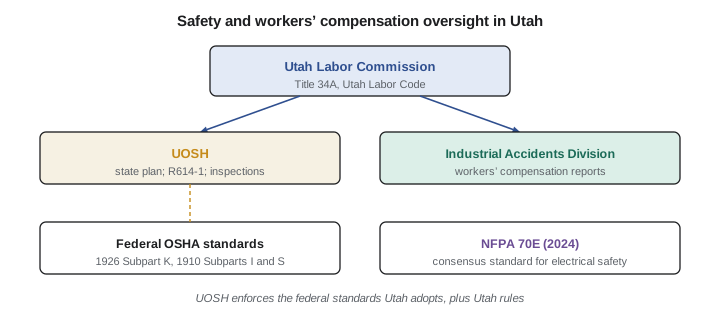
Utah runs its own occupational safety and health program as an OSHA-approved state plan. The Utah Occupational Safety and Health Division, called UOSH, is part of the Utah Labor Commission and enforces safety and health standards for most private and public employers in the state under the Utah Occupational Safety and Health Act in Title 34A. A state plan must be at least as effective as federal OSHA, and Utah generally adopts the federal standards by reference in its rules, R614-1, and adds Utah-specific requirements.
For an electrical contractor, the practical result is that the familiar OSHA standards apply on Utah jobs, but the inspector who arrives after a complaint or an accident is usually from UOSH, and the reporting and recordkeeping rules include Utah's additions. The exam's reference list names R614-1-5, a section of the UOSH rule, along with the Labor Commission's industrial accidents material and the federal PPE standards.
The OSHA standards electricians use
Several groups of OSHA standards matter to electrical contractors. The construction standards in 29 CFR 1926, Subpart K, cover electrical safety on construction sites, including ground-fault protection for temporary power and work near energized parts. The general industry standards in 29 CFR 1910, Subpart S, cover electrical safety in workplaces, including safety-related work practices in 1910.333 and training. The control of hazardous energy, lockout and tagout, is in 1910.147, with related electrical provisions in Subpart S. Fall protection, ladders, scaffolds and excavations each have their own subparts that electrical crews meet every day.
The exam's reference list names one group specifically: 29 CFR 1910, Subpart I, personal protective equipment, with sections 1910.132 (general requirements, including the hazard assessment and training), 1910.133 (eye and face protection) and 1910.134 (respiratory protection). Section 1910.132 requires the employer to assess the workplace for hazards that call for PPE, select appropriate equipment, certify the assessment in writing and train employees in its use. Electrical PPE beyond those sections is addressed in Subpart S and in NFPA 70E.
| Standard | Subject (summary) | Why electricians care |
|---|---|---|
| 29 CFR 1926, Subpart K | Electrical safety in construction | Temporary power, GFCI protection, work near energized parts |
| 29 CFR 1910, Subpart S | Electrical safety in general industry | Safety-related work practices, qualified persons, training |
| 29 CFR 1910.147 | Control of hazardous energy | Lockout and tagout procedures |
| 29 CFR 1910, Subpart I | Personal protective equipment | Hazard assessment, eye and face, respiratory protection |
| NFPA 70E (2024) | Electrical safety in the workplace | Risk assessment, electrically safe work condition, PPE selection |
NFPA 70E
NFPA 70E, Standard for Electrical Safety in the Workplace, is the consensus standard most employers use to meet OSHA's general duty to protect workers from electrical hazards, and the exam lists its 2024 edition with five questions. Its central idea is that work should be done in an electrically safe work condition, with the equipment de-energized, locked out, tested and verified absent of voltage, whenever possible. Energized work is permitted only in the limited circumstances the standard describes, and then only after a shock risk assessment and an arc flash risk assessment, with an energized electrical work permit where the standard requires one, appropriate PPE and qualified workers.
Utah's continuing education rule also puts NFPA 70E in front of every electrician: four of the twelve core hours in each renewal cycle must cover it, as lesson 11 explains. Mateo tabbed his 70E at the articles on the electrically safe work condition, the risk assessments, the work permit and training, which are the subjects most likely to appear in a law-and-safety question.
What went wrong on the warehouse job
The warehouse shock is a textbook failure of energy control. The circuit had been de-energized, but not locked out, and another trade restored it. Under 1910.147 and the electrical work practice standards, each worker exposed to the hazard should have applied a personal lock, and the circuit should have been tested before work. Lorraine's corrective actions were specific: retraining on the company's lockout procedure, a lock and tag for every electrician, a coordination meeting with the ceiling contractor, and a rule that no one works on a circuit without testing it, every time, even if the foreman says it is dead.
Reporting injuries and illnesses
Two sets of reporting rules apply to an injury like the apprentice's. The first is the safety system. Employers keep records of work-related injuries and illnesses as the OSHA recordkeeping rules and UOSH require, and they report fatalities and serious injuries, such as an in-patient hospitalization, an amputation or the loss of an eye, to UOSH within the short time limits the rules set. Read R614-1 for Utah's current reporting deadlines; they are stricter than many people expect.
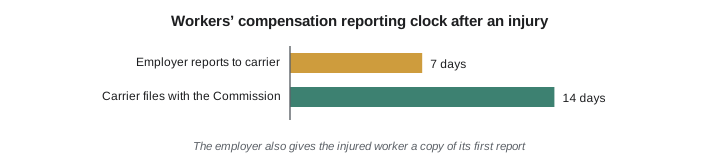
The second is workers' compensation. The Labor Commission's guide for employers says the employer has 7 days to report a claim to its insurance carrier on the employer's first report of injury or illness form and must give the injured worker a copy. The carrier then has 14 days to file the first report electronically with the Commission's Industrial Accidents Division. Employers must also post notices of workers' compensation compliance in conspicuous places at the workplace, and the Commission provides those notices free in English and Spanish.
Workers' compensation in the Utah Labor Code
The Workers' Compensation Act, in Title 34A, Chapter 2, requires nearly every employer to provide workers' compensation coverage for its employees, through an insurer or, for qualifying employers, by self-insurance. Coverage pays medical care and wage replacement for work-related injuries and illnesses, generally without regard to fault, and in exchange the employer is generally protected from lawsuits by employees over covered injuries. Lesson 8 covered the coverage waiver available to qualifying owners without employees.
Contractors should know one more rule. Utah's act can treat a contractor as the employer of the workers of an uninsured subcontractor it hires, which means an injury to a subcontractor's worker can become the contractor's claim. That is why Janelle collects a current certificate of workers' compensation insurance, or a valid coverage waiver, from every subcontractor before it starts work, and checks the Labor Commission's coverage verification tool for anyone she does not know.
# A crew's recordable injury rate (study aid, invented figures)
# OSHA-style rate: recordable cases x 200,000 / hours worked, which expresses
# the rate per 100 full-time workers for a year.
hours = {"2024": 33_800, "2025": 34_900, "2026 to date": 29_400}
cases = {"2024": 1, "2025": 2, "2026 to date": 1}
for year in hours:
    rate = cases[year] * 200_000 / hours[year]
print(year.ljust(13), "cases", cases[year], " rate", round(rate, 1))2024 cases 1 rate 5.9 2025 cases 2 rate 11.5 2026 to date cases 1 rate 6.8
Rates like these matter commercially as well as morally. Many general contractors and owners ask for a subcontractor's injury rate and workers' compensation experience before they award work, and a small company's rate can swing widely after a single case. The way to keep it low is the same as the way to keep people safe: plan the work, control the energy and train the crew.
Worked problem
Handling the apprentice's shock
The apprentice was treated at urgent care and missed two days. He was not hospitalized. What must Wasatch Ridge do?
Show solution
- Make sure he receives proper care and that the circuit and area are safe before work resumes.
- Report the claim to the workers' compensation carrier on the first report of injury form within 7 days and give the apprentice a copy.
- Record the case on the injury and illness log if it meets the recordkeeping criteria, as a case involving days away from work generally does.
- Check whether the injury meets any UOSH reporting threshold; a case without hospitalization, amputation or loss of an eye generally does not, but confirm against R614-1.
- Investigate the cause and correct it: lockout, testing and coordination with the other trade.
Answer: Care first, report to the carrier within 7 days, record the case, check the UOSH reporting rule and fix the cause.
Building a safety program that works
A written safety program is the foundation for meeting UOSH and OSHA requirements, and for electrical contractors it starts with energy control. Wasatch Ridge's program covers lockout and tagout procedures, the hazard assessment and PPE selection required by 1910.132, the arc flash and shock risk assessments NFPA 70E describes, ground-fault protection for temporary power, ladder and fall protection, and training records for each worker. Lorraine reviews it every year and after every incident, as she did after the warehouse shock.
Training is where most programs succeed or fail. NFPA 70E and the OSHA standards expect workers to be trained for the tasks they do and the hazards they face, and qualified persons must know how to recognize and avoid electrical hazards on the equipment they work on. Wasatch Ridge holds a short safety meeting every Monday, keeps sign-in sheets and gives new hires a day of orientation before they go to a site. The four NFPA 70E hours in each renewal cycle, covered in lesson 11, add to that training for every licensed electrician.
| Program element | Source of the requirement (summary) |
|---|---|
| Lockout and tagout | 29 CFR 1910.147 and electrical work practice standards |
| PPE hazard assessment and training | 29 CFR 1910.132 |
| Arc flash and shock risk assessment | NFPA 70E |
| Temporary power GFCI protection | 29 CFR 1926, Subpart K |
| Injury records and reporting | OSHA recordkeeping and R614-1 |
When UOSH visits
UOSH inspections can follow a complaint, a reported injury or a targeted program. The compliance officer presents credentials, explains the reason for the visit, reviews records and walks the site. A contractor should cooperate, accompany the officer, take notes and photographs of the same conditions the officer documents and correct hazards promptly. Citations, if any, come later and can be contested or settled through the process the Labor Commission provides. A company with a written program, training records and a history of correcting hazards is in a far better position than one that has to explain why it has none.
Contractors should also know that UOSH's rules protect workers who raise safety concerns. A worker who reports a hazard or an injury may not be punished for doing so, and retaliation can lead to its own complaint and penalties. Wasatch Ridge tells every new hire, in the first orientation, that reporting a hazard is part of the job and that no one will be punished for stopping work that looks unsafe.
Common mistakes
MistakeAssuming federal OSHA inspects Utah private-sector jobs.
InsteadUtah runs an approved state plan; UOSH, in the Labor Commission, usually inspects.
MistakeTreating de-energized as safe.
InsteadLock out, tag out and test for absence of voltage before work.
MistakeWaiting for the worker to file the claim.
InsteadThe employer reports to its carrier within 7 days and gives the worker a copy.
MistakeSkipping a subcontractor's workers' compensation proof.
InsteadA contractor can be responsible for an uninsured subcontractor's workers.
Summary and key terms
- UOSH, in the Utah Labor Commission, enforces safety standards under Utah's OSHA-approved state plan.
- Electrical contractors work under 29 CFR 1926 Subpart K, 1910 Subpart S, 1910.147 and the PPE standards in 1910 Subpart I.
- NFPA 70E (2024) centers on the electrically safe work condition and risk assessment before any energized work.
- Employers report workers' compensation claims to the carrier within 7 days; the carrier files with the Commission within 14 days.
- Nearly every employer must carry workers' compensation, and a contractor can be liable for an uninsured subcontractor's workers.
- UOSH
- The Utah Occupational Safety and Health Division of the Labor Commission.
- State plan
- A state safety and health program approved by federal OSHA.
- Electrically safe work condition
- Equipment de-energized, locked out, tested and verified absent of voltage.
- First report of injury
- The employer's report of a work injury to its workers' compensation carrier.
- Industrial Accidents Division
- The Labor Commission division that oversees workers' compensation.
Practice problems
Work each problem on paper first, then reveal the answer to check.
Who usually enforces workplace safety on a private Utah job?
Show answer
UOSH, in the Utah Labor Commission.
Which OSHA subpart on the exam covers personal protective equipment?
Show answer
29 CFR 1910, Subpart I (1910.132 to 1910.134).
How long does the employer have to report a claim to its carrier?
Show answer
7 days.
Which edition of NFPA 70E does the exam list?
Show answer
2024.
Lesson quiz · 5 questions
Score 60% or more to complete this lesson.
Create a free account to save your progress, take quizzes and earn a certificate.