
MELU-318 · Lesson 9 of 12 · 21 min
Contracts and mechanics' liens in Texas
▶ Video coming soon A video version of this lesson is on the way.
Two years ago Pecan Creek finished the electrical work on a strip of four shops for a developer who then stopped paying the general contractor, who stopped paying Pecan Creek. Walt was owed about 46,000 dollars. He got all of it, eventually, because Lupe had sent the right notices on time and filed a lien affidavit before the deadline. A competitor on the same project, which did not send its notices, got nothing. That story is why Walt insisted that Rosa learn Texas lien law before she becomes master of record, and why this topic appears in the business and law portion of master and contractor exams. This lesson covers contracts for electrical work, the Texas mechanic's lien system in Chapter 53 of the Property Code as revised for contracts entered on or after January 1, 2022, notices and deadlines, retainage, homestead rules, and prompt payment.
Lien law is technical and deadline-driven, and the 2022 overhaul changed many details. The general framework in this lesson is drawn from Chapter 53 and from law firm summaries of the 2022 changes, checked in November 2026. Specific deadlines below are described as typical and must be confirmed in the current statute for the type of project and the claimant's position before you rely on them. When real money is at stake, talk to a construction attorney early, because missed deadlines usually cannot be fixed.
Contracts first
Most payment problems are prevented by a clear contract, not cured by a lien. A good electrical contract or subcontract identifies the parties correctly, describes the scope of work and what is excluded, references the drawings and specifications, states the price and how changes are priced, sets the payment schedule and the retainage, states the schedule and who bears delays, allocates insurance and indemnity, and explains how disputes are resolved. Change orders should be written and signed before the extra work is done. Pecan Creek's rule is that no crew performs extra work on a commercial job without a signed change order or at least a signed field authorization, because a lien claim for unapproved extras is the hardest kind to win.
Texas law adds specific requirements for some contracts. Residential construction contracts can require particular disclosures, and contracts involving a homestead have special formalities discussed below. Public projects follow the procurement and bonding rules of the owner and of Government Code Chapter 2253, mentioned in Lesson 8. For the exam, know the parts of a sound contract and the purpose of change orders, retainage and lien waivers.
What a mechanic's lien is
A mechanic's lien is a legal claim against real property that secures payment for labor or materials furnished to improve it. If a contractor, subcontractor or supplier is not paid, it can, by following the statute, place a lien on the property and, if necessary, sue to foreclose the lien and have the property sold to pay the debt. Liens give unpaid parties leverage, because an owner cannot easily sell or refinance a property with a lien on it. Texas law protects original contractors, who contract directly with the owner, and also subcontractors and suppliers further down the chain, who have no contract with the owner, through a system of notices that warn the owner to protect itself.
Texas has both a statutory lien under Chapter 53 and a constitutional lien under the Texas Constitution, which benefits original contractors in privity with the owner. In practice, almost everyone relies on the statutory lien and follows Chapter 53's procedures, and that is what the exam emphasizes.
The 2022 overhaul
House Bill 2237 rewrote much of Chapter 53 for original contracts entered into with an owner on or after January 1, 2022. The changes were meant to simplify the system. All subcontractors now have the same notice obligations regardless of tier, so a second-tier subcontractor no longer sends the extra second-month notice that the old law required. The statute now provides required statutory forms for notices, lien affidavits and releases, which claimants must use substantially as written. Deadlines that fall on a weekend or legal holiday are extended to the next business day. And the time to bring a suit to foreclose a lien is now one year for both residential and commercial projects, measured from the last day a claimant could file its lien affidavit, where commercial projects previously had longer. Projects with original contracts before 2022 remain under the old rules, which is one more reason to know the contract date.
Notices and the lien affidavit
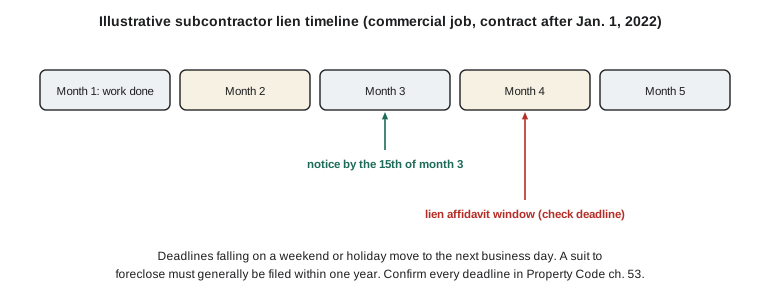
For a subcontractor or supplier, protecting lien rights is a two-step process: send notice, then file the lien affidavit. Under the current law, a subcontractor generally must send a notice of claim for unpaid work to the owner and the original contractor by the 15th day of the third month after the month in which the unpaid work was performed on a commercial project, and by the 15th day of the second month on a residential project. If the claim is not resolved, the claimant files a lien affidavit with the county clerk where the property is located, generally by the 15th day of the fourth month after the month the original contract was completed, terminated or abandoned on a commercial project, and the third month on a residential project, and sends a copy to the owner and original contractor within the time the statute requires. These are the typical deadlines; confirm them in the current statute for your specific situation.
Lupe tracks every commercial job with a simple rule: for each month Pecan Creek performs work that is not paid by the end of the next month, she calendars the notice deadline for the 15th of the third month. On the shopping center job, Pecan Creek's unpaid work was performed in April, so notice was due by July 15, and she sent it on July 2 by certified mail using the statutory form. When the project finished in September and payment still had not come, she calendared the lien affidavit deadline and filed well before it.
Worked problem
Calendaring a notice deadline
Pecan Creek is a first-tier subcontractor on a commercial job whose original contract was signed in 2025. Its May invoice for work performed in May is unpaid. By what date must it send its notice of claim, under the typical commercial rule described in this lesson?
Show solution
- Month the work was performed: May.
- Count forward: June is the first month after, July the second, August the third.
- The notice is due by the 15th day of the third month after the month of the work: August 15.
- If August 15 falls on a weekend or holiday, the 2022 law extends it to the next business day.
Answer: By August 15, or the next business day if it falls on a weekend or holiday.
Retainage
Texas law requires owners on most private projects to retain a portion of each payment to the original contractor for a period after completion, as a fund that protects subcontractors and suppliers who file valid claims. The statute requires the owner to retain 10 in every 100 dollars of the contract price, or of the value of the work, until 30 days after the work is completed; check Section 53.101 for the exact basis. An owner who fails to retain can become personally liable to claimants up to the amount that should have been retained. Separately, contracts often provide for contractual retainage held by the general contractor from its subcontractors. A subcontractor whose contractual retainage is unpaid has its own notice procedure, including a notice of contractual retainage, and the 2022 law sets deadlines for it; this is one of the areas law firm commentators flagged as tricky, so get advice before relying on the retainage procedures.
Homesteads
Texas gives homesteads, the primary residence of a family or single adult, strong protection from forced sale, and a lien on a homestead is valid only if strict requirements are met. In general, the original contractor must have a written contract with the owner, signed by the owner and the owner's spouse if married, before the work begins, and the contract must be filed with the county clerk; subcontractors have additional notice requirements, and residential notices must carry specific statutory warnings. Without these formalities, a lien against a homestead may be unenforceable. Pecan Creek's residential service upgrades use a written contract with spousal signature lines for exactly this reason, and Lupe files the contract when the job is large enough that a lien might matter.
| Item | General rule (confirm in Chapter 53) | Pecan Creek practice |
|---|---|---|
| Subcontractor notice, commercial | By the 15th of the third month after the month of unpaid work | Calendared for every unpaid month |
| Subcontractor notice, residential | By the 15th of the second month after the month of unpaid work | Calendared separately for homes |
| Lien affidavit | Typically by the 15th of the fourth month (commercial) or third month (residential) after completion | Filed well before the deadline |
| Weekend or holiday deadline | Extended to the next business day | Never relied on; files early |
| Suit to foreclose | One year, for both residential and commercial | Attorney engaged early |
| Owner's statutory retainage | 10 in 100 held until 30 days after completion | Asks owners whether they retain |
Lien waivers and releases
When a contractor is paid, the payer usually asks for a lien waiver or release. The 2022 law requires the use of statutory forms for conditional and unconditional waivers and releases, for progress payments and for final payment. A conditional waiver takes effect only when the stated payment actually clears; an unconditional waiver takes effect when signed, whether or not the money arrives. Lupe's rule is simple: Pecan Creek signs conditional waivers when it has not yet received good funds and signs unconditional waivers only after the payment has cleared the bank. Signing an unconditional waiver before payment can give away lien rights for nothing.
Building lien habits into the office
Lien rights are lost far more often through disorganization than through bad law. Pecan Creek's office routine shows what works. When a commercial job starts, Lupe records the owner's legal name and address from the county records, the general contractor's name and address, the project's legal description, and whether the project is residential or commercial. She notes the date the general contractor's contract with the owner was signed, so she knows which version of Chapter 53 applies. Each month she compares invoices with payments and, for any unpaid work, calendars the notice deadline. She uses the statutory forms, sends notices by a method that proves delivery, and keeps copies with the proof of mailing. At the end of the job she calendars the lien affidavit deadline. Walt reviews the list of open notices every month.
The routine costs a few hours a month. On the shopping center job it was worth 46,000 dollars. Rosa now understands why Walt calls lien notices the cheapest insurance the company buys, and why he says a master of record who leaves the office side to chance is not doing the whole job.
Prompt payment
Texas also has prompt payment laws. Chapter 28 of the Property Code covers private construction projects and generally requires owners to pay original contractors, and contractors to pay subcontractors, within set periods after receiving a proper payment request or after receiving payment from upstream, with interest on late payments and the right in some cases to suspend work after notice. Chapter 2251 of the Government Code covers payments by governmental entities. The periods and exceptions are detailed; read the statutes for the current requirements. Prompt payment rights work alongside lien and bond rights, not instead of them.
The calculator below computes the typical notice deadline for each month of unpaid commercial work and shows how far away it is. Change the months and the year, and remember to check the statute for your own case and to move a weekend or holiday deadline to the next business day.
from datetime import date

def notice_deadline(year, month, months_after=3):
    m = month + months_after
    y = year + (m - 1) // 12
    m = (m - 1) % 12 + 1
    return date(y, m, 15)

unpaid_work_months = [(2026, 4), (2026, 5), (2026, 11)]
for y, m in unpaid_work_months:
    d = notice_deadline(y, m)
    note = " (weekend: move to next business day)" if d.weekday() >= 5 else ""
print(f"Work in {y}-{m:02d}: commercial notice due by {d}{note}")Work in 2026-04: commercial notice due by 2026-07-15 Work in 2026-05: commercial notice due by 2026-08-15 (weekend: move to next business day) Work in 2026-11: commercial notice due by 2027-02-15
Common mistakes
MistakeWaiting until the end of the job to send notices.
InsteadNotices are due month by month, based on when each unpaid portion of the work was performed.
MistakeUsing the pre-2022 deadlines on a new project.
InsteadContracts with the owner on or after January 1, 2022 follow the revised Chapter 53.
MistakeSigning an unconditional waiver before payment clears.
InsteadUse a conditional waiver until good funds arrive.
MistakeAssuming a lien on a homestead is automatic.
InsteadHomestead liens require a written contract signed before work, by both spouses if married, and filed.
MistakeLetting the one-year foreclosure deadline pass while negotiating.
InsteadThe suit to foreclose must generally be filed within one year; involve an attorney early.
Summary and key terms
- Clear contracts and signed change orders prevent most payment disputes.
- Chapter 53 gives contractors, subcontractors and suppliers lien rights if they follow its procedures.
- The 2022 overhaul applies to original contracts entered on or after January 1, 2022, with statutory forms.
- Subcontractors send notices month by month and then file a lien affidavit by the statutory deadline.
- Weekend and holiday deadlines move to the next business day; suits to foreclose must generally be filed within one year.
- Owners hold statutory retainage, homesteads need special formalities, and prompt payment laws add further rights.
- Mechanic's lien
- A claim against real property securing payment for labor or materials that improved it.
- Original contractor
- A contractor with a direct contract with the owner.
- Lien affidavit
- The sworn document filed with the county clerk to perfect a lien claim.
- Statutory retainage
- The portion of payments an owner must hold for a period after completion to protect claimants.
- Conditional waiver
- A lien waiver that takes effect only when the stated payment is actually received.
- Homestead
- A protected primary residence, against which liens require special formalities.
Practice problems
Work each problem on paper first, then reveal the answer to check.
A subcontractor's unpaid work was performed in October on a commercial job. Under the typical rule, when is the notice due?
Show answer
By January 15 of the following year, or the next business day if that is a weekend or holiday.
Which projects follow the 2022 version of Chapter 53?
Show answer
Those whose original contract with the owner was entered on or after January 1, 2022.
How long does a claimant generally have to sue to foreclose a lien under the current law?
Show answer
One year, for both residential and commercial projects.
When should a contractor sign an unconditional lien waiver?
Show answer
Only after the payment has cleared.
What must an owner retain under Chapter 53 and for how long?
Show answer
10 in 100 of the contract price or value of the work, until 30 days after completion.
Lesson quiz · 5 questions
Score 60% or more to complete this lesson.
Create a free account to save your progress, take quizzes and earn a certificate.