
MELU-318 · Lesson 10 of 12 · 21 min
Workplace safety law and OSHA for electrical contractors
▶ Video coming soon A video version of this lesson is on the way.
In July, Caleb Nguyen, Pecan Creek's second-year apprentice, was pulling wire through an attic at Bluebonnet Ridge when the heat index outside passed 110 degrees Fahrenheit. He climbed down dizzy and pale, and Rosa sent him to sit in the air-conditioned van with water and a cold towel. He recovered, but the afternoon made her think about everything a master of record answers for besides the code: the crew's safety, the company's legal duties when someone is hurt, and the records the law requires. Electrical contractors work around energized equipment, at heights, in trenches and in extreme heat, and master and contractor exams include safety law because a master directs the work that creates those hazards. This lesson covers who enforces workplace safety in Texas, the federal OSHA standards most relevant to electrical contractors, NFPA 70E, injury reporting and recordkeeping, Texas-specific points, and the safety program a master should run.
The OSHA requirements described here are summarized in plain words from the federal regulations as generally understood in 2026; read the current text of 29 CFR, which is free on the federal government's websites, for exact requirements. Some details, particularly recordkeeping thresholds and electronic reporting rules, change from time to time.
Who enforces workplace safety in Texas
The Occupational Safety and Health Act of 1970 lets states run their own OSHA programs, called state plans, if they are at least as effective as federal OSHA. Texas does not have a state plan for private employers, so federal OSHA enforces workplace safety for private employers in Texas, through its regional and area offices. That means an electrical contractor in Texas follows the federal standards in 29 CFR Part 1926 for construction work and Part 1910 for general industry work, such as maintenance in an operating plant. Federal OSHA does not cover state and local government employers, and Texas has no state plan covering them either, which matters to electricians who work directly for cities or school districts; their employers follow other rules.
Texas does offer free, confidential safety consultation for small employers through a program run by the Texas Department of Insurance, Division of Workers' Compensation, under an agreement with OSHA. A consultant visits, identifies hazards and helps the employer fix them, without issuing citations as long as the employer corrects serious hazards. Walt used the program years ago when Pecan Creek grew past ten employees, and he recommends it to Rosa as the cheapest safety audit available.
The construction electrical standards
Subpart K of 29 CFR Part 1926 covers electrical safety in construction. Its requirements fall into two groups: installation safety requirements for electrical equipment used on construction sites, and safety-related work practices for employees. One of the most cited requirements concerns temporary power. Employers must protect employees from ground faults on 125 volt and some higher-voltage receptacle outlets used for construction, either with ground-fault circuit interrupters or, where the standard allows, with an assured equipment grounding conductor program of inspections and tests. Flexible cords must be the right type, protected from damage and inspected. Equipment must be approved, used according to its listing and kept in safe condition.
The work practice rules require that employees not work near any part of an electric power circuit they could contact unless they are protected, either by de-energizing and grounding the circuit or by guarding it effectively. Lockout and tagging of circuits under work is required, and the construction lockout requirements sit alongside the general industry lockout standard, 29 CFR 1910.147, which applies to servicing and maintenance in general industry settings. Electrical safety-related work practices for general industry, in 29 CFR 1910.331 through 1910.335, cover qualified and unqualified persons, de-energizing, working near overhead lines, protective equipment and alerting techniques. On a typical day, a Pecan Creek crew is under Part 1926 on new construction and under Part 1910 when doing maintenance inside an operating business.
Other OSHA standards electricians meet
Electrical contractors face hazards beyond electricity. Fall protection under Subpart M of Part 1926 generally requires protection for employees working at six feet or more above a lower level in construction, through guardrails, safety nets or personal fall arrest systems, with different rules for ladders and scaffolds in their own subparts. Excavation rules in Subpart P require protective systems for trenches five feet deep or more unless the excavation is in stable rock, and a competent person must inspect excavations. Cranes and derricks rules in Subpart CC set minimum clearances from overhead power lines, starting at ten feet for lines up to 50 kilovolts, and require planning when equipment may approach lines. Hazard communication requires labels, safety data sheets and training for hazardous chemicals such as cleaners and adhesives. Personal protective equipment rules require employers to assess hazards and provide appropriate equipment. And the general duty clause of the OSH Act requires every employer to keep the workplace free of recognized serious hazards even where no specific standard applies, which is how OSHA has addressed hazards such as heat.
| Hazard | Main federal standard | Typical requirement in plain words |
|---|---|---|
| Shock on temporary power | 29 CFR 1926 Subpart K | GFCI protection or an assured equipment grounding conductor program |
| Working on circuits | 1926 Subpart K; 1910.147; 1910.331 to .335 | De-energize, lock out and tag; verify absence of voltage |
| Falls | 1926 Subpart M | Protection at six feet or more in construction |
| Trenches | 1926 Subpart P | Protective systems at five feet or more; competent person inspections |
| Overhead lines and cranes | 1926 Subpart CC | Clearances starting at ten feet for lines up to 50 kV |
| Heat | General duty clause (no final federal heat standard as of 2026) | Water, rest, shade, acclimatization and training |
NFPA 70E and arc flash
NFPA 70E, Standard for Electrical Safety in the Workplace, is the consensus standard for electrical safe work practices. OSHA does not adopt it word for word, but OSHA uses it to show what employers should do to meet the general requirements of the OSHA standards, and Texas makes it one of the required continuing education topics, as Lesson 11 explains. Its central idea is that work should be done in an electrically safe work condition, meaning de-energized, locked out, tested for absence of voltage and grounded where needed. Energized work is justified only in limited cases, such as when de-energizing would create a greater hazard or is infeasible, and then requires an energized electrical work permit, a shock and arc flash risk assessment, appropriate protective equipment and qualified persons.
Arc flash is the hazard that most electricians underestimate. An arcing fault in switchgear can release enormous energy in a fraction of a second, causing severe burns and blast injuries at distances of several feet. Equipment labels, required by the NEC on many types of equipment, warn of the hazard and, under NFPA 70E, carry the information workers need to choose protective equipment. Rosa remembers an inspector telling her that the best arc flash protection she would ever own is the lock and tag on her belt.
Reporting injuries and keeping records
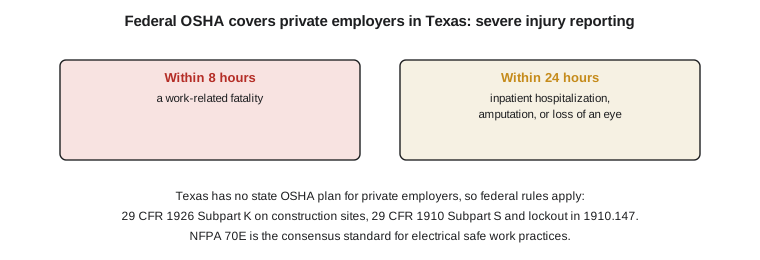
Under 29 CFR 1904.39, an employer must report a work-related fatality to OSHA within eight hours of learning of it, and an inpatient hospitalization, an amputation or the loss of an eye within twenty-four hours. Reports can be made by phone or online. Separately, many employers must keep injury and illness records on OSHA's forms: the 300 log of recordable cases, the 301 incident report, and the 300A annual summary, which must be posted in the workplace from February 1 through April 30 each year. Employers with ten or fewer employees during the year are generally exempt from routine recordkeeping, and some low-hazard industries are partially exempt, but construction specialty trades, including electrical contractors, are not among the exempt industries. Some establishments must also submit injury data electronically to OSHA each year; the thresholds depend on establishment size and industry, so check OSHA's current rule.
Worked problem
Is this a reportable event, and when?
On a Tuesday at 2:00 p.m., an electrician at a Pecan Creek job falls from a ladder and is admitted to the hospital overnight for a broken leg. When must Pecan Creek report to OSHA, and is the case recordable on the 300 log?
Show solution
- An inpatient hospitalization must be reported within 24 hours of the employer learning of it.
- If Rosa learns of the admission at 4:00 p.m. Tuesday, the report is due by 4:00 p.m. Wednesday.
- A broken leg requiring medical treatment beyond first aid is recordable on the 300 log, since Pecan Creek has more than ten employees and is not in an exempt industry.
- Pecan Creek also follows its workers' compensation insurer's reporting procedure, or, if it were a non-subscriber, the Texas DWC reporting rules from Lesson 8.
Answer: Report to OSHA by 4:00 p.m. Wednesday, and record the case on the 300 log.
Texas points to know
Several Texas-specific points connect safety to the rest of this course. Workers' compensation, or the non-subscriber choice described in Lesson 8, determines how injured workers are compensated and what the employer must report to the Texas Department of Insurance. Texas employers, including non-subscribers with more than four employees, have state reporting duties for workplace injuries in addition to OSHA's. Heat is a constant Texas hazard. As of 2026 there was no final federal heat standard, though OSHA proposed one in 2024 and held hearings in 2025, and a 2023 Texas law limited cities' ability to impose their own workplace rules such as mandated water breaks; check the current status of both before relying on either. Whatever the law, heat illness is preventable with water, rest, shade, acclimatization of new workers and training to recognize symptoms, which is what Rosa did for Caleb.
When OSHA visits
OSHA inspections happen for several reasons: a fatality or severe injury report, an employee complaint, a referral, an emphasis program aimed at a hazard such as falls or trenching, or a compliance officer driving past a site and seeing an obvious hazard. On a construction site, the compliance officer usually asks for the person in charge, explains the reason for the inspection and holds an opening conference. The employer may have a representative accompany the officer during the walkaround. The officer looks at conditions, interviews employees and asks for records such as the 300 log and the written programs. At the closing conference the officer discusses apparent violations, and any citations follow in writing with proposed penalties and abatement dates. Employers can request an informal conference and can contest citations within a short deadline set by law.
On a multi-employer construction site, OSHA's policy can hold more than one employer responsible for a hazard: the employer that created it, the employer whose employees are exposed, the employer responsible for correcting it, and the controlling employer, usually the general contractor, that has general supervisory authority over the site. A subcontractor whose crew works near an unguarded floor opening left by another trade can still be cited for exposing its own employees. Rosa's rule for her crews is simple: if a hazard on the site threatens a Pecan Creek worker, the crew stops, tells the general contractor's superintendent, and calls her, whoever created it.
A safety program for a small contractor
A master of record does not need a safety department to run a real safety program. Walt's program at Pecan Creek fits on four pages. It names Rosa as the person responsible for safety. It requires a short safety talk every Monday morning, recorded with the date, topic and attendees. It requires GFCI protection on all temporary power, daily cord inspections, and a lockout kit in every truck. It sets rules for ladders and fall protection. It includes a heat illness plan with water, rest breaks in shade and a buddy system in summer. It explains what to do after an injury: first aid, call for help, notify Rosa, preserve the scene, and report to OSHA and the insurer on time. And it requires a written review of every incident and near miss, with one change made as a result.
The calculator below computes OSHA's injury rates from a year's records, which customers and general contractors often ask for when prequalifying subcontractors. The total recordable incident rate scales cases to 200,000 hours, the hours that 100 employees work in a year. Change the numbers to match your own records.
def rate(cases, hours):
    return cases * 200_000 / hours   # cases per 100 full-time workers

hours_worked = 47_500     # all employees, one year (illustrative)
recordable = 2
dart = 1                  # days away, restricted or transferred cases
print(f"TRIR: {rate(recordable, hours_worked):.2f}")
print(f"DART rate: {rate(dart, hours_worked):.2f}")TRIR: 8.42 DART rate: 4.21
Common mistakes
MistakeThinking Texas runs its own OSHA plan for private employers.
InsteadFederal OSHA enforces workplace safety for private employers in Texas.
MistakeUsing extension cords on a construction site without ground-fault protection.
InsteadSubpart K requires GFCIs or an assured equipment grounding conductor program for temporary power.
MistakeReporting a hospitalization to OSHA days later.
InsteadInpatient hospitalizations must be reported within twenty-four hours.
MistakeTreating NFPA 70E as optional because OSHA did not adopt it word for word.
InsteadOSHA uses it to show how to meet its requirements, and Texas requires it in continuing education.
MistakeAssuming no heat standard means no duty.
InsteadThe general duty clause applies, and heat illness prevention is basic good practice.
Summary and key terms
- Federal OSHA enforces safety for private employers in Texas; there is no state plan for them.
- 29 CFR 1926 Subpart K governs construction electrical safety; 1910.147 and 1910.331 to .335 apply in general industry.
- Fall protection, excavation, crane clearances, hazard communication and PPE rules also apply to electricians.
- NFPA 70E centers on establishing an electrically safe work condition and limits energized work.
- Report fatalities within eight hours and hospitalizations, amputations and eye losses within twenty-four.
- A master of record should run a simple written safety program with training, records and incident reviews.
- State plan
- A state-run OSHA program approved by federal OSHA; Texas has none for private employers.
- Subpart K
- The electrical subpart of OSHA's construction standards, 29 CFR 1926.400 onward.
- Assured equipment grounding conductor program
- An inspection and testing program allowed in some cases instead of GFCIs for temporary power.
- Electrically safe work condition
- Equipment de-energized, locked out, tested for absence of voltage and grounded as needed.
- Arc flash
- The release of heat and blast energy from an arcing electrical fault.
- General duty clause
- The OSH Act requirement to keep the workplace free of recognized serious hazards.
Practice problems
Work each problem on paper first, then reveal the answer to check.
Who enforces workplace safety for a private electrical contractor in Texas?
Show answer
Federal OSHA.
How soon must an employer report an amputation to OSHA?
Show answer
Within twenty-four hours of learning of it.
At what height does construction fall protection generally begin under Subpart M?
Show answer
Six feet above a lower level.
What is the minimum crane clearance from an overhead line up to 50 kV under Subpart CC?
Show answer
Ten feet.
A company had 3 recordable cases in 120,000 hours. What is its TRIR?
Show answer
3 × 200,000 ÷ 120,000 = 5.0.
Lesson quiz · 5 questions
Score 60% or more to complete this lesson.
Create a free account to save your progress, take quizzes and earn a certificate.