
MELU-318 · Lesson 11 of 12 · 20 min
Renewal and continuing education
▶ Video coming soon A video version of this lesson is on the way.
Every June, a few weeks before her journeyman license expires, Rosa gets an email from TDLR reminding her to renew. Every year she completes four hours of continuing education online in the evenings, renews on TDLR's website in about ten minutes, and forgets about it until the next June. When she becomes a master and Pecan Creek's master of record, the routine stays almost the same, but the stakes rise: if her master license lapses, Pecan Creek's contractor license loses its master of record. This lesson covers the annual license term, the continuing education requirement and its required topics, approved providers and certificates, the special rules for contractors, apprentices and holders of multiple licenses, late renewal, and how renewal questions appear on the exam.
The continuing education rules here were checked against TDLR's electrician continuing education page in November 2026. Fees and late-renewal rules change, and TDLR sometimes adjusts continuing education requirements by rule. Check the current TDLR pages before each renewal.
The annual license term
Texas electrician licenses are valid for one year from the date of issuance and must be renewed annually, according to TDLR's license pages. The renewal date is tied to the license, not to the calendar year, so each licensee has his own date. TDLR generally sends a renewal notice before the expiration date to the address and email on file, which is one reason every licensee should keep contact information current with TDLR. Renewals can be completed online. A licensee who does not receive a notice is still responsible for renewing on time.
Contractor licenses also run one year and renew annually. For a contractor, renewal requires that the master of record's license be current and that insurance and workers' compensation information on file with TDLR remain valid. Lupe keeps a single calendar with every renewal date that matters to Pecan Creek: the contractor license, Walt's master license, each journeyman and apprentice, the general liability policy, the auto policy and the company's assumed name filing.
Four hours of continuing education
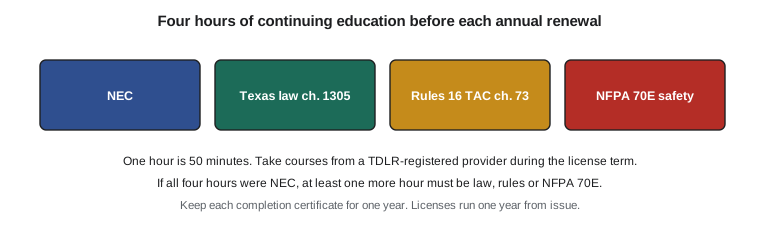
TDLR's continuing education page says that most electrician licensees must complete four hours of continuing education before each license renewal. Each hour is fifty minutes of instruction. The four hours must cover the National Electrical Code, as adopted under the electricians law or the current NFPA-approved version; Texas electrician law, which is Occupations Code Chapter 1305; the Texas electrician administrative rules, 16 TAC Chapter 73; and electrical safety under NFPA 70E. In practice, approved renewal packages usually include several NEC hours and the remaining time on law, rules and safety.
TDLR adds a detail worth memorizing: if you have already completed four hours on the NEC alone, you must take at least one additional hour in law, rules or NFPA 70E safety. In other words, four hours of pure NEC do not satisfy the requirement, because the required topics include more than the code. Most licensees avoid the problem by taking a single four-hour renewal package from an approved provider that already covers all the required topics.
Approved providers, timing and certificates
Courses must be taken from a TDLR-registered continuing education provider; courses from other sources do not count. Courses must fall within the term of the license being renewed. TDLR's example: for a license expiring January 1, 2021, the courses had to be taken between January 1, 2020 and January 1, 2021. TDLR does not accept partial course completion, and a licensee cannot get credit for taking the same course twice. Providers generally report completions to TDLR, but the licensee should keep his completion certificate for one year after the course date, as TDLR's page directs, in case TDLR audits or a report is missing.
Rosa's routine is to finish her continuing education at least six weeks before her expiration date, so that any reporting delay does not hold up her renewal. She takes the course from the same registered provider each year, checks that the course covers the edition of the NEC currently adopted, and saves the certificate as a PDF in a folder labeled with the license year. After the 2026 adoption, she chose a package focused on 2026 NEC changes, which doubled as exam study.
Worked problem
Does this course plan satisfy the requirement?
A journeyman's license expires March 1, 2027. On February 20, 2027 he completes a four-hour course from a registered provider covering only 2026 NEC changes. Has he met the continuing education requirement, and if not, what is missing?
Show solution
- The courses must fall within the license term ending March 1, 2027: February 20, 2027 qualifies.
- The provider is registered, and four hours were completed.
- But the four hours cover only the NEC; TDLR's page says a licensee with four NEC-only hours must take at least one additional hour in law, rules or NFPA 70E.
- He needs at least one more hour, from a registered provider, on Texas law, rules or NFPA 70E before renewing.
Answer: Not yet; he needs at least one more hour on law, rules or NFPA 70E.
Who must and who need not
The four-hour requirement applies to most individual electrician licenses, including masters and journeymen. TDLR's page says contractors and residential appliance installers are exempt; for contractors, that reflects the fact that the contractor license belongs to a business, not to a person. Apprentices have a choice: they can either complete four hours of continuing education or be enrolled in a department-registered apprenticeship training course. A person who holds more than one license type, such as a master electrician who is also a master sign electrician, needs only four hours total, taken during the period of the license being renewed, according to TDLR's page.
That last rule matters to Walt, who holds both a master electrician license and a master sign electrician license from years of sign work early in his career. One four-hour package covers both. Rosa will hold only the master electrician license at first, but if Pecan Creek's sign work grows, she may add the sign license later.
| Licensee | Continuing education before renewal | Notes (as checked November 2026) |
|---|---|---|
| Master electrician | 4 hours | NEC, Chapter 1305, 16 TAC Ch. 73 and NFPA 70E |
| Journeyman electrician | 4 hours | Same topics |
| Apprentice | 4 hours, or enrollment in a registered apprenticeship course | Either option |
| Holder of several license types | 4 hours total | Taken during the license period being renewed |
| Electrical contractor (business) | Exempt | Master of record must keep his own license current |
| Residential appliance installer | Exempt | Per TDLR's page |
Late renewal and lapsed licenses
A license that is not renewed by its expiration date expires, and an expired license does not authorize electrical work. TDLR's general rules for its programs set late renewal fees that rise the longer a license has been expired, and after a set period a former licensee generally must apply as a new applicant rather than renew. The exact periods and fees are in TDLR's rules and change from time to time; check them rather than relying on memory. For an individual, working on an expired license is unlicensed work. For a master of record, an expired license also affects the contractor, which cannot operate without a master of record holding a current license.
Pecan Creek once came close to this problem. Years ago, Walt's renewal reminder went to an old email address after Lupe changed the company's domain, and he noticed the expiration with four days to spare. He finished his course and renewed on the last day. Since then, Lupe has added every renewal date to the company calendar with reminders at ninety, sixty and thirty days, and both Walt and Lupe receive TDLR's emails.
Keeping your record clean
Renewal is also when TDLR asks about changes in a licensee's circumstances, such as criminal history since the last renewal. Answer honestly; a false answer on a renewal is a violation in itself. Keep your mailing address, email and phone number current with TDLR throughout the year, as the rules require, because notices about renewal, audits and complaints go to the contact information on file. A master of record should also check that every crew member renews on time, as Lesson 7 described, because a company that lets unlicensed workers do electrical work faces its own discipline.
Choosing courses that are worth the time
Four hours a year is the minimum, not the goal. Registered providers offer courses in classrooms, live online sessions and self-paced online formats, and the quality varies. Rosa looks for three things. First, the course should match the code Texas has adopted; a course still teaching the 2023 NEC after the 2026 adoption is less useful, even if it counts. Second, the law and rules portion should reflect recent changes to Chapter 1305 and 16 TAC Chapter 73, because the Legislature and the commission change them every few years. Third, the NFPA 70E portion should cover the current edition and practical topics such as energized work permits, risk assessment and arc flash labels, not just definitions.
Walt adds a fourth criterion for a master of record: choose courses the crew can use. Several years ago Pecan Creek paid for a registered provider to teach its four-hour renewal package in the shop on a Saturday, with lunch, for every licensed electrician in the company. The cost per person was about the same as online courses, the instructor answered questions about the crew's own jobs, and Walt could see that everyone had completed the hours. The company has done it every year since, and Rosa plans to continue.
Staying current between renewals
Continuing education is the formal minimum for staying current, but a master needs more. The NEC changes every three years, Texas adopts new editions by rule, cities adopt new amendments, and the Legislature meets every two years and sometimes changes the electricians law. TDLR publishes news, rule proposals and adopted rules on its website and through email bulletins, including a newsletter for electricians. Rosa subscribed to TDLR's electrician updates the week she mailed her master application, and she reads the Texas Register notices for any proposed changes to 16 TAC Chapter 73. When the commission proposes a rule change, licensees can comment during the public comment period, and a master who reads proposals early can prepare the company before the change takes effect.
Industry associations also help. Electrical contractor associations, inspector associations and apprenticeship programs in Texas offer code update seminars, safety training and newsletters that explain changes in practical terms. Darnell recommends that new masters attend at least one code update seminar run by inspectors after each new NEC adoption, because hearing how inspectors plan to enforce the new edition is worth more than reading any summary.
Renewal questions on the exam
Renewal and continuing education questions are straightforward if you remember the numbers and the exceptions. Expect questions on the license term, which is one year; the number of hours, which is four; the length of an hour, which is fifty minutes; the required topics; the extra hour rule when all four hours were NEC; who is exempt, which is contractors and residential appliance installers; the apprentice alternative; the single requirement for holders of multiple licenses; and how long to keep a certificate, which is one year after the course.
The calculator below checks a continuing education record against TDLR's requirements. Edit the list of courses with your own hours and topics. It applies the four-hour total and the rule that four NEC-only hours need at least one more hour on another required topic.
from datetime import date

term_start, term_end = date(2026, 3, 1), date(2027, 3, 1)
courses = [  # (date, hours of 50 minutes, topic)
    (date(2027, 1, 12), 3, "NEC"),
    (date(2027, 1, 12), 1, "NFPA 70E"),
]
in_term = [c for c in courses if term_start <= c[0] <= term_end]
total = sum(h for _, h, _ in in_term)
nec = sum(h for _, h, t in in_term if t == "NEC")
other = total - nec
ok = total >= 4 and not (nec >= 4 and other < 1)
print(f"Hours in term: {total} (NEC {nec}, other {other})")
print("Requirement met" if ok else "Requirement NOT met")Hours in term: 4 (NEC 3, other 1) Requirement met
Common mistakes
MistakeTaking four hours of NEC only and assuming the requirement is met.
InsteadWith four NEC-only hours, at least one more hour on law, rules or NFPA 70E is needed.
MistakeTaking a course from an unregistered provider.
InsteadOnly TDLR-registered providers' courses count.
MistakeCompleting courses in the previous license term.
InsteadCourses must fall within the term of the license being renewed.
MistakeBelieving a contractor license requires its own continuing education.
InsteadContractors are exempt, but the master of record must keep his own license current.
MistakeLetting the master of record's license lapse.
InsteadAn expired master license leaves the contractor without a qualified master of record.
Summary and key terms
- Texas electrician licenses last one year from issuance and are renewed annually, usually online.
- Most individual licensees complete four hours of continuing education before each renewal.
- The hours cover the NEC, Chapter 1305, 16 TAC Chapter 73 and NFPA 70E; one hour is fifty minutes.
- Four NEC-only hours require at least one more hour on law, rules or NFPA 70E.
- Courses must come from registered providers within the license term; keep certificates for one year.
- Contractors and residential appliance installers are exempt; apprentices may use a registered training course instead.
- Continuing education
- Approved instruction a licensee completes before renewing a license.
- Registered provider
- A continuing education provider approved by TDLR.
- License term
- The one-year period between issuance or renewal and expiration.
- Late renewal
- Renewal after expiration, subject to higher fees and time limits in TDLR's rules.
- Completion certificate
- Proof of finishing a course, kept for one year after the course date.
- NFPA 70E
- The standard for electrical safety in the workplace, a required continuing education topic.
Practice problems
Work each problem on paper first, then reveal the answer to check.
How long is one continuing education hour for Texas electricians?
Show answer
Fifty minutes of instruction.
A master holds both master electrician and master sign electrician licenses. How many continuing education hours does he need?
Show answer
Four hours total, taken during the period of the license being renewed.
Name the four required continuing education topics.
Show answer
The NEC, Texas electrician law (Chapter 1305), the rules (16 TAC Chapter 73) and NFPA 70E.
How long should a licensee keep a completion certificate?
Show answer
One year after the course date.
Which licensees are exempt from continuing education, according to TDLR?
Show answer
Contractors and residential appliance installers.
Lesson quiz · 5 questions
Score 60% or more to complete this lesson.
Create a free account to save your progress, take quizzes and earn a certificate.