
MELU-318 · Lesson 8 of 12 · 21 min
Contractor licensing, insurance and bonding
▶ Video coming soon A video version of this lesson is on the way.
A master license lets Rosa supervise electrical work and qualify a company. It does not by itself let anyone sell electrical work to the public. That takes an electrical contractor license, which belongs to the business, not to the person. Pecan Creek's contractor license has been renewed every year since the statewide system began, with Walt as master of record. When Rosa takes over, the license stays with the company and only the master changes. But Rosa has also wondered, as many new masters do, whether she might one day start her own company. This lesson covers the Texas electrical contractor license, the master of record requirement from the company's side, the insurance requirements, the workers' compensation choices, including the Texas option of not carrying coverage, and bonds, which TDLR does not require for the license but which customers and public owners often do.
The contractor requirements here were checked against TDLR's contractor license page in November 2026, and the workers' compensation material against Texas Department of Insurance publications and the Texas Labor Code. Insurance and bonding are areas where a contractor should get advice from a licensed insurance agent and, where needed, an attorney; this lesson explains the rules a master exam tests, not every decision a business faces.
Who needs a contractor license
Under Chapter 1305, a person or business that offers or performs electrical work for the public needs an electrical contractor license. That includes a one-person shop run by a master, a company with a hundred electricians, and anything in between. Electrical sign contractors and residential appliance installation contractors have their own business licenses. A business that only employs electricians to maintain its own facilities is treated differently from one that contracts with the public; read Chapter 1305 and the rules for the exact boundaries, because the exam can ask about them.
The contractor license is issued to the business entity: a sole proprietorship, partnership, corporation or limited liability company. A business operating under a name other than its legal name usually files an assumed name certificate, and the name on TDLR's license, on the vehicles and on permits should match the business's legal or assumed name. Lupe found during Rosa's study months that one of Pecan Creek's older van wraps still showed a slightly different business name from the one on the license; the shop fixed it before an inspector noticed.
Applying for the contractor license
TDLR's page, checked in November 2026, lists the main requirements. The business submits the electrical contractor license application, form ELC-LIC-003, with a non-refundable 110 dollar application fee. It must employ a licensed Master Electrician as master of record, who may be the owner. It must show general liability insurance meeting TDLR's minimums, and it must provide proof of its workers' compensation status. The license is valid for one year from the date of issue and must be renewed annually, which can be done online. Lesson 7 covered the master of record rules: one company per master unless the master owns more than half of each, and thirty business days to designate a replacement after a master leaves.
General liability insurance
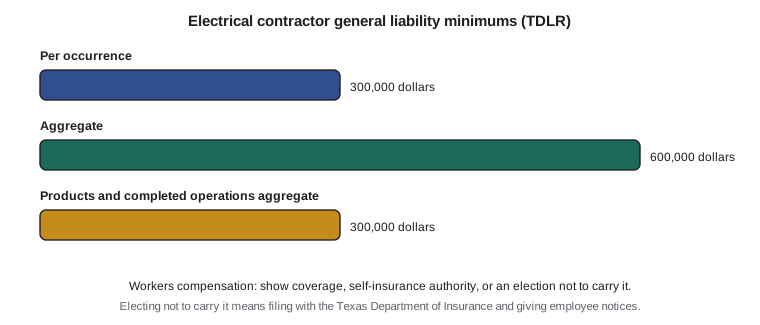
TDLR requires an electrical contractor to carry general liability insurance with minimums of 300,000 dollars per occurrence, combined for property damage and bodily injury; 600,000 dollars aggregate; and 300,000 dollars aggregate for products and completed operations. The insurer files a certificate of insurance with TDLR on the form TDLR specifies, and the coverage must stay in force. If the policy lapses or is canceled, the contractor is out of compliance, and the insurer typically notifies TDLR. Customers, general contractors and public owners often require higher limits, additional insured endorsements and umbrella coverage; the TDLR figures are minimums for the license, not a recommendation.
The three figures mean different things. Per occurrence is the most the policy pays for a single incident. Aggregate is the most it pays for all claims in the policy period, usually a year. Products and completed operations covers claims arising after the work is finished, such as a fire blamed on a connection made months earlier. For an electrical contractor, completed operations coverage matters a great deal, because most claims arise after the crew has left.
Worked problem
Reading the limits
Pecan Creek's policy meets exactly the TDLR minimums. In one policy year it has three claims: a 180,000 dollar property damage claim at a job site, a 250,000 dollar claim from a fire at a finished house traced to a connection, and a 220,000 dollar claim at another finished job. Using the minimum limits, how are these claims treated?
Show solution
- Each claim is below the 300,000 dollar per-occurrence limit, so each could be paid in full on its own.
- The two finished-work claims are completed operations: 250,000 + 220,000 = 470,000 dollars, which exceeds the 300,000 dollar products and completed operations aggregate.
- Only 300,000 dollars of the completed operations claims would be covered; 170,000 dollars would not.
- Total paid would also be checked against the 600,000 dollar general aggregate: 180,000 + 300,000 = 480,000 dollars, within it.
Answer: About 170,000 dollars of the completed operations claims would exceed the minimum coverage, which is why many contractors buy more.
Workers' compensation: the Texas choice
Texas is the only state that lets most private employers choose not to carry workers' compensation insurance. TDLR's page reflects that choice. A contractor must provide one of three things: proof of workers' compensation insurance, a certificate of authority to self-insure, or a statement that it has elected not to obtain coverage. An employer that elects not to carry coverage is called a non-subscriber. A contractor that opts out must file a notice with the Texas Department of Insurance, Division of Workers' Compensation, through its online Employer E-File system, as TDLR's page notes.
Non-subscribers have ongoing duties. According to the Texas Department of Insurance's fact sheet, a non-subscriber must file DWC Form-005, the employer's notice of no coverage, each year between February 1 and April 30, and within 30 days of hiring its first employee. It must post a notice of non-coverage at the workplace in English, Spanish and any other appropriate language, using the format the division adopts, and give each new employee written notice of non-coverage. Non-covered employers with more than four employees must report work-related deaths, injuries causing more than one day away from work, and occupational illnesses to the division monthly. Failing to file or to give notices can lead to administrative penalties.
The biggest consequence of opting out is legal. Under Section 406.033 of the Texas Labor Code, in a lawsuit by an injured employee, a non-subscribing employer cannot defend by arguing that the employee was contributorily negligent, that the employee assumed the risk, or that a fellow employee caused the injury. The employee must still prove the employer's negligence. The employer may still argue that the injury was caused by the employee's intoxication or by the employee's intent to injure himself. Many non-subscribers buy occupational injury benefit plans and employer liability insurance instead of workers' compensation, but those are business decisions with significant risk, and an electrical contractor whose employees work around energized equipment should weigh them carefully with an agent and an attorney.
| Option | What TDLR receives | Ongoing duties |
|---|---|---|
| Workers' compensation insurance | Proof of coverage | Keep the policy in force; follow the insurer's claim process |
| Certified self-insurance | Certificate of authority to self-insure | Meet the state's self-insurance requirements |
| Non-subscriber | Statement of election not to carry coverage | File DWC-005 yearly (Feb. 1 to Apr. 30); post and give notices; monthly injury reports above four employees |
Bonds: what TDLR does and does not require
A bond is a three-party guarantee: a surety company promises an owner, or another protected party, that the contractor will perform or pay as promised. TDLR's electrical contractor application, as checked in November 2026, asks for insurance and workers' compensation information, not a license bond. Bonds still matter to electrical contractors, because owners and the law often require them on particular projects. A performance bond guarantees that the contractor will complete the work according to the contract. A payment bond guarantees that the contractor will pay its subcontractors and suppliers, which matters on public projects where liens against public property are not available.
On Texas public work, Chapter 2253 of the Government Code, often called the McGregor Act, requires prime contractors on public works contracts above certain dollar thresholds to furnish payment and performance bonds; the thresholds commonly cited are 25,000 dollars for payment bonds and 100,000 dollars for performance bonds, but check the current statute and the specific owner's requirements, which can be stricter. A subcontractor on a bonded public job protects its right to be paid by giving notices to the prime contractor and the surety within the deadlines in Chapter 2253, much as a private-project subcontractor protects lien rights under the Property Code, which Lesson 9 covers. Some cities also require license or permit bonds from contractors working within their limits.
Getting bonded depends on the contractor's finances and history. Sureties review financial statements, work in progress, credit and experience, and set a bonding capacity, the largest job and total work they will bond. When Pecan Creek bid its first school district job, Lupe spent two weeks assembling financial statements for the surety. Rosa learned that bonding capacity, not license scope, often limits how large a job a small contractor can pursue.
Other insurance a contractor carries
TDLR's requirements are only the start of an electrical contractor's insurance program. Commercial auto insurance covers the vans and trucks, and Texas requires minimum auto liability coverage for every vehicle on the road. Tools and equipment coverage, often called an inland marine policy, protects the company's meters, benders, lifts and trailers. Builder's risk insurance, usually bought by the owner or general contractor, covers the building and materials during construction. An umbrella policy adds limits above the general liability and auto policies, and many commercial customers require one. Professional liability may matter for a contractor that offers design-build services. Pecan Creek's agent reviews the whole program every year at renewal, and Walt asks Rosa to sit in so she understands it before she becomes responsible for it.
Contracts often shift risk to the subcontractor through indemnity clauses and additional insured requirements. A general contractor's subcontract may require Pecan Creek to name the general contractor and the owner as additional insureds on its general liability policy, to waive the insurer's right to recover from them, and to defend and indemnify them against claims arising from Pecan Creek's work. Texas has its own anti-indemnity statute for construction contracts that limits some of these provisions, and the rules are technical, so Pecan Creek's agent and attorney review any unusual insurance or indemnity language before Walt signs. For the exam, know what each policy type covers and that certificates of insurance are how contractors prove coverage to TDLR and to customers.
Starting a new contractor
If Rosa ever starts her own company, the sequence will look like this: form the business entity and file any assumed name; get general liability insurance meeting at least TDLR's minimums and decide on workers' compensation; file the contractor application with TDLR, naming herself as master of record, which she can do only if she is not still master of record for Pecan Creek, unless she owns more than half of both companies; letter the vehicles; register with the cities where she will pull permits, as their rules require; and set up the records a master of record needs. She has no plans to do it soon, but walking through it helped her understand the rules for the exam.
The calculator below checks a contractor's insurance certificate against TDLR's minimums. Change the numbers to match a certificate you have and see whether each limit meets the requirement.
minimums = {"per occurrence": 300_000, "aggregate": 600_000, "products/completed operations": 300_000}
certificate = {"per occurrence": 1_000_000, "aggregate": 2_000_000, "products/completed operations": 250_000}

for item, need in minimums.items():
    have = certificate[item]
    status = "meets" if have >= need else "SHORT"
print(f"{item}: {have:,} dollars vs {need:,} required -> {status}")per occurrence: 1,000,000 dollars vs 300,000 required -> meets aggregate: 2,000,000 dollars vs 600,000 required -> meets products/completed operations: 250,000 dollars vs 300,000 required -> SHORT
Common mistakes
MistakeTreating the master license as permission to contract with the public.
InsteadThe business needs its own electrical contractor license with a master of record.
MistakeReading the 300,000 dollar per-occurrence figure as the most the policy pays all year.
InsteadThe aggregate limits cap total payments in a policy period.
MistakeThinking Texas requires every employer to carry workers' compensation.
InsteadMost private employers may opt out as non-subscribers, with notice and filing duties.
MistakeAssuming a non-subscriber can blame an injured worker's own negligence in court.
InsteadLabor Code 406.033 bars contributory negligence, assumed risk and fellow-employee defenses.
MistakeBelieving TDLR requires a license bond for the contractor license.
InsteadTDLR's application asks for insurance; bonds are required by owners and statutes on particular projects.
Summary and key terms
- An electrical contractor license belongs to the business and requires a master of record.
- As checked in November 2026, the application is form ELC-LIC-003 with a 110 dollar non-refundable fee, renewed yearly.
- General liability minimums: 300,000 dollars per occurrence, 600,000 aggregate, 300,000 products and completed operations.
- Workers' compensation: insurance, self-insurance, or a filed election not to carry coverage.
- Non-subscribers file DWC-005 yearly, give employee notices and lose key common-law defenses.
- Bonds are not a TDLR license requirement but are common on public and large private projects.
- Electrical contractor license
- The TDLR business license required to offer or perform electrical work for the public.
- Aggregate limit
- The most an insurance policy pays for all claims in a policy period.
- Completed operations
- Insurance coverage for claims arising after work is finished.
- Non-subscriber
- A Texas employer that has elected not to carry workers' compensation insurance.
- Payment bond
- A surety's guarantee that a contractor will pay its subcontractors and suppliers.
- Performance bond
- A surety's guarantee that a contractor will complete the work as contracted.
Practice problems
Work each problem on paper first, then reveal the answer to check.
What three general liability minimums does TDLR require of an electrical contractor?
Show answer
300,000 dollars per occurrence, 600,000 dollars aggregate, and 300,000 dollars products and completed operations aggregate.
When must a non-subscriber file its annual DWC-005?
Show answer
Between February 1 and April 30 each year.
Name the three defenses a non-subscriber loses under Labor Code 406.033.
Show answer
Contributory negligence, assumed risk, and negligence of a fellow employee.
Does TDLR require a license bond for an electrical contractor license?
Show answer
Not according to its application as checked; insurance and workers' compensation status are required.
What does a payment bond protect on a public project?
Show answer
The subcontractors' and suppliers' right to be paid, since liens against public property are not available.
Lesson quiz · 5 questions
Score 60% or more to complete this lesson.
Create a free account to save your progress, take quizzes and earn a certificate.