
MELU-318 · Lesson 1 of 12 · 20 min
How electrical licensing works in Texas
▶ Video coming soon A video version of this lesson is on the way.
Rosa Garza has been pulling wire in Central Texas for thirteen years. She started as a helper at nineteen, registered as an apprentice, passed her journeyman exam in 2021, and has spent the last five years running jobs for Pecan Creek Electric in Pecan Springs, a fictional city of about 150,000 people north of San Antonio. Walt Henley, who founded Pecan Creek and whose Master Electrician license qualifies the company with the state, is sixty-four and has told his crew he wants to retire within three years. He wants Rosa to become the company's master of record. Rosa wants it too, but when she opened the state's website to read the requirements, she found herself in a thicket of statutes, rules, forms and exam bulletins. This course walks through that thicket with her, one lesson at a time.
This is the Texas course in the HSM University master electrician exam prep series. The core courses, MELU-101 through MELU-107, teach the National Electrical Code skills every master exam tests: navigating the code, load calculations, conductors and overcurrent protection, grounding and bonding, motors and transformers, special occupancies, and business and law. This course adds what is specific to Texas: who licenses electricians, who qualifies for the Master Electrician license, how to apply and book the exam, what the exam looks like, which edition of the NEC Texas has adopted, how permits and inspections work, what a master of record is responsible for, contractor licensing and insurance, Texas lien law, workplace safety law, renewal and continuing education, and a final practice review.
Two cautions apply throughout. First, licensing rules change. The facts in this course were checked against the Texas Department of Licensing and Regulation website and other official sources in November 2026, and the lessons say so where a fact came from a secondary source. Before you apply, pay a fee or book an exam, check the current TDLR pages and the current candidate information bulletin from the testing vendor. Second, the NEC is a copyrighted standard. This course cites article and section numbers and explains them in plain words, but it never reproduces the code's text, tables or figures. Keep your own copy of the edition Texas has adopted open beside you.
Statewide licensing since 2003
For most of the twentieth century, Texas had no statewide electrician license. Cities licensed electricians, or did not, and an electrician who moved from Houston to Dallas might have to test again. In 2003 the Legislature changed that by passing the law now found in Chapter 1305 of the Texas Occupations Code, known as the Electricians Licensing Act. Chapter 1305 created statewide licenses for electricians and electrical contractors, made it an offense to perform electrical work without the required license, and gave the state agency the job of issuing licenses and enforcing the law. Cities kept their power to issue permits and inspect electrical work, but they lost the power to make a state-licensed electrician test or register again just to work within their limits.
The law defines electrical work broadly. In general terms, it covers labor or material used in installing, maintaining or extending an electrical wiring system and the equipment connected to it, which reaches from service entrance conductors through branch circuits to outlets and equipment. The act and its rules list exceptions, such as limited work by plumbers on existing circuits to replace appliances, residential appliance installers working within their limited scope, and a homeowner doing certain work in the home where the homeowner lives, where a city ordinance does not regulate it. The exam can ask about these boundaries, so read the definitions section of Chapter 1305 and the matching rules carefully when you study.
The agencies and who does what
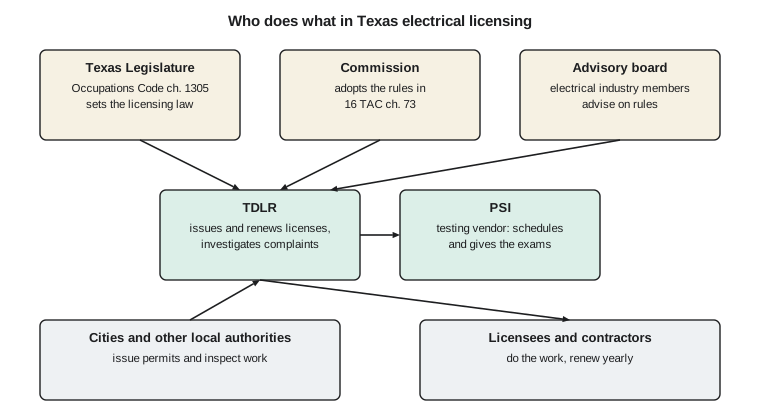
Three bodies shape electrical licensing in Texas. The Texas Legislature writes the statute, Chapter 1305. The Texas Commission of Licensing and Regulation, a governor-appointed board, adopts the administrative rules that fill in the details; those rules are in Title 16 of the Texas Administrative Code, Chapter 73, usually written 16 TAC Chapter 73. The Texas Department of Licensing and Regulation, called TDLR, is the agency that runs the program day to day: it processes applications, issues and renews licenses, approves continuing education providers, investigates complaints and brings enforcement cases. An advisory board of people from the electrical industry and the public advises the commission and the department on rules and technical questions.
Two other groups matter to a candidate. The testing vendor, currently PSI, contracts with TDLR to schedule and give the licensing exams at testing centers around the state. And local authorities, mainly cities, issue permits and inspect electrical installations within their jurisdictions. TDLR licenses people and companies, but it does not inspect a new restaurant before the power company energizes it; the city building department does that. Keeping these roles straight answers a surprising number of law questions on the exam, because many wrong answer choices assign a job to the wrong body.
The individual licenses
Chapter 1305 and its rules create a ladder of individual licenses. At the bottom is the apprentice electrician, who must register with TDLR and work under the supervision of a licensed electrician. Above the apprentice are the journeyman licenses, including the journeyman electrician, and the residential wireman, who is limited to single-family and multifamily dwellings of limited size. The master electrician is the highest general license. Parallel tracks exist for sign electricians, with journeyman and master sign electrician licenses, for residential appliance installers, and for maintenance work, through the journeyman industrial electrician license. Each license has its own experience requirement and its own exam, and the rules define what each license holder may do.
One detail from the master application catches some candidates by surprise: experience as a journeyman industrial electrician does not count toward the Master Electrician license. Rosa does not have that problem, because her experience is in construction and service work under masters at Pecan Creek and her first employer, but a maintenance electrician at a plant who hopes to become a master needs to plan for it. Lesson 2 covers the master eligibility rules in detail.
| License or registration | General scope | Notes |
|---|---|---|
| Apprentice electrician | Electrical work under supervision | Registers with TDLR; experience starts here |
| Residential wireman | Wiring in dwellings within limits set by rule | Its own exam |
| Journeyman electrician | Electrical work under a master's supervision structure | Prerequisite for the master license |
| Journeyman industrial electrician | Industrial maintenance and installation | Experience does not count toward master |
| Master electrician | Highest general license; may be master of record | Two years as journeyman plus 12,000 hours |
| Sign and appliance licenses | Electrical signs; residential appliance installation | Separate tracks with their own rules |
The business licenses
A person's license is not enough to sell electrical work to the public. A business that offers or performs electrical work needs an electrical contractor license from TDLR, and that license requires a Master Electrician to serve as the company's master of record. Walt's master license is what makes Pecan Creek's contractor license valid. If Walt retires without a replacement, Pecan Creek must designate a new master within a deadline set by rule, or it cannot keep contracting. That is why Walt cares so much about Rosa's exam. Electrical sign contractors and residential appliance installation contractors have their own business licenses. Lesson 7 covers the master of record's duties and Lesson 8 covers the contractor license, its insurance requirements and its paperwork.
Contractors also have visible obligations. Every vehicle used in the business must show the company's name and license number on both sides, in permanently attached letters of a contrasting color at least two inches high, with the prefix TECL for an electrical contractor. Pecan Creek's three vans carry 'Pecan Creek Electric, TECL' followed by its license number on each front door. Inspectors and TDLR investigators look for this, and the exam has been known to ask about it.
What cities can and cannot do
The 2003 law drew a line between state and local authority, and the line still matters. A city may adopt and enforce the electrical code, require permits, charge permit and inspection fees, and inspect electrical work. A city may not require a state-licensed electrician to hold a separate local license or pay a fee to register the state license. Some larger cities once had their own master and journeyman licenses; under the statewide system those local licenses no longer stand in for the state license, though the master application lets a person who held a municipal or regional master license verify his own on-the-job training for the years he held it.
In unincorporated areas, where there is no city, the state license still applies, and the state electrical code applies to the work, but there may be no permit or inspection at all unless a county, a utility or another authority requires one. Rosa's company does a fair amount of rural work outside Pecan Springs, and she has learned that an installation nobody inspects is still required to meet the code. Lesson 5 explains which code edition applies in each situation, and Lesson 6 covers permits and inspections.
Enforcement and complaints
Licensing would mean little without enforcement. TDLR accepts complaints from the public, from cities and from other electricians, investigates them, and can bring administrative cases against people and companies that break Chapter 1305 or the rules. Depending on the violation, the outcomes the law allows include administrative penalties, license suspension or revocation, and orders to stop unlicensed work; performing electrical work without the required license can also be a criminal offense. The exact penalty ranges are set in the statute and in TDLR's penalty guidelines, and they change from time to time, so the exam is more likely to ask what kinds of action TDLR can take than to ask for a dollar figure. Check the current statute and rules before you rely on a number.
For a master of record, enforcement is personal. If a company advertises electrical work without a contractor license, uses unlicensed workers, or fails to display its license number, TDLR can act against the company and may look at the master who qualifies it. Walt has told Rosa that the best protection is boring paperwork: current licenses for everyone on the crew, apprentice registrations kept up to date, vehicle lettering checked, and a file for every permit and inspection. Lesson 7 returns to these habits.
Annual licenses and renewal
Texas electrician licenses last one year from the date of issue and must be renewed every year. Most individual license holders, including masters, must complete four hours of continuing education before each renewal, covering the NEC, Texas law, Texas rules and electrical safety. Contractor licenses also renew annually. Lesson 11 covers renewal in detail. The annual cycle matters to a master of record in a way it does not to a journeyman: if Rosa becomes Pecan Creek's master and lets her license lapse, the company's contractor license is affected too.
How this course is organized
The lessons follow the path a candidate actually walks. Lesson 2 covers eligibility and Lesson 3 the application and booking process. Lesson 4 describes the exam and the references allowed. Lesson 5 explains the NEC as adopted in Texas, and Lesson 6 permits and inspections. Lesson 7 covers the master's duties, Lesson 8 contractor licensing and insurance, and Lesson 9 contracts and mechanics' liens. Lesson 10 covers workplace safety law and OSHA, Lesson 11 renewal and continuing education, and Lesson 12 a full practice review with test-day strategy. Every lesson ends with a quiz that mixes multiple choice, true or false, number, ordering and matching questions, and the course ends with a final exam.
A small calculator below shows the kind of planning Rosa does at the start. Walt plans to retire in about three years. Rosa needs time to apply, to wait for approval, to study, to sit the exam and possibly retake one portion, and then for Pecan Creek to file the master of record change. Change the numbers to fit your own situation and see how much margin you have.
# Rosa's planning check (illustrative numbers)
months_until_walt_retires = 36
steps = {
    "gather experience forms and apply": 2,
    "TDLR review and approval": 2,
    "study after approval": 4,
    "first exam attempt and one possible retake": 3,
    "contractor files the master of record change": 1,
}
needed = sum(steps.values())
for step, months in steps.items():
    print(f"{step}: {months} months")
print(f"Total: {needed} months; margin before retirement: {months_until_walt_retires - needed} months")gather experience forms and apply: 2 months TDLR review and approval: 2 months study after approval: 4 months first exam attempt and one possible retake: 3 months contractor files the master of record change: 1 months Total: 12 months; margin before retirement: 24 months
Common mistakes
MistakeThinking TDLR inspects electrical installations for permits.
InsteadTDLR licenses people and companies; local authorities issue permits and perform inspections.
MistakeAssuming a city can require its own license from a state-licensed electrician.
InsteadCities may require permits and charge permit fees but may not require a separate local license or registration fee for the state license.
MistakeCounting journeyman industrial experience toward the master license.
InsteadThe master application excludes journeyman industrial electrician experience.
MistakeBelieving an unpermitted rural job need not meet the code.
InsteadThe state electrical code applies even where no permit or inspection is required.
MistakeTreating the contractor license as automatic once a master works there.
InsteadThe contractor holds its own license with TDLR and must name a master of record.
Summary and key terms
- Texas has licensed electricians statewide since 2003 under Occupations Code Chapter 1305.
- The Commission adopts the rules in 16 TAC Chapter 73; TDLR runs the program; PSI gives the exams.
- Cities issue permits and inspect, but may not require a separate license from state licensees.
- The master license is the top general license and qualifies an electrical contractor as master of record.
- Licenses are annual, and most individual licensees need four hours of continuing education to renew.
- Always confirm current requirements with TDLR and the current candidate bulletin before acting.
- Chapter 1305
- The Texas Occupations Code chapter that creates electrician and electrical contractor licensing.
- 16 TAC Chapter 73
- The administrative rules for the Texas electricians program, adopted by the Commission.
- TDLR
- The Texas Department of Licensing and Regulation, which issues licenses and enforces the electricians law.
- Master of record
- The master electrician a contractor names with TDLR to qualify its contractor license.
- TECL
- The prefix shown with an electrical contractor's license number on its vehicles and documents.
- Unincorporated area
- Land outside any city, where local permits and inspections may not exist.
Practice problems
Work each problem on paper first, then reveal the answer to check.
Which body adopts 16 TAC Chapter 73?
Show answer
The Texas Commission of Licensing and Regulation.
Who issues permits for electrical work inside a city in Texas?
Show answer
The city or other local authority, not TDLR.
What must appear on both sides of a contractor's work vehicles?
Show answer
The company name and license number, with the TECL prefix, in contrasting letters at least two inches high.
Name two things a city may do and one thing it may not do under the statewide system.
Show answer
It may require permits and inspect work (and charge permit fees); it may not require a separate local license or registration fee for the state license.
Why does Pecan Creek's contractor license depend on Walt?
Show answer
Because Walt is its master of record; without a master of record the contractor license cannot continue.
Lesson quiz · 5 questions
Score 60% or more to complete this lesson.
Create a free account to save your progress, take quizzes and earn a certificate.