
MELU-318 · Lesson 6 of 12 · 21 min
Permits, inspections and the inspection authority
▶ Video coming soon A video version of this lesson is on the way.
Darnell Price has been an electrical inspector for twenty-two years, the last nine as chief electrical inspector for the City of Pecan Springs. He has failed Pecan Creek jobs, passed them, and once spent forty minutes in a crawlspace with Walt arguing about a support spacing. When Rosa asked him what a new master should know about permits and inspections, he said that most of the trouble he sees comes from contractors who do not know whose rules they are following: the state's, the city's, the utility's or the customer's. This lesson sorts them out. It covers who issues permits and performs inspections in Texas, what TDLR does and does not do, how a typical city permit works from application to final inspection, what happens in unincorporated areas, how correction notices and re-inspections work, and how the topic appears on the exam.
Local procedures vary widely across Texas. A large city may have online permitting, plan review for every commercial job and inspections scheduled by text message; a small town may have one part-time inspector and paper forms. The examples here are typical, not universal. Before working in any city, read its permit and inspection requirements.
Who inspects in Texas
The statewide licensing system did not make the state an inspection agency. TDLR's compliance guide says it plainly: local licensing or inspecting authorities, meaning cities, counties and regions, inspect work in their areas, and TDLR does not perform inspections required for local permitting and code requirements. TDLR licenses people and companies, sets the state electrical code by rule, investigates complaints about licensing and unlicensed work, and enforces Chapter 1305. The city building department, or another local authority with jurisdiction, decides whether a permit is required, reviews plans, inspects the work and approves it for connection.
In code language, the local official is the authority having jurisdiction, often shortened to AHJ. The NEC uses the term throughout and gives the AHJ the power to interpret the code, approve equipment and materials, grant some exceptions and require special permission for certain installations. In Pecan Springs, Darnell is the AHJ for electrical work. On a state-owned building or a federal facility, the AHJ may be someone else entirely. On an exam question that asks who approves an installation or grants special permission under the NEC, the answer is the authority having jurisdiction, not TDLR.
Cities and their powers
Cities in Texas may require permits for electrical work, charge permit and inspection fees, adopt local amendments to the electrical code, and inspect installations. Under Section 1305.201 of the Occupations Code, they may not require a state-licensed electrician to hold a separate local license or pay a fee to register the state license, though permit fees are allowed. Cities also set their own rules about who may pull an electrical permit. Most require that the permit be pulled by a state-licensed electrical contractor, identified by its TECL number and its master of record, and some allow a homeowner to pull a permit for work on the homeowner's own residence under conditions set by city ordinance. Some cities use third-party inspection firms rather than city employees, but the authority still rests with the city.
Pecan Springs requires electrical permits for new installations, alterations and most repairs beyond like-for-like replacement of devices. Its permit application asks for the contractor's TECL number, the master of record's license number, the job address, a description of the work, the service size and, for commercial work, drawings for plan review. Fees are based on the size and type of job. Lupe submits about forty Pecan Springs permits a month through the city's online portal and keeps a permit log with the permit number, the edition of the code, every inspection date and every result.
A typical permit, step by step
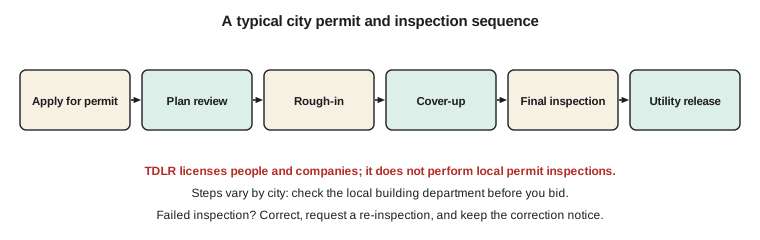
Most city permits follow a similar sequence. First, the contractor applies for the permit and pays the fee. For commercial work and larger residential work, plan review follows, in which a plans examiner checks the drawings for code compliance: service and feeder sizes, load calculations, panel schedules, grounding, emergency systems and so on. When the permit is issued, it must usually be posted at the job site. Next come inspections at defined stages. A temporary power inspection may come first on new construction. A rough-in inspection checks wiring, boxes, supports and grounding before walls are covered. Some cities have separate inspections for underground work before trenches are backfilled, for services, or for slab conduits before concrete is placed. After the rough-in passes, the wiring can be covered. A final inspection checks devices, panels, labeling, GFCI and AFCI protection and the completed installation. When the final passes, the city notifies the electric utility, or issues a release, so that the utility can set a meter or energize the service.
Rosa's Riverside Taqueria remodel followed exactly that path. Lupe applied online with the panel schedule and a one-line diagram; the plans examiner asked for the available fault current at the service, which Rosa obtained from the utility; the permit issued nine days later; the rough-in passed on the second visit after a missing bonding jumper was corrected; and the final passed the day before the restaurant's health inspection. The whole process took six weeks, which is why Pecan Creek's bids include permit time in the schedule.
Worked problem
Planning inspection time into a schedule
A remodel needs plan review (allow 10 working days), a rough-in inspection (allow 2 days to schedule plus 1 day for a possible re-inspection), and a final inspection (allow 2 days plus 1 for a re-inspection). The electrical work itself takes 12 working days, with rough-in done on day 7. How many working days should the schedule allow from permit application to final approval?
Show solution
- Plan review before work starts: 10 days.
- Work to rough-in: 7 days, then 2 + 1 = 3 days for rough-in inspection and possible re-inspection.
- Remaining work after rough-in: 12 − 7 = 5 days.
- Final inspection and possible re-inspection: 2 + 1 = 3 days.
- Total: 10 + 7 + 3 + 5 + 3 = 28 working days.
Answer: About 28 working days, using these illustrative allowances.
Correction notices and re-inspections
When an inspection fails, the inspector issues a correction notice listing the deficiencies and usually the code sections involved. The contractor corrects the work and requests a re-inspection, and many cities charge a re-inspection fee after the first failed visit. A correction notice is not a punishment; it is part of the process. But repeated failures cost money and goodwill, and some cities track contractors' failure rates. A master of record should review every correction notice, make sure the correction is right, and use the notice to train the crew.
Disagreements happen. If a contractor believes an inspector has misread the code, the first step is a calm conversation with the inspector, with the code book open to the section. If that does not resolve it, most cities have an appeal process, often to the chief inspector or building official and then to a board of appeals. Darnell's advice to Rosa: bring the section number, not an opinion, and remember that the AHJ has authority to interpret the code. He also pointed out that the NEC's own provisions give the AHJ discretion in some areas, so an argument that the code permits something does not always win if the code says the authority may require otherwise.
| Body | What it does | What it does not do |
|---|---|---|
| TDLR | Licenses people and companies; enforces Chapter 1305; sets the state code by rule | Inspect installations for local permits |
| City building department | Issues permits, reviews plans, inspects, approves for connection | Issue or renew state licenses |
| Authority having jurisdiction | Interprets the code, approves equipment, grants special permission | Waive the state licensing law |
| Electric utility | Connects and energizes service, sets its own service rules | Enforce the NEC on premises wiring for the city |
| Contractor and master of record | Pull permits, do compliant work, correct deficiencies | Self-certify work where a city requires inspection |
Unincorporated areas
Outside city limits the picture changes. Texas counties have much more limited authority than cities to adopt and enforce building codes, and in many unincorporated areas no local electrical permit or inspection is required for ordinary work. That does not mean anything goes. The state license is still required, and TDLR's compliance guide says the code in effect on the day installation begins applies where no permit is required. Electric utilities and cooperatives often have their own requirements before connecting a new service, which may include an inspection by a licensed inspector, a signed statement from the contractor, or compliance with their service rules. Some counties regulate particular matters, such as development in flood plains or subdivisions, that touch electrical work.
Pecan Creek's ranch and farm work outside Pecan Springs is usually uninspected. Walt's rule for those jobs is that the crew wires them as if Darnell were going to inspect, takes photos at rough-in, and keeps the photos in the job file. Rosa has seen the value of that rule twice: once when an insurance adjuster asked about a barn fire unrelated to the wiring, and once when a customer's lender required proof of code compliance before closing a loan. Without an inspection record, a good photo record and a licensed contractor's name are the next best evidence.
The utility's role
The utility is not the city's inspector, but it controls the connection. Utilities publish service rules covering meter locations, service entrance requirements, metering equipment and clearances, and they usually will not energize a new or upgraded service until the AHJ has released it, where there is one. On the Hill Country Feed and Supply service upgrade, the utility required a site meeting before the new 400 ampere, 480Y/277 volt service was installed, specified the current transformer cabinet, and scheduled the outage for a Sunday morning. Rosa learned to call the utility's new-service group at the start of any service job, not at the end, because their lead times often drive the schedule more than the city's.
Records that protect the master
A master of record signs permits, answers for the work and may be the person TDLR or a city contacts when something goes wrong. Good records are the master's protection. Walt keeps a job file for every permit with the application, the approved plans and any plan review comments, every inspection result with the inspector's name, every correction notice and how it was corrected, photographs at rough-in, the utility release, and the final approval. For jobs that need no permit, the file holds the photographs, the materials list and a short description of the work. Lupe scans everything and keeps the files for years, because questions about a job can come up long after it is finished: an insurance claim, a lawsuit, a sale of the building, or a customer's complaint to TDLR.
Rosa started a habit during her study months that she plans to keep as master. At every final inspection she walks the job with the inspector, asks about anything the inspector noticed but did not write up, and notes it in the file. Inspectors often mention things that are allowed but unusual, or things that will become violations under the next edition. Those notes have already saved Pecan Creek one failed inspection on a later job.
Exam questions on permits and inspections
The exam tests this lesson in a few predictable ways. A question may ask who inspects electrical work in a city, expecting the local authority rather than TDLR. It may ask whether a city can require a separate local license, expecting no, or whether a city can charge permit fees, expecting yes. Questions drawn from the NEC ask about the authority having jurisdiction: who approves equipment, who interprets the code, who grants special permission. Applied questions may combine this lesson with Lesson 5, asking which code edition applies to a job with a given permit date.
The calculator below keeps a simple permit log of the kind Lupe uses, and flags any job with an open correction notice or a final inspection still pending. Change the entries to match your own jobs.
jobs = [
    {"job": "Riverside Taqueria", "edition": "2023", "rough": "pass", "final": "pass"},
    {"job": "Bluebonnet Ridge lot 41", "edition": "2023", "rough": "pass", "final": "pending"},
    {"job": "Feed store service", "edition": "2026", "rough": "correction", "final": "pending"},
]
for j in jobs:
    flags = []
    if j["rough"] == "correction":
        flags.append("rough-in correction open")
    if j["final"] != "pass":
        flags.append("final not passed")
    status = ", ".join(flags) if flags else "complete"
print(f'{j["job"]} ({j["edition"]} NEC): {status}')Riverside Taqueria (2023 NEC): complete Bluebonnet Ridge lot 41 (2023 NEC): final not passed Feed store service (2026 NEC): rough-in correction open, final not passed
Common mistakes
MistakeThinking TDLR inspects installations for local permits.
InsteadLocal authorities inspect; TDLR licenses and enforces Chapter 1305.
MistakeCovering wiring before the rough-in inspection passes.
InsteadWork must be inspected before it is concealed, and covered work may have to be exposed.
MistakeAssuming no permit means no code in unincorporated areas.
InsteadThe state electrical code and license requirements still apply.
MistakeArguing a correction notice from opinion.
InsteadDiscuss the specific code section; the AHJ has authority to interpret the code, and cities have appeal processes.
MistakeWaiting until the end of a job to contact the utility.
InsteadUtility lead times and service rules often control service schedules.
Summary and key terms
- TDLR does not perform inspections for local permits; cities and other local authorities do.
- Cities may require permits, charge permit fees, adopt amendments and inspect, but not require separate licenses.
- A typical permit moves through application, plan review, rough-in, cover-up, final and utility release.
- Correction notices are corrected and re-inspected; disagreements go to the inspector, then the city's appeal process.
- In unincorporated areas there may be no permit or inspection, but the state code and licenses still apply.
- The NEC gives the authority having jurisdiction power to interpret the code and approve equipment.
- Authority having jurisdiction
- The organization, office or person responsible for enforcing the code and approving installations.
- Plan review
- A city's check of drawings for code compliance before a permit is issued.
- Rough-in inspection
- An inspection of wiring, boxes and grounding before walls are covered.
- Correction notice
- An inspector's list of deficiencies that must be corrected before approval.
- Utility release
- The city's notice that a service may be connected or energized.
- Re-inspection fee
- A charge some cities make for repeat inspections after a failure.
Practice problems
Work each problem on paper first, then reveal the answer to check.
Who performs electrical inspections for a permit in a Texas city?
Show answer
The city or its designated inspectors, not TDLR.
May a city charge a permit fee to a state-licensed contractor?
Show answer
Yes; it may not require a separate license or license registration fee.
A rough-in fails for a missing bonding jumper. What happens next?
Show answer
Correct the work, request a re-inspection (possibly with a fee), and cover the wiring only after it passes.
Name two requirements a utility might impose before energizing a new service.
Show answer
A release from the AHJ where one exists, and compliance with its service rules such as meter location or metering equipment.
Who grants special permission under the NEC?
Show answer
The authority having jurisdiction.
Lesson quiz · 5 questions
Score 60% or more to complete this lesson.
Create a free account to save your progress, take quizzes and earn a certificate.