
MELU-318 · Lesson 2 of 12 · 21 min
Eligibility for the Master Electrician License
▶ Video coming soon A video version of this lesson is on the way.
Rosa's first question was simple: does she qualify yet? Walt assumed she did, since she has been a journeyman for five years and in the trade for thirteen. Lupe Ortiz, Pecan Creek's office manager, who handles every license and permit file the company owns, was more careful. She printed the TDLR master application and its experience verification form, sat Rosa down at the conference table, and said they would go through each requirement and the paper that proves it. This lesson follows that conversation. It covers the two experience requirements for the Texas Master Electrician license, how experience is verified, what does not count, the background check, and the one-year window in which every requirement must be met.
As always in this course, the facts come from TDLR's published requirements as checked in November 2026. The master application and its instructions are the controlling documents. If anything here differs from the current form, the form wins, and you should read it line by line before you sign.
Requirement 1: two years as a journeyman
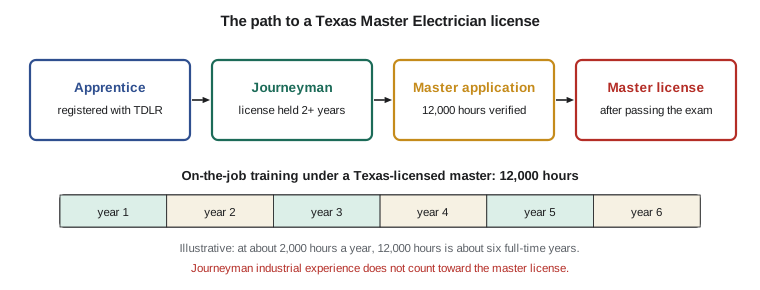
The first requirement is time with a license. TDLR's master application page says the applicant must have held a Journeyman Electrician license for at least two years. The word held matters. It is not two years of journeyman-level work; it is two years during which the person actually held the Texas journeyman license. Rosa passed her journeyman exam and received her license in 2021, so by the time she applies she will have held it for well over two years. A journeyman who received a license eighteen months ago does not yet qualify, however many hours he has worked.
The license must be the journeyman electrician license. Experience as a journeyman industrial electrician does not count toward the master license, and TDLR's page says so plainly. Holding a residential wireman license, a sign license or an appliance installer license does not satisfy this requirement either. A candidate who moved from another state should read TDLR's out-of-state transfer pages, which describe when a license from another state can be used; those rules depend on agreements and on the other state's requirements and change from time to time.
Requirement 2: 12,000 hours of on-the-job training
The second requirement is experience. The applicant must be able to show 12,000 hours of on-the-job training under the supervision of a Master Electrician licensed in Texas. The hours are not limited to the time after the journeyman license; they include the applicant's years as a supervised apprentice and journeyman, as long as the work was supervised by a Texas master. For a full-time electrician working about 2,000 hours a year, 12,000 hours is about six years of work.
Rosa counted her years. She worked for two contractors: Lone Oak Electrical Services from 2013 to 2017 as an apprentice, then Pecan Creek from 2017 onward. Both companies had Texas masters of record, and both kept payroll records. A rough tally gave her more than 20,000 hours, far above the minimum. The question was not whether she had the hours but whether she could prove them in the form TDLR asks for.
Worked problem
Counting hours from a work history
A candidate worked 40 hours a week for 50 weeks a year as a registered apprentice for 3 years, then as a journeyman for 3.5 years, all under Texas masters. How many hours can he document, and does he meet the 12,000 hour requirement?
Show solution
- Hours per year: 40 × 50 = 2,000.
- Total years: 3 + 3.5 = 6.5.
- Total hours: 2,000 × 6.5 = 13,000.
- Compare: 13,000 is more than 12,000, so the hours requirement is met, provided he has held the journeyman license for at least two years and can verify the hours.
Answer: 13,000 hours; the hours requirement is met if the verification forms support it.
Proving the hours: experience verification forms
TDLR asks for the experience to be verified by the masters who supervised it. The master application includes an Experience Verification Form, and each supervising Master Electrician must sign one. If the applicant worked under several masters, each one completes a separate form for the period he supervised. The forms ask for the dates of employment, the number of hours and the type of work, and the supervising master's license information. TDLR reviews them, and it may contact the masters or ask for more documentation.
Lupe's first task was to find the masters. Walt could sign for Rosa's years at Pecan Creek. Lone Oak's former master of record, Bill Esparza, had retired to the coast, but Lupe tracked down his phone number through a former coworker, and he agreed to sign for Rosa's apprentice years. Lupe also pulled Rosa's W-2 forms and her apprentice registration history, not because TDLR asked for them on the form but because she wanted a backup if any question arose about dates. Her advice to any candidate is to start collecting signatures early: masters retire, move and pass away, and a missing signature can delay an application for months.
One exception helps some older applicants. TDLR's page says an applicant who held a municipal or regional master license may verify his own on-the-job training for the years he held that license. That reflects the years before 2003, when some cities licensed masters locally. It does not apply to Rosa, but it may appear on the exam as a distinguishing detail.
| Item | What TDLR asks for | Rosa's evidence |
|---|---|---|
| Journeyman license | Held at least two years | Texas journeyman license issued 2021 |
| Supervised experience | 12,000 hours under a Texas master | About 20,000 hours, 2013 onward |
| Verification | Signed form from each supervising master | Forms from Walt Henley and Bill Esparza |
| Criminal history | Questionnaire if there is a qualifying conviction | Not needed; background check still runs |
| Application fee | Non-refundable fee with the mailed application | 45 dollars, check from Pecan Creek |
What does not count
Several kinds of experience fall outside the 12,000 hours. Work as a journeyman industrial electrician is excluded by name. Work done without supervision by a Texas-licensed master is a problem, because the requirement specifically says under the supervision of a Master Electrician licensed in Texas. Experience gained in another state may be considered under the out-of-state provisions but is not simply added to the Texas hours. Work outside the definition of electrical work, such as installing low-voltage systems that Texas regulates under a different licensing program, may not count. If any part of your history is unusual, call TDLR or read the application instructions before you file, because an application that cannot be approved still costs a non-refundable fee.
Unlicensed work is a special trap. Hours worked as an electrician without being registered as an apprentice or licensed are hard to verify, and the work itself may have violated Chapter 1305. A master cannot honestly sign a form saying he supervised hours he did not supervise. Candidates sometimes ask whether a friendly master can sign for work done years ago at another company; the answer is no. The signature is a statement to a state agency, and a false statement can cost the master his own license.
The background check
TDLR runs a criminal history background check on every applicant. If an applicant has a conviction or deferred adjudication that may relate to the license, TDLR asks for a Criminal History Questionnaire with the application. TDLR reviews convictions case by case under its criminal history guidelines, considering things such as the nature of the offense, its relationship to the duties of the license, the time since the offense and evidence of rehabilitation. A conviction does not automatically disqualify an applicant. Someone with concerns can ask TDLR about a criminal history evaluation before applying, which avoids paying for an application that may be denied.
The one-year window
The last eligibility rule is about time. TDLR's examination page says applicants have one year from the date TDLR receives the application to meet all licensing requirements, including passing the exam. If the year runs out, the application expires and the candidate must apply again and pay again. The one-year clock is why Lupe told Rosa not to mail the application until she had a study plan. Mailing it the week Walt mentioned retirement would have started a clock running while Rosa was still in the middle of a busy summer of new homes at Bluebonnet Ridge.
The year is generous for a prepared candidate. The exam can be retaken as many times as needed within the year, though each attempt costs another exam fee. But candidates who fail a portion, wait months to retake it, fail again and then get busy at work can run out of time. Lesson 3 covers scheduling, and Lesson 12 covers a study plan that fits inside the window.
Three candidates, three answers
Rosa's study group meets at the Pecan Springs library on Tuesday nights, and its members illustrate the rules better than any summary. Marisol Vega has been a journeyman for six years and has worked her whole career for a large commercial contractor in San Antonio with a Texas master of record. She has well over 12,000 supervised hours and has held her license far longer than two years. She qualifies, and her only task is collecting the verification form from her company's master, who is still there.
Derek Olsen is a different case. He spent eight years maintaining production lines at a food plant, first as a registered apprentice and then with a journeyman industrial license, before switching to construction work eighteen months ago, when he passed the journeyman electrician exam. His plant years do not count, because they were journeyman industrial experience, and he has not yet held the journeyman electrician license for two years. Derek needs at least another six months to meet the license-time gate and probably several more years to build 12,000 qualifying hours, depending on how TDLR treats his apprentice years at the plant. He plans to call TDLR before filing anything.
Hector Ruiz, the oldest member of the group, held a City of Pecan Springs master license in the 1990s, before the statewide system, and then worked for a decade in Oklahoma before coming home. The TDLR page lets someone who held a municipal or regional master license verify his own on-the-job training for the years he held it, which helps Hector with that period. His Oklahoma years raise separate questions under the out-of-state provisions. He has a meeting scheduled with a TDLR licensing specialist, and his advice to the group is to ask the agency directly whenever a history does not fit neatly on the form.
The pattern across the three is worth remembering for the exam. The two gates are independent: hours alone do not satisfy the license-time gate, and license time alone does not satisfy the hours gate. The kind of license and the kind of supervision matter as much as the totals. And when in doubt, the applicant asks TDLR before paying a non-refundable fee.
The calculator below checks both experience gates from a simple work history. Edit the list to match your own record. It assumes 2,000 hours per full year, so replace those numbers with the hours your payroll records actually show.
from datetime import date

journeyman_issued = date(2021, 6, 14)
apply_on = date(2026, 12, 1)
years_held = (apply_on - journeyman_issued).days / 365.25

history = [  # (employer, years, hours per year, supervised by a Texas master?)
    ("Lone Oak Electrical Services", 4, 2000, True),
    ("Pecan Creek Electric", 9.4, 2050, True),
]
hours = sum(y * h for _, y, h, ok in history if ok)
print(f"Journeyman license held: {years_held:.1f} years (need 2)")
print(f"Supervised hours: {hours:,.0f} (need 12,000)")
print("Both gates met" if years_held >= 2 and hours >= 12000 else "Not yet eligible")Journeyman license held: 5.5 years (need 2) Supervised hours: 27,270 (need 12,000) Both gates met
Common mistakes
MistakeCounting two years of journeyman-level work instead of two years holding the license.
InsteadThe requirement is two years holding a Texas journeyman electrician license.
MistakeIncluding journeyman industrial electrician experience.
InsteadTDLR excludes journeyman industrial experience from the master requirement.
MistakeAsking a master who did not supervise you to sign the verification form.
InsteadEach supervising master signs only for the period he actually supervised; false statements risk his license.
MistakeMailing the application long before you are ready to test.
InsteadThe one-year window starts when TDLR receives the application.
MistakeAssuming any conviction means automatic denial.
InsteadTDLR reviews criminal history case by case and offers an evaluation process.
Summary and key terms
- The master license requires holding a Texas journeyman electrician license for at least two years.
- It also requires 12,000 hours of on-the-job training under a Texas-licensed master electrician.
- Each supervising master signs an Experience Verification Form for the period he supervised.
- Journeyman industrial electrician experience does not count toward the master license.
- TDLR runs a background check; some applicants must file a Criminal History Questionnaire.
- All requirements, including passing the exam, must be met within one year of TDLR receiving the application.
- Experience Verification Form
- The form each supervising master signs to confirm an applicant's hours and dates.
- On-the-job training
- Supervised work experience counted toward a license requirement.
- Held a license
- Actually possessed the license during the period, not merely worked at that level.
- Criminal History Questionnaire
- The form an applicant with a qualifying conviction or deferred adjudication files with the application.
- One-year window
- The period after TDLR receives an application in which all requirements must be met.
- Out-of-state transfer
- TDLR's process for applicants licensed in other states, governed by its own rules.
Practice problems
Work each problem on paper first, then reveal the answer to check.
A journeyman licensed 22 months ago has 14,000 supervised hours. Can he apply for the master license today?
Show answer
Not yet; he has the hours but has not held the journeyman license for two years.
An applicant worked 1,900 hours a year for 7 years under Texas masters. Total hours?
Show answer
1,900 × 7 = 13,300 hours, which exceeds 12,000.
Who signs an Experience Verification Form for an applicant's first four years at a company whose master has retired?
Show answer
The retired master who supervised those years, if he can be found; each supervising master signs for his own period.
A plant maintenance electrician holds a journeyman industrial license for six years. Do those years count toward the master license?
Show answer
No; journeyman industrial experience is excluded.
TDLR received an application on March 3. By when must the applicant pass the exam?
Show answer
Within one year of that date, so by about March 3 of the following year; check TDLR's notice for the exact expiration.
Lesson quiz · 5 questions
Score 60% or more to complete this lesson.
Create a free account to save your progress, take quizzes and earn a certificate.