
MELU-318 · Lesson 4 of 12 · 21 min
The exam format and the references allowed
▶ Video coming soon A video version of this lesson is on the way.
Rosa's first practice test went badly, and not because she did not know the material. She sat down with a 100-question practice set from a prep book, a timer and her code book, and ran out of time with thirty questions untouched. The prep book had been written for an older, single-sitting version of the Texas exam. When Lupe pulled up the current information, the format was different: two separately timed and separately scored portions, one for NEC knowledge and one for calculations. Rosa had practiced the wrong test. This lesson describes the Texas master exam as it stands in late 2026, the reference and calculator rules, the kinds of questions each portion asks, and how to practice for the real format.
The facts in this lesson come from three places. TDLR's examination page, checked in November 2026, gives the vendor, the passing score, the open-book rule, the binding rules and the NEC edition. The question counts and times come from independent exam prep providers that cite the PSI candidate information bulletin updated in September 2026; they are reported here as reported, not as official statements. The bulletin controls. Read the current version before you book and again before you test.
What TDLR says about the exam
TDLR's examination page makes several statements that apply to the master exam. The exams are given by PSI. A score of 70 or better out of 100 is required to pass. The examination is open book, and candidates must bring their own NEC. Any soft-bound edition may be used, but loose-leaf, spiral-bound and ring-bound copies are not allowed, and electronic notepads are provided for working. The page names the National Electrical Code, 2026 edition, as the edition the exams reference. Candidates may retake each exam as many times as needed, paying additional fees, and must meet all requirements within one year of TDLR receiving the application.
That last point about the edition deserves emphasis because it changed recently. Texas adopted the 2023 NEC as the state electrical code effective September 1, 2023, and the 2026 NEC effective September 1, 2026, as Lesson 5 explains. The exam follows the adopted edition, so a candidate testing after the change needs the 2026 code. Rosa had been studying from her 2023 copy, which she uses on the job for permits issued before September 2026. She bought a new soft-bound 2026 copy for the exam and for new work, and she spent her first week reading the 2026 changes summarized in the MELU core courses, especially the move of load calculations from Article 220 to Article 120.
Two portions, scored separately
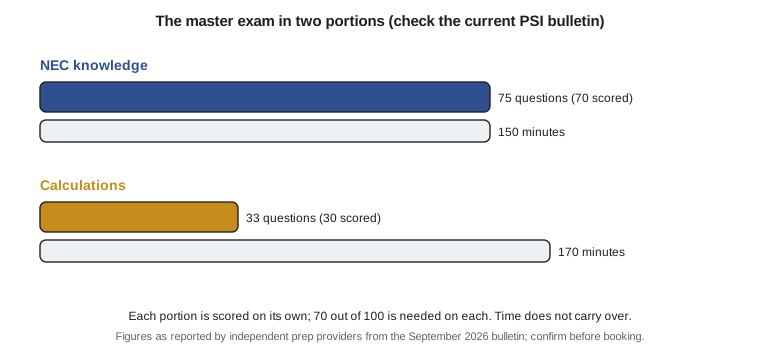
As reported from the September 2026 bulletin, the master exam is given in two portions. The NEC knowledge portion has 75 questions, of which 70 are scored and the rest are unscored pretest items, with 150 minutes allowed. The calculations portion has 33 questions, of which 30 are scored, with 170 minutes allowed. Each portion is scored on its own, and a candidate must reach 70 out of 100 on each portion to pass; a strong score on one cannot make up for a weak score on the other. Unused time on one portion does not carry over to the other. Texas moved the journeyman exam to a similar two-part format in March 2025, and prep providers describe the master exam the same way in 2026.
Pretest items deserve a word. Testing vendors include a few unscored questions to trial them for future exams, and candidates cannot tell which ones they are. The practical lesson is to answer every question as if it counts, and not to waste time worrying that a strange question is the unscored one.
Worked problem
How many questions can you miss?
On the knowledge portion, 70 questions are scored and a candidate needs 70 out of 100. On the calculations portion, 30 are scored. How many scored questions can a candidate miss on each portion and still pass?
Show solution
- Knowledge: 70 out of 100 of 70 scored questions = 0.70 × 70 = 49 correct needed.
- Knowledge misses allowed: 70 − 49 = 21.
- Calculations: 0.70 × 30 = 21 correct needed.
- Calculations misses allowed: 30 − 21 = 9.
Answer: About 21 misses on knowledge and 9 on calculations, if scoring works as reported; check the bulletin.
What the knowledge portion asks
The knowledge portion tests whether a candidate can find and apply NEC requirements quickly, with some questions on Texas electrician law and rules. Typical questions ask what a section requires, permits or prohibits; which article covers a type of installation; a minimum clearance, size, rating or spacing; or which statement about a requirement is true. They range across the whole code, from general requirements in Chapters 1 through 4 to special occupancies, equipment and conditions in Chapters 5 through 7 and communications in Chapter 8. The bulletin's content outline lists the topic areas and the approximate number of questions for each; build your study plan around it.
Law and rules questions draw on Occupations Code Chapter 1305 and 16 TAC Chapter 73: who must be licensed, what each license allows, contractor duties, the master of record, vehicle lettering, renewal and continuing education, and TDLR's enforcement powers. Rosa downloaded current copies of the statute and the rules from the official state websites, printed them and read them twice. Check the bulletin to see whether printed statutes and rules are provided or allowed in the testing room; do not assume they are.
What the calculations portion asks
The calculations portion uses fewer questions and more time, because each question takes several steps. Expect dwelling and commercial load calculations, service and feeder sizing, conductor ampacity with correction and adjustment, voltage drop, box and conduit fill, motor branch circuits and feeders, transformer protection, and similar problems. The MELU core courses, especially MELU-102 on load calculations, MELU-103 on conductors and overcurrent protection and MELU-105 on motors and transformers, cover these methods. For the exam, practice each method until you can do it from the code book alone, without notes, under time pressure.
A calculation question often offers answer choices that match common mistakes: forgetting a demand factor, using the wrong temperature column, or rounding at the wrong step. Work the problem first, then look at the choices. If your answer is not among them, recheck your method rather than picking the nearest number.
The reference: your own NEC
The exam is open book with one reference: your own copy of the adopted NEC. TDLR's page allows any soft-bound edition and bars loose-leaf, spiral-bound and ring-bound copies. The bulletin sets further rules about tabs, highlighting and writing in the book. Exam prep providers reporting on the September 2026 bulletin say the only tabs permitted were permanent index tabs made or supplied by the publisher of the NEC, with homemade and third-party tabs not allowed, and that the NEC Handbook and loose papers were prohibited. Other states allow different tabs, so do not rely on advice written for another state. Read the Texas bulletin and prepare your book to match it exactly.
Rosa tabbed her new code book with the publisher's tab set, checked every page for loose notes, and practiced exclusively with that book for nine weeks so that she knew where everything was. She learned to use the index well, because on a timed exam the index is often faster than flipping. The MELU-101 course covers navigation drills that pay off here.
| Rule | What it means for you | Source |
|---|---|---|
| Open book | Bring your own copy of the adopted NEC | TDLR examination page |
| Soft-bound only | No loose-leaf, spiral-bound or ring-bound copies | TDLR examination page |
| 2026 NEC | The exam references the 2026 edition | TDLR examination page |
| Tabs | Reported as publisher's permanent tabs only | Prep providers citing the bulletin; confirm |
| Calculator | Reported as silent, non-programmable, no printing or alphabetic keys | Prep providers citing the bulletin; confirm |
| Passing score | 70 out of 100 on each portion | TDLR page and bulletin reports |
The calculator
Calculator rules matter more on the calculations portion than anywhere else. As reported from the bulletin, a permitted calculator must be silent and battery-operated, must not be programmable, and must not print or have an alphabetic keyboard; a basic scientific calculator with a square-root key is enough for every exam problem. Phones, watches and anything that can store text are not allowed. Rosa bought the plainest scientific calculator she could find, used it for every practice problem, and put a fresh battery in it the week before the exam.
Practice with the same calculator you will use on test day. Every model handles order of operations, square roots and memory differently, and a candidate who learns those habits during the exam wastes minutes. Rosa also memorized the square root of 3 to four places, 1.732, since three-phase problems use it constantly.
Practicing the real format
The most useful change Rosa made after her bad first practice test was to practice the real format. She built two kinds of practice sessions: a 75-question knowledge set in 150 minutes and a 33-question calculation set in 170 minutes, never mixed. She kept a log of each session: number correct, minutes used, and the type of every miss. Over nine weeks her knowledge scores rose from the low sixties to the high eighties and her calculation scores from the mid fifties to the low eighties, and her log showed that most of her remaining misses came from reading too fast.
Reading the question
Most of Rosa's late misses came from reading, not from the code. Master exam questions are written precisely, and a single word changes the answer. Shall means the rule is mandatory; shall be permitted means the code allows something but does not require it; shall not prohibits it. Minimum and maximum flip a sizing answer. Dwelling unit, multifamily dwelling and guest room each trigger different rules. Questions on the calculations portion add their own traps: a load given in kilowatts instead of volt-amperes, a three-phase system described only by its voltage, or a continuous load hidden in the description of how long equipment operates. Rosa learned to underline, on the electronic notepad, the noun the question is about, the limiting word such as minimum or maximum, and every number with its unit, before turning to the code.
She also learned to read every answer choice before selecting one. Exam writers often include a choice that is true but does not answer the question, or a choice that would be right under a different edition of the code. When two choices look right, the difference is usually in a qualifier, such as a type of occupancy, a voltage range or an exception that applies only in a stated condition. Going back to the section and reading the exception again usually settles it.
A test-day sequence
Rosa's plan for the morning was simple and rehearsed. Arrive at the San Antonio site thirty minutes early. Check in with identification, store everything except the code book and calculator, and let the proctor inspect the book. When the knowledge portion begins, write pacing targets on the notepad, then work through all 75 questions once, answering the ones she could find quickly and marking the rest. Use the second pass for marked questions, and the last few minutes to make sure no question was left blank, since a blank is always wrong and a guess sometimes is not. During any break the bulletin allows, eat something, drink water and do not reread notes, since none are allowed. Then start the calculations portion with the same pattern, giving each problem its full method and checking units at the end.
Walt added one piece of advice from his own exam years ago: do not change an answer on the second pass unless you find the specific section that proves the first answer wrong. Changes made on a hunch, he said, turn right answers into wrong ones about as often as the other way around.
The calculator below turns a practice result into the numbers that matter: the score out of 100 on each portion and whether it would pass. Edit the numbers after each practice session.
def portion(name, correct, scored, minutes_used, minutes_allowed):
    pct = correct / scored * 100
    status = "pass" if pct >= 70 else "below 70"
    print(f"{name}: {correct}/{scored} = {pct:.1f} out of 100 ({status}); "
          f"{minutes_used} of {minutes_allowed} minutes used")
    return pct >= 70

k = portion("Knowledge", 58, 70, 141, 150)
c = portion("Calculations", 22, 30, 162, 170)
print("Both portions pass" if k and c else "Retake needed for any portion below 70")Knowledge: 58/70 = 82.9 out of 100 (pass); 141 of 150 minutes used Calculations: 22/30 = 73.3 out of 100 (pass); 162 of 170 minutes used Both portions pass
Common mistakes
MistakePracticing with an old single-sitting format.
InsteadAs reported for 2026, the master exam has two separately timed and scored portions.
MistakeAssuming a high knowledge score can carry a weak calculation score.
InsteadEach portion must reach 70 out of 100 on its own.
MistakeTesting with the 2023 NEC after September 2026.
InsteadTDLR's examination page references the 2026 edition.
MistakeUsing homemade tabs because another state allows them.
InsteadFollow the Texas bulletin, which was reported to allow only the publisher's permanent tabs.
MistakeBringing a programmable calculator.
InsteadCalculators reported as permitted are silent, non-programmable and without printing or alphabetic keys.
Summary and key terms
- TDLR's exams are given by PSI, are open book with your own NEC, and need 70 out of 100 to pass.
- Only soft-bound copies are allowed; the exam references the 2026 NEC.
- As reported for 2026, the knowledge portion has 75 questions in 150 minutes and the calculations portion 33 questions in 170 minutes.
- Each portion is scored separately and must be passed on its own; time does not carry over.
- Tab and calculator rules are strict; follow the current Texas bulletin exactly.
- Practice in the real format with the same book and calculator you will use on test day.
- Portion
- One separately timed and scored part of the exam.
- Pretest item
- An unscored trial question mixed among scored questions.
- Open book
- An exam that allows a specified reference, here the candidate's own NEC.
- Soft-bound
- A paperback binding, as opposed to spiral, ring or loose-leaf.
- Content outline
- The bulletin's list of topic areas and question counts.
- Non-programmable calculator
- A calculator that cannot store programs or text.
Practice problems
Work each problem on paper first, then reveal the answer to check.
On a 70-question scored portion, how many correct answers are needed for 70 out of 100?
Show answer
0.70 × 70 = 49.
How many minutes per question does the reported knowledge portion allow on average?
Show answer
150 ÷ 75 = 2 minutes.
How many minutes per question does the reported calculations portion allow on average?
Show answer
170 ÷ 33 ≈ 5.2 minutes.
Name three items that are not allowed with your code book.
Show answer
Loose papers or notes, the NEC Handbook, and spiral or ring-bound copies (and, as reported, non-publisher tabs).
A candidate scores 52 of 70 on knowledge and 20 of 30 on calculations. Does he pass?
Show answer
Knowledge: 74.3 out of 100, pass; calculations: 66.7, below 70, so he retakes calculations.
Lesson quiz · 5 questions
Score 60% or more to complete this lesson.
Create a free account to save your progress, take quizzes and earn a certificate.