
MELU-318 · Lesson 7 of 12 · 21 min
Duties and responsibilities of the Master Electrician License holder
▶ Video coming soon A video version of this lesson is on the way.
Walt Henley keeps a framed photocopy of his first master license above his desk, dated before the statewide system existed, when the City of Pecan Springs issued it. Next to it is his current TDLR license card, which he renews every year. When Rosa asked him what changes on the day a journeyman becomes a master, he did not mention the work. He said the difference is that the master is the person the state, the city and the customer hold responsible when the work is wrong, and that being master of record for a company means being responsible for work you did not personally do. This lesson covers what the Texas Master Electrician license allows, the role of master of record, the rules on how many companies a master can qualify, what happens when a master leaves, supervision of other electricians, and the everyday duties that keep a master and a contractor out of trouble with TDLR.
The statements about the master of record in this lesson come from TDLR's application and compliance guide pages, checked in November 2026. Details such as supervision requirements for apprentices and the exact duties in the rules are in 16 TAC Chapter 73; where this lesson describes them generally, read the current rules for the exact language.
What the master license allows
The Master Electrician license is the highest general electrician license in Texas. A master may perform electrical work, supervise other electricians and apprentices, and, most importantly for a business, serve as the master of record that qualifies an electrical contractor license. A master who works alone and contracts directly with customers still needs an electrical contractor license for the business, with himself named as master of record; the individual license and the business license are separate, as Lesson 8 explains. A master may also serve as master of record for an electrical sign contractor under Section 1305.153, according to TDLR's compliance guide.
The license does not cover everything electrical. Fire alarm work falls under a separate state licensing program administered by the State Fire Marshal's Office, and low-voltage work such as alarm and access control systems falls under its own licensing as well. Air conditioning and refrigeration work, plumbing and elevator work are separately licensed. A master who takes on a job that crosses into another licensed field needs a properly licensed subcontractor or the other license. Rosa's study group spent an evening listing every licensed trade that touches a typical restaurant job, and the list surprised them: electrical, plumbing, air conditioning, fire alarm, fire sprinkler, low-voltage security, and the general contractor's own registrations in some cities.
The master of record
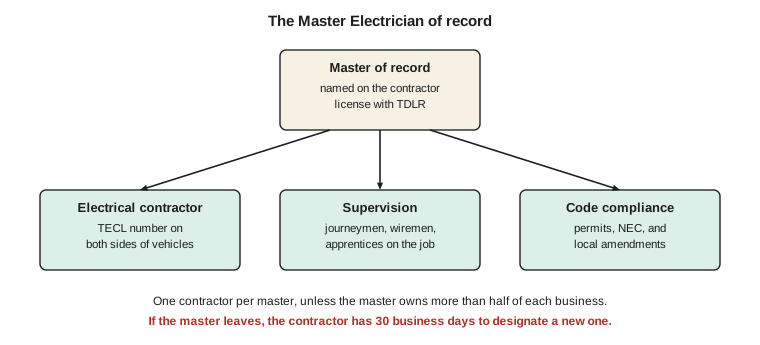
Every electrical contractor in Texas must either hold its own Master Electrician license, in the case of a sole proprietor who is a master, or employ a master electrician as its master of record. TDLR's compliance guide calls this the Master Electrician of Record. The master of record is named on the contractor's license with TDLR. In practical terms, the master of record is the license that allows the company to pull permits and sell electrical work, and the master is responsible under the rules for the electrical work the company performs. That is why a contractor cannot simply list any master's name. The master must actually be connected to the business in the way the rules require.
TDLR's pages set two rules about that connection. First, a master may be assigned to more than one electrical contractor only if the master owns more than half of each company. A master who owns half or less of a company may be assigned to only one company, and must be its employee. Second, if the master of record leaves the company, the contractor must designate a new master within thirty business days from the date of separation. The change is made on TDLR's form for master of record changes, signed by the new master and the company owner.
Worked problem
Can one master qualify two companies?
Walt owns 100 of 100 shares of Pecan Creek. He is considering helping his nephew start a second contractor, Henley Solar Electric, and serving as its master of record too. Under what conditions can he be master of record for both?
Show solution
- The rule: a master may be assigned to more than one contractor only if he owns more than half of each.
- Pecan Creek: Walt owns all of it, which is more than half.
- Henley Solar: Walt would need to own more than half of it as well.
- If his nephew owns half or more of Henley Solar, Walt could not be its master of record while also serving Pecan Creek.
Answer: Only if Walt owns more than half of Henley Solar as well as more than half of Pecan Creek.
When the master leaves
A master of record can leave for many reasons: retirement, a new job, a dispute, illness or death. The thirty-business-day rule gives the contractor a limited time to find and designate a replacement. Thirty business days is about six calendar weeks, not thirty calendar days, but it passes quickly when a company must find a qualified master willing to take responsibility for its work. During the gap, the company should be careful about what work it takes on and should check with TDLR and the cities where it works about permits in progress. The cleanest path is the one Walt is planning: a successor who has the license, knows the company and steps in on a planned date, with the change filed the same day.
Departing masters have responsibilities too. A master who leaves a company should make sure TDLR's records reflect the change, so that he is not listed as master of record for a company whose work he no longer supervises. Cities often keep their own records linking contractors to masters for permits, and some require the master's signature on permit applications; a master who leaves should notify them as well. Walt plans to send letters to every city where Pecan Creek has open permits on the day Rosa becomes master of record.
Supervision of other electricians
The license system is built on supervision. Apprentices must be registered with TDLR and work under the supervision of licensed electricians, as the rules require. Journeymen and residential wiremen perform electrical work within the structure of a contractor whose master of record is responsible for it. The master does not need to stand next to every journeyman, but must have systems that make sure the work is done by properly licensed people, to the code, under permits where required. 16 TAC Chapter 73 contains the supervision rules, including requirements for how apprentices are supervised on job sites; read the current rules for the exact requirements, because exam questions on supervision tend to test the specific wording.
Rosa's first project as acting supervisor, before her license came through, was an audit of Pecan Creek's crew licenses. She checked every electrician's license and every apprentice's registration on TDLR's online license search, recorded the expiration dates in a spreadsheet, and found one apprentice whose registration had lapsed two months earlier because his renewal reminder went to an old email address. He renewed the same week, but she noted that if TDLR had visited a job site in those two months, the company would have had a problem. The audit is now a quarterly routine.
| Duty | What it involves in practice | Where to look |
|---|---|---|
| Qualify the contractor | Be named as master of record with TDLR | TDLR application and compliance guide |
| One company unless majority owner | More than half ownership needed for multiple companies | TDLR compliance guide |
| Replacement on departure | Contractor designates a new master within 30 business days | TDLR contractor page |
| Supervision | Licensed and registered workers, supervised as the rules require | 16 TAC Chapter 73 |
| Code compliance | Work to the adopted NEC and local amendments, under permits | 16 TAC 73.100 and city rules |
| Records and display | Licenses current; vehicles lettered with TECL number | Occupations Code 1305.166; 16 TAC 73.51 to 73.54 |
Code compliance and permits
The master of record answers for whether the company's work meets the code. In practice that means making sure permits are pulled where required, that the crew works to the correct edition of the NEC with the city's amendments, that corrections are made properly, and that the company does not do work it is not qualified or licensed to do. On larger companies the master delegates much of this to supervisors and project managers, but the responsibility does not move. A master who lends a license to a company and never looks at its work is exposed to discipline if the work is bad or done without permits.
Walt's system at Pecan Creek is simple. He reviews every commercial permit application before Lupe submits it, visits every job at least once, reads every correction notice, and holds a short code meeting every other Monday where the crew reviews one correction notice and one code change. Rosa intends to keep all of it and add a digital checklist for rough-in inspections.
Advertising, display and honesty with the public
Contractors have public-facing duties that the master of record should watch. The company's name and license number must appear on both sides of each vehicle used in the business, in contrasting permanent letters at least two inches high with the TECL prefix, under Section 1305.166 and 16 TAC sections 73.51, 73.52 and 73.54. The rules also address showing the license number on advertising and documents; check the current rules for which items require it. Above all, a master and contractor must deal honestly with customers and the state. False statements on applications, verification forms, permit applications or invoices can lead to discipline, and in some cases criminal charges.
The master as teacher
The rules talk about supervision, but the best masters treat it as teaching. Walt still remembers the master who trained him, who would not let an apprentice terminate a conductor until the apprentice could explain why the terminal's temperature rating mattered. Pecan Creek's apprentices rotate through service work, new homes and commercial jobs so they see the whole trade, and each one keeps a log of hours and tasks that Walt reviews every quarter. That log becomes part of the evidence when the apprentice later applies for a journeyman license, and, years later, for a master license of his own. Rosa realized during her own application that the habits a master sets for record-keeping decide how easily the next generation can prove its experience.
Teaching also protects the company. A crew that understands why the code requires something makes fewer mistakes when a situation differs from the last job. Walt's bi-weekly code meetings cost Pecan Creek about an hour of paid time every two weeks, and he credits them for the company's low failure rate at inspections. Rosa plans to add one thing: a short review of every TDLR rule change each year, so that the crew hears about changes from her before they hear about them from an inspector.
Discipline and the master
TDLR can take action against a master for violations of Chapter 1305 or the rules, including performing or allowing unlicensed work, failing to supervise, aiding a company that is not properly licensed, or making false statements. Possible outcomes include administrative penalties and suspension or revocation of the license. A revoked master license ends the master's ability to qualify any contractor. The best protection is the set of habits in this lesson: current licenses, real supervision, permits pulled, corrections made, records kept, and an honest relationship with inspectors and customers.
The calculator below checks a list of crew licenses against today's date and flags anyone whose license or registration expires within sixty days. Rosa runs a version of it every quarter. Replace the names and dates with your own crew.
from datetime import date

today = date(2026, 11, 16)
crew = [("Rosa Garza", "journeyman", date(2027, 6, 14)),
        ("Caleb Nguyen", "apprentice", date(2026, 12, 20)),
        ("Andre Lewis", "journeyman", date(2027, 2, 2)),
        ("Mia Torres", "apprentice", date(2026, 11, 30))]
for name, kind, expires in crew:
    days = (expires - today).days
    flag = "RENEW NOW" if days <= 60 else "ok"
print(f"{name} ({kind}): expires {expires}, {days} days left, {flag}")Rosa Garza (journeyman): expires 2027-06-14, 210 days left, ok Caleb Nguyen (apprentice): expires 2026-12-20, 34 days left, RENEW NOW Andre Lewis (journeyman): expires 2027-02-02, 78 days left, ok Mia Torres (apprentice): expires 2026-11-30, 14 days left, RENEW NOW
Common mistakes
MistakeAssuming a master can qualify any number of companies.
InsteadMore than one only if the master owns more than half of each; otherwise one company, as its employee.
MistakeReading thirty business days as thirty calendar days.
InsteadThirty business days is roughly six calendar weeks, but the deadline is firm.
MistakeThinking the master license covers fire alarm and low-voltage work.
InsteadThose fields have separate Texas licensing programs.
MistakeLending a license without supervising the work.
InsteadThe master of record answers for the company's electrical work and can be disciplined.
MistakeForgetting to notify cities when the master changes.
InsteadMany cities link permits to the master; update them along with TDLR.
Summary and key terms
- The master license allows a person to supervise electrical work and to serve as a contractor's master of record.
- An electrical contractor must hold or employ a Master Electrician of record named with TDLR.
- A master may qualify more than one contractor only by owning more than half of each.
- A contractor must designate a new master within thirty business days after the master leaves.
- The master of record is responsible for supervision, licensing of the crew, permits and code compliance.
- Violations can lead to penalties, suspension or revocation; good records and real supervision are the protection.
- Master Electrician of record
- The master named on a contractor's license with TDLR who qualifies the contractor.
- Separation
- The date a master of record stops working for or with the contractor.
- Business day
- A weekday that is not a holiday, used in the thirty-day replacement rule.
- Supervision
- The oversight of electrical work and workers required by the licensing rules.
- Revocation
- Permanent loss of a license as a disciplinary outcome.
- Majority owner
- A person who owns more than half of a business.
Practice problems
Work each problem on paper first, then reveal the answer to check.
A master owns 40 of 100 shares in a contractor. Can she also be master of record for a second company?
Show answer
No; owning half or less means she may be assigned to only one company, as its employee.
Walt retires on a Friday. Roughly when must Pecan Creek designate a new master?
Show answer
Within thirty business days of the separation, about six calendar weeks later.
Name two licensed fields outside the electrician license that a restaurant job may involve.
Show answer
Fire alarm and low-voltage security (also plumbing, air conditioning or fire sprinklers).
What should a departing master do besides leaving the company?
Show answer
Make sure TDLR's records reflect the change and notify cities that link permits to him.
Name three habits that protect a master of record.
Show answer
Current crew licenses, real supervision and permits pulled where required (also corrections made and records kept).
Lesson quiz · 5 questions
Score 60% or more to complete this lesson.
Create a free account to save your progress, take quizzes and earn a certificate.