
MELU-318 · Lesson 12 of 12 · 25 min
Practice exam review and test-day strategy
▶ Video coming soon A video version of this lesson is on the way.
Nine weeks after her approval notice arrived, Rosa sat at the Pecan Creek conference table on a Saturday morning for her last full practice run. Lupe ran the clock: 150 minutes for 75 knowledge questions, a fifteen-minute break, then 170 minutes for 33 calculation questions, with nothing on the table but her soft-bound 2026 NEC with publisher's tabs, a plain scientific calculator, scratch paper standing in for the electronic notepad, and a bottle of water. She scored 84 out of 100 on knowledge and 80 on calculations, finished each portion with time to spare, and could name the reason for every miss. This final lesson pulls the course together. It reviews the Texas law and licensing points most likely to appear on the exam, works through sample calculation problems of the kind the calculations portion asks, sets out a study plan that fits inside the one-year window, and lays out a test-day strategy.
The practice problems in this lesson are our own, written to resemble exam questions without copying any real exam item. Where a problem needs a value that would come from an NEC table, the value is given in the problem and labeled illustrative; on the real exam you would look it up in your code book. As always, confirm current exam details in the PSI candidate information bulletin.
Texas law and licensing: the review list
Rosa condensed the law content of this course onto one page, which she read every morning for the last two weeks. The statute is Occupations Code Chapter 1305; the rules are 16 TAC Chapter 73; TDLR runs the program and PSI gives the exams. The master license requires holding a Texas journeyman electrician license for at least two years and 12,000 hours of on-the-job training under a Texas-licensed master; journeyman industrial experience does not count. The initial master application goes to TDLR by mail with a non-refundable fee, and every requirement, including passing the exam, must be met within one year of TDLR receiving it. The exam is open book with the candidate's own soft-bound NEC, now the 2026 edition, and a score of 70 out of 100 is needed on each of the two portions.
Texas adopted the 2026 NEC by amending 16 TAC section 73.100, effective September 1, 2026, with a limited exception for GFCI requirements for certain outdoor outlets. Where a permit is required, the code in effect when the permit was obtained applies; where none is required, the code in effect when installation begins. Cities may adopt local amendments, issue permits, charge permit fees and inspect, but may not require a separate local license or a fee to register the state license. TDLR does not perform inspections for local permits. The authority having jurisdiction interprets the code and approves equipment.
An electrical contractor needs its own license with a master of record. A master may qualify more than one contractor only by owning more than half of each, and a contractor must designate a new master within thirty business days after the master leaves. Contractor vehicles show the name and the TECL license number on both sides in letters at least two inches high. General liability minimums are 300,000 dollars per occurrence, 600,000 dollars aggregate and 300,000 dollars products and completed operations aggregate. Workers' compensation can be insured, self-insured, or declined by a non-subscriber who files with TDI, gives employee notices and loses common-law defenses under Labor Code section 406.033.
Lien rights under Property Code Chapter 53, as revised for original contracts on or after January 1, 2022, depend on timely notices and a timely lien affidavit; weekend and holiday deadlines move to the next business day; suits to foreclose generally must be filed within one year. Federal OSHA covers private employers in Texas; fatalities are reported within eight hours and hospitalizations, amputations and eye losses within twenty-four. Licenses are renewed yearly with four hours of continuing education covering the NEC, Chapter 1305, 16 TAC Chapter 73 and NFPA 70E, in fifty-minute hours from registered providers; contractors and residential appliance installers are exempt.
Law question practice
Law questions are short, but they punish vague memory. Rosa's study group practiced them aloud, one person reading a scenario and the others answering with the rule and its source. A contractor's master of record retires on the first of the month; how long does the company have to name a replacement? Thirty business days, under TDLR's contractor rules. A city asks a newly licensed master to pay a registration fee for his state license before pulling permits; is that allowed? No, under Section 1305.201, though the permit fee itself is allowed. A journeyman has 15,000 supervised hours but has held his license for twenty months; can he apply for the master license? Not yet; he needs two years holding the license. A candidate's application was received in February, and he fails the calculations portion in December; what is his constraint? He must pass it before the one-year window closes in February.
The group found that the right answer usually came from noticing who the question was about and which number applied. Questions about a business turned on the contractor license and the master of record; questions about a person turned on eligibility, the exam or renewal; questions about an installation turned on the code edition, the permit and the authority having jurisdiction. Sorting the question first, then recalling the rule, cut their law misses in half over three weeks.
Calculation practice
The calculations portion rewards a consistent method. For every problem, Rosa writes the given values with units, names the code section or formula she will use, works the arithmetic in clear steps, checks the units, and only then looks at the answer choices. The examples below show that method on problems built from the MELU core courses' topics. They use formulas that do not depend on reproduced code tables, or give illustrative table values in the problem.
Worked problem
Three-phase feeder current
A 480Y/277 volt, three-phase feeder serves a calculated load of 150 kVA. What is the feeder current?
Show solution
- Formula: I = VA ÷ (1.732 × V).
- Convert: 150 kVA = 150,000 VA.
- Denominator: 1.732 × 480 = 831.4.
- Current: 150,000 ÷ 831.4 ≈ 180.4 A.
Answer: About 180 A.
Worked problem
Continuous load and the overcurrent device
A branch circuit supplies a continuous load of 32 amperes, such as an EV charger. The overcurrent device is sized at 1.25 times the continuous load, then rounded up to the next standard rating, under the rules covered in MELU-103. If the next standard ratings are 40 A and 45 A, which applies?
Show solution
- Multiply: 32 × 1.25 = 40 A.
- 40 A is itself a standard rating, so no rounding is needed.
- The minimum overcurrent device is 40 A; conductors must also be sized for at least 40 A, checked against terminal ratings in your code book.
Answer: 40 A.
Worked problem
Voltage drop on a single-phase circuit
A 240 volt, single-phase circuit carries 30 A over a one-way length of 150 feet using copper conductors with an illustrative area of 10,380 circular mils. Using K = 12.9 ohm-circular mils per foot for copper, what is the voltage drop, and what is it as a share of 240 volts?
Show solution
- Formula: VD = 2 × K × I × L ÷ CM.
- Numerator: 2 × 12.9 × 30 × 150 = 116,100.
- Voltage drop: 116,100 ÷ 10,380 ≈ 11.2 V.
- Share: 11.2 ÷ 240 ≈ 0.047, or about 4.7 out of every 100 volts.
Answer: About 11.2 V, roughly 4.7 volts in every 100.
Two more patterns appear often. Dwelling load calculations under the 2026 NEC's Article 120, formerly Article 220, follow a fixed sequence of general lighting, small-appliance and laundry loads, demand factors, fixed appliances, the larger of heating or cooling, and then the service size; MELU-102 drills it. Motor problems take the full-load current from the code's tables rather than the nameplate for conductor and short-circuit protection sizing, a point MELU-105 covers in detail. On the exam, the most common mistakes are using the nameplate where the table is required, forgetting a demand factor, and rounding too early.
| Mistake | How it shows up | How to avoid it |
|---|---|---|
| Wrong edition | Section number from the 2023 NEC | Study and test with the 2026 code only |
| Rounding too early | Answer off by one standard size | Round only at the step the code requires |
| Missed continuous load | Overcurrent device too small | Look for three hours or more in the problem |
| Nameplate instead of table | Motor conductors undersized | Use the code table where it is required |
| Misreading the question | Minimum chosen where maximum asked | Underline the limiting word before solving |
A study plan that fits the window
Rosa's plan ran twelve weeks from the day she mailed her application, with the exam booked for about nine weeks after approval. Weeks one and two: read the 2026 changes and rebuild her personal list of moved articles; read Chapter 1305 and 16 TAC Chapter 73. Weeks three through six: one MELU core topic per week, with two timed knowledge sets and two calculation sets each week, logging every miss by type. Weeks seven through nine: full-length practice runs in the real two-portion format every Saturday, with weekday sessions spent on the weakest topics in the log. Weeks ten and eleven: law review every morning and calculation drills every evening. The last week: light review, rest, and preparing the code book, calculator and identification. She studied about ten hours a week, mostly in the evenings, and took Sundays off.
If a portion has to be retaken, the plan adjusts but does not restart. A candidate who fails the calculations portion by a few points should spend the next three or four weeks only on calculation methods and timed calculation sets, book the retake promptly through PSI, and keep the retake well inside the one-year window.
Test-day strategy
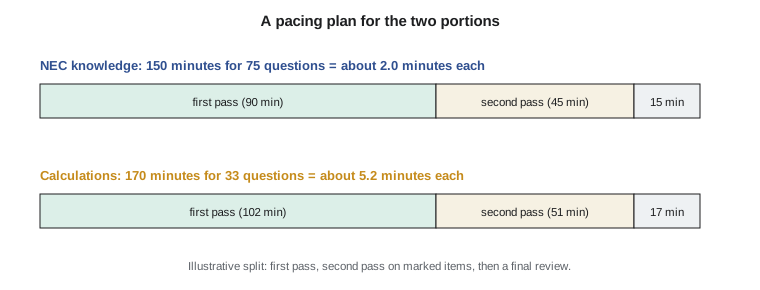
The night before, put your identification, code book, calculator and the exam confirmation in one bag, and check the book page by page for loose papers or notes. Sleep. On the morning, eat, drink water and arrive early. When the knowledge portion starts, write your pacing targets on the electronic notepad: about two minutes per question, with checkpoints at questions 19, 38 and 56. Make a first pass answering everything you can find quickly and marking the rest. Use the second pass for marked questions. In the last few minutes, make sure nothing is blank. On the calculations portion, allow about five minutes per question, work every problem with the full method, and check units before choosing an answer. Change an answer only when you find the section that proves it wrong.
Manage stress deliberately. A run of hard questions early does not mean you are failing; the scored and unscored questions are mixed, and difficulty varies. If you feel panic rising, put the pencil down, take three slow breaths, and read the next question from the beginning. Rosa's practice runs taught her that her worst stretch of questions was usually followed by an easy one.
The calculator below turns practice results into a readiness check: it computes each portion's score, flags anything below 75 as not yet comfortable, and estimates the minutes per question you used. Change the numbers after each practice run.
runs = [  # (portion, correct, scored, minutes used, minutes allowed)
    ("Knowledge", 59, 70, 138, 150),
    ("Calculations", 24, 30, 160, 170),
]
for name, right, scored, used, allowed in runs:
    score = right / scored * 100
    pace = used / scored
    comfort = "comfortable" if score >= 75 else "not yet comfortable"
print(f"{name}: {score:.1f} out of 100, {pace:.1f} min per question, {comfort}")Knowledge: 84.3 out of 100, 2.0 min per question, comfortable Calculations: 80.0 out of 100, 5.3 min per question, comfortable
After the exam
Rosa passed both portions on her first attempt. Her license appeared on TDLR's license search about a week later. Lupe filed the master of record change, signed by Rosa and by Walt as the company's owner, and sent letters to the cities where Pecan Creek had open permits. Walt stayed on for another year as an electrician and advisor, then retired. Rosa completed her first four hours of continuing education as a master the following spring, choosing a package on 2026 NEC changes, and started the first quarterly license audit of her own crew. The exam was the end of one process and the beginning of a job.
Common mistakes
MistakeCramming new topics the night before.
InsteadUse the last week for review of your miss log, the law summary and light timed practice.
MistakeLeaving questions blank when time runs short.
InsteadA blank is always wrong; make a reasoned guess on every question.
MistakeChanging answers on a hunch.
InsteadChange an answer only when you find the section that proves the first answer wrong.
MistakePracticing calculations without units.
InsteadWrite units at every step; unit errors are a common source of wrong choices.
MistakeForgetting the one-year window after a failed portion.
InsteadBook the retake promptly and keep it well inside the window.
Summary and key terms
- Review the Texas law points on one page: statute, rules, eligibility, exam, code adoption, permits, master duties, contractors, liens, safety and renewal.
- Work calculation problems with a fixed method: givens with units, the section or formula, clear steps, a unit check, then the choices.
- Common calculation errors are the wrong edition, early rounding, missed continuous loads and nameplate values used where tables are required.
- A twelve-week plan with timed practice in the real two-portion format fits comfortably inside the one-year window.
- On test day, pace by checkpoints, make two passes, leave nothing blank and change answers only with proof.
- After passing, file the master of record change and notify the cities where the company works.
- Miss log
- A record of every practice miss and its cause, used to target study.
- First pass
- Answering every question that can be found quickly, marking the rest.
- Checkpoint
- A planned point to compare progress with the time remaining.
- Continuous load
- A load expected to run for three hours or more.
- Standard rating
- One of the overcurrent device ratings listed in the code.
- Readiness check
- A comparison of practice scores and pace with passing targets.
Practice problems
Work each problem on paper first, then reveal the answer to check.
A 208Y/120 volt three-phase feeder carries 75 kVA. Find the current.
Show answer
75,000 ÷ (1.732 × 208) = 75,000 ÷ 360.3 ≈ 208 A.
A continuous load is 24 A. Using 1.25 times the continuous load, what minimum overcurrent rating results before rounding?
Show answer
24 × 1.25 = 30 A.
Compute the voltage drop for 20 A, 100 ft one way, copper K = 12.9, and an illustrative 6,530 circular mils.
Show answer
2 × 12.9 × 20 × 100 ÷ 6,530 ≈ 7.9 V.
How many minutes per question does the reported calculations portion allow?
Show answer
170 ÷ 33 ≈ 5.2 minutes.
Name three law facts you should be able to state from memory.
Show answer
Two years as journeyman plus 12,000 hours; 70 out of 100 on each portion; thirty business days to replace a master of record (among others).
Lesson quiz · 5 questions
Score 60% or more to complete this lesson.
Create a free account to save your progress, take quizzes and earn a certificate.