
MELU-318 · Lesson 3 of 12 · 19 min
Applying, approval and booking the exam
▶ Video coming soon A video version of this lesson is on the way.
With the eligibility questions settled, Lupe laid out the application on the conference table in the order TDLR wants it: the Master Electrician License Application form, the Experience Verification Forms from Walt Henley and Bill Esparza, and a check for the application fee. Rosa wanted to scan everything and upload it, the way she renews her journeyman license each year. Lupe pointed to a line on TDLR's page: the initial master application must be made by mail. This lesson walks through the application, what happens at TDLR after it arrives, how the approval notice works, how to book the exam with the testing vendor, what to bring on exam day, and what happens if a portion has to be retaken.
The details here were checked against TDLR's master application and examination pages in November 2026. Fees, forms, addresses and testing procedures change. Before mailing anything or paying anything, open the current TDLR pages and the current candidate information bulletin, and follow them where they differ from this lesson.
Step 1: complete the application
The Master Electrician License Application is a fillable form published on TDLR's website. It asks for the applicant's identifying information, contact information, the journeyman license number, answers to questions about criminal history and other eligibility matters, and the applicant's signature. It comes with one Experience Verification Form attached; the applicant makes a copy for each additional supervising master. Every form must be complete and signed. An unsigned verification form, a missing date range or an illegible license number is a common reason for delay, because TDLR must write back and wait for the missing piece.
Rosa filled in her form at home, then had Lupe check it against the instructions. Lupe has a habit worth copying. Before sealing any envelope to a state agency, she makes a complete copy of every page, writes the mailing date on the copy, and files it. If anything goes missing in the mail or at the agency, Pecan Creek can send a duplicate the same day. She also notes the applicant's journeyman license number and expiration date on the file cover, because an applicant whose journeyman license lapses during the process creates a new problem.
Step 2: mail it with the fee
TDLR's page says the initial license application must be made by mail. As checked in November 2026, the application fee was 45 dollars and non-refundable, and the mailing address was the Texas Department of Licensing and Regulation, PO Box 12157, Austin, Texas 78711-2157. The fee covers the application only; the exam fee is paid separately to the testing vendor. Non-refundable means exactly that: if TDLR cannot approve the application because a requirement is not met, the fee is gone. That is one more reason to resolve doubts about eligibility before filing.
Rosa mailed her application on a Monday in early December using a mailing method that shows delivery. The one-year window from Lesson 2 started when TDLR received it, not when she mailed it. Lupe wrote the delivery date on the file cover and set a reminder ten months later, as a safety net in case anything stalled.
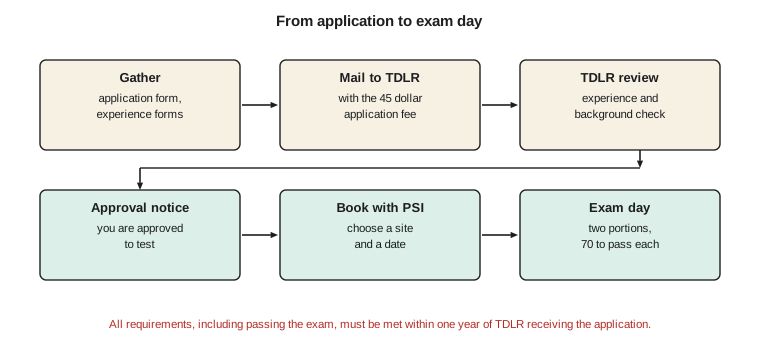
Step 3: TDLR reviews the application
When the application arrives, TDLR checks it for completeness, confirms the journeyman license and how long it has been held, reviews the Experience Verification Forms, and runs the criminal history background check described in Lesson 2. If something is missing or unclear, TDLR sends a deficiency notice explaining what it needs. Processing times vary with the season and the agency's workload; TDLR posts general information about processing on its website, and applicants can check the status of an application online. A deficiency notice does not stop the one-year clock, so answering quickly matters.
Rosa's application went through without a deficiency, but Marisol, from her study group, received a notice asking her supervising master to correct the dates on her verification form, which overlapped with a period when he had not yet been her company's master of record. It took three weeks to get a corrected form signed and returned. Her lesson for the group: make sure each master signs only for dates when he was actually your supervisor, and that the date ranges on different forms do not overlap or leave unexplained gaps.
Step 4: the approval notice
When TDLR verifies the application, it notifies the applicant that he is approved to take the licensing examination. The notice explains how to schedule with the testing vendor. Keep it; you will need the information on it when you book. The approval is not a license. Until the exam is passed and TDLR issues the license, the applicant is still a journeyman and cannot serve as a master of record.
Step 5: book the exam with PSI
TDLR uses PSI, a third-party testing vendor, to give the electrician exams. TDLR's examination page lists the cities with testing sites, including Abilene, Amarillo, Arlington, Austin, Corpus Christi, Dallas, El Paso, Fort Worth, Harlingen, Houston, Lubbock, McAllen, Midland, San Antonio, Tyler and Waco. The candidate books a date and site through PSI, online or by phone, and pays the exam fee to PSI at that time. As reported by exam prep providers citing the September 2026 PSI bulletin, the master exam fee was 78 dollars for both portions, and a retake of one or both portions cost another 78 dollars. Confirm the fee in the current bulletin before you book.
Rosa chose the San Antonio site, about forty minutes from Pecan Springs, and booked a Saturday morning slot nine weeks after her approval. She picked a morning because her practice scores were consistently higher in the morning than after a day on a job site. She also checked the bulletin's rules on rescheduling and cancellation, which require notice a set number of days ahead to avoid losing the fee, and she put that deadline on her calendar too.
| Item | Who receives it | Amount or detail (as checked November 2026) |
|---|---|---|
| Master application | TDLR, by mail | 45 dollar non-refundable fee |
| Exam booking | PSI, online or by phone | About 78 dollars for both portions, per reports of the bulletin |
| Retake of one or both portions | PSI | Another exam fee for each attempt |
| License issuance | TDLR | After a passing result; check TDLR for any issuance steps |
| Deadline | TDLR | All requirements within one year of receipt |
Step 6: exam day logistics
The candidate information bulletin sets the rules for exam day, and candidates who ignore it can be turned away. In general terms, candidates arrive early, present acceptable government-issued photo identification that matches the name on the registration, store personal belongings outside the testing room, and bring only the permitted reference and permitted calculator. For the Texas electrician exams the reference is the NEC, and TDLR's page says the exam is open book, the candidate must bring his own copy, any soft-bound edition of the adopted code may be used, and loose-leaf, spiral-bound and ring-bound copies are not allowed. Lesson 4 covers the reference and calculator rules in detail, including which tabs are allowed.
Rosa packed the night before: her driver's license, her soft-bound 2026 NEC with only permitted tabs, a calculator she had confirmed met the bulletin's rules, and nothing else. She did not bring notes, a highlighted cheat sheet or a phone into the building. Walt told her about a candidate years ago who lost his exam fee because a page of handwritten formulas was tucked inside the cover of his code book. Inspect your book page by page before you leave home.
Testing accommodations
A candidate with a disability or another qualifying condition can ask for testing accommodations, such as extra time, a separate room or a reader, under the procedures described in the candidate information bulletin. Requests generally must be made in advance, with supporting documentation, and approved before the exam is booked, so they take time. Hector, from Rosa's study group, has a hearing impairment and arranged his accommodation request through the process the bulletin describes weeks before he booked. If you think you may need an accommodation, read that section of the bulletin as soon as you are approved to test, not the week before the exam.
Applicants licensed in other states
Texas has provisions for electricians licensed in other states, and TDLR publishes a separate page about transferring an out-of-state license. In general, whether another state's license can be used depends on agreements between Texas and that state and on how that state's requirements compare with Texas requirements, and the details change. An applicant coming from another state should read that page and, if it does not answer his question, contact TDLR before filing. The general master application described in this lesson is the path for Texas journeymen like Rosa.
Keeping the business running during the process
While Rosa's application worked its way through TDLR, Pecan Creek's business did not change. Walt remained the master of record, permits continued to be pulled under the company's contractor license as before, and Rosa continued to work as a journeyman. That is the right way to do it. An approved applicant is not a master, and a company cannot list an applicant as its master of record. Lupe used the waiting weeks to prepare the paperwork Pecan Creek would need later: the master of record change form, an updated insurance certificate naming the company correctly, and a list of the cities where Pecan Creek pulls permits, several of which keep their own records of each contractor's master and would need to be told about the change.
Walt also used the time to start handing Rosa responsibilities that a master carries. She began reviewing permit applications before Lupe submitted them, sitting in on final inspections with Darnell Price, the Pecan Springs chief electrical inspector, and checking apprentice registrations. None of that required a master license, and all of it made her a better candidate. Several law questions on the exam become easier when you have watched a master handle the paperwork for real.
Results, retakes and the license
Results are generally reported to the candidate after the exam, according to the procedures in the bulletin, and PSI reports scores to TDLR. TDLR's page says candidates may retake each exam as many times as needed until they pass, but may have to pay another exam fee with each attempt. Under the current two-portion format described in Lesson 4, a candidate who passes one portion and fails the other generally retakes only the portion he failed; confirm the rule for how long a passed portion remains valid in the current bulletin. Every retake must still fit inside the one-year window.
After a passing result, TDLR issues the Master Electrician license according to its procedures. Rosa's plan was that, once her license appeared on TDLR's online license search, Pecan Creek would file the form to change its master of record from Walt to Rosa, signed by both Rosa and the company's owner. Lesson 7 covers that change and its deadline.
The calculator below works backward from an exam date to the steps that must happen first. Change the dates to fit your own schedule. It is a planning aid, not a statement of TDLR processing times, which vary.
from datetime import date, timedelta

received = date(2026, 12, 8)           # date TDLR received the application
window_ends = received + timedelta(days=365)
approval_expected = received + timedelta(weeks=6)   # illustrative; check TDLR status online
exam_day = date(2027, 3, 13)
retake_buffer = timedelta(weeks=6)

print("Window ends:", window_ends)
print("Approval expected about:", approval_expected)
print("Exam day:", exam_day)
latest_retake = exam_day + retake_buffer
print("A retake six weeks later would be:", latest_retake,
"(inside window)" if latest_retake <= window_ends else "(outside window!)")Window ends: 2027-12-08 Approval expected about: 2027-01-19 Exam day: 2027-03-13 A retake six weeks later would be: 2027-04-24 (inside window)
Common mistakes
MistakeUploading the initial master application online.
InsteadTDLR's page says the initial master application must be made by mail.
MistakePaying the exam fee to TDLR with the application.
InsteadThe application fee goes to TDLR; the exam fee is paid to PSI when booking.
MistakeIgnoring a deficiency notice until after the holidays.
InsteadThe one-year window keeps running while TDLR waits for missing documents.
MistakeBringing a spiral-bound or loose-leaf NEC.
InsteadTDLR allows soft-bound editions only; loose-leaf, spiral and ring bindings are not allowed.
MistakeTreating the approval notice as permission to act as a master.
InsteadThe license is issued only after the exam is passed; until then the applicant is still a journeyman.
Summary and key terms
- The initial master application is mailed to TDLR with a non-refundable application fee.
- TDLR reviews the forms and background and either sends a deficiency notice or an approval to test.
- Candidates book the exam and pay the exam fee to PSI, choosing a site and date.
- The candidate information bulletin controls identification, reference, calculator and rescheduling rules.
- A failed portion can be retaken for another fee, but all requirements must be met within one year.
- After passing, TDLR issues the license and the contractor can file a master of record change.
- Deficiency notice
- TDLR's letter asking for missing or corrected information in an application.
- Approval to test
- TDLR's notice that an applicant may schedule the licensing exam.
- Candidate information bulletin
- The testing vendor's document with the exam's content, rules, fees and procedures.
- PSI
- The testing vendor that schedules and administers the Texas electrician exams.
- Retake
- Another attempt at a failed exam or portion, with another exam fee.
- Non-refundable fee
- A fee that is not returned even if the application is not approved.
Practice problems
Work each problem on paper first, then reveal the answer to check.
Where does the 45 dollar master application fee go, and is it refundable?
Show answer
To TDLR with the mailed application; it is non-refundable.
To whom does a candidate pay the exam fee?
Show answer
To PSI, when booking the exam.
A candidate's application was received on January 10, and he fails one portion on December 20. What constraint does he face?
Show answer
He must retake and pass before the one-year window closes about January 10, so he has only a few weeks.
Name three things the bulletin usually controls on exam day.
Show answer
Acceptable identification, the permitted reference and calculator, and arrival, rescheduling and cancellation rules.
Why should each supervising master sign only for his own dates?
Show answer
Overlapping or wrong dates cause deficiency notices and could be false statements to TDLR.
Lesson quiz · 5 questions
Score 60% or more to complete this lesson.
Create a free account to save your progress, take quizzes and earn a certificate.