
MELU-318 · Lesson 5 of 12 · 20 min
The NEC as adopted in Texas and state amendments
▶ Video coming soon A video version of this lesson is on the way.
On the first Monday of September 2026, Darnell Price, the chief electrical inspector for the City of Pecan Springs, sent every contractor on his list a short email. As of September 1, it said, permit applications would be reviewed under the 2026 National Electrical Code, with the city's local amendments, and permits issued before that date would continue under the 2023 code. Rosa forwarded it to her study group with a one-line question: which code do we study, and which code do we wire to? This lesson answers both. It covers how Texas adopts the NEC as its state electrical code, the 2023 and 2026 adoptions, the limited exception in the 2026 adoption, which edition applies to a given job, how cities adopt local amendments, and how all of this shows up on the exam.
The legal sources here were checked in November 2026: TDLR's compliance guide, TDLR's announcement of the commission's September 2026 rule adoption, and published notices from Texas cities. The details of local amendments vary from city to city and change often. Treat the examples in this lesson as examples and read the actual ordinance of any city where you work.
How the NEC becomes the Texas electrical code
The NEC is written by the National Fire Protection Association and published every three years as NFPA 70. It has no legal force on its own; it becomes law when a government adopts it. Texas does this at the state level through the electricians program. Chapter 1305 of the Occupations Code makes the NEC, as adopted under the chapter, the electrical code for the state, and the commission names the specific edition by rule in 16 TAC Chapter 73. The relevant rule is section 73.100. When NFPA publishes a new edition, the commission goes through the normal rulemaking process: TDLR proposes an amended rule, publishes it in the Texas Register, accepts public comment, and the commission adopts it with an effective date.
The statewide adoption sets the baseline for everyone. A city can amend the code locally, as discussed below, but there is always a state code that applies, including in unincorporated areas where no city exists. That is a key difference from many states where, outside cities, the electrical code depends on county choices or on nothing at all.
The 2023 adoption
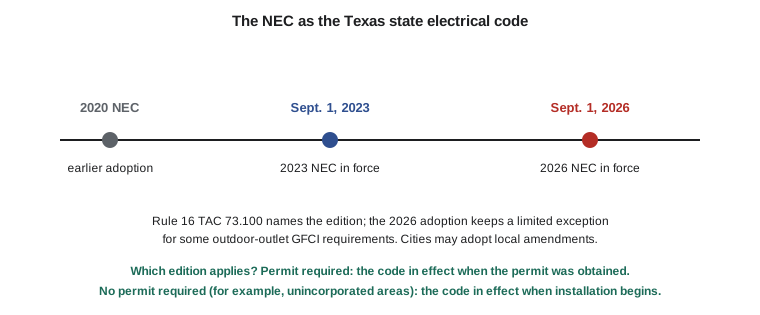
TDLR's compliance guide states that Texas adopted the 2023 edition of the NEC effective September 1, 2023, with the adoption covering the code as it existed on August 25, 2022, which is the date NFPA issued that edition. Rosa wired the first three years of the Bluebonnet Ridge subdivision under the 2023 code, and permits issued for those homes before September 1, 2026 continue under it until they are finaled.
The 2026 adoption and its limited exception
In 2026 the commission amended 16 TAC section 73.100 to adopt the 2026 NEC as the state electrical code. TDLR's rulemaking announcement, posted September 1, 2026, says the amendment adopts the 2026 edition with a limited exception for ground-fault circuit-interrupter requirements for certain outdoor outlets, and gives September 1, 2026 as the effective date; the adoption justification was published in the Texas Register on August 28, 2026. Read the rule itself for the exact scope of the exception, because the announcement describes it only in general terms. On the exam, a question about the exception is more likely to ask whether Texas adopted the code with any exception at all than to quote its wording.
The 2026 NEC is a significant revision. As the MELU core courses describe, load calculations moved from Article 220 to the new Article 120, energy management moved to Article 130, medium-voltage material was gathered into Articles 265 through 270, Chapter 8 material was largely folded into Chapter 7, and a number of articles were renumbered or retitled. For a candidate who learned the 2023 code, the renumbering is the biggest practical change: section numbers that were second nature are now in different places. Rosa spent her first study week building a personal list of moved articles, checking each one against her new code book rather than relying on anyone's summary.
Which edition applies to a job?
The arrival of a new edition raises a practical question: what about jobs already underway? TDLR's compliance guide gives the state rule. Where a permit is required, the code in effect when the permit was obtained applies. Where no permit is required, as in many unincorporated areas, the code in effect on the day the installation begins applies. Cities generally follow the same idea for their own permits, and Darnell's email reflected it: applications submitted on or after the effective date are reviewed under the new code, while work under earlier permits continues under the code in effect when those permits were issued. The City of Houston published a similar notice, saying all permit applications submitted on or after the state-mandated effective date of September 1, 2026 would be reviewed under the new state minimum electrical code.
Worked problem
Which code applies?
Pecan Creek has three jobs in September 2026. Job A is a house at Bluebonnet Ridge permitted in Pecan Springs on August 20, 2026. Job B is a taqueria remodel whose permit application was submitted on September 3, 2026. Job C is a barn on a ranch in an unincorporated part of the county with no electrical permit, where the crew starts work on September 10, 2026. Which edition applies to each?
Show solution
- Job A: permit obtained before September 1, 2026, so the 2023 NEC applies, with the city's amendments to that edition.
- Job B: application on or after September 1, 2026, so the 2026 NEC applies, with the city's current amendments.
- Job C: no permit required; installation began September 10, 2026, after the effective date, so the 2026 NEC applies.
Answer: A: 2023 NEC. B: 2026 NEC. C: 2026 NEC.
Local amendments
Cities may amend the state electrical code locally. Texas law that applies to municipalities treats the NEC adopted under Chapter 1305 as the electrical code in cities and allows a city to establish its own procedure to adopt local amendments; Section 214.214 of the Local Government Code is the provision usually cited. Large Texas cities such as Houston, Dallas, San Antonio, Austin and Fort Worth adopt local amendments with each new edition, and many suburbs adopt regional amendments developed through councils of governments. For example, the City of Fort Worth published a draft of its local amendments to the 2026 NEC for public review in 2026.
Local amendments typically address things like the wiring methods allowed in certain buildings, the size of service equipment that must be accessible to the fire department, requirements for surge protection or arc-fault protection, and administrative matters such as permits and inspections. Some amendments make the code stricter, and some relax a requirement the city considers unnecessary. For a contractor, the practical rule is simple: before bidding a job in a city, get that city's current amendments and read them with the code. Pecan Creek keeps a folder of amendments for every city where it works, updated whenever an inspector announces a change.
For the exam, local amendments matter mostly as a concept. The exam is written to the NEC as adopted by the state, not to any city's amendments, so a question that asks what the code requires is answered from the NEC itself. Questions about amendments are more likely to ask who may adopt them, or which code governs when a city has adopted one, than to test a particular city's text.
| Situation | Code that applies | Where to check |
|---|---|---|
| City permit obtained before Sept. 1, 2026 | 2023 NEC plus that city's amendments to it | Permit date and city ordinance |
| City permit applied for on or after Sept. 1, 2026 | 2026 NEC plus the city's current amendments | City notice of adoption |
| No permit required, work begun before Sept. 1, 2026 | 2023 NEC | Date installation began |
| No permit required, work begun on or after Sept. 1, 2026 | 2026 NEC, with the state's limited exception | 16 TAC 73.100 |
| The licensing exam after the 2026 adoption | 2026 NEC | TDLR examination page |
Working under two editions at once
For a year or more after a new edition takes effect, a busy contractor works under two codes at the same time. In the fall of 2026 Pecan Creek had eleven open permits issued under the 2023 code and new jobs starting under the 2026 code, sometimes on adjacent lots in the same subdivision. Walt's rule for the crews was to put the edition on every job folder in large letters and to keep both code books in the truck. Lupe added the edition to the permit log, so that anyone answering an inspector's question could check which book to open. Rosa found the habit useful for her studying too: every time a crew asked her a code question, she looked up the answer in both editions and noted whether the section had moved.
Inspectors handle the transition the same way. Darnell told Rosa that the most common problem he saw in the first months was not wrong work but wrong citations: contractors arguing a correction notice using the section number from the other edition. On a job permitted under the 2023 code, the 2023 section governs, and on a 2026 job, the 2026 section, even when the requirement itself did not change. A master who keeps the editions straight saves everyone time at the final inspection.
Other codes you will meet
The NEC is not the only code on a Texas job. Cities adopt building codes, usually editions of the International Building Code and the International Residential Code with local amendments, and the IRC contains its own electrical chapters that some cities use for one- and two-family dwellings. Fire codes affect fire alarm systems and emergency power. The Texas Department of Insurance licenses fire alarm work separately, and low-voltage work such as security and access control falls under a separate licensing program as well. The exam focuses on the NEC and the electricians law, but a master of record needs to know when another code or another license is involved, because doing work outside the electrical license's scope or ignoring a city's building code amendments can cost a permit and a customer.
Energy codes matter too. Many Texas cities adopt an edition of the International Energy Conservation Code, which affects lighting power, controls and some electrical design choices on commercial jobs. Rosa learned this the hard way on a small office fit-out when the plan reviewer asked for occupancy sensor details she had not shown. It was not an NEC question, but it delayed the permit by a week.
How the code edition shows up on the exam
Three kinds of questions test this lesson. Direct questions ask which edition Texas has adopted, which rule names it, or when it took effect. Applied questions describe a permit date or an installation start date and ask which edition governs. Code questions, the large majority, simply ask what the code requires, and the answer must come from the adopted edition, which after September 1, 2026 is the 2026 NEC. The worst mistake a candidate can make is answering a code question from memory of the 2023 section numbers. Rosa's renumbering list and her new tabs were her defense.
The calculator below applies the which-edition rule to a list of jobs. Add your own jobs, with the permit date or the date installation began, and see which edition applies to each.
from datetime import date

CHANGE = date(2026, 9, 1)

def edition(permit_date=None, start_date=None):
    key = permit_date if permit_date else start_date   # permit date governs when a permit is required
    return "2026 NEC" if key >= CHANGE else "2023 NEC"

jobs = [("Bluebonnet Ridge lot 41", date(2026, 8, 20), None),
        ("Riverside Taqueria remodel", date(2026, 9, 3), None),
        ("Ranch barn, no permit", None, date(2026, 9, 10)),
        ("Feed store service, no permit", None, date(2026, 8, 28))]
for name, permit, start in jobs:
print(f"{name}: {edition(permit, start)}")Bluebonnet Ridge lot 41: 2023 NEC Riverside Taqueria remodel: 2026 NEC Ranch barn, no permit: 2026 NEC Feed store service, no permit: 2023 NEC
Common mistakes
MistakeStudying for the post-2026 exam with the 2023 NEC.
InsteadTDLR's examination page references the 2026 edition after the adoption.
MistakeApplying the 2026 code to work under a permit issued in August 2026.
InsteadWhere a permit is required, the code in effect when the permit was obtained applies.
MistakeAssuming unincorporated areas have no electrical code.
InsteadThe state electrical code applies statewide; only permits and inspections may be absent.
MistakeAnswering an exam code question from a city's amendments.
InsteadThe exam tests the NEC as adopted by the state, not any city's local amendments.
MistakeRelying on memorized 2023 section numbers.
InsteadThe 2026 NEC moved and renumbered many articles, such as load calculations to Article 120.
Summary and key terms
- Texas adopts the NEC as its state electrical code by rule in 16 TAC section 73.100.
- The 2023 NEC took effect September 1, 2023; the 2026 NEC took effect September 1, 2026.
- The 2026 adoption includes a limited exception for GFCI requirements for certain outdoor outlets.
- With a permit, the code in effect when the permit was obtained applies; without one, the code in effect when work begins.
- Cities may adopt local amendments through their own procedures; read them before bidding.
- The licensing exam follows the state-adopted edition, now the 2026 NEC.
- Adoption
- The legal act that makes an edition of a model code enforceable law.
- 16 TAC 73.100
- The Texas rule that names the edition of the NEC adopted as the state electrical code.
- Local amendment
- A city's change to the state electrical code, adopted through the city's own procedure.
- Effective date
- The date an adopted code edition begins to apply.
- Texas Register
- The state publication where proposed and adopted rules appear.
- Renumbering
- The relocation of code sections to new numbers in a new edition.
Practice problems
Work each problem on paper first, then reveal the answer to check.
Which Texas rule names the adopted edition of the NEC?
Show answer
16 TAC section 73.100.
A city permit was issued on August 31, 2026. Which edition governs the work?
Show answer
The 2023 NEC, with that city's amendments to it.
A crew begins wiring a barn in an unincorporated area with no permit on September 2, 2026. Which edition governs?
Show answer
The 2026 NEC, because installation began after the effective date.
Who may adopt local amendments to the state electrical code?
Show answer
Cities, through their own adoption procedures.
Where did load calculations move in the 2026 NEC?
Show answer
From Article 220 to Article 120.
Lesson quiz · 5 questions
Score 60% or more to complete this lesson.
Create a free account to save your progress, take quizzes and earn a certificate.