
MELU-316 · Lesson 9 of 12 · 22 min
Contracts and mechanics' liens in South Dakota
▶ Video coming soon A video version of this lesson is on the way.
Coteau Ridge Electric has filed exactly four mechanics' liens in thirty years. Dale Vermeer remembers each one, and each one started with a contract that was too short and a customer who stopped answering the phone. The worst was a strip mall tenant finish in 2009, where the general contractor went under and the owner said he had already paid. Dale got paid in the end, but only because the lien statement went to the register of deeds on day 117 of the 120 the statute allows. This lesson covers the contract habits that make liens rare, and the South Dakota lien law in SDCL chapter 44-9, titled Mechanics' and Materialmen's Liens, for the times when they are needed.
Contracts first
Most payment disputes are contract disputes that a better contract would have prevented. A good electrical contract, even a one-page proposal signed by a homeowner, names the parties and the property; describes the scope of work and what is excluded; states the price or the basis for it, such as time and materials with rates; sets payment terms and any retainage; explains how changes will be priced and approved in writing; addresses delays, permits and inspections and who pays for them; allocates responsibility for utility charges and utility work; and says what happens if either side does not pay or does not perform. On commercial jobs, the subcontract usually comes from the general contractor and includes insurance, indemnity and schedule terms that need careful reading.
Two time limits from South Dakota's general law frame contract claims. SDCL 15-2-13 gives six years to sue on a contract. SDCL 15-2A-3 is a statute of repose: no action for a defect in the design, construction or inspection of an improvement may be brought more than ten years after substantial completion, with limited extensions for injuries discovered late, and exceptions for fraud and for longer express warranties. Those limits matter for warranty claims long after a job is closed.
Worked problem
A change order that never got signed
On a Brookings restaurant remodel, the owner asked Marit's crew to add six circuits for new kitchen equipment. Nobody wrote it down. The contract says changes must be approved in writing. When the invoice arrives, the owner refuses to pay for the extra circuits.
Show solution
- The contract required written approval, so the missing change order gives the owner an argument.
- Coteau Ridge can still show the work was requested and performed: texts from the owner, the foreman's daily log, inspection records for the added circuits.
- The extra work is part of the improvement, so it can be included in a lien statement if the claim is otherwise valid.
- A signed one-line change order on the day of the request would have avoided the dispute.
Answer: Coteau Ridge has a claim, but a weaker one than it needed to be. Since that job, every foreman carries a pad of change order forms and gets a signature before starting added work.
Who has a lien
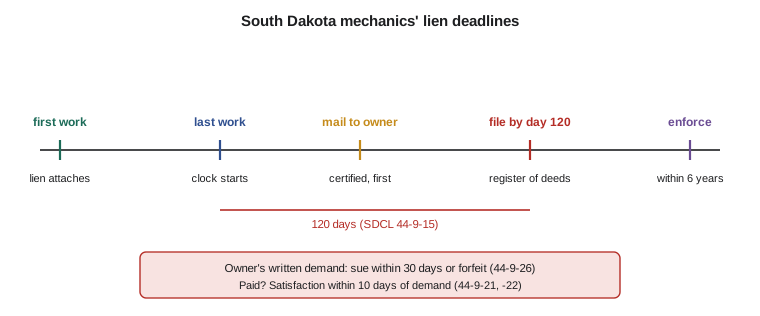
SDCL 44-9-1 gives a lien to those who furnish labor, skill or materials, including equipment and services, for the improvement of real property under a contract with the owner or with a contractor or subcontractor. An electrical contractor working for the owner, an electrical subcontractor working for a general contractor, and a supplier selling to either all fall within it. The lien is on the property improved, and SDCL 44-9-7 says it attaches from the time the first item of labor or material is furnished, taking priority over later-recorded encumbrances unless the claimant had actual notice of them. SDCL 44-9-8 protects a good-faith purchaser or lender without notice: against them, the lien does not attach before the actual and visible beginning of the improvement, unless a statement of the contract has been filed with the register of deeds.
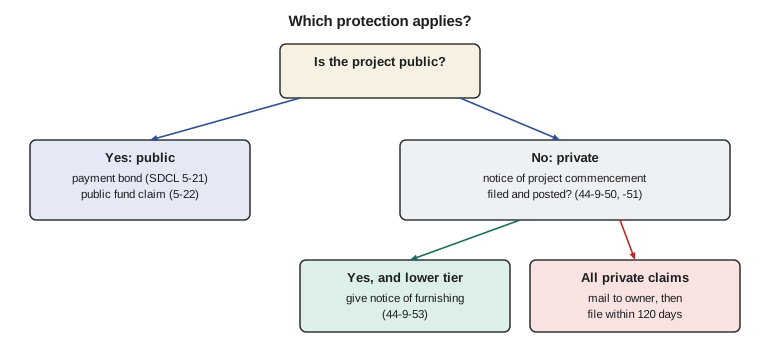
Liens do not attach to public property. Work for a school district, city, county or the state is protected instead by bonds under SDCL chapter 5-21 and by claims against public funds under SDCL chapter 5-22, covered later in this lesson.
Filing the lien statement
SDCL 44-9-15 is the deadline that matters most. The lien ceases unless the claimant files a verified lien statement with the register of deeds of the county where the property is located within 120 days after doing the last work or furnishing the last materials. SDCL 44-9-16 lists what the statement must contain, including the amount claimed, the dates of the first and last labor or materials, a description of the property, the owner's name and an itemized account, verified by oath. SDCL 44-9-17 adds a condition that must come first: before filing, the claimant mails a copy of the statement to the owner at the owner's last known address by registered or certified mail, and attaches the mailing receipt to the statement when filing it.
The last day of work is the date to watch. Small return trips to finish punch-list items may or may not extend the date, depending on whether they were part of the contract work or trivial corrections; courts look at the facts. Do not count on a warranty call to restart the clock. Track the last substantial work and file well before day 120.
| Step | Rule | Source |
|---|---|---|
| Lien attaches | From the first item of labor or material | SDCL 44-9-7 |
| Mail to owner | Copy of the statement by registered or certified mail, before filing; attach receipt | SDCL 44-9-17 |
| File statement | With the register of deeds within 120 days after last work or materials | SDCL 44-9-15 |
| Owner demand | Suit within 30 days after written demand, or the lien is forfeited | SDCL 44-9-26 |
| Enforce | Within 6 years after the last item in the statement | SDCL 44-9-24 |
| Satisfy | Execute satisfaction within 10 days of written demand after payment | SDCL 44-9-21, 44-9-22 |
Notices during the job
South Dakota does not require a general preliminary notice from every claimant. SDCL 44-9-10 gives a claimant that contracted with the contractor a way to protect itself during the job: it may serve the owner with a sworn account and notice of its claim, after which the owner may withhold enough from payments to the contractor to cover it. Under SDCL 44-9-11 the owner gives a copy to the contractor, and if the contractor does not dispute the claim in writing within fifteen days, the contractor is treated as agreeing to it. For an electrical subcontractor that suspects a general contractor is slow-paying, this is a strong tool.
A separate notice applies only on projects where the owner has chosen to file and post a notice of project commencement under SDCL 44-9-50 and 44-9-51. On those projects, SDCL 44-9-53 requires certain lower-tier claimants, such as subcontractors of subcontractors, suppliers to subcontractors and laborers, to give a notice of furnishing to preserve lien rights, and a secondary source describes the deadline as no later than sixty days after last furnishing. The section has details and exemptions this course did not verify in full; on any job where a notice of project commencement is posted, read SDCL 44-9-53 or ask counsel before relying on lien rights.
Enforcing, forfeiting and releasing
SDCL 44-9-24 gives six years after the date of the last item in the lien statement to bring an action to enforce it; after that, the owner may file an affidavit and the register of deeds cancels the lien. Owners can shorten the time. Under SDCL 44-9-26, the owner, the contractor or their agent may serve a written demand on the claimant to start suit, and the claimant must sue within thirty days or forfeit the lien; the owner may then file an affidavit to have it canceled no sooner than the fortieth day after service. When a claimant starts suit, SDCL 44-9-28 requires filing notice of the pending action with the register of deeds.
When the claimant is paid, SDCL 44-9-21 requires a satisfaction to be executed and delivered, and under SDCL 44-9-22 a lienholder who fails to do so within ten days of a written demand is liable for damages, costs, attorney fees and an additional 100-dollar penalty. Coteau Ridge's practice is to send the signed satisfaction the day payment clears.
Chapter 44-9A addresses lien waivers by joint check, where a check is payable jointly to a contractor and its supplier and refers to a separate written waiver agreement. Lien waivers in general deserve care: a waiver signed for a progress payment should be limited to the amount actually paid. Finally, SDCL 44-9-49 says failure to comply with the lien chapter does not bar an ordinary civil action on the debt; a claimant who misses the 120 days loses the lien but can still sue on the contract.
# Lien deadline check for a stalled job (illustrative dates)
from datetime import date, timedelta
last_work = date(2026, 9, 18)
file_by = last_work + timedelta(days=120)
mail_target = file_by - timedelta(days=14)   # Coteau Ridge's own margin
print("Last work:", last_work)
print("Mail statement to owner (certified) by:", mail_target)
print("File with register of deeds by:", file_by)
print("Enforce within six years, by about:", date(last_work.year + 6, last_work.month, last_work.day))
demand_served = date(2027, 2, 1)
print("If owner serves a demand on", demand_served, "sue by", demand_served + timedelta(days=30))Last work: 2026-09-18 Mail statement to owner (certified) by: 2027-01-02 File with register of deeds by: 2027-01-16 Enforce within six years, by about: 2032-09-18 If owner serves a demand on 2027-02-01 sue by 2027-03-03
A lien is a serious step, and it changes a relationship. Before filing, Coteau Ridge sends a polite written demand for payment that names the amount, the job and the date the lien deadline falls. Many owners pay once they understand that a lien will cloud their title and complicate a sale or refinance. When an owner disputes part of the bill, the company files for the undisputed amount it can document, not an inflated number; a claimant who knowingly overstates a lien can face liability of its own.
Public projects
On public work, the electrical contractor looks to two protections. The first is the contractor's surety bond, which SDCL 5-21 requires on public improvement contracts in an amount not less than the contract price, with claim and suit timing set in that chapter. The second is a claim against public funds under SDCL 5-22, under which a claimant files a verified account with the public body and must act within the time the chapter sets after the work is accepted. Both run on short, specific clocks. On a public job, read the bond and the chapter at the start, not when payment stops.
Worked problem
Choosing the tool
Coteau Ridge is a second-tier subcontractor, working for a mechanical contractor, on two jobs: a private medical clinic in Brookings where the owner posted a notice of project commencement, and a county highway shop in Clear Lake.
Show solution
- Clinic: private, so a lien is available. Because a notice of project commencement was posted and Coteau Ridge is lower tier, check SDCL 44-9-53 and give the notice of furnishing on time.
- Clinic: if unpaid, mail the statement to the owner by certified mail, then file within 120 days of last work.
- Highway shop: public property, so no lien. Get the payment bond and track the 5-21 and 5-22 deadlines.
Answer: A lien with the 44-9-53 notice for the clinic; a bond claim and public fund claim for the county shop.
Common mistakes
MistakeFiling the statement and mailing the owner's copy afterward.
InsteadSDCL 44-9-17 requires mailing before filing, with the receipt attached.
MistakeCounting 120 days from the invoice date.
InsteadThe clock runs from the last work or materials furnished.
MistakeFiling a lien on a school.
InsteadPublic property is protected by bonds and public fund claims instead.
MistakeIgnoring an owner's written demand to sue.
InsteadThe lien is forfeited if suit is not started within thirty days.
MistakeHolding a satisfaction until the next job.
InsteadAfter payment and demand, delay beyond ten days risks damages, fees and a 100-dollar penalty.
Summary and key terms
- Good contracts prevent most disputes: scope, price, changes, payment and remedies in writing.
- Liens attach from the first work and must be filed within 120 days after the last work, with the owner mailed first.
- SDCL 44-9-10 lets a subcontractor serve a sworn account on the owner during the job.
- A notice of furnishing under 44-9-53 applies only where a notice of project commencement is posted.
- Enforce within six years, or within thirty days after a written demand.
- Public work uses surety bonds and public fund claims, not liens.
- Mechanics' lien
- A claim against improved real property for unpaid labor or materials.
- Register of deeds
- The county office where lien statements are filed.
- Project commencement notice
- An owner's filed and posted notice that triggers lower-tier notice duties.
- Satisfaction
- A document releasing a paid lien.
- Statute of repose
- A time limit that runs from substantial completion regardless of when a defect is found.
Practice problems
Work each problem on paper first, then reveal the answer to check.
Last work was March 3. What is the filing deadline?
Show answer
120 days later, July 1.
What must happen before filing?
Show answer
Mail a copy of the statement to the owner by registered or certified mail.
The owner serves a written demand to sue on May 1. What is the deadline?
Show answer
Thirty days, May 31.
Can Coteau Ridge lien a city fire station?
Show answer
No; it uses the payment bond and public fund claims.
How long to enforce a lien with no demand?
Show answer
Six years after the last item in the statement.
Lesson quiz · 5 questions
Score 60% or more to complete this lesson.
Create a free account to save your progress, take quizzes and earn a certificate.