
MELU-316 · Lesson 3 of 12 · 20 min
Applying, approval and booking the exam
▶ Video coming soon A video version of this lesson is on the way.
With her eligibility file complete, Marit Halvorsen was ready to apply. Dale Vermeer's advice was blunt: the application itself is easy, but every mistake on it costs a few weeks, and the ninety-day clocks that follow do not wait for anyone. This lesson follows the sequence from the application form to the testing center, and on to the steps between passing the exam and holding a license.
The sequence at a glance
South Dakota's process runs in a fixed order. The candidate applies to the State Electrical Commission with the application fee. The Commission reviews the experience and, if satisfied, sends written approval. The Commission then tells the International Code Council that the candidate is eligible. After a short delay the candidate schedules the exam through Pearson VUE, pays the testing fee and sits the exam within ninety days of approval. After passing, the candidate completes the licensing steps, including the undertaking, insurance and license fee, within ninety days. Each step has a document, a fee or a deadline attached, and the lesson takes them one at a time.
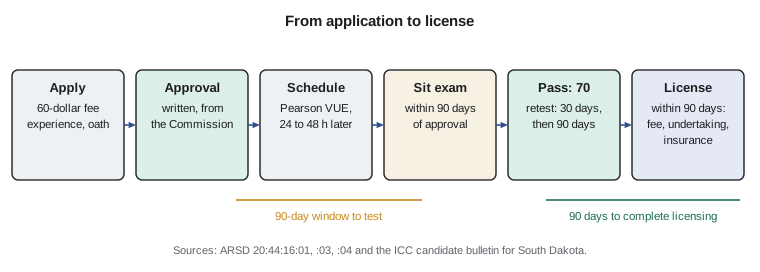
The application
The Commission's general license application is a fillable form posted on its forms page. It asks which license class the candidate is applying for, personal and contact details, the candidate's current South Dakota license numbers, and a full experience history with employers, dates, hours and the kind of work. It also asks the discipline and criminal history questions that SDCL 36-16-33 makes relevant, and it ends with the oath that SDCL 36-16-22 requires. A copy of a valid photo identification goes with it.
The application fee is set by ARSD 20:44:16:04 at 60 dollars for each license class applied for, and it is not refundable. SDCL 36-16-13 caps the application fee at 100 dollars and the examination fee at 150 dollars, so the rule amount sits below the statutory maximum. The Commission accepts payment as its forms and online services describe; its licensing page notes that online payment is by credit card, and that checks or money orders go by mail to the Pierre office.
Marit's application took one evening. She attached Joanne's hour summary and a one-page list of her commercial projects, signed the oath, and mailed it to the Commission with a check for the fee. Joanne put a reminder in the office calendar to call Pierre if no approval had arrived in three weeks.
| Item | Amount or rule | Source |
|---|---|---|
| Application fee | 60 dollars per class, not refundable | ARSD 20:44:16:04 |
| Statutory caps | Application 100 dollars; exam 150 dollars | SDCL 36-16-13 |
| Testing fee at Pearson VUE | 115 dollars in the August 2025 bulletin | ICC candidate bulletin |
| Time to sit the exam | Within 90 days of approval | ARSD 20:44:16:01; bulletin |
| Time to license after passing | Within 90 days | ARSD 20:44:16:01 |
| Contractor license fee | 200 dollars for the two-year term | ARSD 20:44:16:15 |
Approval in writing
The Commission's exam page is direct: a candidate may not take the exam without prior written approval. Approval is the Commission's finding that the candidate meets the experience rules for the class. The approval letter or email tells the candidate how to find a testing site and sit the exam, and it starts the ninety-day window. If the Commission needs more evidence, it asks before approving, and the window does not start until approval is given.
Once the Commission approves a candidate, it notifies the International Code Council that the candidate is eligible. The ICC's candidate bulletin for South Dakota asks candidates to wait 24 to 48 hours after approval before trying to schedule, so that the eligibility record reaches the scheduling system.
Scheduling with Pearson VUE
The ICC delivers South Dakota's electrical exams by computer at Pearson VUE test centers. The candidate creates or signs in to an ICC account, schedules through Pearson VUE's ICC page, chooses a test center and a date, and pays the testing fee, which the August 2025 bulletin lists as 115 dollars. Test centers in Sioux Falls and Rapid City are the usual choices for South Dakota candidates, and centers in neighboring states can also be used if they offer the exam; check the center list when scheduling. Arrive with the identification the bulletin requires and the approved reference books described in Lesson 4.
Marit plans to choose a Saturday morning seat in Sioux Falls, about an hour from Brookings, about seven weeks after the approval she expects, leaving room to reschedule once within the ninety days if she needs more study time or is sick.
The ninety-day window
The window matters because missing it is expensive. Under ARSD 20:44:16:01 the candidate must take the exam within ninety days of the approval notice, and the ICC bulletin adds that a candidate who misses the window must reapply to the Commission and pay the 60-dollar fee again. The window is also why scheduling early is wise. A candidate who waits until week ten to look for a seat may find the nearest centers full on the remaining dates.
# Ninety-day windows for Marit's plan (illustrative dates)
from datetime import date, timedelta
approval = date(2026, 12, 7)
exam_deadline = approval + timedelta(days=90)
planned_exam = date(2027, 1, 23)
print("Exam must be taken by:", exam_deadline)
print("Planned exam date:", planned_exam, "->", "inside window" if planned_exam <= exam_deadline else "too late")
license_deadline = planned_exam + timedelta(days=90)
print("If she passes that day, licensing steps due by:", license_deadline)Exam must be taken by: 2027-03-07 Planned exam date: 2027-01-23 -> inside window If she passes that day, licensing steps due by: 2027-04-23
Retakes
ARSD 20:44:16:03 sets the waiting periods after a failure. A candidate who fails may retest after thirty days. A candidate who fails the retest must wait ninety days before each later attempt. The ICC bulletin states the same rule. Results for the computer exam are available immediately at the test center, so a candidate knows the same day whether to plan a retake. A retake needs a new seat and a new testing fee; ask the Commission whether a new approval or application fee is also required in your case, especially if the original ninety-day window has passed.
Dale encouraged Marit to plan for a possible retake without expecting one. If she failed in late January, the thirty-day wait would put a retake in late February, and a second failure would push the next try to late May. Knowing those dates in advance meant she could tell Dale honestly how long the company might wait for its new licensee.
After passing
Passing the exam does not make the candidate a contractor. ARSD 20:44:16:01 gives the candidate ninety days after passing to complete the licensing process, and for an electrical contractor that process has several parts. The candidate pays the license fee, which ARSD 20:44:16:15 sets at 200 dollars for the contractor class. The candidate files the undertaking required by SDCL 36-16-20 using the Commission's electrical contractor and Class B bond application, which must be printed, notarized and returned. The candidate pays the 50-dollar deposit into the Commission's special fund. And the candidate files a certificate of insurance showing public liability and property damage coverage at the statutory minimums. If the candidate's employer company already meets the undertaking and insurance requirements, the licensed individual is exempt from meeting them separately, but the Commission still needs to see the company's coverage on file. Lesson 8 covers these requirements in detail.
Marit arranged the insurance step early. Coteau Ridge's agent agreed to add her as the licensee on the company's certificate as soon as her license number existed, and Joanne kept the notarized bond application ready in a folder so it could go to Pierre the Monday after the exam.
Building the study calendar around the window
Because the ninety days start when approval is given, the best time to study is before applying. Marit started reading the code chapters on the exam outline in September, two months before she mailed the application, and she treated the approval as the start of the final push rather than the start of the work. Her calendar has three phases. In the weeks before approval she is working through the core courses on code navigation and load calculations and tabbing her code book. In the first five weeks after approval she will work practice sets by content area, starting with the heaviest areas on the outline. In the last two weeks she will take full-length timed practice exams on Saturday mornings, at the same hour as her real seat, and review every miss.
A candidate who is short on preparation time can still use the window well, but should schedule the seat late enough to finish the material and early enough to leave room for one reschedule. Pearson VUE's rules for changing or canceling a seat, and any fee for doing so, are set out in the candidate's confirmation and the bulletin; read them before relying on a change.
Worked problem
Fitting a retake inside a hiring plan
Dale wants a licensed contractor on staff by May 1. Marit's approval is expected in early December, and her seat is in late January. If she fails, when is the latest she could pass on a second attempt, and does it fit Dale's date?
Show solution
- First attempt: late January.
- Earliest retest: thirty days later, late February.
- If she passes then, she has ninety days to finish licensing; she plans to file within a week.
- License issued in early to mid March.
Answer: Yes. Even with one retake, the plan reaches a license before May 1. A second failure would push the next attempt to late May, which would miss Dale's date.
Exam day logistics
The test center checks identification against the name on the ICC eligibility record, so the name on the application, the ICC account and the identification must match. Candidates bring their approved reference books, which staff inspect for loose notes and prohibited material; Lesson 4 lists what is allowed. Personal belongings go in a locker. The exam is taken on a computer with an on-screen clock. When it ends, the candidate receives a score report. A pass report is the document the candidate will need when completing the licensing steps, so keep it with the bond application and insurance papers.
Common application problems
Most delays come from a few problems. Experience entries that do not match Commission records are the first: a start date in the application that is earlier than the apprentice registration date, for example. Missing commercial detail is the second. A list that says only general electrical work for each employer gives the Commission nothing to classify. Unsigned oaths, missing identification and fees for the wrong class are the third. And candidates sometimes apply for two classes at once without realizing each class needs its own fee. None of these is hard to avoid, but each can add weeks.
Address and employer changes during the process matter too. SDCL 36-16-33 lists failure to notify the Commission within thirty days of a change of address or employer as a ground for discipline for licensees. A candidate who changes jobs between applying and testing should tell the Commission right away so approval letters and license records reach the right place.
Common mistakes
MistakeBooking the exam before approval arrives.
InsteadThe Commission's approval must come first; the ICC cannot schedule an unapproved candidate.
MistakeLetting the ninety-day window run out.
InsteadA missed window means reapplying and paying the application fee again.
MistakeRetesting the next week after a failure.
InsteadThe first retest waits thirty days; later retests wait ninety days.
MistakeAssuming passing the exam is the last step.
InsteadThe undertaking, deposit, insurance certificate and license fee must be completed within ninety days of passing.
MistakeExpecting a refund of the application fee if not approved.
InsteadThe 60-dollar application fee is not refundable.
Summary and key terms
- Apply to the State Electrical Commission with the 60-dollar, nonrefundable application fee and evidence of experience.
- Prior written approval is required before the exam.
- The Commission notifies the ICC; schedule with Pearson VUE 24 to 48 hours later.
- Sit the exam within ninety days of approval.
- After a failure, wait thirty days; after a failed retest, ninety days.
- Within ninety days of passing, pay the license fee and file the undertaking, deposit and insurance.
- Written approval
- The Commission's notice that a candidate may sit the exam.
- Pearson VUE
- The testing company that delivers ICC exams at test centers.
- Ninety-day window
- The time allowed to sit the exam after approval, and to license after passing.
- Undertaking
- The 10,000-dollar obligation filed before a contractor license issues.
- Deposit
- The 50-dollar payment into the Commission's special fund at application and renewal.
Practice problems
Work each problem on paper first, then reveal the answer to check.
Approval arrived on March 1. What is the last day to test?
Show answer
Ninety days later, about May 30.
A candidate failed on April 2. When may he retest?
Show answer
After thirty days, so early May.
He failed the retest too. How long before the next attempt?
Show answer
Ninety days.
What must a new contractor file besides the license fee?
Show answer
The notarized undertaking, the 50-dollar deposit and a certificate of insurance, unless the employer already meets them.
Who delivers the South Dakota contractor exam?
Show answer
The ICC, through Pearson VUE test centers.
Lesson quiz · 5 questions
Score 60% or more to complete this lesson.
Create a free account to save your progress, take quizzes and earn a certificate.