
MELU-316 · Lesson 7 of 12 · 22 min
Duties and responsibilities of the Contractor's Electrical License holder
▶ Video coming soon A video version of this lesson is on the way.
Dale Vermeer keeps a short list taped inside his office door. He wrote it in 1996, the week his contractor license arrived, and has added a line or two each decade: permits before work, apprentices never alone on commercial jobs, white copies in fifteen days, the code book on the truck, no favors with the license number, tell Pierre when anything changes. Marit Halvorsen had read it a hundred times without thinking much about it. Now she was studying the law behind each line. This lesson explains the duties a South Dakota electrical contractor carries, the grounds on which the Commission can refuse, suspend or revoke a license, and the habits that keep a licensee out of trouble.
The right to contract, and the duty that comes with it
SDCL 36-16-14 reserves to electrical contractors the right to contract for the installation of electrical wiring, with the exception that Class B electricians may contract for farm and residential wiring. The statute's definition of an electrical contractor in SDCL 36-16-2 is broad: the contractor plans, lays out, supervises, installs and repairs electrical work, and may enter contracts for it. Those powers carry a duty. When Coteau Ridge signs a contract to wire a building, it is the licensee's undertaking and insurance, and ultimately the licensee's license, that stand behind the work.
The license is personal even when the business is a company. SDCL 36-16-22 lets a partnership or corporation qualify through an officer or manager who holds the license, and SDCL 36-16-20 lets the employer meet the undertaking and insurance requirements on the licensee's behalf. But when the Commission disciplines for bad work or unlicensed contracting, it acts against the license, and the person who holds it.
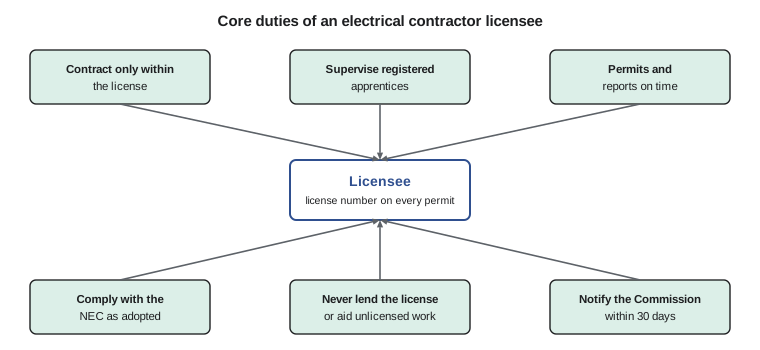
Supervising apprentices
SDCL 36-16-21 requires apprentices to register with the Commission and says an apprentice may do no electrical wiring except under the personal supervision of a licensed electrician. ARSD 20:44:16:05 explains what that means in two settings. On a commercial job site, supervision must be personal and on site by a licensed electrician. On other work, supervision must be daily and personal. The rule describes supervision; this course did not find a fixed numerical ratio of apprentices to licensed electricians in the rules read, so a candidate should check the current rules before answering a ratio question with a number. What is clear is that the licensee is responsible for making sure apprentices are registered and properly supervised on every job.
At Coteau Ridge, the scheduling board shows every apprentice's name next to a journeyman or the licensee for each day. On commercial jobs, the supervising electrician must be on the same site. On a house in Elkton, a journeyman may set up the day's work with an apprentice in the morning and check it during the day, but cannot leave the apprentice to wire alone for a week.
Permits, reports and the code
SDCL 36-16-27 requires compliance with the Commission's rules and provides for wiring permits, and SDCL 36-16-28 requires registered persons to report electrical work to the Commission on the forms it supplies. Lesson 6 covers the five-copy permit. For the licensee the duty is personal: the permit carries the contractor's license number, and late or missing copies are charged to the contractor. SDCL 36-16-33 makes violation of the National Electrical Code, as the state adopts it, a ground for discipline. A licensee who repeatedly fails inspections for the same violations, or who refuses to correct condemned work, puts the license at risk.
The code duty applies to the whole crew's work, not just the licensee's own. An apprentice's mistake that a journeyman should have caught is still the contractor's problem at the inspection, and a pattern of such mistakes is the contractor's problem at the Commission.
Grounds for discipline
SDCL 36-16-33 lists the grounds on which the Commission may refuse to issue, revoke or suspend a license. In plain words they include violating the chapter or the Commission's rules; violating the National Electrical Code; failing to notify the Commission within thirty days of discipline taken against a license in another jurisdiction; failing to notify the Commission within thirty days of a change of address or employer; aiding or abetting an unlicensed person to do work that requires a license; and conviction of a crime of violence. Separately, SDCL 36-16-1 makes contracting without a license a Class 2 misdemeanor, and SDCL 36-16-34 makes failing to register, obtain a license or report wiring a Class 2 misdemeanor. SDCL 36-16-34.1 lets the Commission seek an injunction instead of, or as an alternative to, criminal proceedings.
| Ground or offense | Source | Consequence |
|---|---|---|
| Violating chapter 36-16 or the Commission's rules | SDCL 36-16-33 | Refusal, suspension or revocation |
| Violating the NEC as adopted | SDCL 36-16-33 | Refusal, suspension or revocation |
| Not reporting out-of-state discipline within 30 days | SDCL 36-16-33 | Refusal, suspension or revocation |
| Not reporting a change of address or employer within 30 days | SDCL 36-16-33 | Refusal, suspension or revocation |
| Aiding unlicensed work | SDCL 36-16-33 | Refusal, suspension or revocation |
| Contracting without a license | SDCL 36-16-1 | Class 2 misdemeanor |
| Failing to register, license or report wiring | SDCL 36-16-34 | Class 2 misdemeanor; injunction possible under 36-16-34.1 |
Never lend the license
The ground that catches the most well-meaning contractors is aiding unlicensed work. A former employee starts a small business and asks to buy permits under the old company's license until his own comes through. A homeowner's brother-in-law, a journeyman, wants the contractor to put a permit on the job he is doing on weekends. A general contractor wants the electrical contractor to sign for wiring the general contractor's own crew will install. Each request asks the licensee to put the license number on work the licensee will not supervise. Each is aiding unlicensed work under SDCL 36-16-33, and in the first two cases the person doing the work is also contracting without a license under SDCL 36-16-1. The answer to all three is no.
Owner wiring and the contractor
SDCL 36-16-15 lets an owner wire his or her own residence, including attached and unattached accessory structures on the parcel, his or her own farmstead, a single-family dwelling the owner is building to occupy, and private nonhabitable property not substantially used in a trade or business, without a license. The work must still be inspected where it involves services over 60 amperes, circuits or the electrical parts of other apparatus, and not reporting it is a Class 2 misdemeanor. ARSD 20:44:18:06 sets conditions for an owner permit: the owner must not have used the exemption in the last three years, must occupy or intend to occupy the home, must not rent any part of it, and must do the work personally, or with a spouse. The homeowner page adds that the exemption does not cover commercial or rental property.
For a contractor, owner wiring creates two risks. The first is being asked to finish an owner's half-done job. The contractor then needs its own permit, takes responsibility for the whole installation it is completing, and should inspect what the owner already did before covering it. The second is being asked to work alongside the owner under the owner's permit. The owner's permit may not be used by anyone else, and a contractor who works under it is working without a permit.
Worked problem
The general contractor's crew
A general contractor building a small office in Arlington tells Coteau Ridge it will have its own laborers pull the cable to save money, and asks Coteau Ridge to buy the permit, set the service and sign off. The laborers hold no electrical licenses or apprentice registrations.
Show solution
- Only licensed or registered persons may do the wiring, and apprentices need personal on-site supervision on a commercial site.
- The laborers are neither licensed nor registered, so their wiring would be unlicensed work.
- Coteau Ridge's permit would put its license number on that unlicensed work.
- SDCL 36-16-33 treats aiding unlicensed work as a ground for discipline.
Answer: Decline, or price the job with Coteau Ridge's own licensed crew doing the wiring. If the general contractor wants to cut costs, the laborers could help with work that is not electrical, such as digging or cleanup, but not wiring.
Worked problem
Finishing an owner's project
A homeowner near Bruce wired half his new garage under an owner permit, then took a job out of state. He asks Coteau Ridge to finish.
Show solution
- The owner's permit is personal and cannot cover Coteau Ridge's work.
- Coteau Ridge needs its own permit for the part it will do.
- Before covering anything, Coteau Ridge should inspect the owner's work and talk to the district inspector about how the two permits relate.
Answer: Take a new permit, review the existing work, and coordinate inspections so each permit covers the right part of the installation.
Changes the Commission must hear about
Dale's line about telling Pierre covers the thirty-day notice duties in SDCL 36-16-33: a change of address, a change of employer, and discipline in another state. It also covers practical changes the Commission needs for its records, such as a change in the company's name or ownership, a new insurance carrier or an undertaking replacement. SDCL 36-16-26 addresses what happens when a licensee dies, including continuing a business for a limited time; a planned retirement needs a planned handover, which is why Marit is testing now. An inactive license under SDCL 36-16-13.3 lets a licensee keep a credential without the undertaking, but the holder may not do work that requires a Class B or contractor license while inactive.
# Thirty-day notice tracker for Coteau Ridge (illustrative events)
from datetime import date, timedelta
events = [("new mailing address for Marit", date(2026, 10, 5), date(2026, 10, 21)),
          ("journeyman left for another employer", date(2026, 9, 1), None),
          ("Minnesota discipline notice received (example)", date(2026, 8, 14), date(2026, 9, 20))]
for what, happened, reported in events:
    due = happened + timedelta(days=30)
    if reported is None:
        print(f"{what}: NOT reported; due {due}")
    else:
        late = (reported - due).days
print(f"{what}: reported {reported}; " + (f"{late} days late" if late > 0 else "on time"))new mailing address for Marit: reported 2026-10-21; on time journeyman left for another employer: NOT reported; due 2026-10-01 Minnesota discipline notice received (example): reported 2026-09-20; 7 days late
Supervision of journeymen matters as well. A journeyman may do the work, but the contractor decides what work is accepted, plans it, and answers for it. Regular job visits by the licensee, a review of the rough-in before calling the inspector, and a short talk with the foreman after any failed inspection keep quality consistent across crews. Dale's habit is to walk every commercial job at rough-in himself; Marit plans to keep it.
Records
Good records are a licensee's best defense. For each job, Coteau Ridge keeps the contract, the permit number and blue copy, the date the white copy was sent, inspection dates and results, correction notices and how they were resolved, the names of supervising electricians and apprentices, and photographs of rough-in work before cover. For the company, it keeps current certificates of insurance, the undertaking and deposit receipts, license renewals and continuing education certificates for every licensee, and apprentice registrations. When a question comes from the Commission or a customer two years later, the answer is in the file.
Common mistakes
MistakeLetting a former employee pull permits under the company license.
InsteadThat is aiding unlicensed work and a ground for discipline.
MistakeLeaving an apprentice alone on a commercial site.
InsteadCommercial supervision must be personal and on site by a licensed electrician.
MistakeWorking under the homeowner's permit.
InsteadAn owner's permit may not be used by anyone else.
MistakeTelling the Commission about a move at renewal time.
InsteadAddress and employer changes must be reported within thirty days.
MistakeDoing contractor work on an inactive license.
InsteadAn inactive holder may not do work requiring a Class B or contractor license.
Summary and key terms
- Only electrical contractors, and Class B electricians on farm and residential work, may contract for wiring.
- Apprentices must be registered and personally supervised: on site on commercial jobs, daily on other work.
- Licensees obtain permits, report work and comply with the NEC as adopted.
- SDCL 36-16-33 lists discipline grounds, including aiding unlicensed work and late thirty-day notices.
- Contracting without a license is a Class 2 misdemeanor; the Commission may also seek an injunction.
- Owner permits are personal to the owner and cannot cover a contractor's work.
- Aiding unlicensed work
- Helping an unlicensed person do work that requires a license, such as lending a license number.
- Personal supervision
- Supervision by a licensed electrician that the rules require for apprentices.
- Owner exemption
- The SDCL 36-16-15 right of an owner to wire his or her own residence or farmstead.
- Inactive license
- A license held without the right to do Class B or contractor work.
- Injunction
- A court order the Commission may seek to stop unlicensed work.
Practice problems
Work each problem on paper first, then reveal the answer to check.
A journeyman friend asks Marit to put a permit on his weekend job. What should she do?
Show answer
Refuse; she would be aiding unlicensed work and he would be contracting without a license.
Within how long must a licensee report a new employer?
Show answer
Thirty days.
May an apprentice wire a commercial job with the journeyman at another site?
Show answer
No; commercial supervision must be personal and on site.
An owner has a permit to wire his own house. Can Coteau Ridge help under that permit?
Show answer
No; it needs its own permit.
What is the penalty for contracting without a license?
Show answer
A Class 2 misdemeanor under SDCL 36-16-1.
Lesson quiz · 5 questions
Score 60% or more to complete this lesson.
Create a free account to save your progress, take quizzes and earn a certificate.