
MELU-316 · Lesson 5 of 12 · 22 min
The NEC as adopted in South Dakota and state amendments
▶ Video coming soon A video version of this lesson is on the way.
On a job walk at a new farm shop south of Volga, the general contractor asked Marit Halvorsen a question she had heard many times: which code are we on? In South Dakota the answer is simpler than in many states. The State Electrical Commission adopts one edition of the National Electrical Code for the whole state by rule, and it adopts a short list of state amendments with it. This lesson explains how that adoption works, what the amendments say in plain words, how the adoption fits with the two cities that inspect on their own, and how the edition used on the exam lines up with the edition used in the field.
Adoption by rule
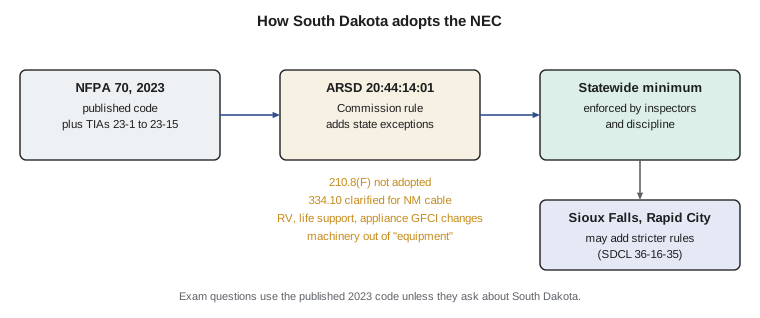
The legislature gave the Commission the power to adopt rules in SDCL 36-16-12, and the Commission uses that power to adopt the National Electrical Code. ARSD 20:44:14:01 defines the National Electrical Code, for South Dakota purposes, as the NFPA's code in its 2023 edition, including tentative interim amendments 23-1 through 23-15, with the state exceptions listed in the same rule. The most recent amendment to that rule shown in the Commission's compilation was effective November 12, 2024. So for an installation begun in South Dakota today, the 2023 NEC, as amended by the state, is the minimum standard.
A tentative interim amendment, or TIA, is a change the NFPA issues between editions when a problem cannot wait for the next cycle. By naming TIAs 23-1 through 23-15, the state adopted those specific corrections along with the base text. A candidate does not need to memorize them, but should know that an adopted code can include TIAs, and that the rule names which ones.
Under SDCL 36-16-33, violating the National Electrical Code is a ground for discipline against a licensee, and under SDCL 36-16-29 and 36-16-31 inspectors can refuse to approve, or condemn, installations that do not comply. The code is not advice in South Dakota; it is the standard that licenses and inspections enforce.
The state amendments in plain words
ARSD 20:44:14:01 lists a small number of changes to the published code. The descriptions below paraphrase them; read the rule itself for the exact wording, and read the code sections they modify in your own book.
First, the rule excludes section 210.8(F) from adoption. That section, added in recent editions, extends ground-fault circuit-interrupter protection to certain outdoor outlets at dwellings. South Dakota does not adopt that requirement. Second, the rule removes the word machinery from the Article 100 definition of equipment, narrowing what counts as equipment for code purposes. Third, it exempts receptacles at recreational vehicle sites, other than 125-volt, single-phase, 15- and 20-ampere receptacles, from the GFCI requirement that 210.8 would otherwise apply. Fourth, it removes GFCI and AFCI requirements for life support equipment, as the authority having jurisdiction determines, so that a tripping device does not cut power to equipment someone's life depends on. Fifth, it clarifies section 334.10 so that nonmetallic-sheathed cable, Types NM, NMC and NMS, may be used in specified dwellings, farmsteads and Type III, IV and V structures, with a fifteen-minute thermal barrier where the cable is concealed in certain Type III to V structures. Sixth, it exempts outlets supplying certain appliances listed in 210.8(D), items 8 through 12, from the GFCI requirement.
| Code provision | South Dakota change (paraphrased) | Practical effect |
|---|---|---|
| 210.8(F) | Not adopted | No GFCI requirement under that section for the outdoor outlets it covers |
| Article 100, equipment | Machinery removed from the definition | Narrower scope for rules that apply to equipment |
| 210.8(A), RV sites | Receptacles other than 125 V, 15 and 20 A exempt | Larger RV receptacles need not be GFCI protected by that rule |
| 210.8 and 210.12, life support | GFCI and AFCI removed for life support equipment, per the AHJ | Avoids nuisance tripping on critical equipment |
| 334.10 | NM, NMC and NMS allowed in specified dwellings, farmsteads and Type III to V buildings | Fifteen-minute thermal barrier where concealed in certain buildings |
| 210.8(D)(8) to (12) | Listed appliance outlets exempt from GFCI | Fewer GFCI devices for those appliances |
Why these amendments
The amendments reflect the state's work and the Commission's view of where the published code goes further than South Dakota wants to require. The 210.8 changes address nuisance tripping and cost on specific loads. The 334.10 clarification matters in a state with many farmsteads and many small wood-frame commercial buildings, where nonmetallic-sheathed cable is the economical method; the thermal barrier condition keeps a fire-safety safeguard where the cable is concealed. Knowing the reason helps a candidate remember the change. It also helps on the job: when a general contractor or an engineer asks why the drawings call for something the state does not require, the licensee can explain the difference and point to the rule.
Modular homes
The same rule addresses modular homes built out of state for South Dakota sites, which are built to the 2021 International Building Code for the purposes the rule describes, and SDCL 36-16-30 provides for inspection fees for out-of-state modular homes, including travel costs. A contractor who sets a modular home still needs a wiring permit for the service and site wiring, and the state inspector inspects that work.
Cities and utilities may go further
SDCL 36-16-35 says the chapter does not prevent a city or a utility from imposing more stringent requirements. In practice, Sioux Falls and Rapid City, which run their own inspection inside city limits, enforce the electrical code through their own ordinances and may adopt local amendments. This course did not confirm the current Sioux Falls and Rapid City adoptions, so it does not list them. A contractor working inside those cities should read the city's adopting ordinance and ask its electrical inspectors about local requirements before bidding. Utilities, too, have service requirements, such as meter locations, service sizes and clearances, that go beyond the code; the utility's service handbook governs those.
Marit's rule of thumb for Coteau Ridge's work is short. Outside Sioux Falls and Rapid City, the state code applies and the state inspector enforces it. Inside those cities, start from the state code, then check the city's ordinance. In every case, check the serving utility's handbook for metering and service details.
Exam edition and field edition
Since December 2, 2024 the state's exams have been based on the 2023 NEC, the same edition the state enforces. That alignment helps candidates, but there is a trap. A national exam like exam 530 is written to the published code. When the state amendment and the published code differ, an exam question that does not mention South Dakota should usually be answered from the published code. If the question explicitly asks about South Dakota's rules, apply the amendment. Read the last line of the question to see which it wants.
Worked problem
Published code or state amendment?
A practice question asks: according to the 2023 NEC, must a 125-volt, 15-ampere receptacle installed outdoors at a dwelling under section 210.8(F) have GFCI protection? A second version asks whether South Dakota requires it under that section.
Show solution
- The first version asks about the published 2023 NEC, so answer from section 210.8(F) as printed in your book.
- The second version asks about South Dakota, where ARSD 20:44:14:01 excludes 210.8(F).
- Other GFCI rules in 210.8 may still apply to the same outlet; the exclusion removes only subsection (F).
Answer: Answer the first from the published code. For the second, South Dakota does not adopt 210.8(F), but check whether another part of 210.8 covers the outlet.
Reading the 334.10 clarification on a real job
The 334.10 change matters most to a contractor like Coteau Ridge, because nonmetallic-sheathed cable is its workhorse on houses, farm shops and small commercial buildings. The published code limits where Type NM cable may be used by building type and use, and refers to the building code's construction types. South Dakota's rule clarifies those limits for specified dwellings, farmsteads and Type III, IV and V structures, and it adds a condition: where the cable is concealed in certain of those structures, it must sit behind a thermal barrier with at least a fifteen-minute finish rating. A typical wood-frame office or shop with gypsum board walls meets that condition when the cable is installed in the stud cavities behind the board. An exposed installation in an open-truss shop is a different question, and so is a concealed installation behind a wall finish that has no fire rating, such as some wood paneling or steel liner panels.
Before relying on the clarification, Marit checks three facts on every project: the construction type the architect or building official assigned, whether the cable will be concealed or exposed, and what finish will cover it. She records those facts in the job file so that the state inspector's rough-in visit is not the first time anyone thinks about them.
Worked problem
A farm shop with steel liner panels
A customer near Volga wants a 60 by 100 foot wood-post farm shop with a steel liner on the inside walls and ceiling. The drawings show Type NM cable concealed behind the steel liner.
Show solution
- The building is on a farmstead and is a wood-frame structure, which brings it within the kinds of buildings the clarification addresses.
- The cable will be concealed.
- A bare steel liner panel may not provide a rated thermal barrier, so the condition that applies to concealed cable in certain structures needs attention.
- Article 547 may also apply if the shop houses livestock or has a corrosive, wet or dusty environment.
Answer: Confirm with the state inspector before rough-in. If a rated barrier is required and the liner does not provide it, choose another wiring method or add a barrier, and check whether Article 547 governs the wiring method in any part of the building.
Keeping the jobsite straight
Code changes cause most of their trouble on jobs that span an edition change, and on jobs designed by out-of-state engineers who assume a different edition or no state amendments. The permit date generally fixes the rules for the job; ask the Commission or the city if a project was permitted under an earlier edition. For each project, Coteau Ridge's job file records the code edition, any state or city amendments that matter for the job and the name of the inspector. When Marit reviews drawings, she marks any place the design relies on a requirement the state did not adopt, such as 210.8(F), so that the general contractor can decide whether to keep it as an owner requirement or delete it.
# Which rule set applies? A simple lookup Coteau Ridge uses (illustrative)
def rules_for(city):
    base = "2023 NEC with TIAs 23-1 to 23-15 and ARSD 20:44:14:01 exceptions"
    if city in ("Sioux Falls", "Rapid City"):
        return base + "; plus city ordinance and city electrical inspection"
    return base + "; state electrical inspector for the district"
for city in ["Brookings", "Volga", "Sioux Falls", "Rapid City", "Watertown"]:
print(f"{city}: {rules_for(city)}")Brookings: 2023 NEC with TIAs 23-1 to 23-15 and ARSD 20:44:14:01 exceptions; state electrical inspector for the district Volga: 2023 NEC with TIAs 23-1 to 23-15 and ARSD 20:44:14:01 exceptions; state electrical inspector for the district Sioux Falls: 2023 NEC with TIAs 23-1 to 23-15 and ARSD 20:44:14:01 exceptions; plus city ordinance and city electrical inspection Rapid City: 2023 NEC with TIAs 23-1 to 23-15 and ARSD 20:44:14:01 exceptions; plus city ordinance and city electrical inspection Watertown: 2023 NEC with TIAs 23-1 to 23-15 and ARSD 20:44:14:01 exceptions; state electrical inspector for the district
Common mistakes
MistakeThinking each county picks its own NEC edition.
InsteadThe Commission adopts one edition statewide by rule.
MistakeAssuming the state adopted the code with no changes.
InsteadARSD 20:44:14:01 lists state exceptions.
MistakeApplying a state amendment to every exam question.
InsteadNational exam questions are written to the published code unless they say otherwise.
MistakeAssuming Sioux Falls uses only the state code.
InsteadCities may impose stricter requirements under SDCL 36-16-35; check the city ordinance.
MistakeForgetting the utility.
InsteadService and metering details follow the serving utility's requirements.
Summary and key terms
- ARSD 20:44:14:01 adopts the 2023 NEC with TIAs 23-1 through 23-15 statewide.
- State exceptions include excluding 210.8(F) and clarifying 334.10 for NM cable.
- Other exceptions narrow GFCI and AFCI rules for RV sites, life support equipment and some appliances, and remove machinery from the equipment definition.
- Cities and utilities may impose stricter requirements under SDCL 36-16-35.
- Exams since December 2, 2024 use the 2023 NEC; answer from the published code unless a question asks about South Dakota.
- Record the edition and amendments in every job file.
- Adoption by rule
- The Commission's adoption of the NEC through its administrative rules.
- TIA
- A tentative interim amendment issued by the NFPA between code editions.
- State exception
- A change to the published code made in ARSD 20:44:14:01.
- Thermal barrier
- A covering that protects concealed cable from fire for a stated time.
- AHJ
- The authority having jurisdiction, such as the state inspector or a city inspector.
Practice problems
Work each problem on paper first, then reveal the answer to check.
Which NEC edition applies to a new installation in Brookings?
Show answer
The 2023 NEC with the named TIAs and South Dakota's exceptions.
Does South Dakota adopt section 210.8(F)?
Show answer
No; ARSD 20:44:14:01 excludes it.
Which code section does the state clarify for nonmetallic-sheathed cable?
Show answer
334.10.
May Rapid City require more than the state code?
Show answer
Yes; SDCL 36-16-35 allows stricter local requirements.
A national exam question about 210.8(F) does not mention South Dakota. Which text do you use?
Show answer
The published 2023 NEC.
Lesson quiz · 5 questions
Score 60% or more to complete this lesson.
Create a free account to save your progress, take quizzes and earn a certificate.