
MELU-316 · Lesson 2 of 12 · 24 min
Eligibility for the Contractor's Electrical License
▶ Video coming soon A video version of this lesson is on the way.
On a Monday in early November 2026, Marit Halvorsen sat at the office table at Coteau Ridge Electric with Joanne Riedel, the company's office manager, and a cardboard box of pay stubs, W-2 forms and old apprentice logbooks. Dale Vermeer had asked a simple question the week before: can you sit the contractor exam this winter? Before she could answer, Marit had to prove to herself, and then to the State Electrical Commission, that she met every eligibility rule. This lesson works through those rules in the order the Commission applies them.
The statute and the rules
Eligibility rests on two layers. SDCL 36-16-19 sets the statutory experience for an electrical contractor license: two years as a licensed journeyman, or one year of commercial experience as a licensed Class B electrician. The Commission's rules in ARSD chapter 20:44:16 add detail. ARSD 20:44:16:06 defines one year of experience as 2,000 hours. ARSD 20:44:16:08 sets the advancement paths between classes, and it adds a requirement the statute does not spell out: of the two years a journeyman needs to move up to contractor, one year must be commercial experience. The Commission's licensing page puts the same rule in hours: two more years as a licensed journeyman, totaling 4,000 additional hours, including at least 2,000 hours of commercial work.
SDCL 36-16-22 requires each applicant to give written evidence of experience, under oath, when applying. Experience is not taken on trust. The application asks for employers, dates and hours, and the Commission may check them against its own records of who held which license when.
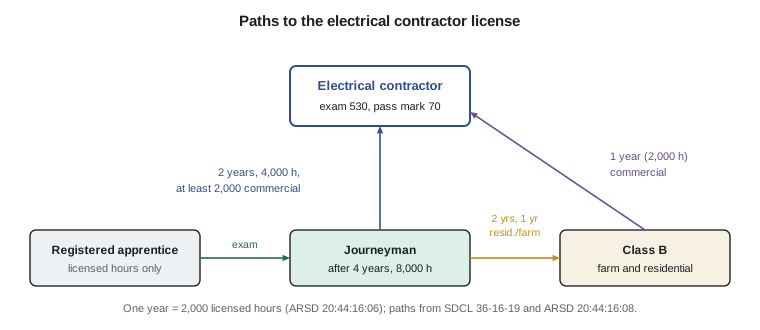
The paths to the contractor license
There are two main roads. The first, and by far the most common, is journeyman to contractor: hold a journeyman license for two years of licensed work, 4,000 hours, with at least one year, 2,000 hours, in commercial work. The second is Class B to contractor: a licensed Class B electrician who adds one year of commercial experience may apply. The Class B road suits electricians who built a residential and farm business on a Class B license and later want to bid commercial work. There are also related paths that do not end in the contractor license directly. A journeyman who wants to contract only for farm and residential work may move to Class B after two years, one of which must be residential or farmstead. A journeyman may also qualify for the inspector exam after two years with one commercial year. The 501(d) class has its own path.
Before any of that, the candidate must become a journeyman. That path is four years, 8,000 hours, as a licensed apprentice working under the employment and supervision of an electrical contractor. Marit's apprentice years ended in 2019, so her journeyman license is the base for everything in this lesson.
| From | To | Experience required | Special condition |
|---|---|---|---|
| Apprentice | Journeyman | Four years (8,000 hours) | Licensed apprentice under a contractor |
| Journeyman | Class B | Two years (4,000 hours) | One year residential or farmstead |
| Journeyman | Electrical contractor | Two years (4,000 hours) | One year (2,000 hours) commercial |
| Class B | Electrical contractor | One year (2,000 hours) | Commercial experience |
| Journeyman | Inspector | Two years | One year commercial; inspector exam pass mark is higher |
What counts as commercial
The commercial-hours rule is where most applications get questions. The rules do not list every kind of building, but the idea is clear from the structure of the classes: residential and farmstead wiring is the scope of the Class B license, so commercial experience means work outside that scope, such as stores, offices, schools, churches, shops, warehouses, multi-family buildings beyond the residential scope the Commission recognizes, and industrial and agricultural processing facilities. The safest approach is to describe each job honestly on the experience form and let the Commission classify it. If a project is borderline, such as a large hog confinement building or a farm grain-drying system, describe what was installed rather than calling it one thing or the other.
Marit's payroll records help. Coteau Ridge's job-costing system tags each timecard line with a job number, and each job number with a type. Joanne exported Marit's hours for every year since 2019 and sorted them by job type. The numbers are illustrative, but the method is what the Commission expects you to be ready to show.
# Sort Marit's journeyman hours by job type (illustrative records)
records = [
    ("2019-2021", "residential", 2400), ("2019-2021", "farm", 900), ("2019-2021", "commercial", 1940),
    ("2022-2024", "residential", 1500), ("2022-2024", "farm", 700), ("2022-2024", "commercial", 4000),
    ("2025-2026", "residential", 1200), ("2025-2026", "farm", 300), ("2025-2026", "commercial", 2320),
]
totals = {}
for period, kind, hours in records:
    totals[kind] = totals.get(kind, 0) + hours
journeyman_hours = sum(totals.values())
print("Hours by type:", totals)
print(f"Total journeyman hours: {journeyman_hours}; needs 4000")
print(f"Commercial hours: {totals['commercial']}; needs 2000")
print("Eligible on hours:", journeyman_hours >= 4000 and totals["commercial"] >= 2000)Hours by type: {'residential': 5100, 'farm': 1900, 'commercial': 8260}
Total journeyman hours: 15260; needs 4000
Commercial hours: 8260; needs 2000
Eligible on hours: TrueLicensed hours, and the gaps that erase them
Only licensed hours count. The Commission's page says that experience hours must be licensed in order for working time to count toward the hours required to take the exams. Three common gaps follow from that rule. The first is work before apprentice registration. An apprentice who starts in May but is registered in August has lost the summer. The second is a lapsed license. South Dakota licenses expire at midnight on June 30 of even-numbered years, and SDCL 36-16-25 allows renewal within thirty days after expiration. A journeyman who renews late, or not at all for a season, may have hours from that period questioned. The third is out-of-state work. Hours worked in another state are not South Dakota licensed hours on their face. SDCL 36-16-23 allows reciprocal licensing with states that offer similar licensing, and the Commission can tell a candidate how it treats experience from another state. Confirm before counting it.
Marit checked each of her renewal dates against the Commission's online license lookup. Her journeyman license renewed in 2020, 2022, 2024 and 2026, each before June 30. Her apprentice registration began the week she started. She had no gaps.
Supervision during the qualifying years
The quality of the hours matters as well as the number. SDCL 36-16-21 says an apprentice may do no electrical wiring except under personal supervision, and ARSD 20:44:16:05 explains that on a commercial site the supervision must be personal and on site by a licensed electrician, while on other work it must be daily personal supervision. A journeyman's hours are her own, but she must work for an electrical contractor, Class B electrician or licensed entity, not on her own account. Hours worked on unlicensed side jobs are not just uncounted; they are evidence of contracting without a license.
Other conditions
Beyond experience, the application asks for the oath required by SDCL 36-16-22, payment of the application fee, a copy of photo identification and answers about discipline. SDCL 36-16-33 lets the Commission refuse a license for violating the law or rules, for violating the National Electrical Code, for aiding unlicensed work, or for conviction of a crime of violence, and for failing to report discipline in another jurisdiction within thirty days. A candidate with any history in those areas should disclose it and attach records. Concealment is a separate ground for discipline later.
There is no separate age or education requirement in the contractor rules beyond what the apprentice and journeyman paths already required. There is no business and law exam separate from the trade exam; the contractor exam covers the code and the state statutes and rules together, as Lesson 4 explains.
Reciprocity and other states
SDCL 36-16-23 authorizes the Commission to issue licenses to electricians licensed in other states that offer similar licensing to South Dakota licensees, and the rules set a reciprocity fee of 200 dollars for the contractor class. The Commission's page on reciprocal agreements lists the current partner states and the conditions. The list was not readable when this course was checked, so this course does not name partner states. A candidate licensed in Minnesota, North Dakota, Iowa or another neighbor should ask the Commission whether a reciprocal license is available before preparing to test.
Putting the file together
By the end of the afternoon Marit had a short eligibility file. It held her apprentice registration date, a list of journeyman license numbers and renewal dates, Joanne's sorted hour totals with job lists for each year, letters from Dale confirming her employment and supervision of crews, and a short note listing three borderline farm projects with a description of what was installed. The file is more than the Commission asks to see, but it means any question can be answered the same day. Lesson 3 takes the file into the application.
Three candidates, three answers
Exam questions on eligibility are usually short stories, and the best way to prepare is to work a few. The three below are invented, but each turns on a rule from this lesson.
Worked problem
Candidate A: plenty of hours, thin commercial record
Jorge has been a licensed journeyman for six years and has 11,800 journeyman hours. Almost all of it is new houses and farm shops; his commercial total is 1,450 hours. Is he eligible for the contractor exam?
Show solution
- Total licensed journeyman hours: 11,800, well above 4,000.
- Commercial hours: 1,450, below the 2,000 the rules require.
- No lapse is mentioned, so licensed status is not the issue.
Answer: Not yet. He needs 550 more commercial hours, or he could look at the Class B license, which matches his residential and farm work.
Worked problem
Candidate B: the Class B road
Keisha has held a Class B license for five years and runs her own residential business. Last year she worked 2,050 hours as an employee of a commercial contractor on a school addition while keeping her Class B current. Is she eligible?
Show solution
- The path is Class B to contractor.
- It requires one year, 2,000 hours, of commercial experience.
- Her 2,050 commercial hours were worked while licensed.
Answer: Yes, on experience. She still needs approval, the exam and the undertaking and insurance.
Worked problem
Candidate C: the lapse
Tom renewed his journeyman license on August 15, 2024, after it expired on June 30. He counts 4,100 journeyman hours, 2,300 commercial, including about 260 hours in July and early August 2024.
Show solution
- SDCL 36-16-25 allows renewal within thirty days after expiration; Tom was well past that.
- Hours worked while the license was expired may not be licensed hours.
- Without the 260 hours his total is 3,840.
Answer: Probably not yet. He should ask the Commission how it treats the gap before applying, and plan to work more hours if it does not count them.
What the Commission does with the file
The Commission's staff read the application against its own records. They can see when an apprentice was registered, when each license was issued and renewed, and who the licensee employer was. They compare the hours claimed with those dates, look for overlaps such as two full-time employers in the same months, and check whether the commercial hours are plausible for the employers listed. When something does not add up, the usual response is a letter asking for more evidence, such as payroll summaries or employer statements, rather than a denial. A candidate who answers quickly and fully loses little time. A candidate who cannot document the hours may be told to reapply once the record supports the claim.
Approval is written. ARSD 20:44:16:01 and the exam page both say a candidate may not take the exam without prior written approval, and the approval starts a ninety-day clock to sit the exam. That clock is the reason Marit did the eligibility work before applying, not after: once the approval arrives, the time belongs to studying, not to hunting for pay stubs.
Common mistakes
MistakeCounting every hour worked since apprenticeship began.
InsteadOnly licensed hours count; time before registration or during a lapse may not.
MistakeThinking any two years as a journeyman is enough.
InsteadOne of the two years, 2,000 hours, must be commercial.
MistakeBelieving Class B holders must start over as journeymen.
InsteadA Class B electrician may qualify for the contractor exam with one year of commercial experience.
MistakeTreating side jobs as experience.
InsteadUnlicensed contracting does not count and is itself a violation.
MistakeAssuming out-of-state hours transfer automatically.
InsteadAsk the Commission how it treats experience from another state and whether reciprocity applies.
Summary and key terms
- SDCL 36-16-19 requires two years as a journeyman or one commercial year as a Class B electrician.
- ARSD 20:44:16:08 requires one of the journeyman's two years to be commercial.
- One year is 2,000 hours, so the journeyman path needs 4,000 hours with 2,000 commercial.
- Only hours worked while licensed count.
- The application requires written evidence of experience under oath.
- Reciprocity is available with states that offer similar licensing; confirm partner states with the Commission.
- Commercial experience
- Work outside the residential and farmstead scope of the Class B license.
- Licensed hours
- Hours worked while the electrician held a current South Dakota license or registration.
- Reciprocity
- Licensing based on a license from another state under SDCL 36-16-23.
- Advancement
- Moving from one license class to a higher one after the required experience.
- Oath
- The sworn statement of experience required by SDCL 36-16-22.
Practice problems
Work each problem on paper first, then reveal the answer to check.
A journeyman has 4,600 hours, of which 1,700 are commercial. Is she eligible for the contractor exam?
Show answer
Not yet; she needs at least 2,000 commercial hours.
A Class B electrician with 2,100 commercial hours applies for the contractor exam. Eligible on experience?
Show answer
Yes, one year of commercial experience as a Class B meets the rule.
A journeyman let his license lapse for August 2024. What should he expect?
Show answer
Hours from the lapse may not count toward the requirement.
What does SDCL 36-16-22 require with the application?
Show answer
Written evidence of experience under oath.
Who decides whether a farm grain-drying project counts as commercial?
Show answer
The Commission, from the applicant's description of the work.
Lesson quiz · 5 questions
Score 60% or more to complete this lesson.
Create a free account to save your progress, take quizzes and earn a certificate.