
MELU-316 · Lesson 4 of 12 · 24 min
The exam format and the references allowed
▶ Video coming soon A video version of this lesson is on the way.
Marit Halvorsen had taken the journeyman exam in 2019, so she knew what a South Dakota trade exam felt like: a quiet room, a computer, a code book with tabs, and a clock that never seemed to slow down. The contractor exam is longer and broader. This lesson describes its format, the references a candidate may bring, the content outline and a pacing plan, and it ends with how to prepare a code book that passes inspection at the test center.
The format
The International Code Council's candidate bulletin for South Dakota, dated August 19, 2025, describes three electrical exams. Exam 530 is the electrical contractor exam: 100 multiple-choice questions in five hours. Exam 531 is the journeyman exam: 80 questions in four hours. Exam 533 is the Class B exam: 60 questions in three hours. All three are open book and delivered by computer at Pearson VUE test centers. Some exam-prep sellers call the 530 exam the Class C or master exam; the Commission's term is the electrical contractor exam, and the code number 530 is what appears on the candidate's eligibility record.
The passing score comes from the Commission's rules. ARSD 20:44:16:03 sets it at 70 for the contractor, Class B, journeyman and 501(d) exams and at 80 for the inspector exam. The same rule says the examination is written and drawn from the National Electrical Code and the state's electrical statutes and rules. The ICC bulletin refers candidates to its exam catalog for scoring details; confirm the passing score in your approval materials, but prepare to reach well above 70 so that a few slow questions cannot sink the result.
Since December 2, 2024 all South Dakota electrical exams have been based on the 2023 edition of the National Electrical Code, the same edition the state adopted for installations, as Lesson 5 explains.
| Exam | Questions | Time | Book | Passing score |
|---|---|---|---|---|
| 530 Electrical contractor | 100 | 5 hours | Open | 70 |
| 531 Journeyman | 80 | 4 hours | Open | 70 |
| 533 Class B | 60 | 3 hours | Open | 70 |
The references allowed
The bulletin lists the references a candidate may bring. The primary reference is NFPA 70, the National Electrical Code, 2023 edition. Also allowed are Ugly's Electrical References by George V. Hart, any edition; Ferm's Fast Finder Index from the International Association of Electrical Inspectors; Tom Henry's Key Word Index; and the NFPA's NEC Handbook, but only in hardcover form. Candidates should bring their own copies, because the test center does not supply them.
The usual rules for open-book exams apply. Permanent tabs are allowed, and highlighting and underlining in the book are generally accepted. Loose papers, sticky notes with writing, photocopies and handwritten notes or formulas in the margins are the items most often refused. Check the bulletin and the test center's rules for the current list; staff will inspect every book at check-in, and a book that fails inspection stays in the locker. Marit used a new 2023 code book with factory-printed tabs and highlighted the section numbers she looked up most often during practice, leaving the margins clean.
The content outline
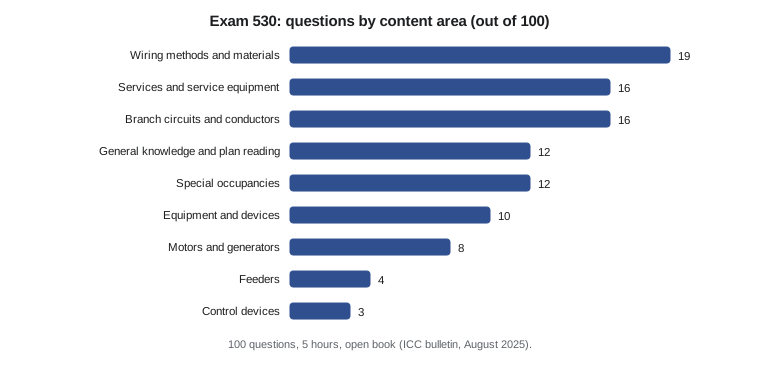
The bulletin divides exam 530 into nine content areas and gives each a share of the exam. Because the exam has exactly 100 questions, each share is also a question count. Wiring methods and materials is the largest area, at 19 questions. Services and service equipment and branch circuits and conductors are next, at 16 each. General knowledge and plan reading and special occupancies, equipment and conditions are 12 each. Equipment and devices is 10, motors and generators 8, feeders 4 and control devices 3.
The outline maps neatly onto the code. Wiring methods and materials is largely Chapter 3: the general rules in Article 300, the cable articles such as 330, 334 and 338, the raceway articles such as 344, 352 and 358, and boxes in Article 314. Services is Article 230 with grounding and bonding in Article 250. Branch circuits and conductors draw on Articles 210, 220, 240 and 310. General knowledge covers Article 90, Article 100 definitions, Article 110 and the use of plans. Special occupancies covers Chapter 5 and parts of Chapters 6 and 7, such as hazardous locations, health care, agricultural buildings in Article 547, and swimming pools in Article 680. Equipment and devices covers Articles 404 through 410 and similar. Motors and generators is Article 430 and Article 445, feeders is Article 215 with Article 220 calculations, and control devices touches motor control and Class 1 circuits.
South Dakota candidates should give Article 547 special attention. Agricultural buildings are common in the state's work, and the state's own amendments, covered in Lesson 5, affect how cable may be used in farmsteads. A question that sets its scene in a dairy barn or a confinement building is probably testing Article 547, Article 250 bonding of equipotential planes, or both.
State law on the exam
ARSD 20:44:16:03 says the exam is drawn from the code and from the state statutes and rules, while the ICC outline lists only code areas. The safest reading is that some questions may draw on South Dakota's chapter 36-16 and article 20:44, especially within general knowledge. Candidates should know the license classes and their limits, who may contract, wiring permit rules, inspection notice, the undertaking and insurance amounts, renewal dates and continuing education. This course's Lessons 1, 2 and 5 through 11 cover all of these. Ask the Commission whether it provides any state supplement for the exam.
Pacing
Five hours for 100 questions is three minutes per question on average. That is generous compared with many state exams, but it disappears quickly on load calculations or on questions that send the candidate through two or three articles. A two-pass method works well. On the first pass, answer every question that can be settled in under two minutes and flag the rest. On the second pass, work the flagged questions in order of how close you came on the first look. Leave the last fifteen minutes to make sure every question has an answer; there is no stated penalty for a wrong answer, so a blank is never better than a guess.
# Pacing check for exam 530: 100 questions in 300 minutes
total_minutes = 300
questions = 100
print(f"Average per question: {total_minutes / questions:.1f} minutes")
first_pass_answered, first_pass_minutes = 72, 140
remaining_q = questions - first_pass_answered
reserve = 15
left = total_minutes - first_pass_minutes - reserve
print(f"After pass one: {remaining_q} flagged, {left} minutes to work them")
print(f"That is {left / remaining_q:.1f} minutes per flagged question")Average per question: 3.0 minutes After pass one: 28 flagged, 145 minutes to work them That is 5.2 minutes per flagged question
Preparing the code book
A good exam code book is a tool, not a scrapbook. The tabs should follow the outline: a tab for each chapter, then extra tabs on the articles that carry the most questions, such as 210, 220, 230, 250, 300, 310, 314, 430 and 547, and on the tables used most often, such as conductor ampacity in Article 310, conduit fill in Chapter 9 and the general lighting loads in Article 220. Highlight section numbers, not whole paragraphs; heavy highlighting hides the text you are trying to read. Practice with the same book you will bring, so that your fingers know where things are.
The index is as important as the tabs. The 2023 code's index is good, and the allowed key word indexes add another route. In practice sessions, Marit timed herself finding a rule through the index and through her tabs, and learned which route was faster for each kind of question. For definitions, Article 100 is fastest. For a specific installation, the index usually beats the tabs.
Working three sample questions
The examples below show the lookup method on invented questions written for this course. They do not quote the code; they show where to go and how to read what you find. Work them with your own 2023 code book open.
Worked problem
A wiring-methods question
A question asks whether Type NM cable may be used as the wiring method in a new two-story wood-frame office building in Brookings.
Show solution
- Identify the article: Type NM cable is Article 334, and the uses permitted and not permitted are in its second part.
- Check the building type the question describes against the construction types listed there.
- Then remember Lesson 5: South Dakota's rules clarify section 334.10 for certain dwellings, farmsteads and Type III, IV and V structures, with a thermal barrier where concealed in some of them.
- The exam tests the published 2023 code unless the question says to apply the state amendment.
Answer: The answer depends on the construction type in the question and on whether the question asks about the code as published or as amended in South Dakota. Read the last line carefully.
Worked problem
A services question
A question gives a service conductor size and asks for the minimum size copper grounding electrode conductor.
Show solution
- Go to Article 250, Part III, which covers the grounding electrode system and its conductor.
- Find the table that sizes the grounding electrode conductor from the service-entrance conductor size.
- Read across the row that matches the given conductor, in copper.
- Check the section's exceptions for the electrode type, because a rod, pipe or plate electrode and a concrete-encased electrode have their own limits.
Answer: Use the table value unless the question names an electrode whose own rule sets a smaller maximum required size.
Worked problem
A special-occupancy question
A question describes a new livestock confinement building with a concrete floor and asks what must be installed in the floor.
Show solution
- Agricultural buildings are Article 547.
- Find the section on equipotential planes and the definition of the term in that article or Article 100.
- Note where the plane is required, such as areas with metallic equipment accessible to livestock, and how it is bonded.
Answer: An equipotential plane bonded as the article requires, in the areas the article names.
None of the three answers came from memory. Each came from finding the right article quickly and reading the specific rule carefully. That is the skill the exam rewards, and it is why practice with the actual book matters more than any list of numbers.
Practice-test habits that transfer
Practice tests are only useful if they look like the real exam. Marit set three rules for herself. First, every practice set was timed at the real pace, three minutes a question, with the clock visible. Second, she used only the references allowed at the test center, so she never leaned on a phone search or a printed cheat sheet she would not have on exam day. Third, she kept an error log. For each miss she wrote the content area, the article she should have used, and the reason she missed it: did not find the rule, found the wrong rule, misread the question, or ran out of time. After four weeks the log showed a pattern. Most of her misses were in services and in motors, and most of them were misreads rather than missing knowledge. She changed her method to underline the last line of each question before reading the rest, and her misses in those areas fell by half.
Error logs also show when to stop studying an area. Once a content area produces almost no misses in two full practice sets, more time there has little value. Move the hours to the areas the log still flags.
What the exam is not
The contractor exam is not a business management exam in the way some states use the term. There is no separate business and law exam. Questions about bids, lien deadlines or tax returns are unlikely; questions about license classes, permits and inspection rules are possible. The exam also does not test local Sioux Falls or Rapid City rules. And because it is open book, it rewards finding and applying a rule more than remembering it. Candidates who studied by memorizing numbers often run out of time; candidates who studied by practicing lookups usually do not.
Common mistakes
MistakeBringing a 2020 code book.
InsteadSouth Dakota exams have used the 2023 NEC since December 2, 2024.
MistakeWriting formulas in the margins.
InsteadHandwritten notes in references are commonly refused at check-in; keep margins clean.
MistakeBringing a paperback NEC Handbook.
InsteadThe bulletin allows the Handbook only in hardcover.
MistakeSpending ten minutes on one calculation on the first pass.
InsteadFlag it and come back; three minutes is the average.
MistakeIgnoring South Dakota law entirely.
InsteadThe rules say the exam draws on state statutes and rules as well as the code.
Summary and key terms
- Exam 530 has 100 open-book questions in five hours at Pearson VUE.
- The passing score is 70 under ARSD 20:44:16:03.
- The 2023 NEC is the primary reference; Ugly's, Ferm's, Tom Henry's index and a hardcover NEC Handbook are allowed.
- Wiring methods, services and branch circuits carry the most questions.
- Prepare for some questions on South Dakota statutes and rules.
- Use a two-pass method and keep a reserve to answer every question.
- Exam 530
- The ICC code number for South Dakota's electrical contractor exam.
- Content outline
- The bulletin's list of topic areas and their share of the exam.
- Open book
- An exam that allows the listed references to be used during testing.
- Two-pass method
- Answering quick questions first and returning to flagged ones.
- Key word index
- An allowed reference that helps find code sections quickly.
Practice problems
Work each problem on paper first, then reveal the answer to check.
How many minutes per question does exam 530 allow on average?
Show answer
Three.
Which content area is largest on exam 530?
Show answer
Wiring methods and materials, at 19 questions.
Can Marit bring a paperback NEC Handbook?
Show answer
No; only the hardcover Handbook is allowed.
What score passes the contractor exam?
Show answer
70, under ARSD 20:44:16:03.
Which NEC edition do the exams use?
Show answer
The 2023 edition, since December 2, 2024.
Lesson quiz · 5 questions
Score 60% or more to complete this lesson.
Create a free account to save your progress, take quizzes and earn a certificate.